
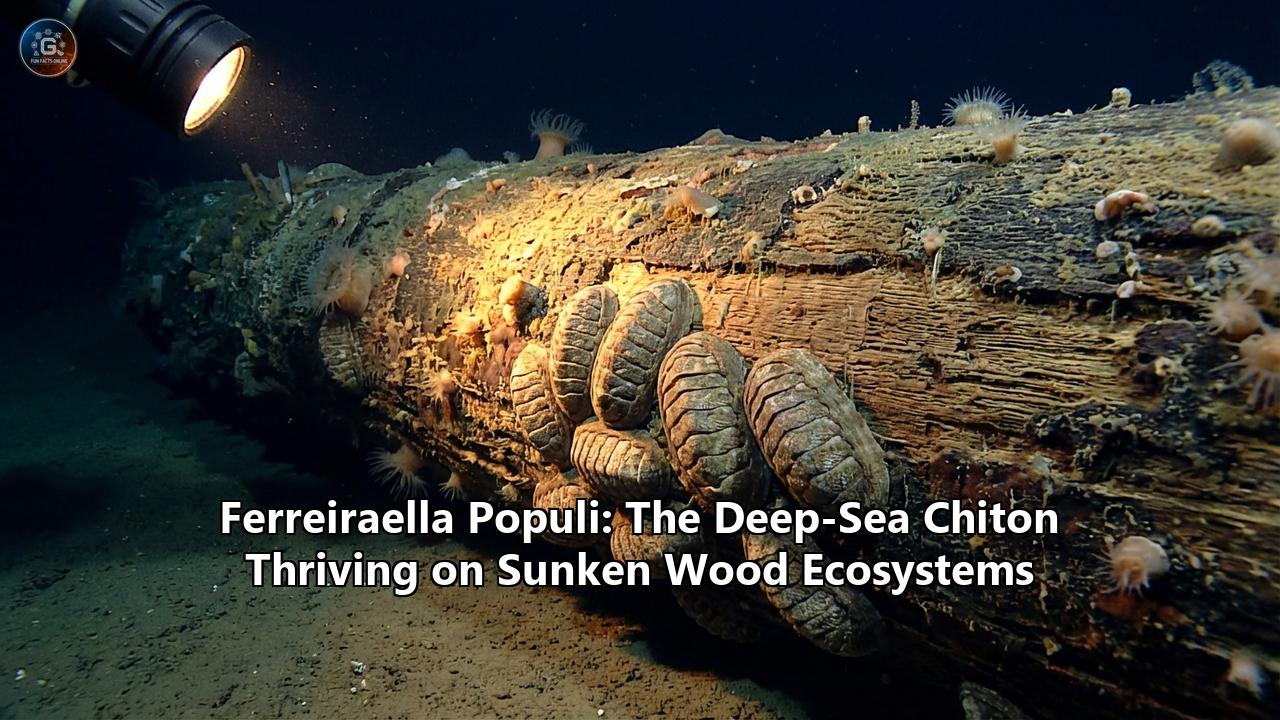
Far beneath the sunlit surface of the ocean, in a realm of crushing pressure and eternal darkness, the deep sea floor is often perceived as a barren wasteland. Yet, in this alien landscape, life finds a way to not just survive, but thrive in the most unexpected of places. When a tree falls in a terrestrial forest and is swept out to sea, its journey is far from over. It eventually sinks miles into the abyss, creating an ephemeral oasis known as a "wood-fall" ecosystem. It is here, in the cold depths of the Pacific Ocean, that scientists discovered a remarkable creature: a tiny, armored mollusk with an iron-clad tongue and a surprising connection to the global public.
Meet Ferreiraella populi, a newly described species of deep-sea chiton whose discovery and subsequent naming have bridged the gap between rigorous marine biology and viral internet culture. Described formally in February 2026, this extraordinary invertebrate offers a fascinating glimpse into the highly specialized ecosystems of the deep sea, the evolutionary marvels of marine anatomy, and the urgent need to catalog our planet's hidden biodiversity before it is lost forever.
The Oasis of the Abyss: Understanding Sunken Wood Ecosystems
To understand Ferreiraella populi, one must first understand the bizarre and fleeting world it inhabits. The abyssal plains of the ocean are generally starved of organic material. The creatures that live there rely heavily on "marine snow"—a continuous shower of organic detritus falling from the upper layers of the water column. However, occasionally, a massive windfall arrives in the form of a sunken log or tree.
When timber is washed into the ocean by storms or river currents, it eventually becomes waterlogged and sinks to the seafloor. In the nutrient-poor deep sea, this sudden arrival of concentrated carbon is the equivalent of an oasis appearing in a desert. Almost immediately, the wood is colonized by a succession of deep-sea life. Bacteria and fungi are the first to arrive, breaking down the tough cellulose and creating a rich, organic biofilm. This microbial mat serves as an invitation to a whole host of secondary inhabitants, including wood-boring bivalves, specialized worms, crustaceans, and grazing mollusks.
Because these wood-falls are temporary—eventually decaying completely—the creatures that rely on them must be highly specialized. They live in small, isolated populations, moving from one rare sunken log to the next through reproductive dispersal. The genus Ferreiraella is a lineage of chitons that has evolved to live exclusively on these decaying timbers. They are the ultimate deep-sea specialists, perfectly adapted to a life spent clinging to rotting wood miles beneath the ocean's surface.
Discovery in the Izu-Ogasawara Trench
The story of Ferreiraella populi began in 2024, during a deep-sea exploration mission off the coast of Japan. Researchers deployed remote sampling equipment into the Izu-Ogasawara Trench, a deep, geologically active depression in the western Pacific. At a staggering depth of 5,500 meters (approximately 18,045 feet or 3.4 miles), the team retrieved a piece of sunken wood.
Clinging tightly to the waterlogged timber were small, pale creatures. Growing to about 25 millimeters (one inch) in length, the animals featured a broad, fleshy edge known as a girdle, surrounding a series of protective plates. Upon closer inspection by experts, including Dr. Julia Sigwart, co-chair of the Senckenberg Ocean Species Alliance (SOSA) at the Senckenberg Research Institute and Natural History Museum Frankfurt, it became clear that this was a species entirely new to science.
The discovery provided a crucial piece of the puzzle in understanding the poorly researched lineage of deep-sea chitons. It offered tangible proof that sunken wood ecosystems host highly specialized communities that are still largely unknown to humanity.
The Anatomy of a Deep-Sea Tank
Chitons (formally known as polyplacophorans) are a class of marine mollusks that look like a cross between a snail and an armored beetle. While most familiar mollusks, like snails or clams, possess a single or bivalve shell, chitons are distinguished by their eight overlapping, separate shell plates, or valves. This unique anatomical design grants them both heavy armor and remarkable flexibility. If dislodged, a chiton can roll into a protective ball, much like an armadillo or pillbug, and its articulated plates allow it to conform perfectly to the irregular, decaying surfaces of deep-sea wood-falls.
But Ferreiraella populi boasts physical adaptations that go far beyond its eight-plated armor. The deep ocean is an extreme environment characterized by absolute darkness, near-freezing temperatures, and immense hydrostatic pressure. To extract nutrients from its wooden home, Ferreiraella populi comes equipped with a formidable tool: an iron-clad radula.
The radula is a ribbon-like, rasping tongue found in most mollusks, covered in microscopic teeth used to scrape food. However, the teeth of Ferreiraella populi are coated in an iron compound, effectively turning its tongue into a biological rasp file. In an environment where every calorie counts, this heavy-duty adaptation allows the chiton to scrape away tough organic films, degrading wood fibers, and algae without suffering the severe wear and tear that a standard radula would endure. It is a stunning example of biological engineering, allowing the tiny creature to literally eat its way through its habitat.
Adding to its bizarre charm, Ferreiraella populi does not live alone on its wooden real estate. Researchers discovered that the chiton acts as a host for a tiny, specialized community of its own. Gathered near the chiton’s tail end, scientists found a microscopic group of worms. These commensal worms have carved out an incredibly specific ecological niche: they survive by feeding exclusively on the chiton's excrement. This microscopic relationship highlights the complex, interconnected food webs that form on deep-sea wood-falls, where nothing goes to waste.
The People's Mollusk: A Viral Naming Campaign
In the traditional halls of taxonomy, the naming of a new species is a quiet, academic affair. Under the rules of the International Commission on Zoological Nomenclature (ICZN), the scientist who describes the species holds the right to name it. Epithets are usually derived from the animal's physical characteristics, the geographic location of its discovery, or in honor of a distinguished colleague. But the researchers at SOSA decided to take a radically different approach with this charismatic little deep-sea tank.
Determined to bridge the gap between academic taxonomy and public engagement, SOSA partnered with the scientific publisher Pensoft Publishers and the famous science communicator and YouTuber Ze Frank. Known for his hilarious and highly informative "True Facts" series, Ze Frank featured the peculiar Ferreiraella chiton in one of his videos. He highlighted its iron teeth, its eight overlapping plates, and, naturally, the community of poop-eating worms living on its rear end.
At the end of the feature, the scientific community issued a call to action: the internet was invited to propose a scientific name for the new species, accompanied by a justification.
The response was nothing short of explosive. Within a single week, over 8,000 name suggestions flooded in from viewers and social media users around the globe. "We were overwhelmed by the response and the massive number of creative name suggestions!" noted Dr. Julia Sigwart.
Sifting through the thousands of submissions, the research team found a striking pattern. Eleven different contributors, entirely independent of one another, had suggested the exact same specific epithet: populi. Derived from a Latin singular noun in the genitive case, populi translates directly to "of the people".
On February 6, 2026, the name Ferreiraella populi was officially cemented into the scientific record via a publication in the Biodiversity Data Journal. It was a fitting moniker for a creature that had captured the collective imagination of the public.
The naming contest also yielded several highly creative honorable mentions that delighted the researchers. One popular suggestion was Ferreiraella stellacadens, meaning "shooting star chiton". This name was proposed due to the unique, star-like pattern of the sensory organs (aesthetes) on its shell plates, and as a playful nod to the fact that the obscure deep-sea bug had suddenly "shot to fame" online. Another notable submission was Ferreiraella ohmu, a tribute to the giant, multi-eyed, armored invertebrates from Hayao Miyazaki’s iconic Studio Ghibli film Nausicaä of the Valley of the Wind. Given that the chiton was discovered in the Izu-Ogasawara Trench off the coast of Japan, the nod to Japanese pop culture was highly resonant.
The Race Against Extinction and Deep-Sea Mining
While the naming of Ferreiraella populi is a heartwarming tale of public engagement, the underlying scientific mission carries a profound sense of urgency. The oceans represent the largest living space on Earth, yet the vast majority of its biodiversity remains entirely unexplored.
Historically, the process of taxonomy has been painfully slow. As Dr. Sigwart explained, "It can often take ten, if not twenty years, for a new species to be studied, scientifically described, named, and published". During this "taxonomic bottleneck," species remain nameless and officially unrecognized, essentially existing in a state of scientific limbo.
This delay is not merely an academic inconvenience; it is a critical conservation issue. You cannot protect what you do not officially know exists. The deep sea is currently facing unprecedented threats from human activity, most notably the looming specter of deep-sea mining. Industrial operations seeking to harvest rare earth metals and minerals from the ocean floor threaten to bulldoze fragile, ancient ecosystems. Sunken wood communities, which rely on small, isolated populations and highly specialized evolutionary adaptations, are particularly vulnerable to changes in the deep-sea environment, including sediment plumes and habitat destruction caused by mining.
"Ferreiraella populi exemplifies the overwhelming biodiversity of the oceans, the vast majority of which remains unexplored. Many species go extinct before we even know they exist—this is especially true for marine invertebrates," Sigwart emphasized.
This is where the mission of the Senckenberg Ocean Species Alliance comes into play. SOSA was founded with the explicit goal of streamlining the taxonomic process, pairing cutting-edge genetic and morphological analysis with a commitment to rapid publication. Thanks to these efforts, Ferreiraella populi transitioned from a mystery specimen found at the bottom of a trench to a globally recognized, officially named species in just two years.
By bringing the public into the scientific process, researchers are doing more than just crowdsourcing nomenclature. They are fostering a sense of global ownership and stewardship over the deep sea. When thousands of people learn about an obscure, iron-tongued mollusk and invest their time in giving it a name, that creature ceases to be an out-of-sight, out-of-mind statistic. It becomes "of the people," representing the weird, wonderful, and fragile life that thrives in the darkest corners of our planet.
A Window into the Unknown
The formal cataloging of Ferreiraella populi is just one small victory in a massive, ongoing campaign to map the tree of life in our oceans. Alongside the "People's Chiton," the 2026 Biodiversity Data Journal publication also described other newly discovered chitons, such as Notoplax madagascariensis, found near sponges off the coast of Madagascar, and Placiphorella granulosa, a rare, carnivorous ambush-predator chiton from Papua New Guinea. Together, these discoveries underscore how unevenly the ocean has been studied and how many wonders are still waiting in the dark.
The deep sea continues to challenge our understanding of biology. In an environment devoid of sunlight, life utilizes alternative energy sources, adapts with iron-laced anatomy, and builds entire miniature ecosystems on the back of a single rotting log.
Ferreiraella populi stands as a testament to the resilience of life and the power of collaborative science. It reminds us that even three and a half miles beneath the waves, there are creatures living out complex, fascinating lives. And, thanks to the power of the internet and dedicated marine biologists, this tiny armored tank will forever carry a name that honors the humans who took the time to look down into the abyss and marvel at what they found.Reference:
- https://www.eurekalert.org/news-releases/1115280
- https://indiandefencereview.com/rare-ocean-creature-found-with-iron-plated-tongue-18000-feet-below-surface/
- https://scitechdaily.com/the-internet-just-named-a-brand-new-deep-sea-creature-found-nearly-3-miles-deep/
- https://www.discovermagazine.com/8-000-suggestions-later-a-newly-discovered-deep-sea-species-gets-its-name-48657
- https://www.independent.co.uk/news/science/deep-sea-creature-species-name-mollusc-b2916563.html
- https://news.ssbcrack.com/public-helps-name-newly-discovered-deep-sea-chiton-ferreiraella-populi/
- https://www.bioscience.com.pk/en/subject/biology/the-internet-helped-name-a-new-deep-sea-species-living-on-sunken-wood
- https://www.earth.com/news/mollusk-species-with-tongue-made-of-iron-discovered-18045-feet-deep/
- https://www.sciencedaily.com/releases/2026/02/260207232242.htm
- https://ecomagazine.com/news/research/the-internet-names-a-new-deep-sea-species/