
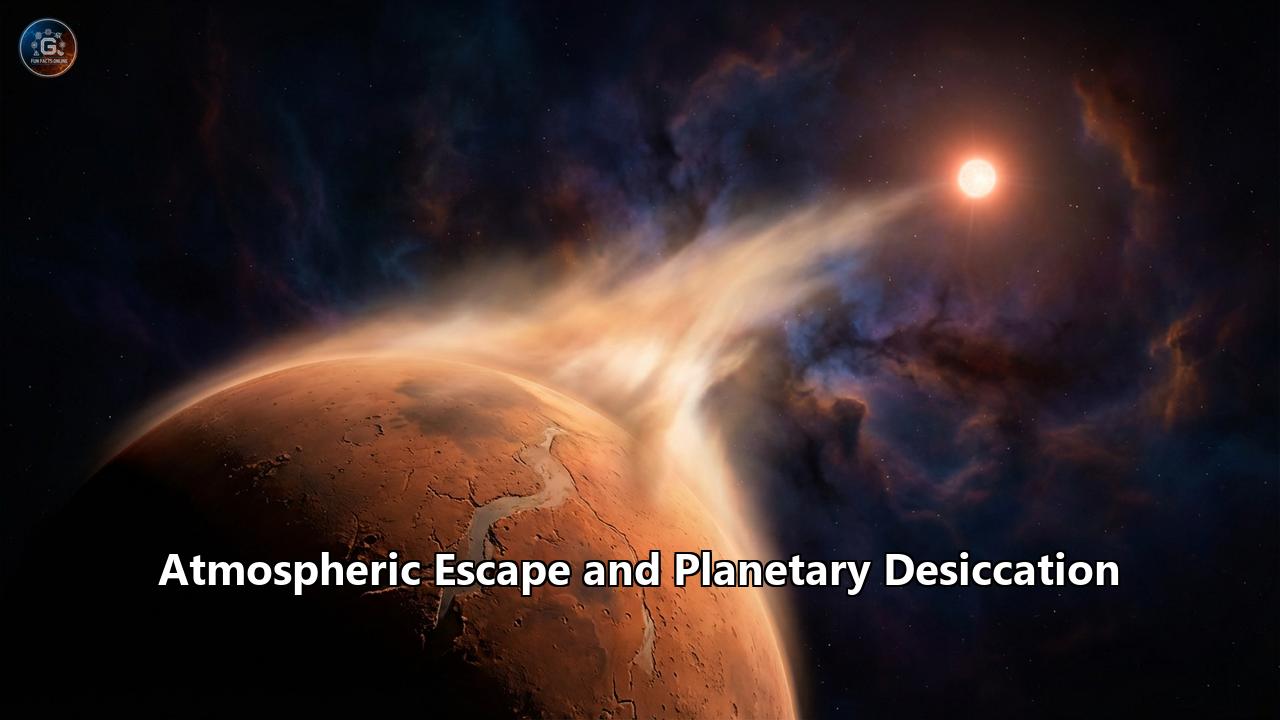
When we look up at the blue dome of Earth’s sky, it feels permanent. The air we breathe, the clouds that drift by, and the pressure that keeps our blood from boiling seem like fundamental constants of our planet. But to a planetary scientist, an atmosphere is not a fixture; it is a fleeting, delicate veil. It is the prize in a relentless, billions-of-year-long tug-of-war between a planet’s gravity and the violent energy of the cosmos.
This battle is the story of Atmospheric Escape, a collection of physical processes that slowly bleed planets dry, turning lush water-worlds into barren rocks. This process, often culminating in Planetary Desiccation, is the primary reason our solar system looks the way it does today: why Mars is a frozen desert, why Venus is a hellscape, and why Earth—for now—remains a blue marble.
In this comprehensive exploration, we will dissect the invisible mechanisms that strip worlds of their air, investigate the forensic evidence left on our planetary neighbors, and look to the future to see when Earth, too, will lose its oceans to the void.
Part I: The Physics of Departure
To understand how a planet dies, we must first understand the physics of "escape." An atmosphere is essentially a gas held down by gravity. For a molecule to leave, it must achieve escape velocity—the speed required to break free from the planet's gravitational well without falling back. On Earth, this is about 11.2 kilometers per second (approx. 25,000 mph). On Mars, it is only 5 km/s.
The mechanisms that accelerate gas particles to these speeds fall into two broad categories: Thermal (driven by heat) and Non-Thermal (driven by solar wind, chemical reactions, and magnetic forces).
1. Thermal Escape: The Molecular Lottery
Jeans Escape
Named after the British physicist Sir James Jeans, this is the slow, steady leakage of an atmosphere. In any gas, molecules are constantly colliding and exchanging energy. While the average speed of the gas might be well below escape velocity, the speeds follow a statistical curve (the Maxwell-Boltzmann distribution).
There is always a "long tail" to this curve—a tiny fraction of molecules that, through a series of lucky collisions, acquire enough speed to exceed escape velocity. If these molecules are high enough in the atmosphere (above the "exobase," where collisions become rare), they can fly off into space.
- The Weight Matters: Lighter gases move faster than heavier ones at the same temperature. This is why hydrogen and helium escape Earth relatively easily, while heavier gases like nitrogen and oxygen stay put.
- The Temperature Matters: A hotter upper atmosphere pushes the entire speed distribution to the right, allowing more particles to reach the escape threshold.
Hydrodynamic Escape (The "Blow-Off")
If Jeans escape is a dripping tap, hydrodynamic escape is a burst pipe. This occurs when the upper atmosphere absorbs so much energy (usually Extreme Ultraviolet or XUV radiation from a young, active star) that it heats up expansively.
Instead of individual molecules escaping one by one, the atmosphere behaves like a fluid, expanding outward in a bulk flow. This wind is so powerful that it can drag heavier molecules along with it. A rushing river of hydrogen can carry heavier "boulders" of oxygen, carbon, or noble gases into space. Astronomers believe this was the primary way Venus lost its oceans early in its history.
2. Non-Thermal Escape: The Violent Stripping
For planets closer to their stars, or those lacking protection, non-thermal processes can be even more destructive. These mechanisms don't rely on temperature; they rely on high-energy interactions.
Sputtering
Imagine a game of cosmic billiards. The solar wind is a stream of charged particles (ions) continuously ejected from the Sun. If a planet lacks a strong magnetic field, these high-speed solar ions can slam directly into the upper atmosphere. The impact transfers kinetic energy to atmospheric atoms, kicking them out into space. This process has been a major culprit in the thinning of the Martian atmosphere.
Ion Pickup
In this scenario, a neutral atom in the upper atmosphere is ionized—perhaps by UV radiation or charge exchange. Once it becomes a charged ion, it suddenly "feels" the magnetic field of the solar wind sweeping past the planet. The ion is instantly grabbed by the solar wind’s magnetic field lines and accelerated away from the planet, much like a hitchhiker catching a ride on a passing freight train.
Photochemical Escape
This is a chemical trapdoor. Solar radiation breaks molecules apart (photodissociation). Sometimes, the energy released in this chemical snap is converted into kinetic energy for the resulting fragments.
- Dissociative Recombination: A common killer of water. A positively charged molecular ion (like HCO+) captures an electron and splits apart. The energy of the recombination flings the resulting atoms apart at high speeds. If a hydrogen atom is created this way, it often has enough speed to escape immediately.
Part II: Solar System Case Studies
Our solar system provides three perfect laboratories for studying atmospheric escape: the survivor (Earth), the victim (Mars), and the cautionary tale (Venus).
The Red Planet: Mars and the Case of the Missing Nitrogen
Billions of years ago, Mars had a thick atmosphere and liquid water flowing across its surface. We see the dry riverbeds and ancient lake deltas today. But Mars had two fatal flaws: it was small (low gravity) and it lost its global magnetic field early in its history.
Without a magnetic shield, the solar wind began to strip away the Martian sky. The MAVEN (Mars Atmosphere and Volatile Evolution) mission has been observing this in real-time. It found that when the Sun is active, the escape rates skyrocket.
The Isotopic Fingerprint: How do we know Mars lost water to space and not just to underground ice? We look at the water that remains. Ordinary hydrogen has a single proton. Deuterium is a heavier isotope of hydrogen (proton + neutron). Because regular hydrogen is lighter, it escapes via Jeans escape much faster than deuterium. By measuring the ratio of Deuterium to Hydrogen (D/H) in the Martian atmosphere, scientists found it is about eight times higher than on Earth. This "enrichment" of heavy hydrogen is forensic proof that Mars has lost a vast ocean's worth of water to space—likely 80-90% of its original inventory. The Nitrogen Mystery: Recent studies have also highlighted a "Nitrogen Mystery." Mars has significantly less nitrogen than expected compared to Earth and Venus. While carbon dioxide is heavy and tends to stay (frozen in caps or rocks), nitrogen is lighter and susceptible to non-thermal escape processes. The lack of nitrogen is a key reason Mars is "dead"—nitrogen is essential for the atmospheric pressure required to keep water liquid and is a building block for life.Venus: The Steam Cooker
Venus is often called Earth’s twin, but its atmosphere is 90 times thicker and made mostly of choking carbon dioxide. Yet, Venus likely started with as much water as Earth.
The culprit here was the Runaway Greenhouse Effect, which fueled a massive Hydrodynamic Escape event.
- As the young Sun brightened, Venus became too hot. Water evaporated from the surface, filling the atmosphere with steam.
- Water vapor is a potent greenhouse gas, so the planet got even hotter, evaporating more water—a runaway loop.
- Once the water was in the upper atmosphere, UV light broke the H2O molecules into Hydrogen and Oxygen.
- The hydrogen, being light, was lost to space in a massive hydrodynamic outflow.
- The oxygen was left behind, but it didn't stay in the atmosphere. It reacted with the surface crust (oxidizing it) or was stripped away by the solar wind.
Recent research suggests mechanisms like dissociative recombination of HCO+ are still active on Venus today, continuing to scour the last traces of hydrogen from the atmosphere, ensuring the planet remains bone-dry.
Earth: The Lucky Blue Marble (For Now)
Why does Earth still have its oceans?
- Gravity: Earth is massive enough to hold onto nitrogen and oxygen easily.
- The Magnetic Field: While its role is debated (see below), the magnetosphere prevents the solar wind from stripping the atmosphere via sputtering.
- The "Cold Trap": This is Earth's secret weapon. In our atmosphere, the temperature drops as you go up (in the troposphere) before rising again (in the stratosphere). At the "tropopause" (about 10-15km up), it is incredibly cold (-60°C). When water vapor rises from the oceans, it hits this cold layer, condenses into ice clouds, and falls back down as rain or snow. Very little water vapor makes it to the upper atmosphere where solar UV could break it apart. This "cold trap" effectively locks our water near the surface.
For decades, textbooks said Earth’s magnetic field is the hero that shielded us. However, recent research (including simulations of unmagnetized Earths) suggests this story is too simple. A magnetic field protects against sputtering, but it actually creates pathways for ions to escape at the poles (the "Polar Wind"). Some models suggest that even without a magnetic field, Earth’s atmosphere would survive because its gravity is strong enough. Venus, with no magnetic field, has retained a massive atmosphere (albeit a dry one). The consensus is shifting: Gravity is the primary keeper of the atmosphere; the magnetic field is a secondary, albeit helpful, shield.
Part III: The Exoplanet Frontier
As our telescopes peer into the galaxy, we are seeing atmospheric escape on a grand scale.
The "Tidal Venus" of the Red Dwarfs
The most common stars in the galaxy are M-dwarfs (Red Dwarfs). These stars are dim, so their "habitable zones" (where water can be liquid) are very close to the star.
However, M-dwarfs are violent teenagers. They remain active for billions of years, firing off massive flares and XUV radiation.
- Proxima Centauri b: Our nearest neighbor is in the habitable zone, but models suggest the stellar wind pressure is thousands of times higher than at Earth. It is likely that the atmosphere of Proxima b has been stripped entirely, or that it has become a "Tidal Venus"—a world where the oceans boiled off and the hydrogen escaped, leaving a dry, oxygen-rich (but lifeless) husk.
- The Trap: This creates a paradox. The stars that live the longest (Red Dwarfs) and are the best candidates for finding life might effectively sterilize their planets through atmospheric stripping.
Hot Jupiters: Observing the Blow-Off
We don't just theorize about escape; we see it. The exoplanet WASP-121b is a "Hot Jupiter" orbiting so close to its star that it is literally boiling away. The James Webb Space Telescope (JWST) and Hubble have detected tails of helium gas trailing behind the planet. The star’s radiation is heating the planet’s atmosphere to thousands of degrees, causing it to expand and escape in a hydrodynamic outflow—a real-time example of the process that likely dried out Venus eons ago.
Part IV: The Future of Earth
We often worry about climate change (warming of a few degrees), but the ultimate climate catastrophe is inevitable and natural: Planetary Desiccation.
Earth’s "Cold Trap" works today, but it won’t work forever. The Sun is gradually getting brighter (about 10% every billion years).
- 1 Billion Years from Now: The Sun’s luminosity will increase enough to trigger a Moist Greenhouse. The atmosphere will heat up, and the "Cold Trap" will fail. Water vapor will rise into the stratosphere.
- The Great Drying: Once water is in the upper atmosphere, UV light will break it apart. The hydrogen will escape into space. Slowly, over millions of years, Earth’s oceans will leak into the void.
- The End State: Earth will not necessarily become a Venus-like hothouse immediately, but it will become a Dune-like desert world. Without water to lubricate plate tectonics, the carbon cycle will stop. Volcanic CO2 will build up, eventually leading to a Venus-like state, but life will have long since perished from the lack of water.
Conclusion
Atmospheric escape is the defining process of planetary evolution. It is the sculptor that chisels away the gas to reveal the rock beneath. It teaches us that habitability is not a static property of a planet, but a dynamic state that must be actively maintained against the harsh erosion of the universe.
Every glass of water you drink is a survivor—a collection of molecules that managed to dodge the escape velocity lottery for 4.5 billion years. And every breath you take is a gift from gravity, the silent jailer that keeps our sky from rushing off into the stars.
Reference:
- https://sseh.uchicago.edu/doc/Catling2009.pdf
- https://astronomy.stackexchange.com/questions/28328/mars-vs-venus-the-retention-of-atmospheres-in-relationship-to-earth
- https://www.reddit.com/r/askscience/comments/bpx562/does_the_earth_ever_gain_or_lose_water/
- https://www.researchgate.net/figure/Three-scenarios-of-Earths-future-encounter-with-the-runaway-greenhouse-effect-With_fig8_51251901
- https://www.quora.com/Is-the-amount-of-time-left-before-the-oceans-boil-away-being-1-billion-years-more-than-enough-time-to-eventually-abandon-the-entire-Earth-and-perhaps-even-the-Solar-System-but-not-before-relocating-to-Mars-Europa
- https://www2.irf.se/~yamau/conference/2012/EANA2012_poster_Nitro.pdf
- https://pubmed.ncbi.nlm.nih.gov/11538226/
- https://www.vice.com/en/article/the-moist-greenhouse-effect-could-be-the-one-that-destroys-our-atmosphere/
- https://www.amnh.org/explore/ology/earth/ask-a-scientist-about-our-environment/will-earth-run-out-of-water
- https://www.annualreviews.org/doi/pdf/10.1146/annurev.ea.15.050187.001131
- https://en.wikipedia.org/wiki/Future_of_Earth
- https://ntrs.nasa.gov/citations/19880055273
- https://www.sciencedaily.com/releases/2013/12/131216142310.htm