
Imagine sitting down at your favorite high-end steakhouse. The waiter places a sizzling ribeye in front of you, the marbling perfect, the aroma intoxicating. You cut into it, revealing a tender, medium-rare pink center. It tastes exactly like the best beef you’ve ever had. But there is one crucial difference: no cow was slaughtered to put this meal on your plate. In fact, this steak didn't come from a farm at all. It was born from a biopsy the size of a sesame seed and constructed, layer by microscopic layer, by a robotic arm in a sterile facility.
Welcome to the dawn of the 3D-printed meat revolution.
This is not science fiction, nor is it a distant dystopian dream. It is a rapidly crystallizing reality occurring in laboratories and pilot factories from Tel Aviv to Singapore, Silicon Valley to Maastricht. We are witnessing the convergence of two of the most transformative technologies of the 21st century: tissue engineering and additive manufacturing. Together, they promise to upend the 12,000-year-old history of agriculture, offering a solution to some of humanity’s most pressing existential threats—climate change, food insecurity, and animal welfare—while promising a culinary future where our food is programmable, personalizable, and arguably, more "perfect" than nature ever intended.
Chapter 1: The Genesis of a New Food System
To understand where we are going, we must understand the limitations of where we are. Traditional animal agriculture is a resource-intensive behemoth. It utilizes approximately 77% of the world's agricultural land yet supplies only 17% of humanity's caloric supply. It is a primary driver of deforestation, a massive consumer of fresh water, and a significant contributor to greenhouse gas emissions—producing more than the entire transportation sector combined by some estimates.
For decades, the only alternative was plant-based analogues—veggie burgers that, while noble in intent, often failed to capture the primal sensory experience of eating meat. Then came the pioneers of "cellular agriculture." In 2013, Dr. Mark Post of Maastricht University unveiled the world’s first lab-grown burger. It cost $330,000 to produce and was dry and tasteless, lacking the fat and connective tissue that gives meat its succulence. But it proved a point: we could grow muscle outside an animal.
However, a pile of muscle cells is not a steak. It is a paste. To recreate the complex architecture of a ribeye or a salmon fillet—the interplay of muscle fibers, fat cells, collagen, and blood vessels—scientists realized they needed a way to organize these cells in three-dimensional space. Enter 3D printing.
Chapter 2: The Cellular Symphony — How It Works
The science of 3D-printed meat is a marvel of biological engineering, often described as "printing life." It is distinct from 3D-printed plant-based meat (which extrudes soy or pea protein pastes), though the printing mechanics can be similar. True cultivated 3D-printed meat involves a biological process that mimics the healing capability of an animal.
The Biopsy and The Bank
The process begins with a harmless biopsy from a living animal—a cow, chicken, pig, or fish. Scientists isolate stem cells, the body's master builders. These cells have the miraculous ability to self-renew and differentiate into specialized cell types. They are placed in a nutrient-rich "soup" called a culture medium, which contains amino acids, glucose, vitamins, and growth factors. This environment mimics the warmth and nourishment of the animal's body, tricking the cells into believing they are still inside the host.
The Proliferation Phase
Inside massive stainless-steel bioreactors, these cells multiply exponentially. A sample the size of a peppercorn can theoretically produce tons of meat. But at this stage, the result is an amorphous slurry of cells. To become meat, they need structure.
The Bio-Ink
This is where the "printing" magic happens. The living cells are mixed with a hydrogel to create "bio-ink." This ink is the crucial medium that protects the cells during the printing process and provides them with a temporary home. The hydrogel is often made from natural, edible materials like alginate (from seaweed), chitosan, or collagen. It acts as the "scaffold"—a lattice structure that holds the cells in place.
The Print
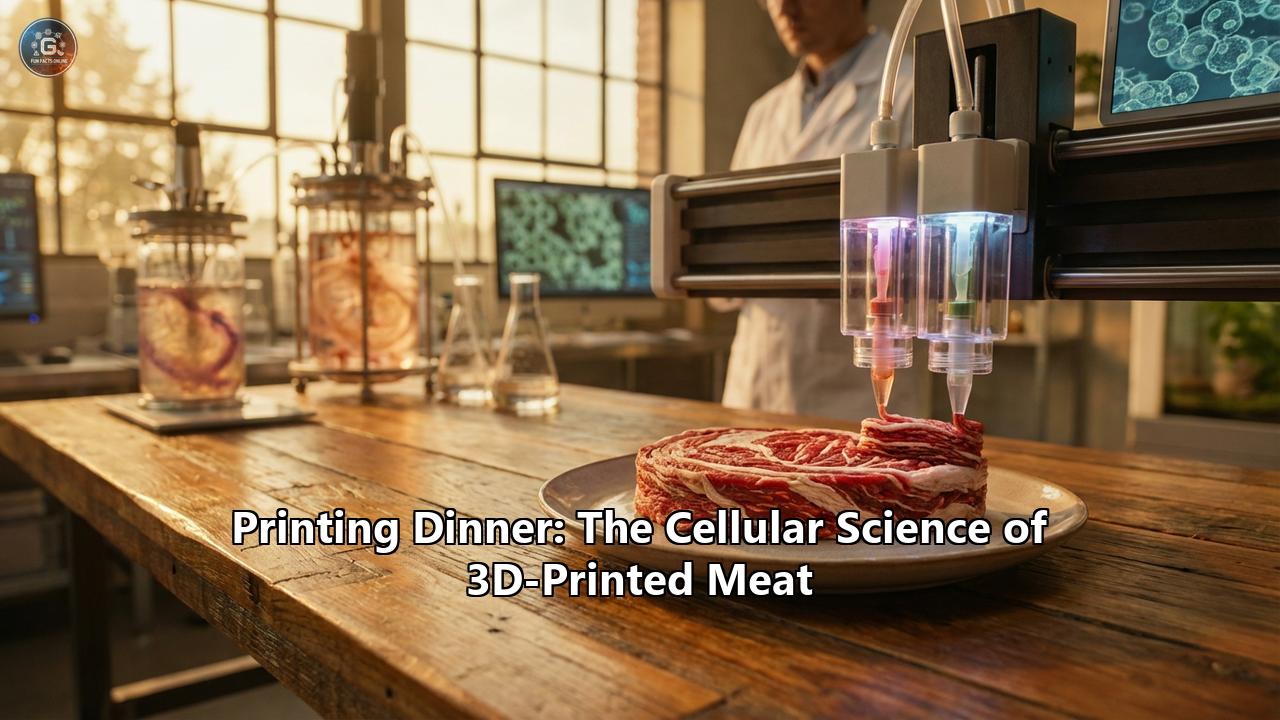
A specialized 3D bioprinter reads a digital file—a CAD (Computer-Aided Design) model of a steak. The printer features multiple nozzles. One nozzle might extrude "muscle ink," another "fat ink," and a third "vascular ink." The printer lays these down with micron-level precision, following the exact marbling pattern of a Wagyu beef or the flaky layering of a salmon fillet.
The Maturation (The Post-Print Life)
When the printing is done, the product is not yet meat. It is a "pre-tissue." The printed structure is returned to an incubator. Here, the magic of biology takes over. The scaffold degrades or integrates as the cells communicate with one another. Muscle cells fuse to form fibers; fat cells accumulate lipids. The tissue contracts and "exercises" itself, gaining density and texture. Over a period of weeks, the printed construct matures into a biologically identical piece of meat, indistinguishable under a microscope from its farm-raised counterpart.
Chapter 3: The Architects of Dinner
A global race is underway to dominate this nascient industry, with different companies betting on different technologies and culinary niches.
Aleph Farms (Israel): perhaps the most famous name in the sector, Aleph Farms made headlines by 3D printing a small steak on the International Space Station, proving that meat can be grown in zero gravity with minimal resources. Their focus is on high-fidelity, whole-cut steaks. They utilize a proprietary 3D bioprinting platform to create thin steaks that have the texture and mouthfeel of beef, focusing heavily on the "vascularization" challenge to ensure nutrients reach the inner cells of thicker cuts. Steakholder Foods (formerly MeaTech 3D): This company is pushing the industrial boundaries. They are developing massive, high-throughput bioprinters capable of printing tons of meat per day. Their technology focuses on "Bio-pumping," where the printer deposits layers of proprietary bio-ink tailored to differentiate into fat and muscle. Their goal is to sell the printers and the ink to food manufacturers, becoming the "HP" of the meat world. Redefine Meat (Israel): While currently focusing on plant-based ingredients, Redefine Meat is crucial to the conversation because of their mastery of "Alt-Muscle," "Alt-Fat," and "Alt-Blood." Their "New-Meat" printers are so precise they can digitally program the exact tenderness and juiciness of a flank steak. Their "matrix" technology maps millions of 3D points to recreate the chaotic, non-uniform texture of real animal muscle, solving the "uncanny valley" problem of food. Revo Foods (Austria): Focusing on the ocean, Revo uses 3D printing to recreate the complex orange-and-white layering of salmon fillets. Their technology addresses the urgent need to reduce pressure on global fish stocks, offering a product that is rich in Omega-3s but free from the microplastics and mercury increasingly found in wild fish.Chapter 4: The Customization Revolution
The most exciting aspect of 3D-printed meat is not just replication, but optimization. Because the meat is built pixel by pixel (or voxel by voxel), it is fully programmable.
Imagine a steak where the fat is not saturated animal fat, but replaced with heart-healthy Omega-3 fatty acids or avocado oil, yet it still sizzles and tastes like beef tallow. Imagine a pork chop fortified with extra iron or vitamins for anemic patients. Imagine a texture dial where you can choose "melt-in-your-mouth" tenderness for the elderly or a chewier, fibrous texture for a BBQ enthusiast.
This is the era of "Personalized Nutrition." In the future, your smartwatch might detect a protein deficiency or high cholesterol, send data to your kitchen printer, and customize your dinner's nutritional profile in real-time. We are moving from a "one-size-fits-all" food system to one that is distinctly "made-for-you."
Chapter 5: The Sustainability & Ethical Calculus
The environmental argument for 3D-printed meat is staggering. Oxford University research suggests that cultured meat could be produced with up to 96% lower greenhouse gas emissions, 45% less energy, 99% lower land use, and 96% lower water use than conventional meat.
In a world approaching a population of 10 billion, where arable land is shrinking, this efficiency is not just a luxury; it is a survival mechanism. It allows us to return vast swathes of pastureland to nature, restoring biodiversity and carbon sinks (forests).
Ethically, it decouples meat consumption from animal suffering. For the first time in history, a vegetarian could theoretically eat meat without compromising their values. It eliminates the need for antibiotics in farming (a major driver of superbugs) since the meat is grown in a sterile environment. It also removes the risk of zoonotic diseases (like COVID-19 or Avian Flu) jumping from livestock to humans.
Chapter 6: The Great Hurdles
Despite the promise, the path to a printed dinner is paved with obstacles.
1. The Cost of the Ink: Currently, the "growth medium" used to feed the cells is astronomically expensive. Historically, this medium relied on Fetal Bovine Serum (FBS), which was both costly and ethically controversial. The industry is now racing to develop plant-based, animal-free growth media that are cheap and effective. Until the cost drops from thousands of dollars per pound to tens of dollars, it will remain a niche luxury. 2. The Vascularization Challenge: Printing a thin burger is relatively easy. Printing a thick 2-inch ribeye is incredibly hard. In a living animal, blood vessels transport oxygen to every cell. In a printed steak, without a vascular network, the cells in the center of the meat would die and rot (necrosis) before they could mature. Scientists are developing "sacrificial inks"—materials printed to form channels that melt away later, leaving hollow tubes for nutrients to flow through, effectively creating artificial veins. 3. The "Yuck" Factor: Consumer psychology is a fragile thing. To many, the idea of meat grown in a tank and printed by a robot feels unnatural, sparking fears of "Frankenfoods." The industry faces a massive PR challenge to normalize the technology, framing it not as "lab-grown" but as "clean meat" or "cultivated meat"—analogous to how beer is brewed or yogurt is cultured. 4. Regulation: Food safety agencies like the FDA (USA), EFSA (Europe), and SFA (Singapore) are charting unknown waters. How do you inspect a slaughter-free slaughterhouse? Singapore became the first country to approve the sale of cultured meat in 2020, and the US followed with approvals for Upside Foods and Good Meat in 2023, but global regulatory alignment is still years away.Chapter 7: The Future Landscape (2030 and Beyond)
We are currently in the "Roadster" phase of this technology—high cost, low volume, high excitement. By the late 2020s, we will likely enter the "Model S" phase: premium products available in high-end restaurants in major cosmopolitan hubs.
By the 2030s, we may see the "hybrid" era dominate—products that are 50% plant-based protein (for bulk and cost) and 50% cultivated animal fat (for flavor), printed together to create affordable, tasty burgers and nuggets.
By 2050, the 3D food printer might be as common a household appliance as the microwave. You might download a recipe from a celebrity chef, buy a cartridge of "Wagyu stem cells" and "Vegetable scaffolding" from the grocery store, and print a Michelin-star quality dinner while you finish up work.
Conclusion
Printing dinner is not merely about novelty; it is about necessary evolution. We have reached the biological limits of the cow and the chicken. We cannot breed them to grow faster or use less water without creating ethical monstrosities. To feed the future, we must transcend biology's limitations, stripping meat down to its cellular essence and rebuilding it with the precision of engineering.
The 3D-printed steak represents a shift from extraction to creation. It is a culinary canvas where science meets sustenance, promising a world where we can have our steak and eat it too—without killing the planet or the animal. The cellular revolution is here, and it looks delicious.
Reference:
- https://www.theethicalfuturists.com/exploring-the-revolutionary-concept-of-what-is-3d-printed-steak/
- https://builtin.com/articles/3d-printed-meat
- https://medium.com/@keplers-team/lab-grown-meat-and-3d-printed-food-innovations-transforming-our-diet-2894f17ad9e7
- https://3dprint.com/303655/a-decade-of-progress-in-cultured-and-bioprinted-meat/
- https://www.nikkoindustries.com/blogs/news/how-to-3d-print-a-steak
- https://www.coherentmarketinsights.com/market-insight/3d-printed-meat-market-6161
- https://www.womentech.net/en-ng/how-to/innovating-3d-printed-food-custom-nutrition
- https://www.steakholderfoods.com/blog/engineering-challenges-of-bringing-3d-printing-technologies-into-the-food-production-industry
- https://savoreat.com/what-is-3d-meat-how-is-it-made-and-what-are-its-benefits/
- https://www.researchgate.net/publication/385788957_Technology_of_3D_Meat_printing
- https://www.nikkoindustries.com/blogs/news/how-does-3d-printed-meat-work
- https://labgrownmeat.com/what-is-3d-bioprinting/
- https://www.aiu.edu/innovative/printing-the-future-how-3d-printed-meat-from-stem-cells-is-revolutionizing-what-we-eat/
- https://www.tno.nl/en/newsroom/insights/2024/09/3d-printed-food-personalised-nutrition/
- https://www.theethicalfuturists.com/exploring-the-future-of-food-what-is-3d-printed-steak/
- https://gfi.org/science/the-science-of-cultivated-meat/
- https://www.scispot.com/blog/top-emerging-lab-grown-meat-companies-leading-the-charge
- https://bernardmarr.com/the-future-of-food-amazing-lab-grown-and-3d-printed-meat-and-fish/