
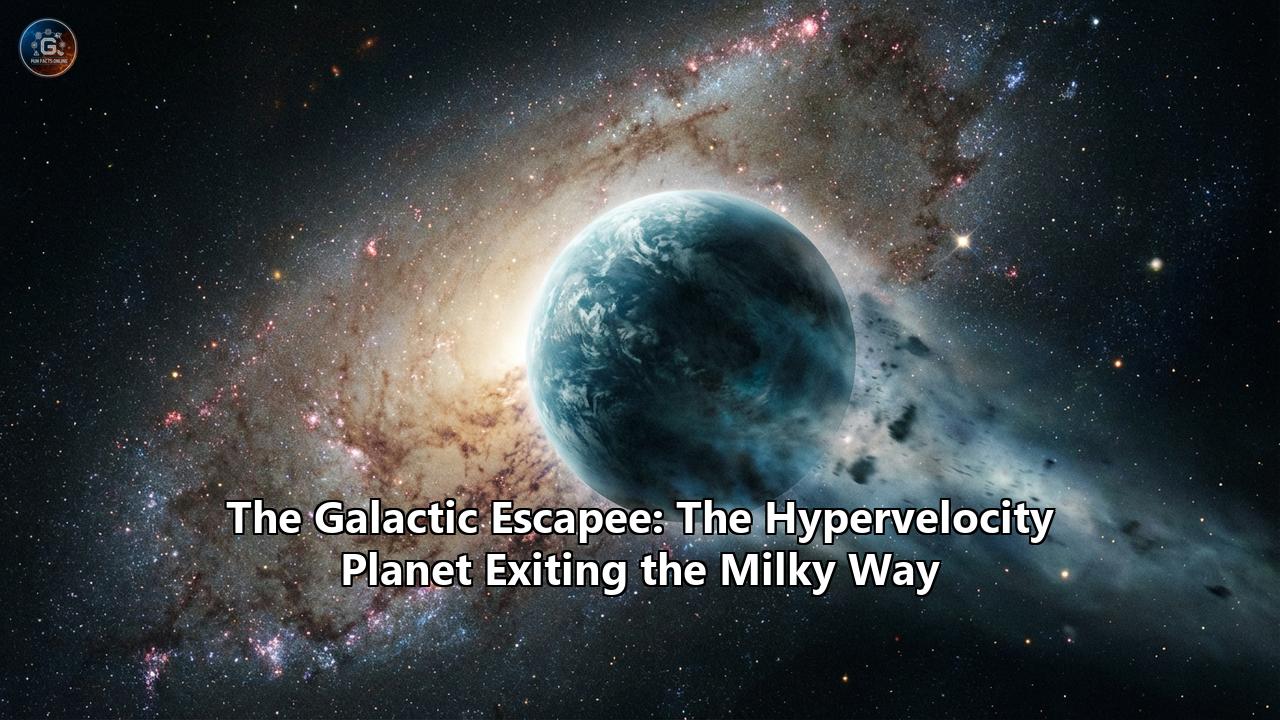
In the grand, silent theatre of the cosmos, a drama of exile is unfolding. It is a story not of a star, but of a world—a planet that has been unmoored from the gravitational harbors of our galaxy and cast out into the unimaginable blackness of intergalactic space. This is not science fiction. It is the reality of a newly confirmed celestial object, a "hypervelocity planet," that is currently screaming through the outer reaches of the Milky Way at a speed so incomprehensible that it defies the gravitational grasp of the galaxy itself.
This is the story of the Galactic Escapee.
Part I: The Departure
Imagine standing on the surface of a moon orbiting this world. For billions of years, your sky was dominated by the thick, milky band of the galaxy—a river of light composed of billions of stars, dust lanes, and the glow of nebulae. But today, the view is different. The band is receding. The familiar constellations are warping, stretching, and fading. The star you orbit is moving faster than any star has a right to move—over 1.2 million miles per hour (approx. 540 kilometers per second).
You are not orbiting the galactic center; you are fleeing it.
The discovery of this system, tentatively cataloged as HVP-1 (Hypervelocity Planet 1) in the popular press following the groundbreaking papers published in early 2025, marks a watershed moment in astronomy. While astronomers have known for two decades that stars can be ejected from the galaxy—so-called hypervelocity stars (HVS)—the idea that they could drag their planetary families with them was, until recently, a matter of simulation and hope.
The confirmation comes from a team led by researchers at NASA’s Goddard Space Flight Center and the University of Maryland, who revisited data from a microlensing event that occurred more than a decade ago. What they found was a "scrawny" red dwarf star, roughly 20% the mass of our Sun, tearing through the galactic halo. But it wasn’t alone. Tightly bound to it, surviving the violent gravitational forces that accelerated its parent, was a planet—a "Super-Neptune," roughly 30 times the mass of Earth.
Together, this dyad is embarking on the ultimate road trip, one with no return ticket. They are destined to cross the event horizon of the Milky Way’s gravity well and drift forever in the void between galaxies.
Part II: The Violent Kick
To understand how a planet gets evicted from its home galaxy, we must look to the violent heart of the Milky Way. The center of our galaxy is a chaotic, crowded region, dominated by Sagittarius A (Sgr A), a supermassive black hole four million times the mass of our Sun.
Sgr A is the engine of ejection. The leading theory for the creation of hypervelocity objects is the "Hills Mechanism," proposed by astronomer Jack Hills in 1988. The mechanism works like a celestial trebuchet. It begins with a binary star system—two stars orbiting each other—drifting too close to the supermassive black hole.
Gravity is a harsh mistress in the galactic core. As the binary pair approaches the black hole, the tidal forces become extreme. The gravity of the black hole pulls on the two stars with different strengths. If the approach is close enough, the binding energy of the binary system is overcome. The partnership is shattered.
In this gravitational divorce, one star is the loser, captured by the black hole into a tight, doomed orbit, eventually to be consumed or shredded. The other star is the winner. It steals energy from the interaction, receiving a gravitational "kick" of immense power. It is slingshot outward at thousands of kilometers per second, moving fast enough to escape the galaxy entirely.
For years, this was the accepted model for hypervelocity stars. But the question remained: What happens to the planets?
Planetary orbits are delicate. If a star undergoes a violent disruption by a black hole, wouldn't its planets be stripped away, left to wander as rogue worlds or swallowed by the dark? Simulations run by astrophysicists at Harvard and Oxford suggested a caveat: proximity is protection.
If a planet orbits its star at a great distance (like Neptune or Pluto in our system), the black hole's gravity would indeed strip it away. But if the planet hugs its parent star tightly—orbiting in the "safe zone" where the star's gravity dominates over the tidal forces of the black hole—it can survive.
The Super-Neptune of the Galactic Escapee system is one such survivor. It orbits its red dwarf parent at a distance smaller than that of Earth to the Sun. When its parent star was kicked by Sgr A, the planet held on. It endured the g-forces, the tidal squeezing, and the sudden acceleration. It is now a stowaway on a hypervelocity missile.
Part III: The Forensic Hunt
Finding a planet moving at 1.2 million mph is harder than finding a needle in a haystack; it’s like finding a specific grain of sand in a sandstorm, while the sand is moving at Mach 10.
The discovery of the Galactic Escapee was a triumph of "archival archaeology." It began with a technique called gravitational microlensing.
Microlensing occurs when a massive object (the lens) passes in front of a distant background star (the source). The gravity of the lens bends and magnifies the light of the background star, creating a temporary brightening. If the lens is a single star, the light curve is a smooth bell shape. But if the lens is a star with a planet, the planet's gravity creates a small, secondary spike in the light curve—a "blip" that betrays its presence.
In 2011, the MOA (Microlensing Observations in Astrophysics) survey in New Zealand detected such an event. It was cataloged, analyzed, and shelved. The data suggested a star and a planet, but the distances and velocities were ambiguous.
Fast forward to 2025. A team led by Sean Terry and colleagues decided to combine the old 2011 microlensing data with the exquisite astrometric data from the European Space Agency’s Gaia satellite and the Keck Observatory in Hawaii.
Gaia measures the positions and motions of billions of stars with unprecedented precision. By tracking the source star from the 2011 event and comparing it to its position a decade later, the team realized something startling. The "lens" system wasn't drifting lazily in the galactic disk. It was sprinting.
The proper motion—the apparent movement across the sky—was exceptionally high for its estimated distance of 24,000 light-years. When the team crunched the numbers, calculating the radial velocity and the transverse velocity, the result was undeniable. The system was moving at ~540 km/s relative to the galactic rest frame.
This speed exceeds the escape velocity of the Milky Way at its current location. The system is unbound. It is leaving.
Part IV: The System and the View
What is this system like?
The star is a red dwarf, a class M stellar object. These are the most common stars in the galaxy—small, cool, and dim. On its own, it would be unremarkable. But its velocity makes it unique.
The planet is a "Super-Neptune." This term describes a world more massive than Neptune but less massive than Saturn. It is likely a gas giant, composed of a rocky core shrouded in a thick envelope of hydrogen and helium, perhaps with layers of exotic ices—water, ammonia, methane—compressed under extreme pressure.
Because the star is a red dwarf, it is much cooler than our Sun. For the planet to be warm, it must orbit close. In this case, the planet is likely in the "snow line" or slightly inward. It is not a habitable world in the terrestrial sense—it has no solid surface to walk on, and its gravity would crush a human—but it might host a retinue of moons.
If there is a rocky moon orbiting this Super-Neptune, shielded by the giant's magnetic field, warmed by tidal heating, could it be habitable? It’s a stretch, but not impossible.
Let us return to the view from such a moon.
As the system punches through the Galactic Halo—the spherical cloud of old stars and dark matter surrounding the spiral disk—the sky is changing. The Milky Way, usually seen as a band overhead, is beginning to look like a distinct object.
Behind the spacecraft-world, the galaxy spreads out like a shimmering discus. You can see the spiral arms wrapping around the bright, yellowish bulge of the core. It is a view no human has ever seen, a perspective usually reserved for artists' impressions.
Ahead lies the intergalactic void. It is not empty, but it is dark. The nearest major galaxy, Andromeda, is a smudge in the distance. The Magellanic Clouds are visible as satellite detachments. But mostly, the sky is blacker than the blackest night on Earth. There are fewer foreground stars to clutter the view. The isolation is absolute.
Part V: The Physics of Exile
The speed of the Galactic Escapee is roughly 0.2% the speed of light. At this pace, it will take millions of years to truly leave the Milky Way's halo and enter the deep intergalactic medium (IGM).
But "leaving" is a relative term. The Milky Way's gravity extends far beyond its visible disk, influenced by the massive halo of Dark Matter that envelops it. The planet must climb out of this gravitational well. As it does, it trades kinetic energy for potential energy, slowing down slightly, but its initial kick was so powerful that it will never stop.
Once it crosses the "virial radius"—the technical edge of the galaxy's hold—it will become a rogue system in the Local Group.
This raises a fascinating question: Is this planet truly alone?
Astronomers estimate that for every hypervelocity star we see, there are thousands of rogue planets that were ejected without their stars. When the Hills Mechanism shatters a binary system, it doesn't just eject stars; it scatters planets like shrapnel. Some planets are ripped from their stars and flung out alone—cold, dark, free-floating worlds.
These "rogue planets" are invisible to most telescopes, detectable only by the briefest of microlensing blips. The James Webb Space Telescope (JWST) has found hints of hundreds of them in the Orion Nebula and other star-forming regions, but those are drifting slowly. The hypervelocity rogues are different. They are invisible bullets, crossing the void.
Our Galactic Escapee is special because it kept its sun. It has a power source. It has day and night. It has seasons. It carries a bubble of warmth and light into the freezing dark.
Part VI: Intergalactic Panspermia
This discovery reignites a controversial but compelling hypothesis: Intergalactic Panspermia.
Panspermia is the idea that life exists throughout the Universe and is distributed by space dust, meteoroids, asteroids, comets, and planetoids. Usually, we think of this happening between planets in a solar system (like Mars to Earth).
But hypervelocity systems suggest a grander scale. Could a life-bearing planet be ejected from a galaxy and travel to another?
Avi Loeb of Harvard University has theorized that hypervelocity stars could act as "lifeboats" or "seeds." If our Galactic Escapee had a habitable moon, and if life had evolved there, that life is now being transported out of the Milky Way.
The journey to Andromeda, our nearest large neighbor, would take billions of years. The red dwarf star, however, is long-lived. While our Sun will burn out in 5 billion years, a red dwarf can shine for trillions. It is the perfect engine for a trans-galactic voyage.
If the planet carries microbial life, it is effectively a biological capsule sealed in rock and ice. If the system were to eventually be captured by another galaxy (a low probability event, but possible over infinite time), it could introduce Milky Way biology to an alien ecosystem.
Conversely, some of the hypervelocity stars we see entering the Milky Way might be refugees from other galaxies, bringing their own planetary packages with them. We might be the recipients of intergalactic mail.
Part VII: The Future of Detection
The detection of this single system is likely just the tip of the iceberg. The upcoming Nancy Grace Roman Space Telescope, set to launch in 2027, is a microlensing machine. It will survey the galactic center with a field of view 100 times larger than Hubble's.
Astronomers predict that Roman will find thousands of rogue planets and potentially dozens of hypervelocity systems. We are moving from the era of anecdotal discovery (finding one weird star) to statistical astronomy (mapping the population of the exiled).
Additionally, the LISA mission (Laser Interferometer Space Antenna), a space-based gravitational wave detector planned for the 2030s, will be able to detect the binaries orbiting Sgr A before they are disrupted. We might be able to watch the "loading of the trebuchet" in real-time, predicting ejections before they happen.
Part VIII: The "Blanet" Connection
While our Galactic Escapee was formed in a traditional star system and then kicked out, there is another theoretical class of objects that inhabits the galactic center: "Blanets."
Blanets (Black Hole Planets) are hypothetical worlds that form not around stars, but in the accretion disks of supermassive black holes. The dust and gas swirling around Sgr A is dense enough to clump together into planetary bodies.
These worlds would be strange beasts—bathed in X-rays, orbiting at relativistic speeds, and kept warm not by a sun but by the friction of the accretion disk.
It is possible that some hypervelocity objects are not ejected stars, but ejected blanets—worlds born in the hellfire of the galactic core and then cast out to cool in the void. Distinguishing a blanet from a normal planet is currently beyond our capabilities, but the study of high-velocity objects brings us closer to understanding the extreme environments where they originate.
Part IX: A Lonely Destiny
There is a poignancy to the Galactic Escapee. We humans have always looked at the stars and felt small. We group them into constellations, weaving myths to make the void feel populated and familiar.
But for any observer on the Galactic Escapee, the mythology would be one of loss. Over millions of years, the "sky" would empty. The great Milky Way would shrink to a spiral nebula, then a smudge, and finally, just another point of light, indistinguishable from the thousands of other distant galaxies.
The night sky of that world will eventually be perfectly black, save for the red glare of its own sun. It will be a world of eternal solitude.
And yet, it is also a world of ultimate freedom. It is liberated from the galactic politics of spiral arms, supernovae, and stellar collisions. It is safe from the eventual collision between the Milky Way and Andromeda. While our solar system will be flung about during that great galactic merger in 4 billion years, the Galactic Escapee will be watching from the safety of the dress circle, far away in the dark.
Part X: The Scientific Legacy
The confirmation of the Galactic Escapee validates the dynamic models of our galaxy. It proves that the supermassive black hole at the center is not just a consumer of matter, but a disperser of it. It shows that planetary systems are robust enough to survive the most violent gravitational events in nature.
It also challenges our definitions of "galaxy" and "solar system." We tend to think of these as fixed, nested hierarchies. Planets belong to stars; stars belong to galaxies. But nature is more fluid. Planets can be stripped. Stars can be exiled. The boundaries are porous.
As we continue to monitor this scrawny red star and its Super-Neptune companion, we are watching a pioneer. It is the first of its kind we have found, but it represents a population of millions of silent voyagers, filling the vast emptiness between the island universes.
In the end, the Galactic Escapee reminds us that the universe is in constant motion. Nothing is static. Even the galaxy itself is leaking worlds into the void, seeding the darkness with the potential for discovery, and perhaps, the potential for life.
As we look up tonight at the band of the Milky Way, we might spare a thought for that faint, invisible dot, rushing away from us at 1.2 million miles per hour, carrying its secrets into the forever dark. It is the ultimate explorer, and it goes where we can only dream to follow.
Extended Analysis: The Science Behind the Speed
To truly appreciate the Galactic Escapee, we must delve deeper into the numbers and the mechanics that make its existence possible. The figure of 540 km/s is not arbitrary. It tells a specific story about the interaction that created it.
The Hills Mechanism EquationThe ejection velocity ($v_{ej}$) of a star via the Hills Mechanism is roughly given by:
$$v_{ej} \approx 1800 \text{ km/s} \times (a / 0.1 \text{ AU})^{-1/2} \times (M_{BH} / 4 \times 10^6 M_{\odot})^{1/6} \times (M_ / M_{\odot})^{1/3}$$
Where:
- $a$ is the semi-major axis of the original binary star system.
- $M_{BH}$ is the mass of the black hole (Sgr A).
- $M_$ is the mass of the ejected star.
For our red dwarf ($0.2 M_{\odot}$) to be ejected at 540 km/s, the original binary pair must have been relatively tight, but not extremely so. This velocity is actually on the lower end of what the Hills Mechanism can produce. Some hypervelocity stars have been clocked at over 1,000 km/s.
The fact that this system is moving at "only" 540 km/s is actually good news for the planet. A more violent ejection (producing higher speeds) would have involved closer periapsis (closest approach) to the black hole, which would have exerted stronger tidal forces on the planet itself. The "moderate" hypervelocity of this system suggests a "Goldilocks" ejection: fast enough to escape the galaxy, but gentle enough (relatively speaking) to keep the planetary system intact.
The Fate of the OrbitWhen the binary was disrupted, the red dwarf's orbit around the black hole was converted into a hyperbolic trajectory. However, the planet's orbit around the red dwarf would have been perturbed. The sudden acceleration would have likely made the planet's orbit more eccentric (oval-shaped).
Over time, tidal interactions with the red dwarf might circularize the orbit again, but for now, the Super-Neptune likely has highly seasonal weather—swinging close to its sun for a hot summer, then drifting out for a long, frozen winter.
Atmospheric Stripping?Did the pass by Sgr A strip the planet's atmosphere? Unlikely. The planet is deep in the red dwarf's gravity well. However, the radiation environment near the Galactic Center is intense. For the millions of years the star resided in the core before ejection, the planet was bombarded by X-rays and cosmic rays. This might have stripped the lighter hydrogen from its upper atmosphere, potentially leaving it as a "chthonian" world—the exposed core of a gas giant—though its mass suggests it retained much of its envelope.
The Human Perspective: Why We Care
Why does a ball of gas and rock leaving the galaxy capture the public imagination?
Perhaps it is because the Galactic Escapee serves as a metaphor for our own condition. We are all on a rock, drifting through space. We often feel bound by our circumstances, our gravity, our "orbits." The idea of breaking free—of achieving escape velocity and venturing into the unknown—is a fundamental human drive.
The Galactic Escapee is the celestial embodiment of the "Hero's Journey." It has left the Ordinary World (the Galactic Disk), crossed the Threshold (the Event Horizon of the Hills Mechanism), and is now navigating the Special World (Intergalactic Space).
Furthermore, it highlights the fragility and resilience of planetary systems. We usually think of solar systems as stable clockwork mechanisms. This discovery shows they are also rafts in a turbulent ocean. That a planet can survive the shearing forces of a supermassive black hole is a testament to the strength of gravity—the glue that holds worlds together.
Conclusion
The Galactic Escapee is more than just a data point in a catalog. It is a world with a history and a destiny. Born in the crowded, violent stellar nursery of the Galactic Bulge, it spent eons paired with another star. It witnessed the monstrous silhouette of Sagittarius A*. It survived the gravitational catastrophe that destroyed its stellar partner.
Now, it is the loneliest object we know.
As it fades into the intergalactic dark, it carries with it the chemical history of the Milky Way. It is a message in a bottle, cast into the cosmic ocean. And though we will never visit it, never land on its moons, or breathe its air, its discovery changes us. It expands the horizon of what is possible. It proves that the sky is not a fixed dome, but a dynamic, explosive, and ever-expanding frontier.
The Galactic Escapee is leaving us, but in doing so, it has brought us closer to understanding the universe we call home.
Reference:
- https://www.universetoday.com/articles/a-hyper-velocity-star-found-with-an-exoplanet-hanging-on-for-dear-life
- https://lweb.cfa.harvard.edu/~wbrown/Files/SmithsonianResearch_HVS.html
- https://www.earth.com/news/nearby-exoplanet-lhs-1140-b-best-chance-yet-finding-alien-ocean-life/
- https://www.labroots.com/trending/space/28529/planet-orbiting-hypervelocity-star-found-galaxy-2
- https://astrobites.org/2013/05/24/where-do-hypervelocity-stars-come-from/
- https://www.space.com/james-webb-space-telescope-alien-ocean-lhs-1140b
- https://www.nasa.gov/universe/exoplanets/nasa-scientists-spot-candidate-for-speediest-exoplanet-system/
- https://www.space.com/hypervelocity-star-drags-fastest-exoplanet-1-million-mph
- https://www.reddit.com/r/askastronomy/comments/1pbbtmr/rogue_planets_or_solar_systems_outside_of_galaxies/
- https://www.space.com/hypervelocity-star-ejected-from-milky-way.html
- https://www.snexplores.org/article/rogue-planets-wander-galaxy-space
- https://euroweeklynews.com/2025/05/27/is-this-mysterious-world-home-to-alien-life-astronomers-spot-signs-of-a-second-earth/
- https://www.eso.org/public/news/eso2516/
- https://www.sciencefocus.com/news/rogue-planet-fastest-growing
- https://www.cbsnews.com/news/astronomers-discover-rogue-planets-roaming-galaxy-without-star/
- https://www.reddit.com/r/space/comments/kqymbm/astronomers_discover_hundreds_of_highvelocity/
- https://www.universetoday.com/articles/astronomers-discover-hundreds-of-high-velocity-stars-many-on-their-way-out-of-the-milky-way
- https://www.gbnews.com/science/science-new-planet-discovery-nasa-2668720481
- https://bigthink.com/starts-with-a-bang/milky-way-stars-being-ejected/
- https://medium.com/global-science-news/hypervelocity-stars-as-a-mechanism-for-intergalactic-travel-theoretical-possibilities-and-c13265cb632d
- https://www.universetoday.com/articles/planets-could-travel-along-with-rogue-hypervelocity-stars-spreading-life-throughout-the-universe