
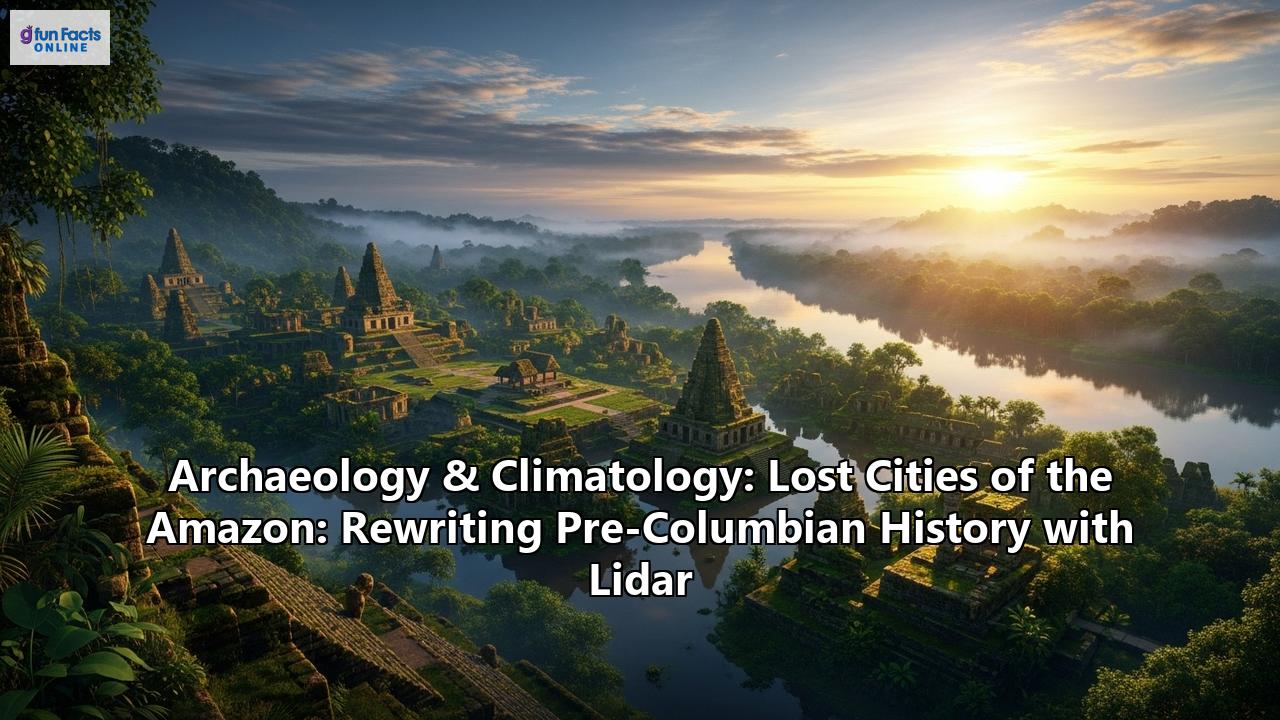
The Amazon's Twilight: How Lidar and Climatology are Unearthing Lost Cities and Rewriting Pre-Columbian History
For centuries, the Amazon rainforest was shrouded in a myth of pristine wilderness, an impenetrable jungle where complex societies could never have taken root. This narrative, long perpetuated by the sheer density of the forest that jealously guarded its secrets, has been shattered in recent years. A technological marvel, Lidar, has peeled back the verdant canopy, revealing a landscape profoundly shaped by human hands. In doing so, it has not only unearthed lost cities but has also forced a radical rewriting of pre-Columbian history, revealing a story of sophisticated urbanism, ingenious environmental management, and a delicate dance with a changing climate.
This is not a tale of a few scattered tribes, but of sprawling, interconnected urban centers that flourished for centuries, home to potentially millions of people. These discoveries, particularly in the Upano Valley of Ecuador and the Llanos de Mojos in Bolivia, are forcing us to reconsider our understanding of human history, sustainability, and the very nature of the Amazon itself.
Piercing the Green Veil: The Lidar Revolution
Traditional archaeology in the Amazon has always been a painstaking, almost impossible task. The dense vegetation, often dismissed as an obstacle, was, in fact, a shroud, concealing the very evidence that would overturn long-held beliefs. Archaeologists could spend entire careers hacking through the jungle, uncovering only tantalizing fragments of a much larger picture. For decades, the prevailing academic view, championed by figures like Betty J. Meggars, was that the Amazon's nutrient-poor soils and challenging environment could not have supported large, sedentary populations. This "environmental determinism" painted a picture of small, nomadic tribes living in a state of primitive harmony with nature.
Enter Lidar (Light Detection and Ranging), a remote sensing technology that has become the archaeologist's x-ray vision for landscapes. Mounted on aircraft or drones, Lidar systems fire millions of laser pulses per second towards the ground. By measuring the time it takes for these pulses to bounce back, it creates a detailed three-dimensional map of the terrain. Crucially, some laser pulses penetrate the forest canopy, reflecting off the ground below. Sophisticated software can then filter out the vegetation, digitally deforesting the landscape to reveal the subtle and sometimes monumental earthworks hidden beneath.
This technology has been a game-changer, allowing researchers to map vast areas with a speed and precision previously unimaginable. It has unveiled not just individual structures, but the very fabric of ancient societies: their cities, their road networks, their agricultural systems, and their ceremonial centers. The result has been a paradigm shift in Amazonian archaeology, moving from a focus on scattered artifacts to an understanding of entire urban landscapes.
The Vanished Cities of the Upano Valley
One of the most spectacular revelations has come from the Upano Valley in the eastern foothills of the Ecuadorian Andes. Here, a team led by archaeologist Stéphen Rostain, who has dedicated decades to studying the region, used Lidar to uncover a dense network of settlements that date back at least 2,500 years, making it the oldest and largest example of an agricultural civilization in the Amazon.
What the Lidar revealed was breathtaking: more than 6,000 rectangular earthen platforms, some measuring up to 150 meters long and 8 meters high. These were not random mounds; they were organized in distinct settlements, complete with plazas and streets. At least 15 distinct settlements, including five large ones, have been identified across a 300-square-kilometer area. The scale of this urbanism is staggering, with some of the larger centers drawing comparisons to the well-known Mayan cities of Central America.
Connecting these settlements was an extensive and sophisticated road network, stretching for tens of kilometers. These were not mere footpaths; some were wide, straight avenues, dug into the earth and featuring right-angled intersections, a clear indication of advanced planning and engineering. This interconnectedness suggests a high degree of social and political organization, linking a large and dispersed population.
The inhabitants of the Upano Valley were not just city builders; they were also master agriculturalists. The Lidar scans revealed extensive systems of hillside terraces and rectangular agricultural fields, drained by a complex network of canals. The fertile volcanic soil of the valley, enriched by the nearby Sangay volcano, was systematically managed to support a large population, estimated to have been in the tens of thousands, and possibly even higher. Excavations have unearthed pottery, grinding stones, and the remains of crops like maize, beans, and sweet potatoes, as well as evidence of the brewing of chicha, a traditional maize beer.
The society of the Upano Valley, identified with the Kilamope and Upano cultures, flourished from around 500 BCE to between 300 and 600 CE. The reasons for its decline remain a subject of investigation, with one prominent theory pointing to the eruptions of the Sangay volcano.
The Garden Cities of the Casarabe Culture
In another part of the Amazon, the Llanos de Mojos, a seasonally flooded savanna in Bolivia, Lidar has uncovered a different, yet equally impressive, form of ancient urbanism. Here, the Casarabe culture flourished between 500 and 1400 CE, building a landscape of "low-density urbanism."
Lidar surveys have revealed two remarkably large sites, Cotoca and Landívar, surrounded by a network of smaller settlements. These centers were characterized by monumental platform mounds and conical pyramids, some reaching over 20 meters in height, built atop artificial terraces. These structures were not just ceremonial; they were the heart of year-round communities of farmers, fishers, and hunters. The settlements were fortified with concentric polygonal banks and moats, and interconnected by straight, raised causeways that stretched for several kilometers.
What is particularly striking about the Casarabe culture is their mastery of water management. In a region with distinct wet and dry seasons, they engineered a massive infrastructure of canals and reservoirs. This allowed them to control flooding during the rainy season and to irrigate their crops during the dry season, ensuring a stable food supply. Recent research has shown they developed a sophisticated dual water management system that enabled them to cultivate maize year-round, a feat that challenges previous assumptions about the limits of agriculture in the Amazon. This intensive agriculture likely supported a large and stratified society. The very layout of their settlements, with a clear hierarchy of sites, suggests a complex political organization that could be described as an early state-level society.
The decline of the Casarabe culture around 1400 CE, before the arrival of Europeans, remains an enigma, with some researchers speculating that a prolonged drought and the failure of their water management systems, due to climate change, may have played a significant role.
From Pristine Wilderness to a Human-Shaped Landscape
The discoveries in the Upano Valley and the Llanos de Mojos are the most dramatic evidence yet against the long-held myth of the Amazon as a "pristine wilderness." This idea, which took hold after the catastrophic decline of indigenous populations following European contact, has been systematically dismantled by decades of archaeological and ecological research, a process now dramatically accelerated by Lidar.
Early European accounts, such as those of the Spanish conquistador Francisco de Orellana, who in 1541 became the first European to navigate the length of the Amazon River, spoke of "large cities, glistening in white" and a densely populated landscape. For centuries, these accounts were dismissed as exaggerations, the fantasies of explorers seeking to impress their royal patrons. However, the recent archaeological findings are forcing a reassessment of these historical chronicles, suggesting they may have been more accurate than previously believed.
The evidence for a human-shaped Amazon extends beyond urban centers. The very composition of the rainforest bears the imprint of its former inhabitants. Studies have shown that forests around archaeological sites have a higher concentration of domesticated and useful plant species, such as Brazil nuts and cacao trees. This suggests that pre-Columbian peoples actively managed the forest, creating a kind of "garden city" that integrated agriculture with the natural environment. They practiced a form of agroforestry, cultivating a diverse range of crops while keeping the forest standing.
Masters of the Earth: Terra Preta and Raised Fields
Perhaps the most compelling evidence of the ingenuity of ancient Amazonians is their creation of terra preta, or "black earth." The soils of the Amazon are typically nutrient-poor and acidic, making sustained agriculture difficult. To overcome this, pre-Columbian peoples developed a remarkable soil enrichment technique. By adding a mixture of charcoal, pottery shards, animal bones, and organic waste to the soil, they created a highly fertile, self-regenerating soil that remains productive for thousands of years.
Terra preta was not an accidental byproduct of settlement; it was a deliberate and sophisticated form of environmental engineering. It allowed for permanent, intensive agriculture, supporting large, sedentary populations. The creation of these soils also had an unintended but significant consequence: carbon sequestration. The charcoal in terra preta is highly stable, locking carbon in the soil for centuries, a process that offers valuable lessons for modern efforts to mitigate climate change.In addition to terra preta, ancient Amazonians also developed other advanced agricultural techniques, such as the construction of raised fields in seasonally flooded areas. These elevated platforms allowed for drainage during the wet season and retained moisture during the dry season, turning otherwise unproductive wetlands into fertile croplands.
Climatology and the Rise and Fall of Amazonian Civilizations
The story of the lost cities of the Amazon is not just one of archaeological discovery; it is also a story of the intricate relationship between human societies and their environment, a story where climatology plays a crucial role. The rise of complex societies in the Amazon was not a random occurrence; it was likely facilitated by favorable climatic conditions during the Holocene, the geological epoch that began around 11,700 years ago. More stable and wetter climates in certain periods would have supported the development of agriculture and allowed populations to grow.
Conversely, climate change is emerging as a key suspect in the decline of some of these civilizations, even before the arrival of Europeans. Research suggests that shifts in rainfall patterns and prolonged droughts could have stressed the sophisticated agricultural and water management systems upon which societies like the Casarabe depended. For societies that had become highly adapted to a specific set of environmental conditions, even relatively small climatic shifts could have had devastating consequences.
The study of fossil pollen and charcoal records has revealed that some areas of the Amazon experienced a decline in human activity and reforestation starting around 1200 CE, several centuries before the arrival of Columbus. This suggests that pre-Columbian pandemics or social strife, possibly exacerbated by environmental pressures, may have already been causing population declines.
The Great Dying and the Creation of a Myth
While climate change may have played a role in the pre-Columbian decline of some societies, the catastrophic collapse of Amazonian populations came with the arrival of Europeans in the 16th century. Diseases like smallpox and measles, to which the indigenous peoples had no immunity, swept through the continent, wiping out an estimated 90% of the population.
This "Great Dying" was a demographic catastrophe of unimaginable proportions. The great cities and towns described by Orellana were abandoned, their populations decimated. The carefully managed landscapes were reclaimed by the jungle, and within a few generations, the memory of these once-thriving civilizations faded, giving rise to the myth of a pristine and untouched wilderness.
Rewriting History, Reimagining the Future
The rediscovery of the lost cities of the Amazon is more than just a fascinating archaeological puzzle; it has profound implications for our understanding of the past, present, and future. It challenges the Eurocentric view of history that has long dominated our thinking, demonstrating that complex, urban societies were not confined to the Old World or the highlands of the Americas.
The ingenuity of these ancient civilizations, their ability to create sustainable, large-scale societies in a challenging environment, offers valuable lessons for the present. Their sophisticated agroforestry systems, their creation of terra preta, and their mastery of water management demonstrate a deep understanding of ecological principles that we are only now beginning to appreciate. In an era of climate change and environmental degradation, the sustainable land management practices of pre-Columbian Amazonians offer a powerful model for a more harmonious relationship with our planet.
The story of the lost cities of the Amazon is still being written. Lidar continues to peel back the layers of the jungle, revealing more and more of this hidden world. Each new discovery adds another piece to the puzzle, bringing into sharper focus the incredible achievements of these ancient civilizations and the profound impact they had on the world's largest rainforest. The Amazon is not a wilderness untouched by humanity; it is a landscape shaped by a long and complex history, a history that is finally, and spectacularly, coming to light.
Reference:
- https://news.mongabay.com/2005/10/pre-columbian-amazon-supported-millions-of-people/
- https://www.eco-business.com/news/ancient-amazonian-societies-managed-the-forest-intensively-but-sustainably-heres-what-we-can-learn-from-them/
- https://www.youtube.com/watch?v=VaXrX0veR9Y
- https://archaeologymag.com/2024/01/laser-scans-reveal-ancient-cities-hidden-deep-in-the-amazon-rainforest/
- https://www.sciencedaily.com/releases/2018/07/180723142845.htm
- https://www.cgiar.org/news-events/news/ancient-amazon-farming-methods-offer-lessons-rainforest-conservation-scientists-say/
- https://en.wikipedia.org/wiki/Upano_Valley_sites
- https://www.researchgate.net/publication/360764209_Monumentality_and_Social_Complexity_in_the_Upano_Valley_Upper_Amazon_of_Ecuador
- https://www.youtube.com/watch?v=7og1rUG0Xj4
- https://www.siliconrepublic.com/innovation/aceint-amazon-river-basin-amazonian-practices-dark-earth-soil-carbon-sequestration
- https://learningenglish.voanews.com/a/from-ancient-farmers-lessons-for-todays-amazon-147746985/609075.html
- https://www.researchgate.net/publication/354899307_Monumentality_and_Social_Complexity_in_the_Upano_Valley_Upper_Amazon_of_Ecuador
- https://www.sciencedaily.com/releases/2021/05/210524110207.htm
- https://ensia.com/features/ancient-amazonian-societies-managed-the-forest-intensively-but-sustainably-heres-what-we-can-learn-from-them/
- https://mymodernmet.com/lidar-cities-amazon/
- https://news.mit.edu/2023/ancient-amazonians-intentionally-created-fertile-dark-earth-0920
- https://en.wikipedia.org/wiki/Pre-Columbian_agriculture_in_the_Amazon_Basin
- https://www.youtube.com/watch?v=iOJ8BjbiPdE
- https://www.researchgate.net/publication/229922996_The_Development_of_Prehistoric_Complex_Societies_Amazonia_A_Tropical_Forest
- https://www.humansforabundance.com/post/healing-the-amazon-through-ancestral-farming-traditions
- https://www.youtube.com/watch?v=eyNpnDmQSDA
- https://brewminate.com/francisco-de-orellanas-exploration-of-the-amazon-in-the-16th-century/
- https://en.wikipedia.org/wiki/Francisco_de_Orellana
- https://news.mongabay.com/2008/08/pre-colombian-amazonians-lived-in-sustainable-urban-society/
- https://www.britannica.com/biography/Francisco-de-Orellana
- https://www.pbs.org/video/ancient-builders-of-the-amazon-cs7env/
- https://bibliotekanauki.pl/articles/55994905.pdf
- https://www.researchgate.net/publication/274250402_Paleoclimates_of_Amazonia_An_Ice-Age_view
- https://www.youtube.com/watch?v=kop8Oj_i6eY
- https://thinklandscape.globallandscapesforum.org/28736/ancient-amazon-farming-methods-offer-lessons-for-rainforest-conservation-scientists-say/
- https://www.youtube.com/watch?v=Tq5drH5c19g
- https://www.psu.edu/news/research/story/human-settlements-amazonia-much-older-previously-thought
- https://sites.santafe.edu/~bowles/Holocene.pdf
- https://www.youtube.com/watch?v=dY82nZTxXQ4