
A Horrifying Affliction: The Reign of the New World Screwworm
Before a groundbreaking solution fell from the sky, a sinister predator plagued the Americas, leaving a trail of death and economic ruin in its wake. This was no lion or wolf, but an insect—a metallic blue fly known as Cochliomyia hominivorax, the New World screwworm. The name, derived from its larvae's gruesome feeding habit of screwing into the flesh of living animals, only hints at the horror it inflicted.
Unlike many flies that are content with feasting on decaying matter, the New World screwworm is an obligate parasite, meaning its larvae require living tissue to survive. This gruesome preference makes it a particularly devastating pest. A female screwworm fly, with its distinctive orange eyes and a dark metallic-blue body marked by three dark stripes on its back, is drawn to any open wound on a warm-blooded animal. This could be a minor scratch from a barbed-wire fence, a tick bite, the navel of a newborn calf, or wounds from dehorning and castration.
Upon finding a suitable host, the female lays a batch of 100 to 400 eggs on the edge of the wound. Within a mere 12 to 24 hours, these eggs hatch into tiny larvae. These maggots, armed with sharp mouth hooks, immediately begin to burrow into the healthy flesh of the host, tearing and feeding as they go. This burrowing action, which gives the screwworm its name, deepens and widens the wound, creating a larger, more attractive site for other gravid female flies to lay their eggs.
An untreated infestation, known as myiasis, is a horrific and painful ordeal for the animal. The wound emits a foul odor of decay, and the constant feeding of the larvae causes immense stress, loss of appetite, and eventually, death. In severe cases, the host can be eaten alive from the inside out within a week or two. This gruesome life cycle, from egg to mature larva, takes about five to seven days, after which the larvae drop to the ground, burrow into the soil, and pupate. About a week later, they emerge as adult flies, ready to repeat the cycle. A single female fly can lay up to 3,000 eggs in her lifetime and travel as far as 120 miles.
The economic impact of the screwworm was staggering. In the early to mid-20th century, the livestock industry in the southern United States and beyond was in a constant state of siege. By the 1950s, the financial toll on livestock ranchers was estimated to be around $200 million annually, which translates to approximately $1.8 billion in today's currency. In Texas alone, a 1935 outbreak was responsible for the death of an estimated 180,000 cattle. The costs were not just from livestock deaths but also from decreased productivity in meat and milk, and the immense labor and resources poured into prevention and treatment. Ranch hands and farmers spent their days "doctoring wormies," a grim and labor-intensive task of inspecting animals for wounds, physically removing the maggots with sticks or fingers, and applying foul-smelling chemical pastes like "Smear 62" in a desperate attempt to save their animals.
This menace wasn't confined to livestock; it affected wildlife, pets, and even humans, though human cases were rarer. The first recorded case of screwworm was, in fact, from a human sample collected on Devil's Island in 1858. In areas where the fly was endemic, even a minor cut could become a life-threatening infestation.
Initially, scientists and ranchers struggled to understand the pest. For a time, it was believed that the screwworm fly was the same as the common blowfly. It wasn't until 1933 that entomologists Emory C. Cushing and Walter S. Patton identified Cochliomyia hominivorax as a distinct species that exclusively targets living tissue. This discovery was a crucial first step, as it highlighted the unique nature of the threat and paved the way for a revolutionary new approach to pest control—one that would eventually bring salvation from the skies.
A Spark of Genius: The Birth of the Sterile Insect Technique
The battle against the screwworm was long, arduous, and for many years, seemingly hopeless. The chemical treatments and manual removal of larvae were mere stopgaps, treating the symptoms of a plague that felt unstoppable. But in the 1930s, a visionary entomologist at the U.S. Department of Agriculture (USDA), Edward F. Knipling, began to ponder a radically different approach. His idea, born from a deep understanding of the screwworm's own biology, was as elegant as it was audacious: what if you could turn the fly's own reproductive drive against itself?
Knipling's concept, which would come to be known as the Sterile Insect Technique (SIT), was rooted in a key observation about the screwworm's mating habits. Through careful study, it was discovered that the female screwworm fly mates only once in her lifetime. Knipling reasoned that if a massive number of sterile male flies could be released into the wild, they would compete with the fertile wild males to mate with the virgin females. If the sterile males could outnumber their wild counterparts, a significant portion of the females would lay infertile eggs, leading to a sharp decline in the next generation. A sustained release of these sterile males could, in theory, drive the entire population to extinction.
At the time, this idea was met with skepticism. Knipling's superiors at the USDA's Bureau of Entomology and Plant Quarantine initially dismissed it as impractical. However, Knipling's conviction was unshakeable, and he found a crucial ally in fellow entomologist Raymond C. Bushland. Together, they began to tackle the immense practical challenges of turning this revolutionary concept into a reality.
The first major hurdle was figuring out how to rear millions of screwworm flies in a laboratory. The only known way to produce screwworms was on live animals, a practice that was both inhumane and prohibitively expensive for mass production. Working at the USDA's research laboratory in Menard, Texas, Bushland dedicated himself to this problem and, in 1936, achieved a critical breakthrough. He developed an artificial diet—a grotesque but effective slurry of ground meat, beef blood, water, and a touch of preservative like formalin—that could sustain the larvae. This invention was a game-changer, making it possible to produce the vast numbers of flies needed for research and, eventually, for a full-scale eradication program.
The next, and perhaps most critical, challenge was finding a way to sterilize the millions of male flies without killing them or diminishing their ability to compete and mate. Bushland initially experimented with chemicals to induce sterility, but with little success. The solution came from an unlikely source: the dawn of the atomic age. In 1950, Knipling was made aware of an article by Nobel laureate H. J. Muller, who had demonstrated that fruit flies could be sterilized by exposing them to high doses of X-rays.
Intrigued, Bushland secured access to an X-ray machine at a military hospital in San Antonio. Through meticulous experimentation, he discovered that exposing screwworm pupae to a specific dose of X-rays—and later, the more efficient gamma rays from Cobalt-60—rendered the emerging adult flies sterile but otherwise healthy, vigorous, and sexually aggressive. The pieces of the puzzle were finally falling into place.
With the ability to mass-rear and sterilize the flies, Knipling and Bushland were ready to put their theory to the test. Their first field trials took place between 1951 and 1953 on Sanibel Island, off the coast of Florida. The results were promising, successfully eradicating the local screwworm population, though the island was quickly re-infested by flies migrating from the mainland. This highlighted the need for a more isolated testing ground.
The perfect opportunity arose in 1954 on the Caribbean island of Curaçao. Located about 40 kilometers off the coast of Venezuela, the island was sufficiently isolated to prevent re-infestation, had a significant livestock population suffering from screwworm, and was small enough for a controlled experiment. With the cooperation of the Dutch government, the USDA launched the first full-scale SIT eradication program. Flies were mass-reared in Florida, sterilized, and flown to Curaçao, where they were released from the air at a rate of 400 sterile males per square mile per week.
The results were spectacular and exceeded all expectations. Within just a few months—or about three generations of the fly—the screwworm population on Curaçao was completely wiped out. The last sterile egg mass was found just ten weeks after the program began. The "fanciful" idea had been proven, not just in theory, but in practice. This resounding success on a small island set the stage for a much larger and more ambitious war against the screwworm, starting in the southeastern United States. The era of airdropping salvation had begun.
The War from the Skies: Eradication in the U.S. and Beyond
The stunning success on Curaçao provided the proof of concept needed to launch a full-scale assault on the New World screwworm in its primary U.S. stronghold: the Southeast. Ranchers and livestock producers, who had borne the brunt of the parasite's devastation for decades, became the fiercest advocates for the program. Their lobbying efforts were instrumental in securing the necessary funding and support from state legislatures and the U.S. Congress.
In 1958, the USDA officially adopted the Sterile Insect Technique for a massive eradication campaign in Florida. A dedicated "fly factory" was established in Sebring, Florida, with the capacity to produce and sterilize an astonishing 50 million flies per week. The timing of the campaign was fortuitous. A particularly severe winter in 1957-1958 had decimated the screwworm population, pushing its overwintering boundary south to a line between Tampa and Vero Beach. This natural die-off significantly reduced the number of wild flies the sterile males had to compete with, giving the program a crucial head start.
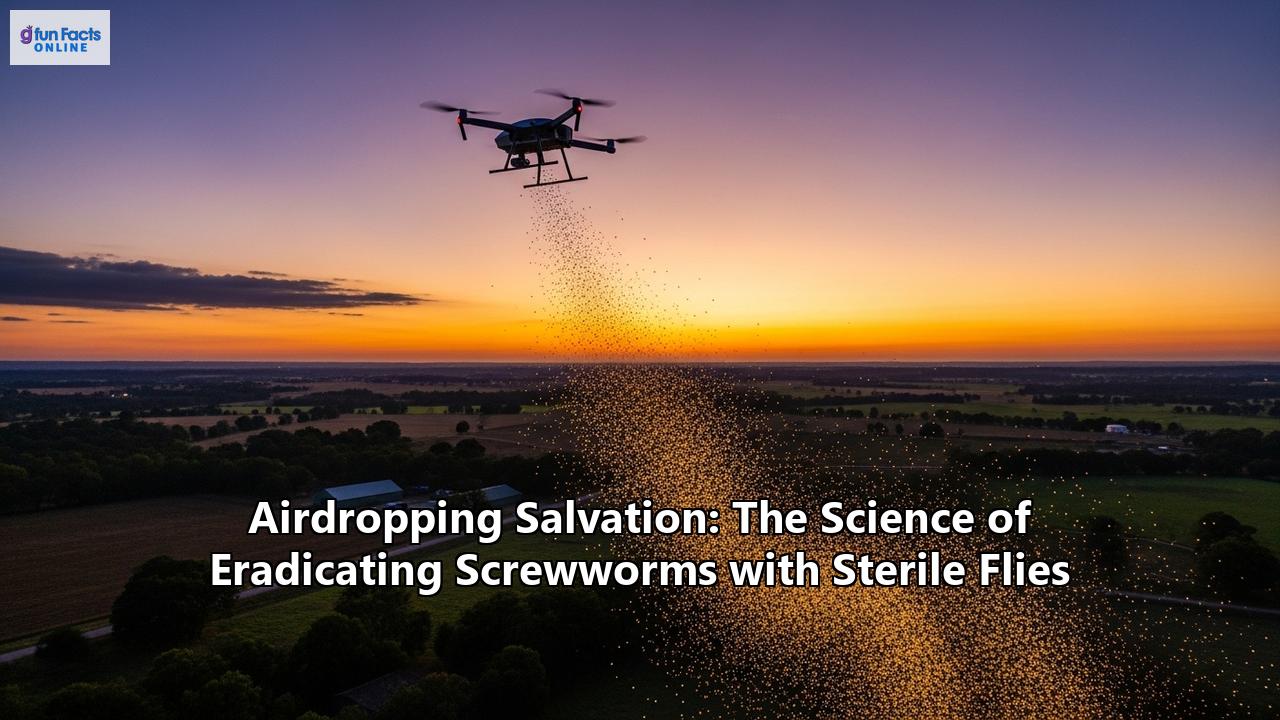
The logistics were unprecedented. Small planes, flying in precise grid patterns, became a common sight in the skies over Florida and neighboring states. They released specially designed cardboard boxes, each containing hundreds of sterilized pupae, which would emerge as adult flies ready to mate. The program was a model of public-private partnership. Ranchers played a vital role, not only by supporting the program financially but also by diligently inspecting their herds, treating any remaining wounds, and collecting larvae samples to be sent to USDA labs for monitoring. This ground-level effort was essential to suppress the larval population and increase the ratio of sterile to wild flies, a key factor in the program's success.
The campaign was a resounding success. By 1959, just over a year after it began, the screwworm was declared eradicated from the southeastern United States. This victory paved the way for an even bigger challenge: tackling the vast, semi-arid landscapes of the Southwest. In 1962, the program was launched in Texas and New Mexico. Given the scale of the region, the production of sterile flies was ramped up even further. By 1966, the screwworm was officially eradicated from the entire United States, a monumental achievement in the history of pest control. The annual benefit to American livestock producers was estimated at over $1 billion in today's dollars.
However, the architects of the program understood that the U.S. could never be truly safe as long as the fly thrived just across the border. The constant threat of re-infestation from Mexico, carried by migrating animals or the flies themselves, necessitated a more audacious goal: pushing the screwworm south, out of Mexico and all of Central America.
In 1972, the U.S. and Mexican governments formed the Mexico-USA Screwworm Eradication Commission, a binational effort to eliminate the pest from Mexico. A massive new fly production plant was built in Tuxtla Gutierrez, in the southern Mexican state of Chiapas. This state-of-the-art facility, which began operations in 1976, eventually had the capacity to produce an incredible 500 million sterile flies per week.
The campaign in Mexico was a long, slow, and methodical battle fought across diverse and often difficult terrain. It required a fleet of up to 60 aircraft flying daily dispersal missions. Scientists continuously refined their techniques, introducing new fly strains and a supplementary method called the Screwworm Adult Suppression System (SWASS), which used pellets containing attractants and insecticides to further reduce the wild fly population.
Slowly but surely, the barrier of sterile flies was pushed southward. By 1982, northern Mexico was cleared, and by 1991, the screwworm was officially eradicated from the entire country. But the mission didn't stop there. The ultimate goal was to establish a permanent biological barrier at the narrowest point of the isthmus, the Darién Gap, a dense, roadless jungle separating Panama and Colombia.
Throughout the 1990s, the program marched relentlessly south, a wave of sterile flies washing over Central America. Guatemala and Belize were cleared by 1994, El Salvador by 1995, Honduras by 1996, Nicaragua by 1999, and Costa Rica by 2000. Finally, the program reached Panama, where a permanent fly production facility was established to maintain the barrier. This facility continuously produces and releases sterile flies in a buffer zone to prevent the northward migration of screwworms from their remaining habitats in South America.
This decades-long, international effort stands as one of the most successful examples of area-wide pest management in history, a testament to scientific ingenuity and cross-border cooperation.
A Global Threat and a Swift Response: The Libyan Outbreak
For decades, the New World screwworm was a uniquely American problem. The pest was native to the Western Hemisphere, and it was widely believed that the vast expanse of the Atlantic Ocean was an insurmountable barrier. That sense of security was shattered in 1988 when the unthinkable happened. The screwworm was discovered in Libya, marking its first-ever appearance in the Eastern Hemisphere.
The discovery sent shockwaves through the international agricultural and public health communities. The fly was found to have established a foothold in a 25,000-square-kilometer area, threatening over 2.7 million domestic animals. The arid, warm climate of North Africa was frighteningly suitable for the pest, and there were grave fears that it could spread uncontrollably across Africa, into the Middle East, and up through the Mediterranean basin, causing an agricultural and ecological catastrophe of unimaginable proportions.
An investigation traced the source of the outbreak to a quarantine station near Tripoli, where sheep imported from South America were held. The infestation spread rapidly. The local livestock—and the veterinarians who cared for them—had no experience with this gruesome parasite. Classical control methods, such as wound treatment and insecticides, proved incapable of halting the advance of this new, aggressive invader.
Recognizing the extreme gravity of the situation, the international community mounted an unprecedented emergency response. The Food and Agriculture Organization (FAO) of the United Nations took the lead, coordinating a multi-national effort to contain and eradicate the outbreak. It was quickly decided that the only hope for success was to deploy the one weapon that had been proven to work: the Sterile Insect Technique.
However, this presented a monumental logistical challenge. The world's only screwworm mass-rearing facility was thousands of miles away in Tuxtla Gutierrez, Mexico. An audacious plan was hatched: an intercontinental airlift of sterile flies.
Scientists in Mexico and the U.S. worked feverishly to ensure the plan was viable. They had to confirm that the sterile flies produced in Mexico would be able to successfully mate with the wild Libyan population. They also had to devise methods for packing and shipping millions of flies on long-haul flights without compromising their health or effectiveness. The timing was critical. The pupae had to be irradiated, packed into special dispersal boxes, and flown to Libya to be released within a tight 58-hour window to ensure they would emerge as healthy, sexually aggressive adults.
The operation was a masterpiece of international cooperation and logistical precision. Sterile flies from the Mexican plant were airlifted to Libya, a journey across an ocean, to fight a war on a new continent. Starting in 1990, an aerial campaign began, dispersing approximately 1.3 billion sterile flies over the infested territory and a surrounding protective buffer zone.
Just as in the Americas, the program in Libya combined the high-tech air war with a crucial ground campaign. Veterinary services were mobilized to conduct intensive surveillance, treat infested animals, and control livestock movement to prevent the pest from spreading.
The results were swift and decisive. Within months of the sterile fly releases beginning, the wild screwworm population began to crash. From July 1989 to the official end of the campaign, a total of 14,111 cases of screwworm infestation were recorded. By April 1991, the battle was won. Africa and the entire Eastern Hemisphere were declared free of the New World screwworm.
The Libyan eradication program, which cost nearly $100 million, is hailed as one of the most effective and successful international animal health campaigns in history. It demonstrated not only the remarkable power of the Sterile Insect Technique but also the world's capacity to unite and act decisively in the face of a common biological threat. The crisis served as a stark reminder of the globalized nature of pest and disease risk, while its successful resolution provided a powerful blueprint for future international responses.
The Science of Salvation: Inside a Fly Factory
The success of the screwworm eradication campaigns hinges on a complex and highly specialized industrial process: the mass production and sterilization of billions of flies. These "fly factories," like the one operating in Panama to maintain the barrier zone, are marvels of biological engineering, combining entomological science with assembly-line precision.
The process begins with a carefully managed colony of flies. This is not just a random swarm; it's a genetically selected strain, continuously monitored and improved to ensure the males are vigorous, competitive, and well-suited for survival and mating in the wild.
Mass Rearing: The life cycle is meticulously controlled. Adult flies are kept in large cages where they lay their eggs on a special medium. These eggs are collected and placed in large vats filled with the artificial larval diet—the nutrient-rich slurry of ground meat, blood, and other components first developed by Raymond Bushland. The temperature and humidity in these rearing rooms are kept at optimal levels to encourage rapid growth. For about five to seven days, the larvae feast on this mixture, growing to their full size. Pupation and Sterilization: Once the larvae are mature, they are separated from the feeding medium. They naturally seek a dry place to pupate, a process that is facilitated within the factory. The pupal stage is the most critical phase for the Sterile Insect Technique. During this time, the pupae are carefully collected and prepared for sterilization.The sterilization itself is achieved through irradiation. The pupae are loaded onto a conveyor system that passes them through a chamber containing a source of ionizing radiation, typically Cesium-137. They are exposed to a precise dose of gamma rays—enough to render the reproductive cells of the future flies sterile, but not so much that it harms their overall health, longevity, or mating instincts. This delicate balance is the scientific cornerstone of the entire technique.
Packaging and Dispersal: After sterilization, the pupae are packaged for their final mission. They are carefully measured out and placed into small cardboard boxes, each designed with openings that allow the adult flies to escape after they emerge. These boxes are chilled to keep the pupae dormant and prevent them from emerging prematurely during transport.The boxes are then loaded onto small aircraft. Flying at low altitudes in precise, pre-determined grid patterns, the crew drops the boxes over the target landscape. As the boxes fall, they warm up, and by the time they reach the ground, the pupae are beginning to emerge as adult flies. Millions of these sterile flies are released each week, creating an overwhelming "overflooding ratio" where sterile males vastly outnumber their wild, fertile rivals.
This continuous, large-scale industrial process—from egg to airdrop—is what makes the eradication and barrier maintenance possible. It is a testament to decades of research and refinement, transforming a horrifying pest problem into a manageable, albeit complex, logistical operation.
A Tenuous Peace: The Ongoing Battle and Future Threats
The eradication of the screwworm from North and Central America is a monumental achievement, but it is not a final victory. It is a hard-won peace that requires constant vigilance and a permanent, costly defense. The biological barrier maintained at the Darién Gap in Panama is the front line in a perpetual war against re-infestation from South America, where the fly remains endemic.
This barrier is not a physical wall but a continuously reinforced zone of sterile flies. The production plant in Panama, a joint effort between the U.S. and Panama under the Commission for the Eradication and Prevention of Screwworm (COPEG), releases tens of millions of sterile flies every week to ensure that any wild screwworm flies that venture north from Colombia are unable to reproduce.
Despite these efforts, the threat is ever-present. In late 2016, a small but alarming outbreak occurred in the Florida Keys, likely introduced via an infested animal. The response was swift and decisive, deploying the same SIT methods that had worked decades before. The outbreak was successfully eliminated in 2017, but it served as a stark reminder of the vulnerability of even eradicated zones.
More recently, the threat has intensified. In 2024 and 2025, a resurgence of the pest in parts of Central America and southern Mexico, north of the established barrier, has caused significant alarm. These outbreaks have prompted emergency measures, including the temporary suspension of livestock imports from Mexico into the United States, to prevent the pest from crossing the border.
The re-emergence highlights the immense challenges of maintaining the barrier and the potential for the pest to bypass it. The exact causes of these recent outbreaks are under investigation, but they underscore the need for enhanced surveillance and a robust rapid-response capability. The cost of complacency is enormous. A USDA analysis estimated that a renewed, widespread infestation in the U.S. could have an economic impact of over $1.9 billion annually in Texas alone.
In response to this heightened risk, there are renewed calls to bolster the defenses. This includes proposals to build new, modern fly production facilities, potentially even reopening old sites in Texas to serve as distribution centers. The estimated cost of a new production plant ranges from $300 to $600 million, a significant investment but one that pales in comparison to the potential economic devastation of a full-scale return of the screwworm.
The story of the screwworm is a powerful saga of science, salvation, and the enduring struggle between humanity and the natural world. It is a tale of a horrific pest that brought an entire industry to its knees and the brilliant, innovative minds that devised a way to fight back. The Sterile Insect Technique, born from the fight against the screwworm, has since been adapted to control other insect pests around the globe, from fruit flies to tsetse flies, protecting crops and public health.
The ongoing battle at the Darién Gap and the recent outbreaks serve as a crucial lesson: eradication is not an endpoint but a continuous process. The salvation that falls from the sky, in the form of billions of sterile flies, is a shield that must be perpetually maintained. The fight against the New World screwworm is a marathon, not a sprint, a commitment to vigilance to ensure this gruesome chapter of agricultural history is never repeated.
Reference:
- https://www.aphis.usda.gov/livestock-poultry-disease/cattle/ticks/screwworm
- https://agrilifeextension.tamu.edu/new-world-screwworm/
- https://en.wikipedia.org/wiki/Cochliomyia_hominivorax
- https://www.woah.org/en/disease/new-world-screwworm-cochliomyia-hominivorax/
- https://capcvet.org/guidelines/cochliomyia-hominivorax/
- https://livestockvetento.tamu.edu/insectspests/screwworm-fly/
- https://sentientmedia.org/screwworm-outbreak-halt-livestock-imports-from-mexico/
- https://openknowledge.fao.org/server/api/core/bitstreams/322ae7fa-1a6b-4c18-ae62-4f5e0c2a2c83/content
- https://rr-americas.woah.org/en/news/frequently-asked-questions-about-new-world-screwworm/
- https://integrativebio.utexas.edu/news/features/history-ut-entomology-part-4-screwworms
- https://www.drovers.com/news/industry/new-world-screwworm-billion-dollar-battle-southern-bordernbsp
- https://www.fao.org/4/ah499e/ah499e.pdf
- https://www.agproud.com/articles/61428-the-historical-impact-of-new-world-screwworm-outbreaks-in-us
- https://www.pitchstonewaters.com/screwworm-eradication-program-and-history/
- https://www.fao.org/4/t8600t/t8600T0j.htm
- https://www.nal.usda.gov/exhibits/speccoll/exhibits/show/stop-screwworms--selections-fr/1930s
- https://livestockvetento.tamu.edu/files/2010/10/ColumnPoster2SWB.fnl2_.pdf
- [https://bioone.org/journals/florida-entomologist/volume-85/issue-4/0015-4040_2002_085_0666_APAODT_2.0.CO_2/A-PERSONAL-ACCOUNT-OF-DEVELOPING-THE-STERILE-INSECT-TECHNIQUE-TO/10.1653/0015-4040(2002)085[0666:APAODT]2.0.CO;2.full](https://bioone.org/journals/florida-entomologist/volume-85/issue-4/0015-4040_2002_085_0666_APAODT_2.0.CO_2/A-PERSONAL-ACCOUNT-OF-DEVELOPING-THE-STERILE-INSECT-TECHNIQUE-TO/10.1653/0015-4040(2002)085[0666:APAODT]2.0.CO;2.full)
- https://www.iaea.org/sites/default/files/21/07/nafa-ipc-technical-report-screwworm-eradication-africa-1992.pdf
- https://www.nal.usda.gov/exhibits/speccoll/exhibits/show/stop-screwworms--selections-fr/introduction
- https://pubmed.ncbi.nlm.nih.gov/15376361/
- https://www.fb.org/market-intel/new-world-screwworm-moves-beyond-containment-threshold