
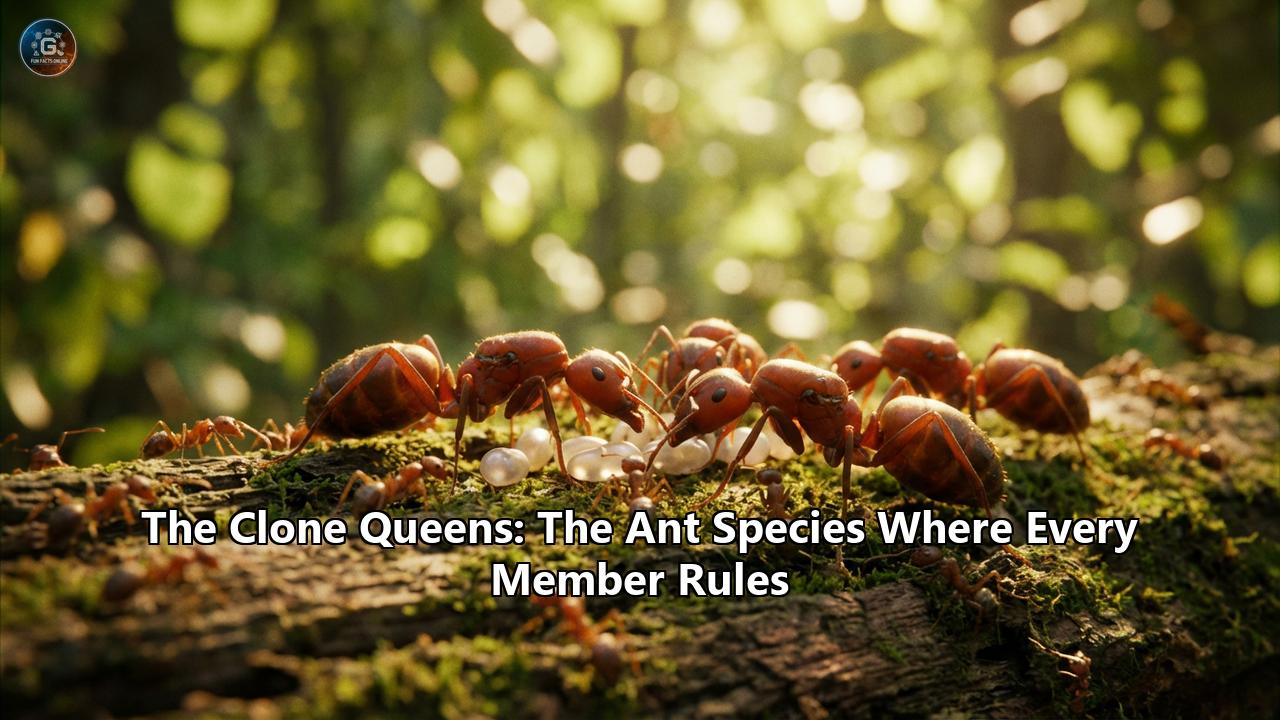
kinomurai offspring have already matured into a new generation of clone queens, ready to disperse into the forest and repeat the cycle of usurpation.
Proving the Impossible in the Laboratory
In the meticulous world of science, extraordinary biological claims require extraordinary evidence. How do researchers definitively prove a negative—that a species has absolutely zero workers and zero males across its entire population?
Between 2022 and 2024, the research team embarked on a painstaking quest to collect live specimens. Finding these ants is incredibly difficult, as they are known to exist in only nine highly specific geographic pockets in Japan. After exhaustive fieldwork, the team successfully harvested six mixed colonies from the wild containing the parasitic queens and their enslaved hosts.
These colonies were transported to a controlled laboratory environment and housed in artificial nest boxes designed to mimic their natural acorn habitats. The scientists eagerly monitored the development of the brood. Over the observation period, the captive colonies successfully reared a total of 43 offspring. As each pupa developed into an adult, the scientists inspected them under microscopes, specifically looking for male morphology or worker traits. The results were unequivocal: zero males, zero workers. All 43 offspring were female clone queens.
To further validate the ant's parasitic lifecycle, the researchers conducted real-time invasion experiments. They introduced the newly reared clone queens to uninfected T. makora colonies in the lab. The team watched as the invaders successfully orchestrated seven takeovers, assassinating the host queens and hijacking the labor force. Following these controlled usurpations, the captive clone queens produced another massive batch of 57 all-female offspring. This multi-generational laboratory observation provided the definitive, irrefutable proof required: Temnothorax kinomurai is a truly male-less, worker-less species.
The Evolutionary Logic of a Queen-Only World
Nature does not discard essential traits without profound selective pressure. Why would an ant species abandon the worker caste, which is the very engine of eusocial dominance? And why abandon males, the critical vectors of genetic diversity?
Dr. Jürgen Heinze and his colleagues propose that this bizarre societal structure is the ultimate, logical endpoint of extreme social parasitism. Nest usurpation is a game of incredibly high stakes. An invading queen faces immense danger when entering a foreign colony; the vast majority of infiltration attempts fail, resulting in the invader being swarmed and killed by defensive host workers. Because the survival and success rate of founding a new colony is vanishingly low, a successful parasitic queen cannot afford biological waste.
In a standard ant colony, massive amounts of metabolic energy are poured into rearing thousands of sterile workers. But for T. kinomurai, the host species provides the entire workforce. Producing its own workers would be a redundant and inefficient use of precious resources. Every calorie consumed by the clone queen must be directed toward producing individuals capable of continuing the lineage.
Furthermore, if the parasite produced males, those males would face a statistical impossibility. A male would have to fly out of the hijacked nest, navigate the dense forest, and somehow locate another incredibly rare T. kinomurai queen in a different host nest to mate. By discarding sexual reproduction and relying solely on thelytokous parthenogenesis, a single successful clone queen guarantees that 100% of her genetic material is passed on. She can exponentially multiply her reproductive output without the energetic costs or logistical nightmares of mating. This all-queen strategy maximizes the potential for colony foundation, allowing a highly vulnerable species to cling to existence.
Tracing the Bloodline: From Slavers to Cloners
Tracing the evolutionary family tree of T. kinomurai reveals another fascinating narrative twist. In the study of myrmecology, a principle known as "Emery's Rule" dictates that social parasites are frequently closely related to the host species they exploit. It is a biological irony where a species effectively parasitizes its own evolutionary cousins. Initially, one might assume that T. kinomurai is simply a rogue, mutated lineage of its host, T. makora.
However, modern DNA sequencing tells a different and much darker evolutionary story. Preliminary phylogenetic analysis indicates that the clone queens did not evolve directly from their current host. Instead, their closest genetic relative is Temnothorax bikara, another incredibly rare ant species that practices dulosis—the taking of slaves. T. bikara operates by raiding the nests of Temnothorax spinosior (a sibling species of makora), stealing their pupae, and hatching them to serve as slave laborers.
This genetic link suggests a dramatic evolutionary journey spanning millions of years. The ancestor of the clone queens was likely a slave-making ant that still produced its own worker caste to conduct violent raids. However, as this ancestral species became increasingly reliant on the labor of its stolen slaves, its own worker caste became obsolete. Slowly, over countless generations, the workers were phased out of the genome. The species transitioned from an active slave-maker that conducted external raids to a localized, permanent inquiline parasite. In the final stage of its evolutionary metamorphosis, it shed males and sexual reproduction entirely. As Heinze noted, T. kinomurai represents what may be considered the "final step in the evolution of social parasitism," highlighting the boundless flexibility in the life histories of social insects.
The Rule-Breakers of the Ant World
To truly appreciate the uniqueness of the "Clone Queens," it is helpful to contrast them with other famous rule-breakers in the insect world. For instance, the widely studied Clonal Raider Ant (Ooceraea biroi) is also famous for reproducing entirely through cloning without the need for males. However, in Ooceraea biroi, it is the queen caste that has been completely lost. The entire colony consists of morphologically similar workers that undergo synchronized, collective phases of egg-laying and foraging. They represent a society where every member is a worker, and every worker rules.
Similarly, in certain populations of the Cape honeybee (Apis mellifera capensis), workers can clone themselves to produce "pseudo-clone" queens that usurp the colonies of rival honeybee subspecies. Yet, they still maintain a complex worker caste to function.
Temnothorax kinomurai has done the exact inverse of these species. It has entirely discarded the working class and elevated every single individual to the rank of solitary royalty. It is the polar opposite of the Clonal Raider Ant—a society composed exclusively of monarchs, completely devoid of laborers, sustained entirely on the backs of an enslaved foreign populace.
A Paradigm Shift in Biology
The discovery of Temnothorax kinomurai forces science to reconsider the absolute boundaries of biological organization. Eusociality—the intricate, harmonious division of reproduction and labor—has long been hailed as the pinnacle of insect evolution, the very reason ants dominate terrestrial ecosystems. Yet, buried inside the decaying fallen acorns of the Japanese forest floor, a microscopic lineage of clone queens has proven that evolution is an endless landscape of exceptions.
By weaponizing parthenogenesis and perfecting the art of the royal heist, T. kinomurai* has achieved what was previously thought biologically impossible: a thriving, all-female, all-queen society. They are the ultimate evolutionary hackers, exploiting the rigid social codes of their hosts to sustain an endless dynasty of identical, self-replicating monarchs. As scientists continue to explore the hidden micro-worlds beneath our feet, the acorn kingdoms of Japan stand as a profound testament to the bizarre, ruthless, and infinitely adaptable nature of life on Earth.
Reference:
- https://www.livescience.com/animals/insects/every-ant-is-a-queen-in-this-parasitic-species-and-they-reproduce-by-cloning-themselves-and-hijacking-other-ant-colonies
- https://nplus1.ru/news/2026/02/24/temnothorax-kinomurai
- https://www.odditycentral.com/news/the-unique-ant-species-that-consists-only-of-queens-that-reproduce-without-males.html
- https://www.jpost.com/science/article-888116
- https://belosnet.dn.ua/en/uk-uavidkritij-vid-muravjov-scho-skladayetsja-tilki-z-matok-nova/
- https://www.perplexity.ai/page/scientists-confirm-first-ant-s-RoOu6ZIySSiBzXKoWDqm8Q
- https://epub.uni-regensburg.de/78750/1/1-s2.0-S0960982225016215-main.pdf
- https://inshorts.com/en/news/all-queen-ant-species-discovered-in-japan--reproduces-without-males-1771945816368
- https://www.antwiki.org/wiki/Temnothorax_kinomurai
- https://www.nacion.com/ciencia/descubren-la-primera-especie-de-hormiga-sin/DK6KMEF6XRDKFHGGG6LNDN6J44/story/
- https://www.youtube.com/watch?v=JgY2IuiY2C4
- https://www.wissenschaft.de/erde-umwelt/seltene-ameisenart-besteht-nur-aus-koeniginnen/
- https://www.independent.co.uk/bulletin/news/ant-species-japan-temnothorax-kinomura-b2926434.html