
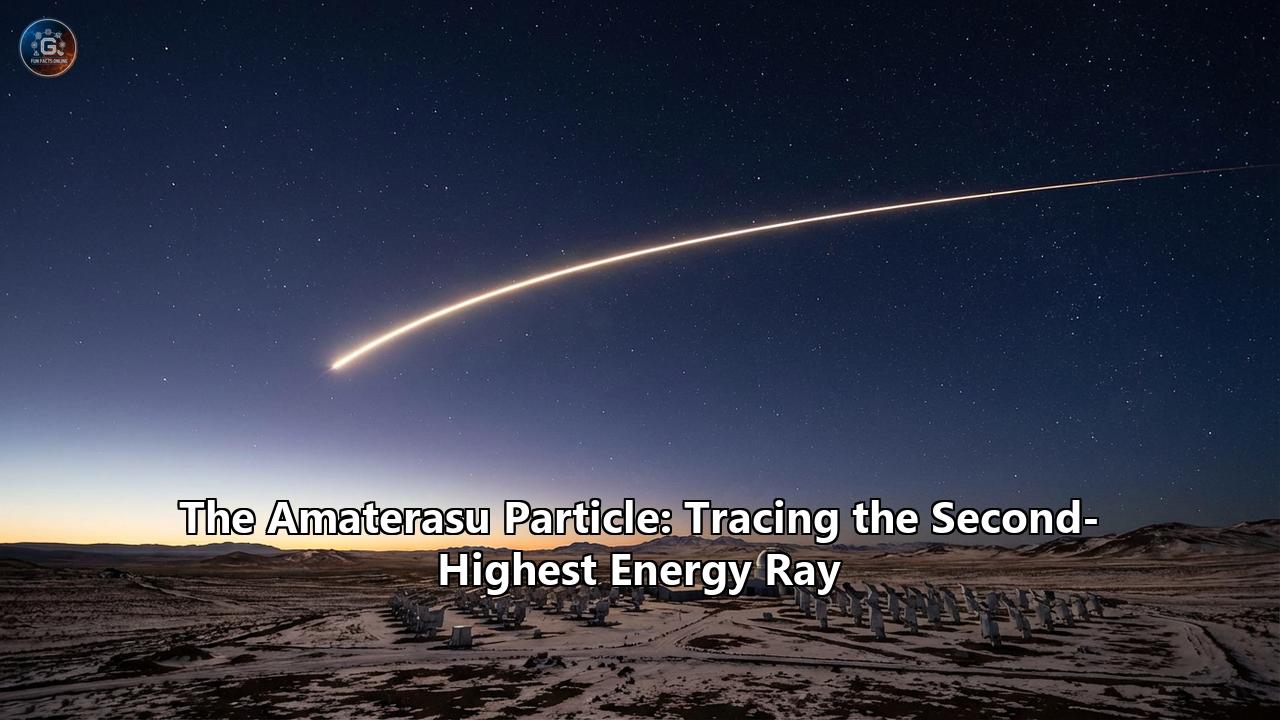
In the desolate, high-altitude desert of Utah, under a sky so dark it feels like the edge of the world, a ghost slammed into our atmosphere. It arrived without warning on May 27, 2021, screaming through the cosmos at a speed indistinguishable from light. It carried with it not just energy, but a message that would rattle the foundations of astrophysics.
This was not a meteor. It was not a photon from a distant star. It was a single subatomic particle—likely a proton or a naked nucleus—packing an energy level so extreme that it defies the conventional laws of particle physics.
Scientists named it Amaterasu, after the Shinto goddess of the sun and the universe. It is the second-highest energy cosmic ray ever detected by humankind, a "sun goddess" that emerged not from a blazing inferno of creation, but from the darkest, emptiest region of the nearby universe: the Local Void.
This is the story of that particle, the observatory that caught it, and the baffling mystery that suggests our understanding of the high-energy universe may be fundamentally incomplete.
Part I: The Silent Impact
The Night of Discovery
The Telescope Array Project operates in the vast silence of Utah’s West Desert, a location chosen for its isolation. Here, far from the electromagnetic noise of civilization, 507 surface detectors are arranged in a grid across 700 square kilometers (270 square miles). They wait patiently for "air showers"—the cascades of secondary particles produced when a cosmic ray smashes into the molecules of Earth's upper atmosphere.
On that morning in May 2021, at 4:35 AM local time, the array lit up.
The event didn't trigger just one or two detectors; it triggered 23 of them, splashing across 48 square kilometers of the desert floor. The data flooded the control servers, but it wasn't until later, during routine analysis, that the true magnitude of the event became clear.
Toshihiro Fujii, an associate professor at Osaka Metropolitan University, was the one inspecting the data. When he saw the calculated energy levels, his first instinct was skepticism. "I thought there must have been a mistake," Fujii later told the press. "The energy level was unprecedented in the last three decades."
The sensors were telling him that a single particle had struck the atmosphere with an energy of 244 exa-electron volts (EeV).
To put that number into perspective: In the world of subatomic particles, energy is usually measured in electron volts (eV). A typical electron in a beam of light might carry a few eV. The most powerful particle accelerator humans have ever built, the Large Hadron Collider (LHC) at CERN, smashes particles together at roughly 13.6 tera-electron volts (TeV).
- 1 TeV = 1,000,000,000,000 eV ($10^{12}$)
- 1 EeV = 1,000,000,000,000,000,000 eV ($10^{18}$)
The Amaterasu particle was millions of times more energetic than anything the LHC can produce. If you could scale a proton up to the size of a baseball, the Amaterasu particle would be a baseball thrown at 95 miles per hour. That doesn't sound like much until you remember: this is a single subatomic particle. It struck with the kinetic force of a brick dropped from waist height, all concentrated into a point smaller than an atom.
The "Oh-My-God" Precedent
The discovery of Amaterasu immediately evoked memories of the most legendary event in cosmic ray history: the "Oh-My-God" particle.
Detected on the evening of October 15, 1991, by the Fly's Eye experiment (the predecessor to the Telescope Array, also in Utah), the Oh-My-God particle possessed an estimated energy of 320 EeV. At the time, astrophysicists were stunned. The particle was moving so fast that, had it been racing a beam of light from the time the universe began, the light beam would have only beaten it by a fraction of a millimeter.
For thirty years, the Oh-My-God particle stood as a lonely anomaly. While other high-energy rays were found, none approached that threshold of insanity. Many wondered if it was a measurement error, a glitch in the matrix of data processing.
Amaterasu changed that. By clocking in at 244 EeV, it confirmed that the Oh-My-God particle was not a fluke. The universe really does have a mechanism to accelerate particles to these macroscopic energy scales. The question that haunts scientists now is: Where are they coming from?
Part II: The Physics of the Impossible
To understand why Amaterasu is so baffling, one must understand the "speed limit" of the universe—not just the speed of light, but the distance limit for high-energy travel known as the GZK Cutoff.
The GZK Cutoff
In 1966, physicists Kenneth Greisen, Georgiy Zatsepin, and Vadim Kuzmin independently calculated a theoretical upper limit for the energy of cosmic rays coming from distant sources. This is known as the Greisen-Zatsepin-Kuzmin (GZK) limit.
The universe is not truly empty; it is filled with the Cosmic Microwave Background (CMB), the faint afterglow of the Big Bang. To a human, this radiation is harmless. But to a proton traveling at 99.99999999999999999999951% of the speed of light (the speed of the Amaterasu particle), the CMB photons appear to be high-energy gamma rays due to the Doppler effect.
At energies above 50 EeV ($5 \times 10^{19}$ eV), a cosmic ray proton will collide with these CMB photons, creating pions. This interaction drains energy from the cosmic ray. It acts like a cosmic friction.
The math dictates that any cosmic ray with energy above 60 EeV loses its energy rapidly as it travels. It cannot survive a journey longer than about 50 to 100 megaparsecs (roughly 160 to 320 million light-years). If a particle hits Earth with 244 EeV, it must have originated from within our local cosmic neighborhood. It simply couldn't have traveled from the distant reaches of the universe without losing its punch.
The Source Problem
This creates a paradox. We know the particle must be "local" (within ~160 million light-years). Therefore, we should be able to look at its arrival direction, trace the path back, and see a massive, violent astrophysical object capable of launching it.
To accelerate a particle to 244 EeV, you need a magnetic field of terrifying power. Standard supernovae—exploding stars—are nowhere near strong enough. We are looking for:
- Active Galactic Nuclei (AGN): Supermassive black holes at the centers of galaxies devouring matter and spitting out relativistic jets.
- Magnetars: Neutron stars with magnetic fields trillions of times stronger than Earth's.
- Gamma-Ray Bursts: The most powerful explosions in the universe.
When the team calculated the trajectory of Amaterasu, they traced it back to a region of the sky bordering the Milky Way. They expected to see a bustling galaxy cluster or a raging quasar.
Instead, they found nothing.
The particle appeared to come from the Local Void.
Part III: Staring into the Void
What is the Local Void?
The universe, on a grand scale, looks like a web. Galaxies are clustered together in filaments and sheets, surrounding vast, empty bubbles called voids. The Milky Way exists on the inner edge of the "Local Sheet," a flat array of galaxies.
Directly adjacent to us is the Local Void. It is a massive region of desolation, stretching approximately 150 million light-years across. It contains very few galaxies, and the ones that are there are mostly isolated, dim dwarfs. It is the last place you would look for a cosmic particle accelerator.
"You trace its trajectory to its source and there's nothing high energy enough to have produced it," said John Matthews, a co-spokesperson for the Telescope Array at the University of Utah. "That's the mystery of this—what the heck is going on?"
If the GZK limit holds true, the source must be nearby. If the source is nearby, we should see it. But the direction points to empty space. This leaves scientists with three uncomfortable possibilities.
Possibility 1: Magnetic Deflection Gone Wrong
Cosmic rays are charged particles (usually protons or helium nuclei). As they travel through space, magnetic fields bend their paths. The Milky Way has a magnetic field, and there are weaker intergalactic magnetic fields.
If the Amaterasu particle was a simple proton, its energy is so high that it should have cut through these magnetic fields like a bullet through fog, bending only about 1 degree. This would allow us to point almost directly back to the source.
However, if the particle was a heavier nucleus—like iron—it would have a much greater electric charge. A heavier charge means it interacts more strongly with magnetic fields, bending much more significantly (perhaps 20 or 30 degrees).
If Amaterasu was an iron nucleus, its path could have been bent so severely that it looks like it came from the Local Void, but actually originated from a known source, such as the starburst galaxy M82 or the radio galaxy Centaurus A.
The problem? The composition analysis (how the air shower developed in the atmosphere) suggests Amaterasu was likely a lighter particle, closer to a proton. If it is a proton, the magnetic deflection argument falls apart.
Possibility 2: An Invisible Source
Could there be something in the Local Void we can't see?
Perhaps there is a "silent" Active Galactic Nucleus—a black hole that fired a jet millions of years ago and has since gone dormant. The particle is just now arriving, but the "gun" that fired it has stopped smoking.
Alternatively, some physicists have proposed "topological defects" in the structure of spacetime itself—relics from the early universe like Cosmic Strings. These hypothetical 1-dimensional cracks in the universe could, theoretically, decay and release massive amounts of energy in the form of particles. If a cosmic string decayed in the Local Void, it could produce Amaterasu without an associated galaxy.
Possibility 3: New Physics
This is the most exciting and terrifying option. It suggests that our understanding of particle physics is wrong.
Perhaps the GZK limit is not absolute. Maybe at these extreme energies, special relativity works differently, or particles interact with the Cosmic Microwave Background in ways the Standard Model doesn't predict. This would be a violation of Lorentz Invariance, a cornerstone of Einstein's theory of relativity.
Or, perhaps the particle is dark matter related. If Super-Heavy Dark Matter (SHDM) decays, it could produce ultra-high-energy cosmic rays. Since dark matter is everywhere (and potentially clustered in voids or halos), this could explain an origin that doesn't match visible matter.
Part IV: The Machine in the Desert
To understand the weight of this discovery, we must look at the instrument that made it possible. The Telescope Array is a marvel of "hybrid" detection.
The Surface Scintillators
The 507 detectors scattered across the Utah desert look like nondescript solar panels or weather stations. Inside each plastic box are two layers of scintillator material. When a charged particle from an air shower passes through the scintillator, it emits a tiny flash of fluorescent light.
Fiber optic cables catch this light and convert it into an electronic signal. These stations run on solar power and communicate via radio. They are robust, designed to survive the blistering summer heat and freezing winter nights of the high desert.
The Fluorescence Telescopes
Overlooking the grid of surface detectors are three fluorescence detector stations. These look like observatories, but instead of focusing on stars, they stare horizontally across the desert air.
When a high-energy cosmic ray hits the atmosphere, it excites nitrogen molecules in the air. As these molecules de-excite, they emit faint ultraviolet light—a fast-moving, invisible streak of blue lightning across the sky. The fluorescence telescopes watch for these streaks on moonless nights.
By combining the "footprint" of the shower on the ground (from the scintillators) with the "profile" of the shower in the air (from the telescopes), scientists can calculate the cosmic ray's energy, mass, and arrival direction with high precision.
For Amaterasu, the signal was so strong it saturated the detectors. The team had to meticulously reconstruct the event, ensuring that the unprecedented energy reading wasn't a calibration error. It wasn't.
Part V: The Broader Implications
The existence of the Amaterasu particle forces a reckoning in high-energy astrophysics. It suggests that the "ultra-high-energy" universe is far more active—and mysterious—than previously thought.
The Limit of Acceleration
We generally believe particles are accelerated by "Fermi acceleration"—bouncing back and forth in magnetic shockwaves (like inside a supernova remnant) until they gain speed. To get to 244 EeV, the shockwave must be enormous and moving at relativistic speeds.
If we cannot find a source in the Local Void, it implies that magnetic fields in intergalactic space might be much stronger than our models predict, capable of bending even high-energy protons into loops. This would mean we are effectively inside a "magnetic fog," unable to see the true sources of cosmic rays because their paths are hopelessly scrambled.
The Future of Detection
The Amaterasu event has accelerated calls for larger, more sensitive observatories. The Telescope Array is currently being expanded. The TAx4 project aims to quadruple the detection area, increasing the chances of catching more of these rare "goddess" particles.
Furthermore, the scientific community is looking toward next-generation experiments like GRAND (Giant Radio Array for Neutrino Detection). Instead of using light or scintillators, GRAND will use 200,000 radio antennas spread over 200,000 square kilometers in China to listen for the radio pulses generated by cosmic ray air showers. This immense scale is necessary because particles like Amaterasu are incredibly rare—striking any given square kilometer of Earth perhaps once per century.
Conclusion: A Message from the Dark
The Amaterasu particle is a reminder of how much we still have to learn. We stand on the surface of our small planet, catching the debris of cosmic violence, trying to reconstruct the events that shaped the universe.
For decades, we believed that if we just built better detectors, the sky would come into focus. We thought we would trace these energetic messengers back to the spinning hearts of black holes or the births of new galaxies. Instead, the second most powerful particle ever seen has pointed us back to nothingness.
It came from the void, carrying the energy of a brick and the speed of light, and it vanished into the Utah soil, leaving us with a question that may take another generation to answer. Until then, the detectors in the desert will keep watching, waiting for the next message from the dark.
Reference:
- https://attheu.utah.edu/facultystaff/cosmic-ray-2023/
- https://magazine.utah.edu/issues/summer-2024/enigmatic-particle-detected/
- https://www.omu.ac.jp/en/info/research-news/entry-39535.html
- https://www.earth.com/news/amaterasu-extremely-high-energy-cosmic-ray-detected-with-no-clear-source/
- https://universemagazine.com/en/true-mystery-the-first-ultrahigh-energy-particle-recorded-in-30-years-came-out-of-nowhere/
- https://hayadan.com/not-science-fiction-an-unfamiliar-particle-with-energy-c
- https://newatlas.com/space/local-void-extreme-energy-cosmic-ray/
- https://www.reddit.com/r/space/comments/182fh6d/meet_amaterasu_astronomers_detect_highest_energy/
- https://www.sci.news/astronomy/amaterasu-particle-12477.html
- https://www.wionews.com/science/after-god-particle-and-oh-my-god-particle-scientists-discover-sun-goddess-particle-662176
- https://arxiv.org/pdf/2405.17409
- https://en.wikipedia.org/wiki/Ultra-high-energy_cosmic_ray
- https://www.thetelegraphandargus.co.uk/news/national/23944735.astronomers-detect-mysterious-high-energy-particle-falling-earth-space/
- https://www.irishexaminer.com/world/arid-41282071.html
- https://www.sciencefriday.com/segments/very-powerful-cosmic-ray/
- https://www.inverse.com/science/cosmic-ray-amaterasu-particle
- https://astrobites.org/2023/12/20/amaterasu/