
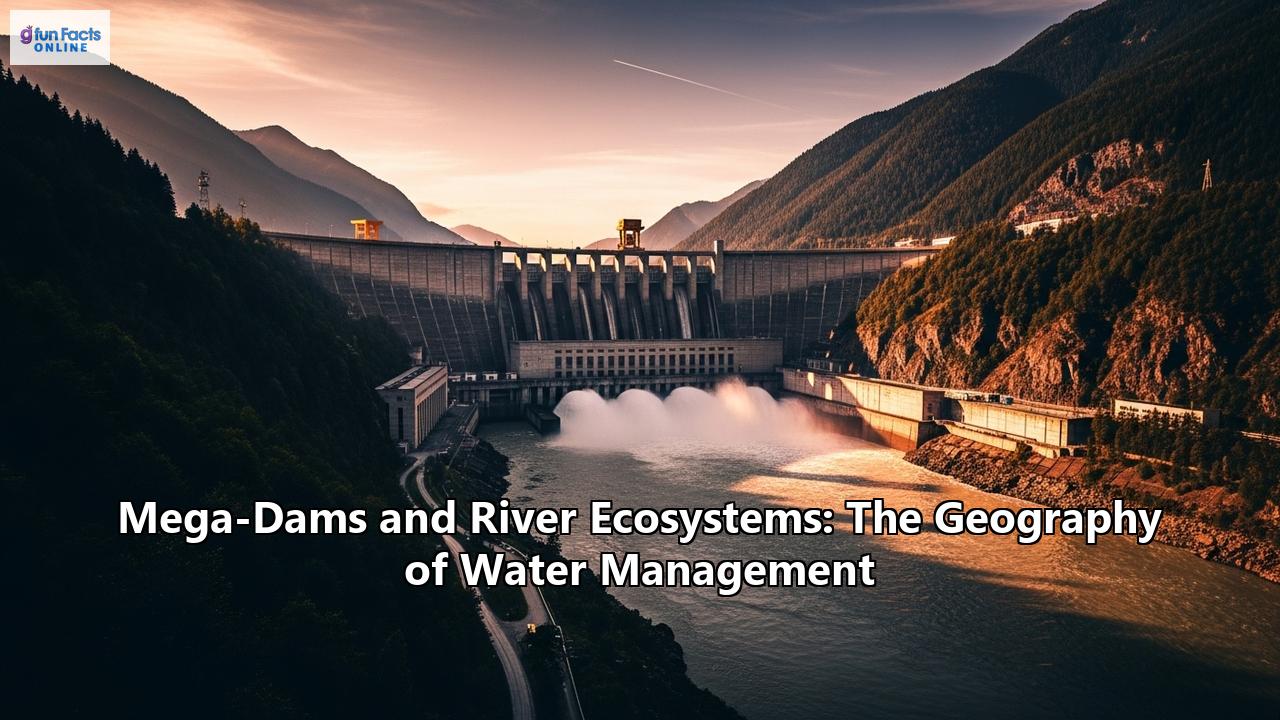
The Unforgiving Flow: Mega-Dams and the Great Reshaping of River Ecosystems
An in-depth exploration of the complex relationship between colossal water management projects and the delicate balance of our planet's riverine lifelines, this article navigates the turbulent waters of geography, ecology, and the socio-economic currents that define the era of the mega-dam.In the grand tapestry of human endeavor, few projects rival the sheer scale and ambition of the mega-dam. These colossal structures of concrete and steel, often hailed as monuments to progress, are designed to tame the world's mightiest rivers, promising a future of abundant clean energy, reliable water supplies, and protection from devastating floods. Yet, beneath the surface of these promises lies a complex and often contentious reality. The construction of mega-dams represents a profound intervention in the natural world, one that fundamentally alters the geography of water management and sets in motion a cascade of ecological and social consequences that can ripple through entire river basins and across generations. This article delves into the heart of this complex issue, examining the multifaceted impacts of mega-dams on river ecosystems, the communities that depend on them, and the geopolitical landscapes they reshape.
The Engineering of Rivers: A Fundamental Shift in the Water Cycle
At its core, a mega-dam is a dramatic exercise in hydrological reorganization. By obstructing the natural flow of a river, these structures create vast artificial lakes, or reservoirs, fundamentally altering the timing, volume, and character of the water that flows downstream. This engineered control over a river's pulse has far-reaching consequences that extend from the riverbed to the coastal delta.
Altered Flow Regimes: The Disrupted Rhythm of the River
Rivers are not static channels of water; they are dynamic systems with natural rhythms of high and low flows, dictated by seasonal rainfall and snowmelt. These fluctuations, or flood pulses, are vital to the health of river ecosystems. They inundate floodplains, depositing nutrient-rich sediments that support agriculture and replenish wetlands. Mega-dams, however, are designed to smooth out these natural variations, storing water during wet seasons and releasing it during dry periods to ensure a steady supply for hydropower generation and irrigation.
This regulation of flow can have devastating effects. The reduction in peak flows can prevent the natural flooding that riparian ecosystems have adapted to over millennia, leading to a decline in the fertility of floodplains and the shrinkage of vital wetland habitats. Conversely, the artificial increase in dry-season flows can disrupt the life cycles of aquatic species adapted to lower water levels. Furthermore, the practice of "hydropeaking," the rapid release of water to meet peak electricity demand, can cause sudden and unnatural fluctuations in downstream water levels, stranding fish and eroding riverbanks.
The Sediment Trap: Starving the Deltas
One of the most significant and often overlooked impacts of mega-dams is the trapping of sediment. Rivers are the primary conduits of sediment from the land to the sea, carrying billions of tons of silt, sand, and nutrients that are essential for maintaining the physical form and ecological productivity of downstream environments. When a river is dammed, the velocity of the water slows as it enters the reservoir, causing the suspended sediment to settle out. This process effectively turns the reservoir into a giant sediment trap, depriving the downstream river of its life-sustaining load.
The consequences of this sediment starvation are profound. Downstream, the "hungry" water, now devoid of its natural sediment load, can begin to erode the riverbed and banks, leading to channel incision and a lowering of the water table. This can undermine bridges and other infrastructure and reduce the availability of water for riverside vegetation.
Perhaps the most dramatic impact of sediment trapping is felt at the river's mouth. Deltas, which are built up over millennia by the deposition of river-borne sediment, begin to shrink and subside when their sediment supply is cut off. This makes coastal communities and ecosystems more vulnerable to rising sea levels and storm surges. The Nile Delta, for example, has experienced significant erosion and land loss since the construction of the Aswan High Dam. Globally, it is estimated that dams have already trapped a significant portion of the sediment that would naturally reach the world's oceans, with profound implications for coastal geomorphology and marine ecosystems.
Barriers to Life: The Fragmentation of River Ecosystems
Rivers are not just channels of water; they are corridors of life, facilitating the movement of migratory fish and other aquatic organisms. Mega-dams represent a formidable, and often insurmountable, barrier to this movement. For species like salmon, sturgeon, and giant catfish, which migrate upstream to spawn, a dam can mean the difference between survival and extinction. While fish ladders and other passage technologies have been developed, their effectiveness is often limited, and many fish are still unable to complete their life cycles.
The fragmentation of river habitats by dams has led to a dramatic decline in freshwater biodiversity. A global analysis of over 10,000 freshwater fish species found that dams have significantly fragmented their habitats, with the most severe impacts observed in the United States, Europe, South Africa, India, and China. The study also warned that future dam construction, particularly in the tropics, will lead to even greater fragmentation and biodiversity loss. The decline of migratory fish populations has a ripple effect throughout the food web, impacting predators such as birds and mammals that rely on them for food. The construction of the Itaipu Dam on the Paraná River, for instance, is reported to have led to a 70% loss in biodiversity.
The Human Cost: Socio-Economic Upheaval and Uneven Development
The impacts of mega-dams extend far beyond the river channel, profoundly affecting the lives and livelihoods of millions of people. While often promoted as engines of economic growth, these projects frequently come with a heavy social price tag, disproportionately borne by the most vulnerable communities.
Displacement and Resettlement: The Uprooting of Communities
The creation of vast reservoirs behind mega-dams inevitably leads to the inundation of land, displacing entire communities and submerging homes, farms, and cultural heritage sites. The World Commission on Dams estimated that dams have displaced between 40 and 80 million people worldwide. This process of involuntary resettlement is often fraught with challenges and can lead to long-term impoverishment and social disruption.
Case studies from around the world reveal a consistent pattern of inadequate compensation, loss of livelihoods, and the erosion of social cohesion among resettled communities. In China, the construction of the Manwan Dam displaced twice the number of people officially estimated, and the resettlement process was plagued by insufficient oversight and resources. Similarly, the Ilisu Dam in Turkey has faced criticism for its lack of consultation with affected communities and inadequate compensation for lost land and housing. These experiences highlight the immense social cost of mega-dams and the frequent failure of resettlement programs to restore, let alone improve, the living standards of those displaced.
Livelihoods on the Line: The Impact on Fishing and Agriculture
For communities living along the banks of a river, the water is not just a resource; it is the foundation of their culture and their economy. Fishing and floodplain agriculture are often the primary sources of food and income for millions of people. The construction of a mega-dam can decimate these traditional livelihoods.
The decline in fish populations due to blocked migration routes and altered habitats has had a devastating impact on fisheries. In the Mekong River Basin, where millions of people depend on fish for their protein and income, dam construction has led to a dramatic decline in fish catches. The Pak Mun Dam in Thailand, for example, has been blamed for a sharp drop in local fish stocks, leading to protests from affected communities.
Floodplain agriculture is also severely affected by the regulation of river flows. The reduction in natural floods and the sediment they carry deprives downstream agricultural land of essential nutrients, leading to a decline in soil fertility and crop yields. In some cases, the disruption of traditional farming practices can threaten food security and push communities deeper into poverty. A study on the Masinga Dam in Kenya found that while the dam led to an increase in irrigated vegetable farming, its overall impact on reducing food insecurity was insignificant.
The Economic Equation: A High-Stakes Gamble
Proponents of mega-dams often point to their potential to generate vast amounts of electricity, stimulate industrial growth, and create jobs. Hydropower is frequently touted as a clean and renewable energy source that can help developing countries meet their growing energy demands and reduce their reliance on fossil fuels. Dams can also provide a reliable water supply for cities and industries and play a crucial role in flood control, protecting lives and property from catastrophic inundations.
However, a growing body of evidence suggests that the economic benefits of mega-dams are often overestimated, while their costs are consistently underestimated. A study by Oxford University found that, on average, the construction costs of large dams are 90% higher than their initial budgets, and eight out of ten projects experience schedule overruns. These cost overruns can saddle developing countries with massive debts, undermining their economic stability.
Furthermore, the long-term economic performance of mega-dams can be hampered by a range of factors, including sedimentation that reduces reservoir capacity, the high cost of maintenance, and the social and environmental mitigation measures that are often required. In some cases, the electricity generated by mega-dams primarily benefits urban centers and industries, while rural communities, who often bear the brunt of the negative impacts, see little improvement in their access to energy.
The Geography of Power: Where and Why Mega-Dams are Built
The global distribution of mega-dams is far from uniform. The era of large-dam construction in North America and Europe has largely passed, with many of the most suitable sites already developed. Today, the frontier of mega-dam construction has shifted to the developing world, particularly to Asia, South America, and Africa. China is by far the world's most prolific dam builder, accounting for a significant portion of the world's large dams. Other countries with major dam-building programs include Brazil, India, Turkey, and Ethiopia.
The decision to build a mega-dam is rarely a purely technical or economic one. It is often deeply intertwined with politics, power, and national identity. In many developing countries, mega-dams are seen as symbols of national pride and modernity, a way to demonstrate a nation's technological prowess and control over its natural resources. For governments, these projects can be a powerful tool for consolidating political power and promoting a particular vision of national development.
The financing of mega-dams also plays a crucial role in shaping where and how they are built. Historically, the World Bank was the primary financier of large dams, but in recent years, its role has been increasingly supplemented, and in some cases surpassed, by national and regional development banks, as well as private investors. Chinese financial institutions, in particular, have become major players in the global dam-building industry, financing numerous projects in Africa, Asia, and Latin America. This shift in financing has been accompanied by a complex and often opaque web of political and economic interests, raising concerns about transparency, accountability, and the social and environmental standards applied to these projects.
Flashpoints of Conflict: Transboundary Rivers and Geopolitical Tensions
When a river flows across international borders, the decision to build a mega-dam in one country can have profound implications for its downstream neighbors, creating a fertile ground for geopolitical conflict. The control and allocation of water from transboundary rivers is one of the most pressing and potentially explosive issues in international relations.
The Nile River Basin is a prime example of the complex geopolitics of water. The construction of the Grand Ethiopian Renaissance Dam (GERD) on the Blue Nile has created a deep and protracted dispute between Ethiopia, Egypt, and Sudan. Egypt, which relies on the Nile for over 95% of its freshwater, views the dam as an existential threat to its water security. Ethiopia, on the other hand, sees the GERD as a vital engine for its economic development and a symbol of its national sovereignty. The ongoing negotiations over the filling and operation of the dam have been fraught with tension, highlighting the immense challenges of managing shared water resources in a region with a long history of political rivalry.
Similar tensions are playing out in other parts of the world. In the Mekong River Basin, China's extensive dam-building program on the upper reaches of the river has raised concerns among downstream countries like Vietnam, Cambodia, and Thailand, who fear the impacts on their fisheries, agriculture, and water security. The lack of a comprehensive and binding agreement on water management in the Mekong has created a climate of uncertainty and distrust, further complicating regional relations.
Case Studies in Contrast: The Nile, Yangtze, Mekong, and Amazon
To truly understand the multifaceted impacts of mega-dams, it is essential to examine specific case studies from different geographical and political contexts.
The Grand Ethiopian Renaissance Dam (GERD) on the Nile: A Modern-Day Geopolitical Saga
The GERD is one of the most ambitious and controversial dam projects of the 21st century. For Ethiopia, the dam represents a historic opportunity to harness the power of the Blue Nile to generate electricity for its growing population and to become a major power exporter in the region. However, for Egypt and Sudan, the dam poses a significant threat to their water supply. The potential reduction in the Nile's flow during the filling of the reservoir could have a devastating impact on Egypt's agriculture and economy. The dispute over the GERD is a stark reminder of the potential for water to become a major source of conflict in the 21st century.
The Three Gorges Dam on the Yangtze: A Monument to Power and a Source of Controversy
The Three Gorges Dam in China is the world's largest hydropower project, a symbol of the country's rapid economic development and technological prowess. The dam has been credited with providing a massive amount of clean energy, improving navigation on the Yangtze River, and controlling devastating floods. However, the project has also come at an enormous environmental and social cost. The creation of the reservoir submerged vast areas of land, displacing over a million people and destroying countless archaeological and cultural sites. The dam has also had a profound impact on the river's ecosystem, leading to a decline in biodiversity, particularly of iconic species like the Chinese sturgeon and the now-extinct baiji dolphin. The Three Gorges Dam remains a potent symbol of the immense trade-offs involved in large-scale water management projects.
The Damming of the Mekong: A Cascade of Consequences
The Mekong River, the lifeblood of Southeast Asia, is undergoing a rapid and transformative process of dam construction. A cascade of dams, primarily in China and Laos, is altering the river's flow, trapping sediment, and blocking fish migration routes. These changes are having a devastating impact on the livelihoods of the 65 million people who depend on the river for their food and income. The decline in fish catches is a major concern, as is the loss of fertile agricultural land in the Mekong Delta. The damming of the Mekong is a clear example of how the pursuit of hydropower can undermine the food security and ecological integrity of an entire region.
The Belo Monte Dam on the Amazon: A Threat to a Global Treasure
The Amazon rainforest, one of the most biodiverse regions on the planet, is facing a new and growing threat from the construction of mega-dams. The Belo Monte Dam on the Xingu River in Brazil is a case in point. The project, which has been plagued by controversy since its inception, has displaced thousands of indigenous people, flooded vast areas of pristine rainforest, and threatened the survival of numerous endemic species. The dam has also been criticized for its economic inefficiency and its potential to exacerbate the impacts of climate change. The Belo Monte Dam serves as a stark warning about the irreversible damage that can be inflicted on some of the world's most precious ecosystems in the name of development.
The Path Forward: Sustainable Water Management and the Search for Alternatives
The growing awareness of the negative impacts of mega-dams has led to a search for more sustainable and equitable approaches to water management. A one-size-fits-all solution is unlikely, as the optimal approach will vary depending on the specific geographical, social, and economic context. However, a range of alternatives to large-scale dams are being explored and implemented around the world.
These alternatives include:
- Improving the efficiency of existing water and energy systems: In many cases, significant gains can be made by reducing water waste in agriculture and industry and by improving the efficiency of existing power grids.
- Investing in decentralized renewable energy: Solar, wind, and geothermal power are becoming increasingly cost-competitive and offer a more decentralized and less environmentally destructive way to generate electricity.
- Small-scale hydropower: Smaller, run-of-the-river hydropower projects can have a much smaller environmental footprint than mega-dams, although their cumulative impacts need to be carefully assessed.
- Water harvesting and conservation: Techniques such as rainwater harvesting and improved soil moisture management can help to increase water availability at a local level without the need for large-scale infrastructure.
- Non-structural flood management: Instead of relying on large dams to control floods, a range of non-structural measures can be employed, such as restoring wetlands and floodplains, improving early warning systems, and implementing zoning regulations to prevent development in high-risk areas.
- Integrated Water Resources Management (IWRM): This approach emphasizes a holistic and participatory approach to water management, taking into account the needs of all stakeholders and the importance of maintaining healthy ecosystems. It seeks to move beyond a purely engineering-focused approach to one that integrates social, economic, and environmental considerations.
The debate over mega-dams is a microcosm of the broader challenge of achieving sustainable development in a world of growing population, increasing resource demand, and a changing climate. These colossal structures are a testament to human ingenuity and our capacity to reshape the natural world. However, they are also a stark reminder of the profound responsibility that comes with such power. As we navigate the complex geography of water management in the 21st century, it is clear that a new paradigm is needed, one that moves beyond the era of the mega-dam and embraces a more sustainable, equitable, and ecologically sensitive approach to managing our planet's most precious resource.
Reference:
- https://www.researchgate.net/publication/377703241_The_Grand_Ethiopian_Renaissance_Dam_GERD_Geopolitical_Implications
- https://www.refworld.org/reference/annualreport/mrgi/2012/en/86650
- https://www.montana.edu/rmaher/engr125_fl06/Three%20Gorges%20Dam.pdf
- https://www.researchgate.net/publication/312441438_Impact_of_the_Three_Gorges_Dam_on_the_Hydrology_and_Ecology_of_the_Yangtze_River
- https://www.iai.it/en/pubblicazioni/c03/ethiopias-grand-renaissance-dam
- https://en.wikipedia.org/wiki/Three_Gorges_Dam
- http://benthos.ihb.ac.cn/XieWang07Fisheries.pdf
- https://www.crisisgroup.org/asia/south-east-asia/cambodia-thailand-china/343-dammed-mekong-averting-environmental-catastrophe
- https://www.mdpi.com/2073-4441/8/12/590
- https://www.mdpi.com/2073-4441/14/3/312
- https://nvdatabase.swarthmore.edu/content/brazilian-indigenous-protest-construction-belo-monte-dam-xingu-river-brazilian-amazon-2008-2
- https://thediplomat.com/2024/07/the-intensifying-impacts-of-upstream-dams-on-the-mekong/
- https://homopolitikus.si/en/geopolitics-of-the-grand-ethiopian-renaissance-dam/
- https://www.globe.uio.no/english/sdg/blog/oda-fagerland/the-grand-ethiopian-renaissance-dam-gerd.html
- https://grademiners.com/examples/debate-on-developmental-goals-and-environmental-impacts-of-belo-monte-dam
- https://dialogue.earth/en/energy/what-are-the-impacts-of-dams-on-the-mekong-river/
- http://www.mekongwatch.org/PDF/MekongDam_20160223_report.pdf
- https://www.journalijdr.com/hydropower-dam-impact-environment-and-livelihood-mekong-river-basin
- https://amazonwatch.org/assets/files/2011-august-belo-monte-dam-fact-sheet.pdf
- https://www.bohrium.com/paper-details/the-impacts-of-hydropower-dams-in-the-mekong-river-basin-a-review/812510453337948160-3157
- https://www.hydrobiodiversityimpact.org/three-gorges
- https://www.mdpi.com/2072-4292/13/5/874
- https://survey.amu.edu.et/ojs/index.php/EJWST/article/download/377/186
- https://aida-americas.org/en/holding-brazil-accountable-belo-monte-dam
- https://www.google.com/search?q=time+in+%E1%88%9D%E1%8B%95%E1%88%AB%E1%89%A5+%E1%88%83%E1%88%A8%E1%88%AD%E1%8C%8C%E1%8D%A2,+ET
- https://en.wikipedia.org/wiki/Grand_Ethiopian_Renaissance_Dam
- https://climate-diplomacy.org/magazine/conflict/politics-grand-ethiopian-renaissance-dam
- https://lawjournals.celnet.in/index.php/njrel/article/view/1719
- http://www.egyptembassy.net/media/2021-GERD_Egypt-Fact-Sheet_012921-1.pdf
- https://vc.bridgew.edu/cgi/viewcontent.cgi?article=1556&context=undergrad_rev
- https://climate-diplomacy.org/case-studies/dam-projects-and-disputes-mekong-river-basin
- https://www.internetgeography.net/educas-gcse-geography/managing-the-mekong-river-a-transboundary-water-issue/
- https://www.researchgate.net/publication/350063358_Mekong_River_Cooperation_A_Case_Study_of_Hydropower_Dams_in_the_Sesan_Srepok_and_Sekong_Basins
- https://wmo.int/media/magazine-article/addressing-potential-climate-effects-of-chinas-three-gorges-project
- https://www.mdpi.com/2077-0472/12/9/1372
- https://www.mdpi.com/2071-1050/15/5/4465
- https://www.mdpi.com/2073-4441/13/3/265
- https://www.internationalrivers.org/news/thailands-national-human-rights-commission-raises-serious-concerns-about-impacts-of-mekong-river-dams/
- https://escholarship.org/content/qt6x27d4hr/qt6x27d4hr_noSplash_87bcb8342769814d7032932071bd9852.pdf?t=pkwojk
- https://www.rgs.org/schools/resources-for-schools/the-belo-monte-hydroelectric-dam-complex-in-brazil
- https://news.mongabay.com/2018/02/belo-monte-legacy-harm-from-amazon-dam-didnt-end-with-construction/
- https://www.cambridge.org/core/journals/environmental-conservation/article/abs/droughts-and-controlled-rivers-how-belo-monte-dam-has-affected-the-food-security-of-amazonian-riverine-communities/EAB8C1D6132784F17A0C637BB8CCEFB6