
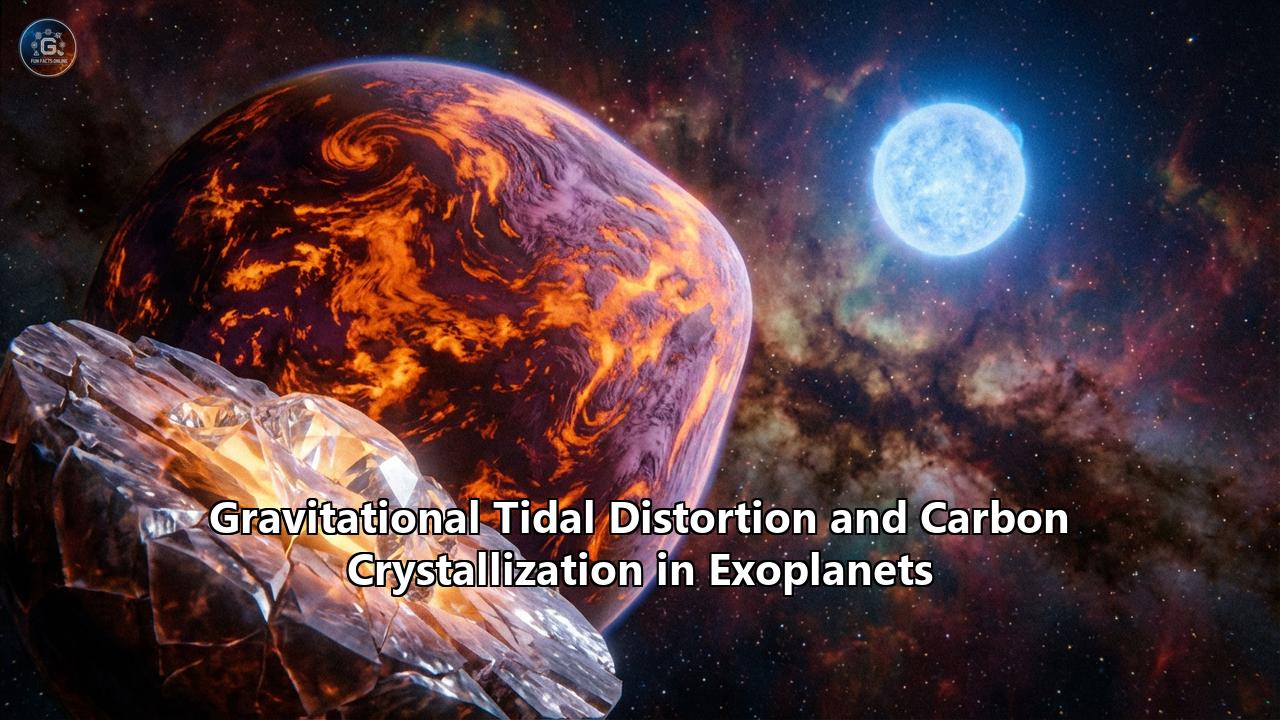
The universe is a laboratory of extremes, a place where the familiar laws of physics play out on scales that defy human intuition. Among the most captivating discoveries of the modern exoplanetary era is the existence of worlds that challenge our understanding of planetary formation and composition: the "carbon planets." These are not the silicate-and-iron worlds of our own solar system, but exotic realms where graphite crusts may float upon mantles of diamond. Yet, these jewels of the cosmos often exist in the most violent environments imaginable, orbiting so close to their host stars that they are kneaded by immense gravitational forces. This article explores the intersection of two of astrophysics' most dramatic phenomena: the crushing, shape-shifting power of gravitational tidal distortion and the silent, deep-pressure alchemy of carbon crystallization.
Part I: The Architecture of Carbon Worlds
To understand how a planet becomes a diamond, one must first understand the ingredients. In our solar system, oxygen is the dominant heavy element, binding with silicon, magnesium, and iron to form the silicate rocks that make up Earth, Mars, and Venus. This "oxygen-rich" chemistry is a result of the specific conditions in the protoplanetary disk that birthed our sun. However, the galaxy is diverse.
1.1 The C/O RatioThe fundamental determinant of a planet’s mineralogy is the carbon-to-oxygen (C/O) ratio of its primordial nebula.
- Silicate Worlds (C/O < 0.8): Like Earth, where oxygen is abundant. Excess oxygen oxidizes all available carbon into gases like carbon monoxide (CO) and carbon dioxide (CO2), leaving silicon and magnesium to form solid rocks (silicates).
- Carbon Worlds (C/O > 0.8): When carbon outnumbers oxygen, the chemistry flips. Oxygen is rapidly consumed to form CO, leaving a surplus of carbon. This excess carbon cannot form gas; instead, it condenses into solids. In this environment, the "rocks" are not silicates but carbides (like silicon carbide or SiC) and pure carbon allotropes (graphite and diamond).
Astronomers have identified two primary pathways for the creation of these carbon-rich bodies:
- Carbon-Enriched Disks: Planets forming around stars with naturally high carbon abundances (often asymptotic giant branch stars or specific populations of red dwarfs). In these systems, the dust grains coagulating into planetesimals are composed of graphite and silicon carbide rather than olivine and pyroxene.
- The Stripped Remnant (The White Dwarf Pathway): A more dramatic channel involves the death of a star. When a massive star creates a pulsar, or a sun-like star evolves into a white dwarf, the core remains rich in carbon and oxygen. If such a remnant is in a binary system, the outer layers can be stripped away by the companion’s gravity, leaving behind a naked, ultra-dense core. This "planet" is essentially a crystallized stellar ember.
Part II: The Physics of the Squeeze – Gravitational Tidal Distortion
Planets orbiting close to their stars do not exist in peaceful isolation. They are subject to the tyranny of the inverse-cube law of tidal forces.
2.1 The Tidal PotentialGravity is not uniform. The side of a planet facing its star experiences a stronger pull than the center, and the center experiences a stronger pull than the far side. This differential force creates a "stretching" effect along the line connecting the two bodies. For Earth, the Moon’s pull raises the oceans by a few meters. For a "Hot Jupiter" or a close-in carbon Super-Earth, the star’s gravity can raise "tides" of solid rock kilometers high.
2.2 Ellipsoidal DeformationWhen these forces become extreme, the planet ceases to be a sphere. It is pulled into a triaxial ellipsoid—a shape resembling a rugby ball or a lemon.
- The Prolate Spheroid: The longest axis of the planet points directly at the star.
- The Roche Limit: If a planet gets too close, the tidal forces overcome the planet's own self-gravity (the force holding it together). At this point, the planet disintegrates, forming a ring system. Many carbon planets we observe exist dangerously close to this limit, surviving only because their high density (thanks to diamond and tightly packed carbides) gives them immense structural integrity.
If a planet’s orbit is perfectly circular and its rotation is tidally locked (one face always pointing to the star), the distortion is static. The planet is permanently stretched, but the rock doesn't move. However, most orbits have a slight eccentricity (an oval shape).
- The Pumping Action: As the planet moves closer to the star (periastron), the gravitational grip tightens, stretching the planet further. As it moves away (apoastron), the gravity weakens, and the planet tries to spring back to a sphere.
- Viscoelastic Dissipation: This constant rhythmic flexing—stretching and relaxing—generates friction within the planet’s mantle. Rock grinds against rock on a microscopic scale. This energy dissipates as heat. In extreme cases, like Jupiter’s moon Io or the exoplanet 55 Cancri e, this "tidal heating" can be more powerful than the heat from radioactive decay, turning the mantle into a magma ocean and driving violent volcanism.
Part III: The Diamond Anvil – Crystallization under Pressure
The journey from carbon to diamond is a story of pressure (P) and temperature (T).
3.1 The Phase Diagram of CarbonCarbon is a polymorph; it can exist in different crystal structures depending on conditions.
- Graphite: At low pressures (like Earth's surface), carbon atoms arrange in hexagonal sheets. It is soft and opaque.
- Diamond: As pressure rises above ~4 GPa (Gigapascals), the atoms rearrange into a cubic lattice, where every atom is bonded to four others in a rigid tetrahedron. This is the hardest known natural material.
- Metallic Carbon / BC8: At even more extreme pressures (predicted around 1000+ GPa, conditions found in the cores of super-Earths), diamond may transform into even denser, potentially metallic phases.
For a planet to have a diamond mantle, it needs to be massive enough to generate the requisite internal pressure.
- Earth-mass planets: Pressures in the mantle are sufficient to stabilize diamond at depths greater than ~150 km.
- Super-Earths: On a planet with 2 to 10 times Earth's mass, the internal pressures are immense. If the composition is carbon-rich, the "mantle" is not made of flowing silicate rock but of solid or viscous diamond.
This is where tidal distortion plays a crucial role. Crystallization requires the material to be cool enough to solidify. However, tidal distortion generates heat.
- The Molten Scenario: If tidal heating is too intense (as with 55 Cancri e), the carbon may remain liquid. Liquid carbon is a strange beast; experiments suggest it acts like a metal and is less dense than diamond. A planet with a liquid carbon ocean would not be a "diamond planet" in the static sense, but a world of black, metallic seas.
- The Crystallized Scenario: If the planet can dissipate heat efficiently, or if the tidal forcing settles down, the interior cools. Under the crushing weight of the overlaying crust, the carbon lattice locks into place. The result is a planetary-scale crystal.
Part IV: Case Studies in the Cosmos
Let us examine the specific worlds where these forces collide.
4.1 PSR J1719-1438 b: The Pulsar’s Gem
Discovered in 2011, this object is the archetype of the "diamond planet."
- The System: It orbits a millisecond pulsar—a neutron star spinning 10,000 times a minute. The planet orbits incredibly close, completing a "year" in just 2.2 hours.
- The Origin: PSR J1719-1438 b is likely not a planet in the traditional sense. It is believed to be the remnant core of a white dwarf star. The pulsar’s gravity stripped away 99.9% of the star’s original mass (mostly hydrogen and helium), leaving only the dense, carbon-oxygen core.
- Crystallization: White dwarfs are degenerate matter; they cool over billions of years and crystallize. PSR J1719-1438 b is essentially a diamond sphere 60,000 km across—five times the diameter of Earth but with a mass similar to Jupiter. Its density is at least 23 g/cm³, far denser than platinum.
- Tidal Resilience: Orbiting so close to a pulsar, a normal gas giant would be ripped apart. Only the immense tensile strength and density of crystalline carbon allow this world to survive the tidal forces.
4.2 55 Cancri e: The Lava-Diamond Hybrid
Located 40 light-years away, this super-Earth orbits a Sun-like star.
- The Environment: It orbits so close that its surface temperature exceeds 2,000°C (3,600°F).
- Composition: Early density estimates suggested a carbon-rich interior. While recent JWST data hints at a volatile atmosphere (possibly CO or CO2) and a potential silicate mix, the "carbon planet" hypothesis remains a potent model for its interior dynamics.
- Tidal Torture: 55 Cancri e is tidally locked. The day side is a permanent magma ocean; the night side is solidified. The tidal forces here are not breaking the planet, but they are heating it. If the mantle is carbon-rich, we might see a "graphite crust" floating on a "diamond magma" slush.
- Heat Transport: Diamond has the highest thermal conductivity of any geologic material. A diamond mantle would transfer heat from the core to the surface with terrifying efficiency, potentially creating a unique tectonic regime where the planet cools much faster than a silicate world.
4.3 PSR J2322-2650 b: The Lemon World
A more recent discovery, this planet orbits a millisecond pulsar and exhibits extreme tidal distortion.
- Shape: Observations and models suggest the planet is significantly deformed, shaped like a football (prolate).
- Atmosphere: Unlike normal gas giants, its atmosphere is devoid of water but rich in carbon species, hinting at a carbon-dominated interior.
- The Link: This planet perfectly illustrates the connection. It is a carbon world (implied by atmosphere) undergoing visible tidal distortion (implied by light curves). The internal pressure created by this distortion likely creates a complex zoning of crystallization—perhaps a diamond core that is "kneaded" by tides, generating heat that keeps the outer layers liquid or gaseous.
Part V: Observational Signatures and the Future
How do we detect these diamond worlds and their distorted shapes?
5.1 Ellipsoidal VariationsWhen a football-shaped planet orbits a star, it changes its cross-section relative to the observer. When we look at the "broad" side, it reflects more light; when we look at the "pointed" end, it reflects less. This subtle brightening and dimming, separate from the transit (eclipse), allows astronomers to calculate the "Love number"—a measure of the planet's rigidity. A solid diamond planet will deform differently than a gaseous or silicate one.
5.2 Thermal Phase CurvesBy using infrared telescopes like JWST, we can map the heat distribution. A diamond planet, with its high thermal conductivity, might show a smaller temperature difference between day and night compared to a silicate planet, as the heat is rapidly shunted through the crystalline interior to the dark side.
5.3 SeismologyIn the future, we may detect "exoseismology." Tidal forces can trigger quakes. The speed at which seismic waves travel through diamond is roughly twice as fast as through silicate rock. If we can detect the "ringing" of a planet after a violent tidal event (perhaps caused by a flare or orbital resonance), the frequency of the vibration would scream "Diamond!"
Conclusion: The Precious Violence
The concept of a "diamond planet" sounds like the setting of a science fiction fantasy—a world of infinite wealth. But the reality is far more formidable. These are worlds born of stellar death or chemical anomaly, forged in the crushing gravity of pulsars and red dwarfs. They are not sparkling gems to be mined, but alien engines of heat and pressure.
Gravitational tidal distortion acts as the sculptor, kneading these worlds into impossible shapes and powering their internal fires. Carbon crystallization acts as the hardener, turning their mantles into the stiffest structures in the universe, allowing them to survive orbits that would shred a lesser world. Together, these forces tell a story of survival and transformation, reminding us that the universe is capable of creating wonders far stranger, and far harder, than anything we could dream of on our soft, blue, silicate home.Reference:
- https://news.ssbcrack.com/scientists-discover-unique-carbon-dominated-exoplanet-with-unusual-atmospheric-composition/
- https://en.wikipedia.org/wiki/55_Cancri_Ae
- https://en.wikipedia.org/wiki/PSR_J1719%E2%88%921438_b
- https://sciencemeetsfiction.com/2013/08/08/the-diamond-planet-that-was-once-a-star/
- https://arxiv.org/abs/1009.1352
- https://pmc.ncbi.nlm.nih.gov/articles/PMC4582693/
- https://planetplanet.net/2019/02/08/how-planets-die-fried-by-tidal-volcanoes/
- https://www.youtube.com/watch?v=YVJihXcE_7M
- https://www.youtube.com/watch?v=Vu0PQVV6XzQ
- https://www.astrojack.com/tidal-heating-of-planets-and-its-effects-on-their-thermal-evolution-and-habitability/
- https://www.sciencecodex.com/psr_j17191438_a_planet_made_of_diamond
- https://www.earth.com/news/diamond-planet-55-cancri-e-has-signs-of-an-atmosphere/