
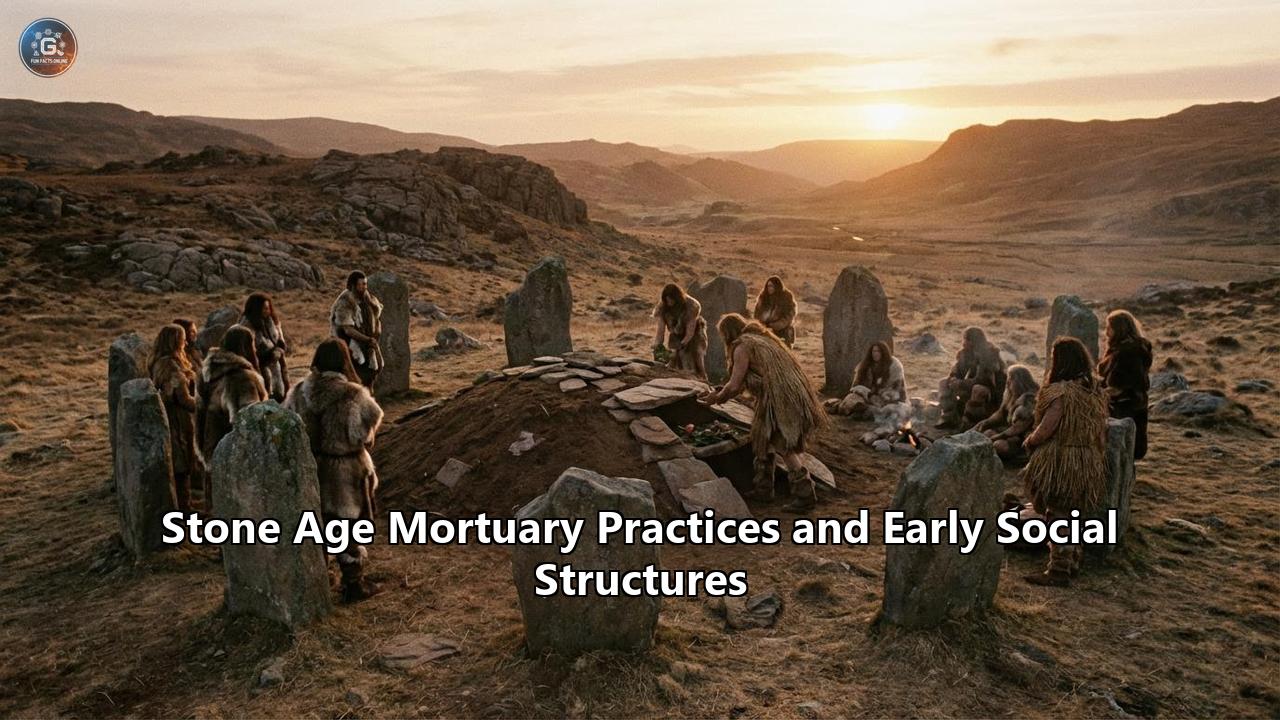
To understand the dawn of human society, we must look not only at how our ancestors lived, but how they faced the great unknown: death. Long before the invention of writing, monumental architecture, or even agriculture, early humans were burying their dead. These acts were far from mere functional disposal. They were profound, symbolic statements about community, cosmology, and the human condition. The archaeological record of Stone Age mortuary practices serves as a silent, subterranean archive, preserving the earliest whispers of social structure, spiritual belief, and the emotional lives of ancient peoples.
From the dark recesses of Paleolithic caves to the sprawling, megalithic cemeteries of the Neolithic, the evolution of how we treat our dead perfectly mirrors the evolution of human society itself. Tracing this lineage reveals a dramatic transformation from small, mobile, egalitarian hunter-gatherer bands into complex, stratified, and highly territorial societies.
Part I: Whispers in the Dark – The Paleolithic Dawn
For the vast majority of human history, our ancestors were nomadic foragers. Life during the Paleolithic (the Old Stone Age, extending roughly from 2.5 million years ago to around 10,000 BCE) was dictated by the movement of animal herds and the shifting of the ice sheets. Yet, even in this fluid, survival-driven existence, we find the roots of ritual behavior.
The Neanderthal Debate: Care, Compassion, and RitualThe question of when intentional burial began is one of the most hotly debated topics in paleoanthropology. While there are controversial claims surrounding earlier hominins like Homo naledi caching their dead in deep cave systems, the first widely accepted evidence of intentional mortuary practice belongs to Neanderthals (Homo neanderthalensis) and early modern humans (Homo sapiens) during the Middle Paleolithic.
Sites like La Chapelle-aux-Saints and La Ferrassie in France, and Shanidar Cave in the Kurdistan region of Iraq, provide compelling evidence. At Shanidar, the discovery of individuals with severe, lifelong injuries—such as Shanidar 1, an individual who was blind in one eye, lacked a right hand, and had severe arthritis—proves that these early communities cared for their sick and disabled. When these individuals died, they were placed in deliberately dug depressions.
The famous "Flower Burial" of Shanidar 4, where pollen from medicinal plants was found clustered around the skeleton, was long championed as proof of Neanderthal funeral rites. While modern taphonomic studies suggest rodents or natural winds might have brought the pollen into the cave, the intentionality of the earth-moving remains undeniable. These actions signify a monumental leap in cognitive evolution: the recognition that a lifeless body retains a social identity that must be honored, or perhaps protected from scavengers out of respect for the deceased.
The Symbolic Explosion of Homo sapiensWith the emergence of anatomically modern humans and the transition into the Upper Paleolithic (roughly 50,000 to 10,000 years ago), mortuary practices underwent a "symbolic explosion." In the Levant, sites like Qafzeh and Skhul caves showcase some of the earliest Homo sapiens burials, dating back 90,000 to 100,000 years. Here, we see the deliberate inclusion of grave goods—such as a large boar mandible placed in the arms of an individual at Skhul—and the extensive use of red ochre.
Red ochre, an iron oxide pigment, is arguably humanity's first universal symbol. Smeared on the bodies of the dead across the globe, it is widely interpreted as a symbol of blood, vitality, and the earth. Its use suggests a belief in sympathetic magic or an afterlife: coating the dead in the color of life to sustain them in the next world.
The Gravettian Splendor: Sunghir and the Origins of InequalityIf early Paleolithic burials hint at egalitarian bands where status was earned rather than inherited, the mid-to-late Upper Paleolithic provides a shocking twist. In the freezing plains of Pleistocene Russia, the site of Sunghir (dating to roughly 30,000 to 34,000 years ago) shatters the illusion of universal Stone Age equality.
At Sunghir, archaeologists uncovered the remains of an older man and, in a spectacular double burial laid head-to-head, a boy of about thirteen and a girl of about ten. The children were draped in absolute wealth. They were adorned with over 10,000 mammoth ivory beads, pierced fox canine teeth, ivory bracelets, and carved art. Furthermore, they were buried with massive spears carved from straightened mammoth tusks.
Experimental archaeology has shown that carving just one of those ivory beads took an hour. The clothing of the children alone represented roughly 10,000 hours of labor. In a nomadic hunter-gatherer society where time is a matter of survival, this expenditure of energy is staggering. Because children of that age could not have possibly accumulated such wealth or achieved such high status through their own hunting prowess or wisdom, Sunghir provides the earliest undeniable evidence of ascribed or inherited status. It indicates that even 30,000 years ago, certain lineages held elevated social ranks, pointing to a level of social stratification previously thought impossible before the invention of agriculture.
Difference and the Divine: Pathologies and ShamanismUpper Paleolithic burials also reveal a deep societal engagement with physical abnormalities. In many cases, individuals with severe physical differences were given the most elaborate burials. The Sunghir children both exhibited severe physiological abnormalities; the Dolní Věstonice triple burial in the Czech Republic features an individual with severe spinal deformities; and in Italy’s Romito Cave, a young man with dwarfism was buried with immense care.
Rather than being ostracized, these individuals were integrated, cared for, and treated with distinct reverence in death. Many anthropologists believe these individuals may have been viewed as having one foot in the physical world and one in the spiritual realm, acting as shamans or intermediaries for their tribes. Their unique burials suggest that Upper Paleolithic societies possessed complex spiritual ideologies that valued the extraordinary.
Part II: The Mesolithic Transition – Roots in the Earth
As the Pleistocene ice sheets retreated and the global climate warmed around 10,000 BCE, humanity entered the Mesolithic (the Middle Stone Age). Environments transformed; dense forests replaced open tundras, and sea levels rose to create resource-rich coastal estuaries. Human populations adapted by adopting semi-sedentary lifestyles, settling down for longer periods to exploit seasonal abundances of fish, nuts, and game.
This environmental shift triggered a profound change in mortuary practices. For the first time in human history, we see the emergence of formal cemeteries—distinct, bounded spaces entirely dedicated to the dead.
Territory and the AncestorsWhy create a cemetery? In a nomadic society, the dead are left behind as the band moves on. But in a semi-sedentary society relying on specific, localized resources like a rich salmon run or an oyster bed, land becomes property. Cemeteries acted as territorial markers. By burying their dead in a specific landscape, Mesolithic communities were laying claim to that land. The ancestors became the deeds to the territory, silently stating to neighboring groups: Our fathers are in this soil; therefore, this land and its bounty belong to us.
The Scandinavian Archives: Vedbæk and SkateholmNowhere is the complexity of Mesolithic society more apparent than in the beautifully preserved cemeteries of southern Scandinavia, particularly Skateholm in Sweden and Vedbæk in Denmark. These sites, dating between 5000 and 4000 BCE, offer a vivid snapshot of communities grappling with changing demographics and emerging social identities.
At Vedbæk, one of the most poignant burials ever discovered features a young woman who died alongside her newborn infant. The community laid the infant to rest on the wing of a whooper swan. This incredibly evocative gesture speaks volumes about Mesolithic cosmology—perhaps the swan, a creature of the air, land, and water, was viewed as a psychopomp to carry the child's soul to the afterlife.
The Skateholm cemetery reveals a society with highly formalized, yet diverse, rituals. Bodies were buried in various positions—supine, hocker (fetal position), or sitting up. Red ochre was still heavily utilized. But perhaps the most striking feature of Skateholm is the inclusion of dogs. Several dogs were given their own individual graves, sprinkled with red ochre and provided with grave goods like flint tools and deer antlers, receiving the exact same mortuary treatment as human beings. This suggests a worldview where the boundary between human and animal was porous, and where animal companions held a social status equal to that of community members.
Furthermore, recent analyses of Mesolithic sites demonstrate that mortuary practices were highly dynamic. At Vedbæk, researchers have documented the coexistence of inhumation (burying the body intact) and cremation, showing that multiple traditions operated simultaneously. Pits containing heavily calcined, cremated human remains alongside unburnt bodies indicate a complex ritual landscape where fire was used perhaps to purify or release the spirit. Additionally, the presence of "Loose Human Bones" (LHB) across Danish Mesolithic sites suggests that the dead were not just buried and forgotten; their remains were sometimes exhumed, manipulated, or kept among the living as relics, while in other instances they may point to darker realities of interpersonal violence or cannibalism.
Challenging Gender and ComplexityRecent archaeological studies continue to revolutionise our understanding of Mesolithic social structures. A groundbreaking 2025 study of the Zvejnieki cemetery in northern Latvia—one of Europe's largest Stone Age burial sites, used continuously for over 5,000 years—has thoroughly challenged modern gender stereotypes. For decades, the presence of stone tools in graves was reflexively associated with male hunters. However, meticulous lithic analysis revealed that stone tools were equally distributed among the graves of women, children, and the elderly. These tools were often purposefully crafted for the burial itself, sometimes deliberately broken to "kill" the object before placing it with the deceased. This proves that women and children played vital, respected roles in the technological and economic survival of the group, and that grave goods were complex ritual symbols rather than simple reflections of a gendered division of labor.
Simultaneously, discoveries in Africa are pushing the timeline of complex forager rituals further back. The recent uncovering of a 9,500-year-old communal cremation pyre in Malawi represents the oldest known cremation in Africa. This finding shatters the outdated assumption that early African hunter-gatherers lacked complex mortuary traditions, proving that highly sophisticated, communal death rituals were a pan-global phenomenon during the climatic transition of the Early Holocene.
The Shadows of Sedentism: Violence in the GraveHowever, the shift toward sedentism also brought shadows. As populations grew and territories became restricted, conflict escalated. The Mesolithic record provides some of the earliest evidence of mass warfare. At the Ofnet Cave in Germany, archaeologists discovered the skulls of 33 individuals—mostly women and children—arranged like eggs in two pits. Almost all the skulls show clear signs of blunt force trauma from stone axes.
In this context, mortuary practices reflect the grim reality of resource competition. The careful arrangement of the Ofnet skulls, despite their violent end, suggests that survivors returned to honor their massacred kin. Social structures were becoming rigid; the lines between "us" and "them" were being drawn in blood and bone.
Part III: The Neolithic Revolution – Monuments, Memory, and Hierarchy
Around 10,000 BCE in the Near East, and spreading globally over the ensuing millennia, humanity undertook its most radical experiment: agriculture. The Neolithic (New Stone Age) transition from foraging to farming fundamentally rewired the human species. People became permanently tied to the land they cultivated. Surpluses of grain allowed for population booms, the specialization of labor, and the accumulation of vast wealth.
If Mesolithic cemeteries whispered about territorial claims, Neolithic mortuary practices shouted it from the mountaintops. The dead were no longer just ancestors; they became deities, property markers, and political tools.
The Plastered Skulls of the Levant: Living with the DeadIn the early farming communities of the Levant, such as Jericho and Ain Ghazal, and extending into Anatolia at sites like Çatalhöyük, the boundary between the living and the dead effectively collapsed. In these densely packed, proto-urban settlements, communities buried their dead directly beneath the plastered floors of their houses. They literally slept, ate, and lived on top of their ancestors.
But the ritual did not end with burial. After the flesh had decayed, the graves were reopened, and the skulls of select individuals were removed. The community then undertook a hauntingly intimate art form: they reconstructed the faces of the deceased using plaster, inserting seashells for eyes, and painting the plaster to resemble living flesh.
These "plastered skulls" were kept above ground, displayed in domestic spaces, and used in complex ancestor veneration cults. In a society where land ownership was based on inheritance, possessing the skulls of your ancestors was the ultimate proof of your right to farm the surrounding fields. The dead became active participants in the socio-economic life of the community.
The Megalithic Landscapes of EuropeAs agriculture spread into Western and Northern Europe, it encountered landscapes of deep forests and dramatic coastlines. Here, the Neolithic obsession with the dead manifested in an architectural explosion: the Megaliths (from the Greek mega meaning "great" and lithos meaning "stone").
From 4000 to 2000 BCE, farming societies mobilized staggering amounts of labor to construct monumental tombs—dolmens, passage graves, and long barrows. Sites like Newgrange in Ireland, Maeshowe in Scotland, and the sprawling alignments of Carnac in France are testaments to early engineering and social organization.
These megalithic tombs were collective burials. Inside a long barrow, the bones of dozens or hundreds of individuals would be mixed together over generations. Skulls were stacked with skulls, femurs with femurs. This communal mixing of bones suggests a social ideology that prioritized the collective over the individual. In death, identity was dissolved into a generalized "ancestor" spirit that protected the lineage.
However, constructing a site like Newgrange—with its 200,000 tons of stone and precise astronomical alignment that floods the inner burial chamber with light on the winter solstice—requires a highly organized workforce. It requires leaders to command the labor, engineers to plan the alignment, and farmers to produce the surplus food to feed the builders. Therefore, while the tombs housed communal bones, the act of building them points to a rapidly stratifying society. A ruling elite was emerging, using the grand theater of death to legitimize their temporal power.
The Rise of the Individual and the EliteAs the Neolithic progressed toward the Chalcolithic (Copper Age) and the Bronze Age, the collective ethos of the megaliths began to fracture. A new social structure was taking hold: the chiefdom.
This shift is starkly visible in the archaeological record as the reappearance of the individual, single-grave burial, but this time accompanied by breathtaking wealth. The Varna Necropolis in Bulgaria (dating to around 4500 BCE) provides a chilling glimpse into the birth of strict social hierarchy. While most graves at Varna contained simple pottery or a few flint tools, a handful of graves held individuals dripping in gold. Grave 43, for example, contained an older male buried with over 1,000 gold objects—more gold than has been found in the rest of the world combined from that epoch. He held a gold-sheathed stone battle-axe, a symbol of martial and political authority.
This represents the culmination of a process that began at Sunghir. Society was now definitively split into the "haves" and "have-nots." The mortuary practices of the Late Neolithic demonstrate that a person's worth was no longer tied merely to their hunting skill or age, but to their lineage, their control over agricultural surplus, and their command over new metallurgical technologies.
Part IV: Deciphering Early Social Structures Through Death
Looking at the vast sweep of Stone Age mortuary practices, several key themes emerge that allow anthropologists to decode the earliest blueprints of human society.
1. The Myth of the Unchanging Hunter-GathererFor decades, modern anthropology operated under the assumption that all pre-agricultural societies were perfectly egalitarian, harmonious bands. Mortuary archaeology proves this is a gross oversimplification. From the princely burials of the Gravettian to the complex cremations of Mesolithic Africa, hunter-gatherers were capable of immense social complexity, seasonal hierarchy, and elaborate spiritual dogmas. Sedentism and agriculture accelerated inequality, but the seeds of social stratification were sown deep in the Pleistocene.
2. Redefining Gender and LaborGrave goods are not a direct mirror of daily life; they are a funhouse mirror, reflecting the idealized social persona of the deceased. The 2025 Zvejnieki lithic studies have dealt a death blow to the rigid "Man the Hunter, Woman the Gatherer" paradigm. When women and children are buried with freshly knapped, ritually killed stone tools, it indicates a society where technological agency and economic contribution were not strictly partitioned by sex. Stone Age gender roles were likely fluid, pragmatic, and highly variable depending on the ecological and cultural context.
3. The Social Standing of ChildrenInfant and child mortality in the Stone Age was brutally high. Yet, the archaeological record is filled with tender, painstakingly prepared child burials. The Vedbæk swan wing burial or the Lagar Velho child in Portugal (wrapped in an ochre-painted shroud) prove that children were viewed as full, emotionally valued members of the community from a very early age. When children are buried with extreme wealth, as at Sunghir, it is the ultimate indicator that a society has transitioned to a system of inherited power.
4. The Origins of Religion and ShamanismThe deep cave spaces of the Paleolithic and the dark chambers of Neolithic passage tombs were the first temples. The deliberate selection of animal parts—such as tortoise shells in Natufian graves or deer antlers at Skateholm—points to animistic belief systems. The dead were not truly gone; they transitioned into a different state of being. Shamans, often individuals with physical anomalies, mediated this boundary. The inclusion of complex rituals, fires, and circular enclosures underscores that human spirituality evolved from a localized, nature-based animism into formalized, ancestral religions meant to maintain social cohesion in growing populations.
The Enduring Legacy of the Stone Age Dead
To study Stone Age mortuary practices is to look into the cradle of human consciousness. The bones, ochre, ivory beads, and shattered stone tools left behind by our ancestors are not morbid relics; they are testaments to love, grief, power, and the desperate human need to leave a mark on eternity.
When a Neanderthal dug a grave in the floor of a cave, they were defying the entropy of nature. When a Mesolithic hunter laid their beloved dog to rest with a sprinkling of red ochre, they were recognizing a kindred soul. When Neolithic farmers hauled megalithic stones across miles of rolling hills, they were building an axis around which their entire civilization would turn.
These ancient social structures—the tension between equality and hierarchy, the negotiation of gender roles, the deep ties to the land, and the veneration of the past—did not disappear with the melting of the glaciers or the forging of the first copper sword. They became the bedrock upon which all subsequent human civilizations were built. By excavating the graves of the Stone Age, we are ultimately excavating the foundations of ourselves.
Reference:
- https://www.journals.uchicago.edu/doi/10.1086/321801
- https://www.scribd.com/document/27013741/From-the-Sunghir-Children-to-the-Romito-Dwarf-Aspects-of-the-Upper-Paleolithic-Funerary-Landscape
- https://www.researchgate.net/publication/256385812_Burial_evidence_for_social_differentiation_of_age_classes_in_the_Early_Upper_Paleolithic
- https://www.researchgate.net/publication/322356605_Memory_landscape_mortuary_practice_understanding_recurrent_ritual_activity_at_the_Jonsas_Stone_Age_cemetery_in_southern_Finland
- https://www.academia.edu/9957687/Three_Cremations_and_a_Funeral_Aspects_of_Burial_Practice_In_Mesolithic_Vedb%C3%A6k
- https://www.megalithic.co.uk/article.php?sid=32658
- https://lucris.lub.lu.se/ws/files/66259656/13_Larsson_1.pdf
- https://www.researchgate.net/profile/Erik-Petersen-2/publication/288700823_DIVERSITY_OF_MESOLITHIC_VEDBAEK/links/5c406817458515a4c72c37b3/DIVERSITY-OF-MESOLITHIC-VEDBAEK.pdf
- https://archaeologymag.com/2025/09/latvian-stone-age-burials-challenge-gender-stereotypes/
- https://www.biznews.com/africa/africas-oldest-cremation-complex-9500
- https://www.pnas.org/doi/10.1073/pnas.2404632121