
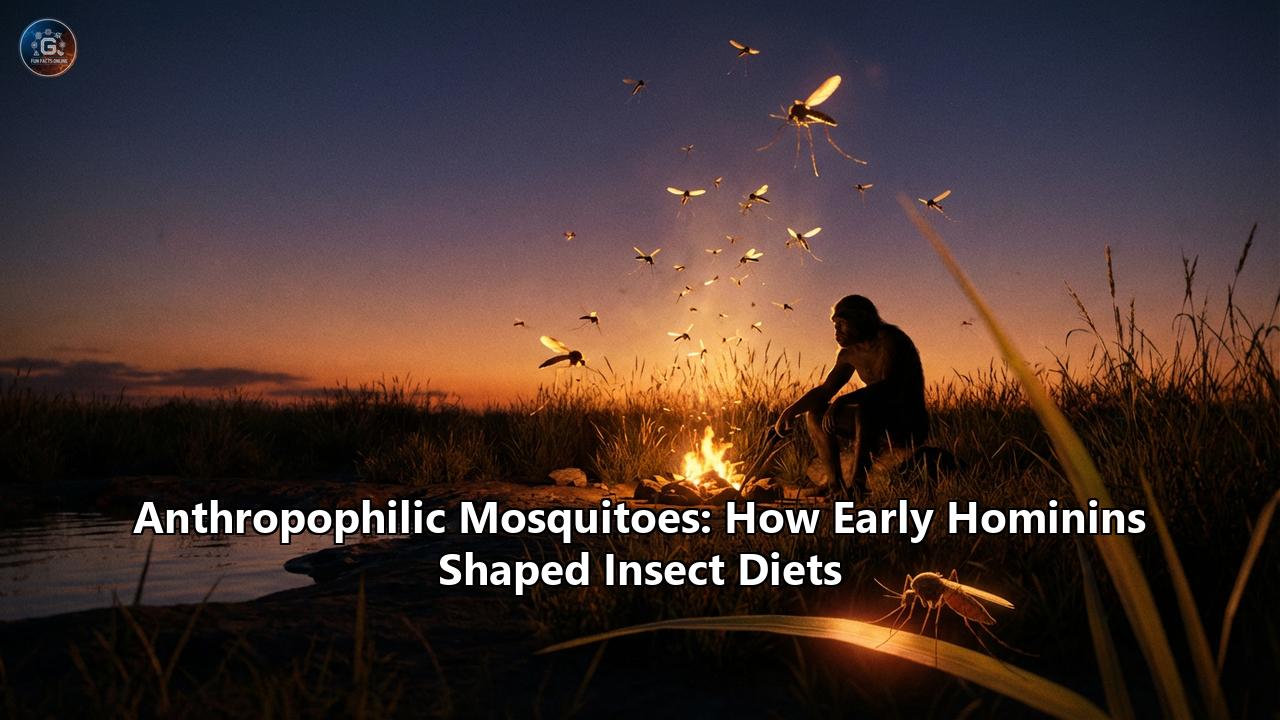
You are trying to enjoy a warm evening outside when you suddenly hear it—that familiar, high-pitched whine. You slap your arm in frustration, looking down at the small, itchy welt left behind. It is a nearly universal human experience to despise mosquitoes. But the next time you swat at one of these bloodsuckers, consider this: you are participating in a bitter, evolutionary rivalry that is older than our own species.
Out of the roughly 3,500 known mosquito species on Earth today, only a tiny fraction actually prefer to feed on people. The vast majority are "zoophilic," meaning they seek out the blood of birds, amphibians, or non-human mammals. The select few that actively hunt us are termed "anthropophilic" (human-loving). For decades, scientists have sought to understand why and when certain mosquitoes developed this lethal affinity for humans. Recent breakthroughs in genomics and evolutionary biology have uncovered a startling truth: we did not just accidentally cross paths with these pests. From our earliest bipedal ancestors to modern urbanites, the physiological traits and cultural habits of hominins directly engineered the diet, genetics, and global spread of the deadliest insects on the planet.
The Sundaland Shift: Homo erectus on the Menu
For a long time, the benchmark for human-mosquito co-evolution was set in Africa. It was widely believed that the major African malaria carriers, such as Anopheles gambiae and Anopheles coluzzii, developed their strong preference for humans relatively recently—between 509,000 and 61,000 years ago—coinciding with the rise of anatomically modern humans and early agriculture.
However, a groundbreaking 2026 study published in Scientific Reports shattered this timeline. Researchers sequenced the DNA of 38 modern mosquitoes across 11 species from the Anopheles leucosphyrus group in Southeast Asia. By analyzing mutation rates, they were able to reconstruct the evolutionary history of these insects. The results were astonishing: an ancestral mosquito species in this group developed a specialized craving for human blood between 2.9 and 1.6 million years ago.
The epicenter of this dietary shift was Sundaland, a vast, now-partially-submerged landmass encompassing the modern-day Malay Peninsula, Borneo, Sumatra, and Java. Because anatomically modern Homo sapiens did not arrive in this region until roughly 76,000 to 63,000 years ago, they could not have been the catalyst. The dates point an unwavering finger at an earlier hominin: Homo erectus.
Homo erectus arrived in the region around 1.8 million years ago. Before their arrival, mosquitoes in the rainforest canopy fed exclusively on the blood of non-human primates, a behavior that had been established for over 3.6 million years. But shifting a diet from a canopy-dwelling monkey to a hominin required more than just flying lower to the ground. For a massive evolutionary leap to occur, the new host had to be a highly reliable and abundant food source. Homo erectus, settling in large numbers on the forest floor, provided a predictable, steady supply of blood. As these early humans wandered into the tropical forests of Southeast Asia, they inadvertently triggered the transformation of a harmless, monkey-biting bug into one of the most effective disease vectors in history.The Genetics of Attraction
Changing a diet from monkeys to humans requires massive genetic rewiring. Mosquitoes hunt largely by smell, utilizing a complex array of chemical receptors on their antennae to detect the unique body odors, carbon dioxide plumes, and thermal signatures of their preferred hosts.
Early hominins were undergoing their own massive physical changes. By shedding thick body fur and developing advanced sweat glands for thermoregulation, our ancestors became walking olfactory beacons. We secrete a distinct, pungent bouquet of skin volatiles, including lactic acid, ammonia, and specific compounds like sulcatone.
To exploit Homo erectus and later Homo sapiens, mosquitoes had to fundamentally alter their sensory apparatus. A prime example of this mechanism is found in the modern Aedes aegypti mosquito, the primary vector for Dengue, Zika, and Yellow Fever. By comparing the genomes of human-hungry mosquitoes to those that prefer animals, scientists discovered specific "hotspots" within the mosquito genome that dictate human preference. In particular, the evolution of human attraction is tightly linked to the heightened expression and ligand-sensitivity of an odorant receptor gene known as AaegOr4. This receptor acts like a biological lock, and the key that opens it is sulcatone—a chemical highly concentrated in human odor.
When a random genetic mutation allowed an ancient female mosquito to better detect hominin scent, she gained a massive survival advantage. She could easily locate a slow-moving, relatively hairless, and abundant host, ensuring a rich blood meal to develop her eggs. Over countless generations, natural selection relentlessly favored these human-sniffing mutants.
Drought, Clay Pots, and Self-Domestication
While Homo erectus was shaping Anopheles mosquitoes in the jungles of Asia, a completely different evolutionary drama was unfolding in West Africa—one driven not just by our bodies, but by our ingenuity.
Aedes aegypti originated as a wild, forest-dwelling species (Aedes aegypti formosus) that exclusively bit non-human animals and laid its eggs in tree holes. Yet, thousands of years ago, a new ecotype emerged: the domesticated Aedes aegypti aegypti, which specializes almost entirely on humans.The driver of this evolution was extreme climate change coupled with human cultural adaptation. West Africa is characterized by long, intensely hot, and dry seasons. Female mosquitoes are caught in a biological bind: they require blood to produce their eggs, but those eggs also require standing water to hatch. As early human societies developed in these arid regions, they began storing water in clay pots, gourds, and other accessible containers to survive the harsh dry months.
In doing so, humans inadvertently created the ultimate mosquito oasis. By gathering water when it was scarce, humans provided mosquitoes with a one-stop-shop containing all the blood and breeding habitat they needed to survive. "It wasn't living with people per se that made mosquitoes specialize in biting humans," explained Princeton researcher Noah Rose. "It was actually them adapting to these really hot and dry places where they lived intimately with humans."
This process is a textbook example of "self-domestication." Much like wolves evolving into domestic dogs by scavenging at the edges of human encampments, these mosquitoes evolved to thrive exclusively in human-constructed environments. Eventually, this highly specialized, human-dependent lineage hitched rides on ships during the transatlantic slave trade, spreading its deadly, virus-transmitting capabilities to the Americas and across the globe.
The Agricultural Revolution and Malaria
A similarly intimate co-evolution occurred with the Afrotropical Anopheles gambiae complex, a group of cryptic (physically indistinguishable but genetically distinct) species responsible for the vast majority of modern malaria transmission.
As human populations exploded and transitioned from hunter-gatherers to agrarian societies, they fundamentally altered the landscape. The clearing of dense forests for agriculture created sunlit puddles, irrigation ditches, and water-filled footprints—the perfect aquatic nurseries for Anopheles gambiae. This new, human-made environment drove the mosquitoes away from zoophily and straight into anthropophily.
Genomic studies reveal that massive introgression—the transfer of genetic information between species via hybridization—allowed the Anopheles gambiae and Anopheles funestus complexes to rapidly adapt to these new anthropogenic niches. The evolutionary divergence within these mosquito species sometimes mirrors our own cultural milestones. For instance, the split between indoor-dwelling and outdoor-dwelling ecotypes of Anopheles funestus traces back roughly 1,850 years, closely following the timeline of African rice domestication and the subsequent shifts in human habitation. We literally built the ecological stages upon which these insects evolved.
An Unending Evolutionary Arms Race
The biological entanglement of hominins and mosquitoes is not just a chapter of prehistoric trivia; it is an ongoing, high-stakes arms race. Anthropophily is the single most critical factor that makes mosquitoes such devastating disease vectors. If they did not overwhelmingly prefer humans, pathogens like Plasmodium falciparum (malaria) or the Dengue virus would struggle to maintain the unbroken transmission cycles required to cause global epidemics.
Today, human behavior and interventions continue to violently force mosquito evolution. The widespread distribution of Insecticide-Treated Nets (ITNs) across Africa has placed immense selective pressure on Anopheles populations. To survive this physical and chemical barrier, some highly anthropophilic mosquitoes are exhibiting rapid behavioral shifts. They are changing their peak biting times from the middle of the night to the early evening or dawn, catching humans while they are awake and outside the protection of their nets. In some areas, these specialized human-biters are even displaying evolutionary bistability—reverting slightly to generalized feeding behaviors and taking blood from cattle when humans become too difficult to access.
Simultaneously, the modern era is accelerating the very conditions that breed human-specialist mosquitoes. Swelling mega-cities and rapid urbanization, particularly in sub-Saharan Africa, are creating vast landscapes filled with artificial containers, poor drainage, and millions of tightly packed humans. Predictive models indicate that within the next 30 years, this intense urbanization—combined with a warming global climate—will likely drive even more mosquito populations to shift their genetic preference toward human hosts.
When we look at the broad sweep of human history, we tend to focus on the mastery of fire, the invention of agriculture, and the building of sprawling metropolises. Yet, perfectly mirrored in our ascent is the shadow of the mosquito. By walking upright, losing our fur, storing water in droughts, and gathering in dense communities, hominins unwittingly sculpted a harmless, canopy-dwelling insect into the deadliest creature on earth. The high-pitched whine that disturbs a quiet evening is not merely a nuisance; it is an ancient echo of our own evolutionary success, a biological consequence of Homo erectus stepping out into the prehistoric forests nearly two million years ago. As long as humans continue to reshape the planet, the mosquito will be right beside us—evolving, adapting, and feeding on our shared history.
Reference:
- https://research.princeton.edu/news/taste-humans-how-disease-carrying-mosquitoes-evolved-specialize-biting-us
- https://www.zmescience.com/science/news-science/mosquitoes-have-been-bugging-humans-since-homo-erectus-1-8-million-years-ago/
- https://www.researchgate.net/publication/274408666_Evolution_of_Anopheles_gambiae_in_Relation_to_Humans_and_Malaria
- https://pmc.ncbi.nlm.nih.gov/articles/PMC6038201/
- https://www.biorxiv.org/content/10.1101/2024.09.28.615606v1.full-text
- https://www.sci.news/biology/homo-erectus-arrival-malaria-mosquitoes-14587.html
- https://www.sciencenews.org/article/mosquitoes-first-human-bite-years
- https://nautil.us/mosquitoes-developed-a-taste-for-human-blood-before-we-existed-1270607/
- https://pmc.ncbi.nlm.nih.gov/articles/PMC4286346/
- https://bigthink.com/surprising-science/why-mosquitoes-evolved-to-like-us/
- https://www.pacb.com/publications/evolution-of-mosquito-preference-for-humans-linked-to-an-odorant-receptor/
- https://www.scienceopen.com/document_file/0f3e402e-00b4-46eb-b879-fa01491d639b/PubMedCentral/0f3e402e-00b4-46eb-b879-fa01491d639b.pdf
- https://communities.springernature.com/posts/traces-of-human-specialization-in-the-genome-of-the-yellow-fever-mosquito-e13274f1-5184-4741-aa0f-26fc94c68429
- https://scispace.com/pdf/human-impacts-have-shaped-historical-and-recent-evolution-in-4uwd0b7bju.pdf
- https://www.princeton.edu/news/2020/07/23/taste-humans-how-disease-carrying-mosquitoes-evolved-specialize-biting-us
- https://www.news-medical.net/news/20250918/Genomic-studies-reveal-human-influence-on-mosquito-evolution-and-disease-spread.aspx
- https://www.pnas.org/doi/10.1073/pnas.2018142117
- https://www.dipterajournal.com/pdf/2020/vol7issue2/PartA/7-1-13-840.pdf