
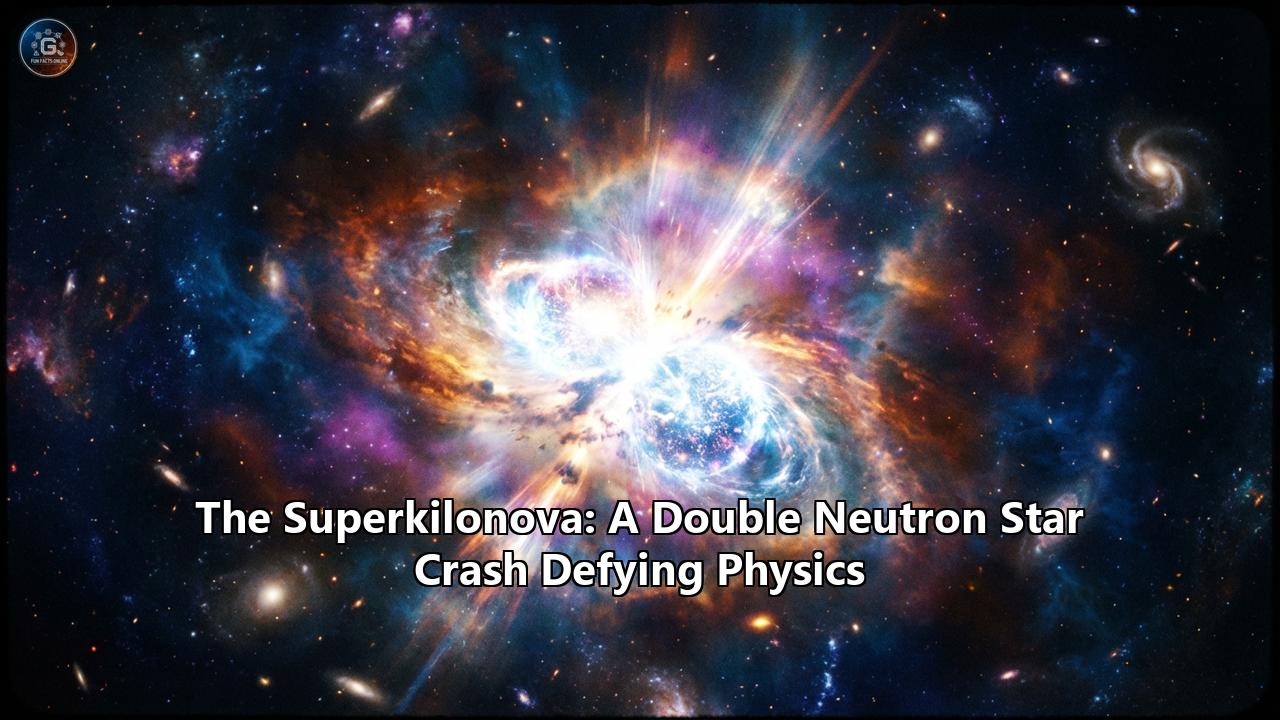
The universe has a way of shattering our most confident assumptions just when we think we have the celestial mechanics figured out. For decades, the life cycle of stars was a well-ordered narrative: massive stars burn bright, collapse, and explode as supernovae, leaving behind a solitary neutron star or a black hole. Separately, binary neutron stars—pairs of these ultra-dense city-sized remnants—were thought to spiral toward each other over billions of years before finally colliding in a "kilonova," a rare forge of the cosmos’s heaviest elements.
But on August 18, 2025, a ripple in spacetime washed over Earth’s gravitational wave detectors, followed moments later by a baffling flash of light that rewrote the textbooks. Astronomers had just witnessed something physically "impossible": a star that exploded twice.
This is the story of AT2025ulz, the event that birthed the term "Superkilonova." It was a cataclysm that defied the standard timelines of stellar evolution, collapsing the eons-long dance of neutron stars into a matter of hours, and proving that the universe is far more violent—and creative—than we ever imagined.
Part I: The Signal from the Void
The morning of August 18, 2025, began as a routine shift for the teams monitoring the Laser Interferometer Gravitational-Wave Observatory (LIGO) in the United States and the Virgo detector in Italy. The detectors had been undergoing their "O5" observing run, hunting for the faint "chirps" of merging black holes and neutron stars.
At 09:42 UTC, the automated pipelines screamed. A signal, loud and clear, arrived from a galaxy approximately 1.3 billion light-years away in the constellation Eridanus. The wave pattern indicated a merger, but the parameters were bizarre. The masses of the colliding objects were remarkably low—one was significantly less massive than the Sun, a range populated by neither neutron stars nor black holes in standard models.
"It was a 'mass gap' object," recalls Dr. Elena Rossi, a lead analyst at the Virgo collaboration. "We see neutron stars around 1.4 solar masses. We see black holes starting around 5 solar masses. But this? One object was barely 0.8 solar masses. It shouldn't exist."
While the gravitational wave community scrambled to make sense of the masses, the electromagnetic astronomers were already slewing their telescopes. The Zwicky Transient Facility (ZTF) at Palomar Observatory was the first to catch the visual counterpart. Located in the exact patch of sky triangulated by LIGO/Virgo was a rapidly fading red dot—the classic signature of a kilonova.
A kilonova occurs when neutron stars collide. The neutron-rich debris, ejected at a fraction of the speed of light, glows red due to the opacity of the heavy elements (lanthanides and actinides) being forged. But kilonovae are supposed to be the end result of a binary system that has decayed over millions of years. They are not associated with fresh star formation or young, massive stars.
Then came the second twist. Three days after the initial red flash, the object didn't fade into oblivion as a kilonova should. Instead, it brightened. It turned blue. It began to exhibit the spectral lines of hydrogen and helium—the fingerprints of a classic core-collapse supernova.
"It was like watching a car crash turn into a volcano," said Dr. Mansi Kasliwal of Caltech. "We saw the end of the movie (the merger) before the beginning (the supernova). It defied causality as we understood it."
The astronomical community realized they were looking at a hybrid monster: a Superkilonova. A single massive star had died, but in its death throes, it had birthed two neutron stars that merged almost instantly.
Part II: The Physics of the Impossible
To understand why AT2025ulz broke physics, we must look at the standard model of stellar death.
The Solitary Death: A massive star (above 8 solar masses) burns through its nuclear fuel. When the core turns to iron, fusion stops. Gravity wins. The core collapses in milliseconds, rebounding off nuclear density to trigger a shockwave—a supernova. The remnant is a single neutron star. The Binary Waltz: In binary systems, two massive stars live their lives. One explodes, leaving a neutron star. Eons later, the second explodes, leaving another. If the system survives these blasts, the two neutron stars orbit each other, emitting gravitational waves that sap their orbital energy. They spiral in, inch by inch, for billions of years until they merge.AT2025ulz short-circuited this process. The detection of gravitational waves (the merger) coincident with the supernova (the explosion) meant the interval between formation and collision wasn't billions of years. It was hours.
How can two neutron stars form and merge inside the span of a single stellar explosion?
The "Core Fission" Hypothesis
Theoretical astrophysicists had toyed with the idea of "rotational instability" for decades, but it was largely relegated to chalkboard exercises. The Superkilonova brought it to life.
The leading theory for AT2025ulz is Core Fission. The progenitor star was likely a Wolf-Rayet star, stripped of its outer hydrogen envelope and spinning at a frantic velocity. As the iron core collapsed, the conservation of angular momentum caused it to spin even faster, reaching speeds close to the breakup point.
Instead of collapsing into a single sphere, the core elongated into a barbell shape and snapped. It split into two distinct clumps of nuclear matter—two "proto-neutron stars."
"Imagine spinning a pizza dough so fast it rips into two pieces," explains Dr. Brian Metzger of Columbia University. "That’s what happened to the core. But these pieces are trapped deep inside the still-exploding star."
These two newborn neutron stars were born in an incredibly tight orbit, separated by perhaps only a few hundred kilometers. At that distance, the emission of gravitational waves is catastrophic. They didn't have billions of years to dance; they had minutes.
While the outer layers of the star were still being blasted outward by the supernova shockwave, the two cores in the center spiraled together and crashed. This merger released the gravitational wave signal detected by LIGO and a jet of neutron-rich matter that powered the initial red flash—the internal kilonova.
The energy from this merger then slammed into the expanding supernova shell, reheating it and causing the strange "blue brightening" observed days later.
Part III: The Precursors – Hints in the Data
Science is rarely a straight line; it is a puzzle assembled backward. While AT2025ulz was the smoking gun, the universe had been dropping hints about Superkilonovae for years.
The Anomaly of GRB 211211A
In December 2021, the Neil Gehrels Swift Observatory detected a Gamma-Ray Burst (GRB) lasting over 50 seconds. By definition, this was a "Long GRB," which are universally attributed to collapsing massive stars (collapsars). "Short GRBs" (under 2 seconds) are the domain of neutron star mergers.
However, when astronomers looked for the afterglow of GRB 211211A, they didn't find a supernova. They found a kilonova. It was a contradiction: a "long" burst from a "merger" event. The physics didn't fit the binary classification. In hindsight, this may have been a system where the merger process was prolonged, or a precursor to the Superkilonova phenomenon where the lines between collapse and merger blur.
The Brightest of All Time: GRB 230307A
In March 2023, the James Webb Space Telescope (JWST) turned its golden eye toward GRB 230307A, the second-brightest gamma-ray burst ever seen. Like its 211211A cousin, it was a long-duration burst that originated from a merger.
JWST’s mid-infrared instruments detected something extraordinary in the wreckage: Tellurium. This rare, heavy element is Earth-like but cosmic in origin. Its presence confirmed that "long" mergers could be prolific factories of r-process elements (rapid neutron capture), creating gold, platinum, and iodine.
These events were the "soft openers" for the main act. They showed us that neutron star mergers could generate long, complex energy bursts. But AT2025ulz was different. It wasn't just a merger pretending to be a collapse; it was a collapse containing a merger.
Part IV: The Cosmic Alchemy
The discovery of the Superkilonova has profound implications for the Periodic Table of Elements.
For a long time, astronomers struggled to account for the abundance of heavy elements in the universe. Regular supernovae are great at making iron, oxygen, and carbon, but they fail to produce the "r-process" elements—those heavy atoms like gold, uranium, and plutonium that require a rapid bombardment of neutrons to form.
Binary neutron star mergers (standard kilonovae) were the proposed solution. But there was a problem: they are too rare. If binaries take billions of years to merge, the early universe should have been devoid of gold. Yet, we see ancient stars rich in these heavy metals.
The Superkilonova solves the riddle.
Because Superkilonovae occur immediately at the death of a massive star, they don't require the billion-year wait. They can inject heavy r-process elements into the galaxy just millions of years after star formation begins.
"AT2025ulz taught us that nature has a 'fast track' for gold production," says Dr. Jennifer Barnes, a theorist specializing in nucleosynthesis. "A single Superkilonova can produce 100 Earth masses of pure gold and disperse it instantly into the star-forming nebula. This explains why we see heavy metals even in the oldest galaxies observed by Webb."
The "red flash" observed by ZTF in the first hours of the AT2025ulz event was the radioactive glow of these elements decaying. It was the light of creation—tons of tellurium, lanthanum, and gold cooling down from a billion degrees.
Part V: The Mass Gap Mystery
One of the most disturbing aspects of the AT2025ulz gravitational signal was the mass of the lighter object: roughly 0.8 solar masses.
Standard neutron stars are remarkably uniform, usually weighing in at about 1.4 times the mass of the Sun (the Chandrasekhar limit implies the core collapse usually settles near this point). A neutron star under 1 solar mass is theoretically difficult to produce. If a core is too light, it shouldn't collapse into a neutron star at all; it should stay a white dwarf. But white dwarfs cannot exist inside a supernova explosion.
The "Core Fission" theory explains this. If a 1.6 solar mass core splits unevenly, you could get two fragments: one 0.8 solar mass and another 0.8 solar mass (minus binding energy losses).
These "sub-mass" neutron stars are exotic objects. Their internal pressure is lower, meaning they might be physically larger and "fluffier" (in nuclear terms) than typical neutron stars. Their collision would be less violent than a standard merger, which matches the data from AT2025ulz—the gravitational wave "chirp" was softer and more prolonged than the sharp crack of GW170817 (the 2017 merger).
This discovery forces nuclear physicists to rewrite the Equation of State for dense matter. It suggests that neutron star matter can be stable at lower densities and masses than previously thought, opening up a new family of compact objects.
Part VI: The Multi-Messenger Future
The detection of the Superkilonova is a triumph of "Multi-Messenger Astronomy"—the coordinated use of light, particles, and gravitational waves to observe the universe.
In the past, an optical telescope might have dismissed AT2025ulz as a weird, fast-evolving supernova. A gravitational wave detector might have dismissed it as a glitch or a low-significance noise artifact due to the strange masses. Only by combining the two—hearing the crash and seeing the flash—could the picture be resolved.
This event has kickstarted a new race. The "O5" run of LIGO/Virgo/KAGRA is now being combed for "sub-threshold" triggers—signals that were previously ignored because they didn't look like standard black holes.
Furthermore, the Roman Space Telescope (scheduled for launch soon) and the continued operation of JWST are being prepped to hunt for the "orphan" afterglows of these events in the distant universe.
Part VII: A Universe of Violence and Wonder
The Superkilonova AT2025ulz stands as a stark reminder of our ignorance. In a single event, the cosmos demonstrated that:
- Stars can split their cores and merge with themselves.
- Neutron stars can exist below the theoretical mass limit.
- The production of heavy elements is tied to the death of massive stars in a way far more complex than simple supernovae.
We live in a galaxy enriched by these impossible crashes. The gold in our wedding rings, the uranium in our reactors, and the iodine in our blood were likely forged not just in the slow spiral of ancient binaries, but in the violent, immediate screams of Superkilonovae.
As we look up at the night sky in 2026, we do so with a new understanding. The dark spaces between the stars are not empty; they are vibrating with the echoes of engines that defy our physics, writing the history of matter in bursts of gamma rays and ripples of gravity. The Superkilonova is not just a rarity; it is a crucial piece of our own origin story, a fiery bridge between the death of stars and the materials of life.
Reference:
- https://www.youtube.com/watch?v=RuD8mqQI6qQ
- https://www.livescience.com/space/first-ever-superkilonova-double-star-explosion-puzzles-astronomers
- https://www.popsci.com/science/first-superkilonova/
- https://www.sciencenews.org/article/double-explosion-by-star-superkilonova
- https://www.smithsonianmag.com/smart-news/in-a-first-astronomers-may-have-witnessed-a-rare-double-explosion-of-a-star-called-a-superkilonova-180987908/
- https://www.youtube.com/watch?v=Mw5iEI6ntZs
- https://www.universetoday.com/articles/the-aftermath-of-neutron-star-mergers
- https://ciera.northwestern.edu/2022/12/07/surprise-kilonova-upends-established-understanding-of-long-gamma-ray-bursts/
- https://www.sciencenews.org/article/gamma-ray-burst-breaks-rules-kilonova
- https://www.iflscience.com/brightest-kilonova-to-date-gives-insight-into-the-origin-of-gamma-ray-bursts-57764
- https://www.gemini.edu/news/press-releases/noirlab2228
- https://science.nasa.gov/asset/webb/kilonova-and-host-galaxy/
- https://science.nasa.gov/missions/webb/nasas-webb-makes-first-detection-of-heavy-element-from-star-merger/
- https://news.clemson.edu/astronomers-discover-heavy-elements-after-bright-gamma-ray-burst-from-neutron-star-merger/
- https://scitechdaily.com/challenging-our-understanding-of-the-universe-astronomers-discover-an-enigmatic-cosmic-explosion/
- https://goldncloudpublications.com/index.php/irjaem/article/download/483/502/1045
- https://news.northwestern.edu/stories/2024/04/first-gravitational-wave-detection-of-mass-gap-object-merging-with-neutron-star
- https://www.chronicleindia.in/current-affairs/11294-astrophysicists-discover-first-neutron-star-mystery-object-merger