
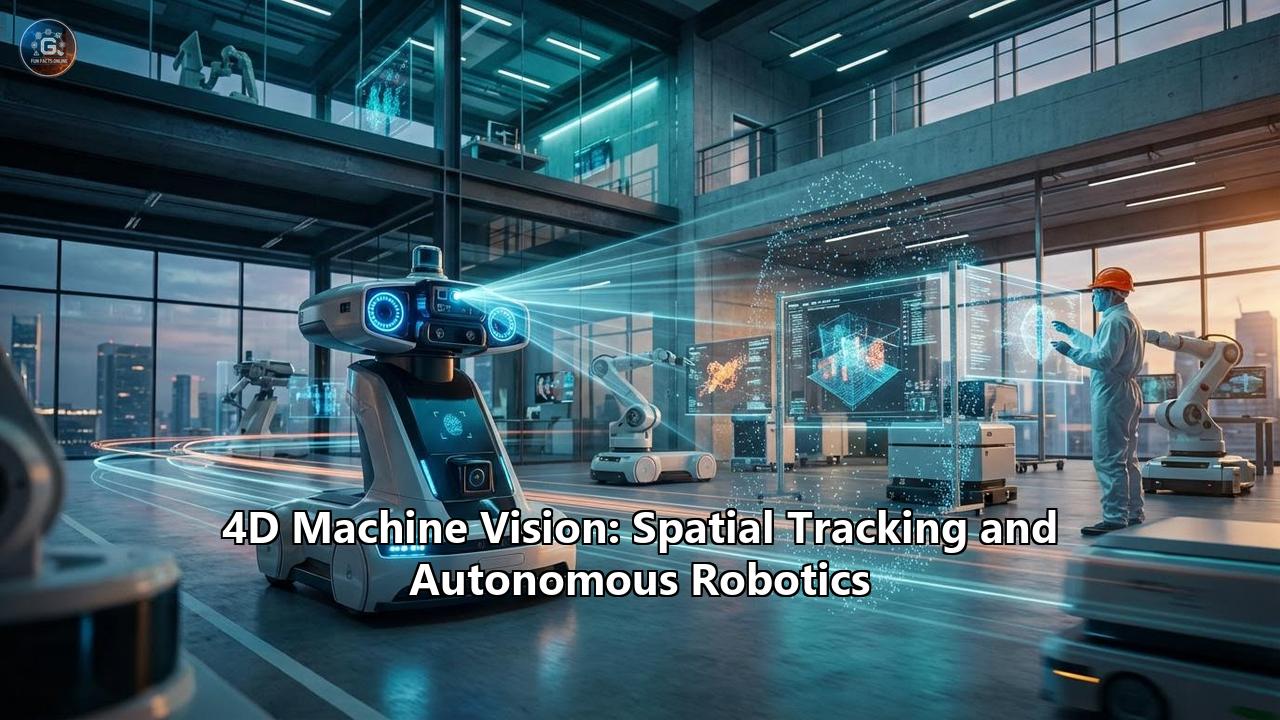
The evolution of artificial intelligence has long been constrained by a single, fundamental bottleneck: the inability of machines to truly perceive the physical world the way biological organisms do. For decades, robotic perception was trapped in a flattened reality, relying on 2D images that stripped away depth, context, and scale. The leap to 3D vision gave machines an understanding of space, allowing them to measure distance and navigate static environments. Yet, the real world is not a static diorama. It is a chaotic, infinitely complex ecosystem defined by constant motion.
To achieve true autonomy, machines needed the fourth dimension: time.
Welcome to the era of 4D machine vision—a paradigm shift where spatial tracking and autonomous robotics converge to give machines near-human, and in some cases superhuman, situational awareness. By capturing range, azimuth, elevation, and instantaneous velocity simultaneously, 4D machine vision is transforming how robots understand, predict, and interact with their surroundings. From the factory floor to the skies above our smart cities, the integration of 4D perception is rewriting the rules of what autonomous systems can achieve.
The Anatomy of 4D Machine Vision: Beyond Spatial Mapping
Traditional 3D vision, powered by conventional cameras and time-of-flight (ToF) LiDAR, captures spatial data by creating point clouds that represent the geometry of an environment. However, understanding movement requires comparing multiple 3D frames over time, a computationally heavy process fraught with latency, motion blur, and predictive errors. 4D perception fundamentally changes this architecture by embedding temporal dynamics directly into the sensor data at the hardware level.
The transition to 4D machine vision is being driven by three revolutionary hardware pillars: 4D Imaging Radar, Coherent FMCW LiDAR, and Neuromorphic Event Cameras.
4D Imaging Radar: Seeing Through the Noise
Historically, radar was a low-resolution sensor capable only of detecting the presence and speed of large metallic objects. Today, 4D imaging radar, operating at millimeter-wave (mmWave) frequencies—commonly 77GHz—has emerged as a foundational technology for robotic perception. Unlike optical sensors that are blinded by fog, heavy rain, dust, or pitch darkness, 4D radar provides absolute environmental resilience.
What makes it "4D" is its ability to capture a high-resolution point cloud encompassing four dimensions of data: range (distance), azimuth (horizontal angle), elevation (vertical angle), and direct Doppler velocity. Because the Doppler effect measures the phase shift of the returning wave, the radar can instantly determine the radial velocity of every single point in its field of view without needing to compare sequential frames. This allows an autonomous robot to distinguish between a stationary bridge and a moving truck beneath it, or detect a pedestrian stepping out from behind a parked car, long before a camera could process the pixels.
Coherent FMCW LiDAR: The Bionic Eye
While 4D radar excels in harsh weather and long-range detection, Frequency-Modulated Continuous Wave (FMCW) LiDAR brings microscopic precision to the 4D landscape. Traditional ToF LiDAR emits laser pulses and times their return, but FMCW LiDAR emits a continuous, frequency-chirped laser beam. By measuring the interference between the emitted and received light, it captures both depth and velocity for every single pixel simultaneously.
Recent breakthroughs in silicon photonics have allowed these complex optical systems to be integrated onto single microchips, drastically reducing cost and size while increasing performance. Furthermore, innovations in "bionic" or "retinal" LiDAR architectures have introduced dynamic gazing capabilities. Much like the human fovea, which focuses high-resolution vision on a specific region of interest (ROI) while maintaining a lower-resolution peripheral view, adaptive FMCW LiDAR can dynamically allocate sensing channels to critical areas without global oversampling. This hardware-efficient design enables real-time 4D imaging at a staggering 0.012° beyond-retinal resolution, offering unprecedented clarity for machines tracking rapid, complex movements.
Neuromorphic Event-Based Vision: The Biological Approach
Perhaps the most disruptive innovation in optical machine vision is the advent of event-based sensors. Conventional cameras operate by taking discrete snapshots at fixed frame rates (e.g., 30 or 60 frames per second), which creates massive data redundancy and introduces motion blur for fast-moving objects.
Event-based cameras, inspired by the biological retina, discard the concept of frame rates entirely. Instead, each individual pixel operates independently and only generates an "event" or signal when it detects a change in light intensity. If a robot is looking at a static wall, the sensor transmits zero data. But the moment a fast-moving object enters the frame, the active pixels fire continuously with microsecond latency. This leads to an astonishingly high dynamic range (up to 120 dB, compared to a standard camera's 70 dB) and dramatically reduces the computational bandwidth required to process visual data. By capturing the exact temporal micro-dynamics of a scene, event cameras provide a flawless 4D data stream perfectly suited for high-speed robotic reflexes.
The Cognitive Engine: AI and Spatiotemporal Processing
Hardware alone does not create autonomy; the raw 4D data streams must be interpreted, categorized, and acted upon in milliseconds. The software intelligence layer has evolved from rigid, rule-based programming to dynamic, self-learning artificial intelligence.
Vision Transformers and 4D Foundation Models
For years, Convolutional Neural Networks (CNNs) dominated computer vision. However, CNNs struggle to capture global spatial relationships in highly cluttered environments. In recent years, the industry has aggressively pivoted toward Vision Transformers (ViTs). By dividing visual data into patches and applying self-attention mechanisms, ViTs excel at understanding complex spatiotemporal relationships.
This has given rise to unified 4D foundation models. Cutting-edge frameworks, such as Uni4D-LLM and Track4Gen, are designed to seamlessly integrate 4D scene understanding with natural language processing and spatial tracking. Track4Gen, for example, unifies video generation and point tracking across frames, providing enhanced spatial supervision. These AI models don't just recognize a human; they understand the trajectory of the human's limbs, predict where they will step next, and instantly compute an evasion or collaboration path for the robot.
Synthetic 4D Data and Generative AI
A major hurdle in training autonomous systems is the scarcity of edge-case training data—how do you teach a robot to handle a scenario that only happens once in ten million hours of operation? Generative AI models, specifically tailored for 4D generation like Dream4D and 4Diffusion, solve this by synthesizing spatiotemporally consistent 4D environments. These models use complex diffusion techniques to simulate physically plausible temporal dynamics, allowing engineers to train robots in hyper-realistic virtual worlds. By creating synthetic scenarios of failing machinery, erratic human behavior, or extreme weather conditions, Generative AI ensures that 4D machine vision systems are battle-tested before they ever touch the physical world.
Edge Computing: Intelligence at the Source
Processing massive 4D point clouds in the cloud introduces unacceptable latency for systems that must react in milliseconds. The solution is Edge AI. By bringing high-performance computing directly to the sensor or the robotic platform, edge-optimized neural networks process 4D data instantaneously. This localized processing not only slashes response times but also drastically reduces bandwidth costs and fortifies data privacy by keeping raw, sensitive data on the device.
Redefining Spatial Tracking in Dynamic Environments
Spatial tracking is the heartbeat of autonomous navigation. Historically, robots relied on Simultaneous Localization and Mapping (SLAM) to build static 3D maps of their environment and locate themselves within it. However, classic SLAM breaks down in highly dynamic spaces where the environment is constantly shifting—such as a bustling warehouse, a busy city intersection, or a crowded hospital corridor.
4D machine vision upgrades this capability to 4D SLAM. Because 4D sensors inherently capture velocity at the pixel or point-cloud level, the tracking algorithm can instantly separate static background infrastructure from dynamic actors.
Micro-Doppler Signatures and Biometric Tracking
One of the most profound applications of 4D spatial tracking is the use of micro-Doppler signatures. When a person walks, their torso moves at one speed, but their arms and legs swing at different, oscillating speeds. A 4D imaging radar or FMCW LiDAR captures these minute velocity variations, creating a unique kinematic signature for the subject.
Advanced multi-target tracking algorithms can use these micro-Doppler features to identify and track individuals even when they are temporarily occluded by obstacles or leave the sensor's field of view. In a multi-user scenario, this ensures absolute identity consistency without relying on facial recognition, making it a highly robust, privacy-preserving method of spatial tracking for applications ranging from smart home healthcare monitoring to complex industrial safety zones.
Autonomous Robotics Transformed
The injection of 4D machine vision into robotic platforms is unlocking capabilities across multiple industries that were previously deemed science fiction.
Industrial Automation and Collaborative Robots (Cobots)
Manufacturing and logistics have been fundamentally rewired by 4D machine vision. In warehouse environments, Autonomous Mobile Robots (AMRs) must navigate a chaotic dance of human workers, forklifts, and shifting inventory. Traditional 2D/3D optical sensors often trigger false emergency stops due to lighting glares, shadows, or an inability to accurately judge the speed of an approaching object.
Equipped with 4D radar and AI-enhanced vision software, these robots can confidently track the precise velocity and vector of every moving object in the warehouse. The 4D perception enables robots to perform complex tasks like high-speed counting, adaptive palletizing, and identifying microscopic surface defects in real-time. Furthermore, collaborative robots (cobots) equipped with bionic LiDAR can dynamically adjust their robotic arms based on the predictive tracking of a human worker's micro-movements, ensuring fluid, injury-free collaboration.
Unmanned Aerial Vehicles (UAVs) and the Z-Axis Challenge
Navigating the ground is difficult, but navigating the air adds the unforgiving complexity of the Z-axis. UAVs and delivery drones operate in an environment fraught with thin power lines, unpredictable wind shear, and sudden obstacles like birds or other aircraft. 4D imaging radar and coherent LiDAR give drones the "eyes in the sky" required for high-speed, autonomous flight in dense urban environments. Because 4D sensors capture vertical elevation and instantaneous velocity, a drone delivering medical supplies can detect a swaying overhead wire or a rapidly approaching obstacle and execute microsecond course corrections without relying on a GPS signal or clear weather conditions.
Connected Mobility and Smart Cities
The future of autonomous mobility is not just about isolated self-driving cars; it is about a seamlessly connected ecosystem. 4D machine vision is democratizing advanced perception, allowing not just cars, but electric scooters, autonomous shuttles, and small delivery bots to possess enterprise-grade situational awareness.
As these devices move through a city, their 4D sensors act as nodes in a massive, real-time spatial network. If a delivery bot's 4D radar detects a pedestrian sprinting toward a blind intersection, that spatial tracking data can be instantly shared with an approaching autonomous vehicle. This collaborative perception, powered by the collective intelligence of every connected 4D device, creates an environment where machines anticipate human actions collectively, eliminating blind spots and paving the way for zero-collision smart cities.
Healthcare and Humanoid Robotics
The non-invasive nature of 4D machine vision holds immense potential for healthcare and humanoid robotics. 4D radar can monitor the micro-movements of a patient's chest to track respiration and heart rates with clinical precision, without a single wire touching their body. In the realm of humanoid robotics, the ability to read body posture and hand gestures via 4D spatial tracking allows robots to infer human intent. A nursing assistant robot could detect if a patient is losing their balance by analyzing their gait and kinematic momentum, rushing to support them before a fall occurs.
Sensor Fusion: The Ultimate Perception Stack
Despite the incredible advancements in individual technologies, there is no single "silver bullet" sensor. FMCW LiDAR provides unmatched bionic resolution but requires complex photonics. 4D Imaging Radar penetrates any weather condition and measures long-range velocity but lacks the photorealistic semantic detail of an optical camera. Event cameras capture lightning-fast temporal dynamics but discard static background data.
The true power of 4D machine vision lies in Sensor Fusion. Modern autonomous robotics utilize an integrated perception stack where the strengths of one sensor offset the weaknesses of another. For instance, a 4D radar can detect the presence, speed, and trajectory of a pedestrian moving through heavy fog at 300 meters. The radar immediately directs the high-resolution, dynamic-gazing FMCW LiDAR (acting as a bionic fovea) to that specific Region of Interest to confirm the object's exact spatial dimensions. Simultaneously, the AI software merges this data with the optical or event-camera stream to semantically classify the object, achieving a state of "4D-plus" cooperative sensing. This multi-modal integration ensures that the robotic system maintains a flawless, unbroken understanding of its environment regardless of sensory degradation.
The Horizon: AGI, Privacy, and the Path to 2030
As we look toward the end of the decade, the implications of 4D machine vision extend far beyond operational efficiency. One of the most critical debates surrounding the deployment of visual sensors in public spaces is privacy. 4D machine vision offers an elegant solution. Technologies like mmWave radar and time-of-flight depth estimation inherently protect privacy by designing systems with "privacy at the core". They track shapes, velocities, and kinematic behaviors without capturing the highly identifiable facial textures recorded by traditional RGB cameras. This allows for the widespread deployment of autonomous surveillance, smart infrastructure, and robotic assistance in sensitive environments like hospitals, corporate campuses, and private homes without creating a dystopian surveillance state.
Furthermore, 4D machine vision is a critical stepping stone on the path to Artificial General Intelligence (AGI). True AGI requires "embodied AI"—an artificial intellect that can interact seamlessly with the physical universe. By providing AI models with a flawless, real-time, four-dimensional understanding of space and time, we are giving machines the perceptual equivalent of human intuition.
Conclusion
The leap from static imaging to 4D machine vision marks one of the most significant technological milestones of the 21st century. By merging the spatial clarity of bionic LiDAR and advanced optics with the relentless temporal tracking of 4D imaging radar and neuromorphic event sensors, we have unlocked a new frontier in automation. Spatial tracking is no longer just about knowing where an object is; it is about understanding where it has been, how fast it is moving, and predicting exactly where it will be.
As edge computing accelerates, generative AI perfects synthetic training, and sensor fusion bridges the physical and digital divide, autonomous robotics will transcend their current limitations. From factory floors operating with flawless precision to drones weaving safely through our cityscapes, and humanoid robots seamlessly assisting in our daily lives, 4D machine vision is the ultimate catalyst. It is the technology that finally allows machines to open their eyes and truly see the world in all its dynamic, chaotic, and beautiful complexity.
Reference:
- https://www.reportsnreports.com/semiconductor-and-electronics/4d-imaging-radar-expands-beyond-automotive-to-drones-robotics-and-smart-infrastructure/
- https://www.azooptics.com/Article.aspx?ArticleID=2421
- https://www.zlyradar.com/how-4d-imaging-radar-enhances-ai-in-autonomous-robots/
- https://arberobotics.com/4d-imaging-high-resolution-radar-explained/
- https://africanminingmarket.com/machine-vision-now-in-4d/22664/
- https://www.researchgate.net/publication/399004286_Integrated_bionic_LiDAR_for_adaptive_4D_machine_vision
- https://www.ee.cityu.edu.hk/~cwang/document/Integrated%20bionic%20LiDAR%20for%20adaptive%204D%20machine%20vision.pdf
- https://www.youtube.com/watch?v=6O8fuyXD5VI
- https://www.mech-mind.com/blog/machine-vision-software-trends.html
- https://averroes.ai/blog/computer-vision-trends
- https://huggingface.co/papers?q=diffusion-based%204D%20Scene%20Trajectory%20Generator
- https://www.researchgate.net/publication/335361592_mID_Tracking_and_Identifying_People_with_Millimeter_Wave_Radar
- https://etechgroup.com/robotics-automation-companies/
- https://www.bitsensing.com/blog/from-cars-to-drones-how-4d-imaging-radar-is-shaping-the-future-of-mobility-seeing-the-world-more-reliably
- https://www.youtube.com/watch?v=Uvo78ixchLs