
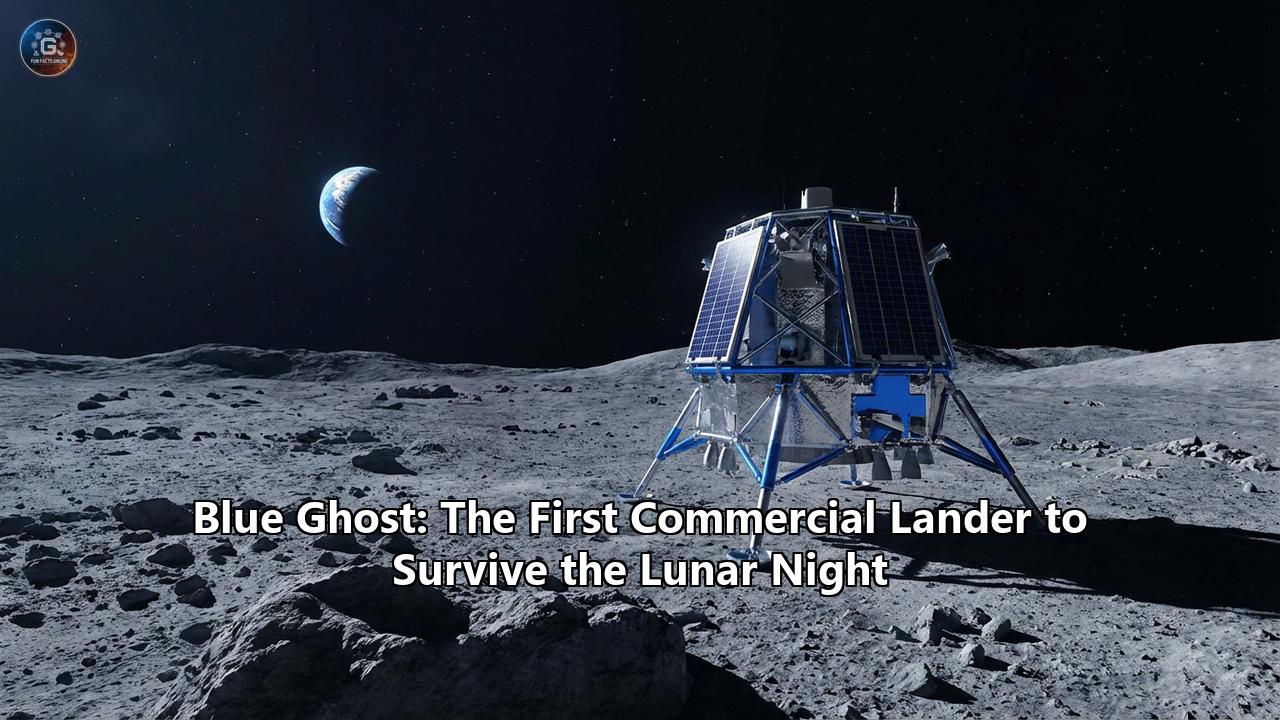
In the annals of space exploration, the Moon has always kept one formidable defense against human ambition: the lunar night. For two weeks, the surface plunges into a deep freeze of -280°F (-173°C), a darkness so absolute and a cold so biting that it shatters electronics, drains batteries, and turns advanced robotics into frozen statues. For decades, surviving this "long night" was the exclusive domain of nuclear-powered government rovers. But in March 2025, a commercial lander named Blue Ghost changed the narrative forever.
Developed by the Texas-based company Firefly Aerospace, Blue Ghost didn’t just land; it endured. It completed a flawless mission that culminated in a historic feat: becoming the first commercial spacecraft to operate into the freezing abyss of the lunar night, beaming back data and images of a sunset that no private eye had ever seen before. This is the story of how a small lander named after a rare firefly lit up the future of the lunar economy.
The Challenge of the Cryogenic Dark
To understand Blue Ghost’s achievement, one must first respect the enemy. The lunar day lasts 14 Earth days, followed by 14 Earth days of night. Without an atmosphere to trap heat, the temperature swing is violent. Most commercial landers are designed as "day-trippers"—they land after sunrise, sprint to complete their science goals, and die the moment the sun dips below the horizon.
Surviving even a few hours past sunset requires a mastery of thermal engineering and energy management that had previously eluded the private sector. The batteries must not only power the computer but also keep themselves warm enough to discharge. The electronics must withstand thermal contraction that can snap circuit boards. For a commercial entity to face this environment was the next great barrier in the "New Space" race.
A Perfect Touchdown in Mare Crisium
The journey began on January 15, 2025, atop a SpaceX Falcon 9 rocket. Unlike the "sprint" trajectories of the Apollo era, Blue Ghost took a fuel-efficient, 45-day spiral to the Moon, allowing its team to test every system in deep space. On March 2, 2025, it faced its moment of truth.
While previous commercial attempts had ended in tipped-over landers or crash landings, Blue Ghost performed a ballet of autonomy. Its vision-based navigation system scanned the hazardous terrain of Mare Crisium (the Sea of Crises) and gently set the 1,500-kilogram vehicle down near the volcanic mound of Mons Latreille.
"It was upright, stable, and talking," said Firefly CEO Jason Kim. "We didn't just land; we arrived."
14 Days of Science and the "Diamond Ring" Eclipse
For the next two weeks, Blue Ghost was a hive of activity. It carried ten payloads for NASA’s Commercial Lunar Payload Services (CLPS) initiative, effectively serving as a robotic scout for future Artemis astronauts.
The lander drilled into the regolith to measure heat flow, tested a radiation-tolerant computer, and even acted as a node for a "lunar GPS" experiment, tracking signals from Earth's GNSS satellites to prove that future astronauts could navigate on the Moon just like drivers do on Earth.
But the mission’s most stunning surprise came on March 14, 2025. As a total lunar eclipse was viewed from Earth, Blue Ghost looked up to see a total solar eclipse from the Moon. The Earth passed directly in front of the Sun, plunging the landing site into premature darkness and cold. Blue Ghost didn’t flinch. It captured breathtaking images of the "diamond ring" effect—sunlight refracting through Earth’s atmosphere—and continued operating through the sudden temperature drop, a dress rehearsal for the true night to come.
Crossing the Threshold: Into the Night
On March 16, 2025, the sun began to set on Mare Crisium. This was the end of the line for the solar panels. The standard procedure for a commercial lander would be to power down immediately to preserve data. Firefly, however, had a bolder plan.
As the shadows lengthened and the solar power trickled to zero, Blue Ghost switched to its onboard battery reserves. For the first time in commercial history, a private lander watched the sun vanish and kept working.
For over five hours into the lunar night, Blue Ghost operated in the dark. It pointed its cameras at the western horizon, capturing the eerie "horizon glow"—a phenomenon hypothesized to be caused by levitating lunar dust charged by the solar wind. These images, sent back before the batteries finally drained, provided scientists with the first ground-level view of a lunar sunset's aftereffects since the Apollo 17 astronauts left in 1972.
That five-hour vigil was more than just a bonus; it was a statement. It proved that Firefly’s thermal design could hold off the deep freeze longer than predicted, validating the architecture for future missions that will survive the entire two-week night.
The "Ghost" That Lives On
Blue Ghost’s final transmission was a poetic "Goodnight, friends," received at Firefly’s mission control in Cedar Park, Texas. While the lander was not expected to wake up after the two-week freeze (and indeed, remained silent during the April check-in), its legacy was secured.
It had achieved 100% of its mission objectives, downloaded 119 gigabytes of data (more than double the requirement), and proved that a commercial company could execute a complex, full-lunar-day mission with precision.
The Future: Mission 2 and True Night Survival
The success of Blue Ghost Mission 1 has set the stage for an even more ambitious sequel. Scheduled for 2026, Blue Ghost Mission 2 will head to the far side of the Moon. This time, the "survival" aspect will be taken to the next level.
Mission 2 will carry NASA's LuSEE-Night (Lunar Surface Electromagnetics Experiment-Night) radio telescope. While the lander itself may power down, it is designed to serve as a sturdy platform for this payload, which will survive the night to listen to the ancient radio waves of the universe, shielded from Earth's noise by the bulk of the Moon itself. Furthermore, Firefly is integrating Volta Space Technologies' LightPort, a wireless power receiver designed to test technologies that could one day beam energy to landers during the dark, eliminating the need for hibernation altogether.
Conclusion
In the harsh calculus of spaceflight, survival is measured in data, in milestones, and in the boundaries pushed. Blue Ghost Mission 1 didn’t just survive the landing; it survived the skepticism facing the commercial space industry. By operating past the sunset and beaming back the secrets of the gathering dark, it earned its title. It was the first commercial lander to look the lunar night in the eye and keep its eyes open, paving the way for a future where humanity doesn't just visit the Moon by day, but stays through the night.
Reference:
- https://www.astronomy.com/space-exploration/fireflys-blue-ghost-lander-nails-lunar-mission/
- https://www.sciencenews.org/article/favorite-space-stories-2025
- https://www.smithsonianmag.com/smart-news/see-last-weeks-stunning-eclipse-from-the-moon-in-photos-captured-by-the-blue-ghost-lander-now-at-the-end-of-its-mission-180986253/
- https://en.wikipedia.org/wiki/Blue_Ghost_Mission_1
- https://skyandtelescope.org/astronomy-news/spaceflight-for-astronomy-a-look-back-and-ahead/
- https://www.youtube.com/watch?v=zMniZKhYVmQ
- https://helio.space/projects/firefly-aerospace-blue-ghost-2-lunar-lander/
- https://en.wikipedia.org/wiki/Firefly_Aerospace_Blue_Ghost
- https://www.nasaspaceflight.com/2025/03/blue-ghost-im-2-landings/
- https://www.tomorrowsworldtoday.com/technology/space-firms-will-test-moon-receiver-for-a-lunar-power-grid/