
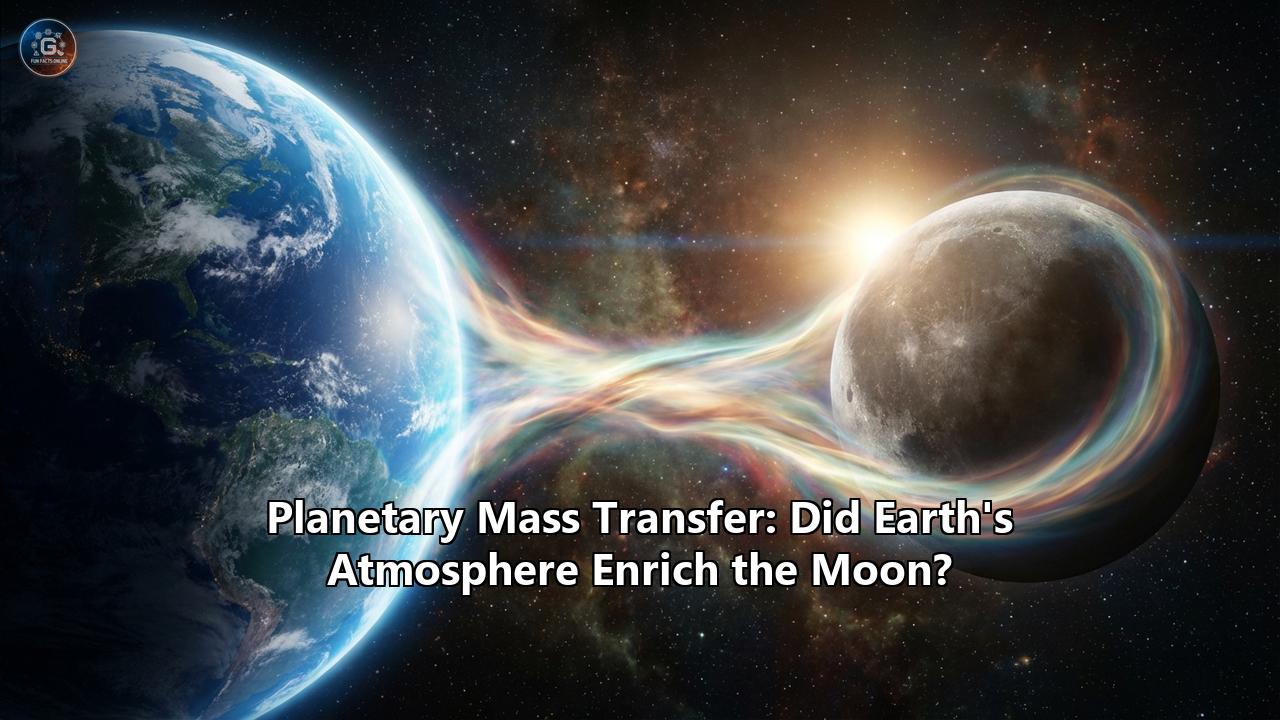
For centuries, we have looked up at the Moon and seen a silent, separate world—a desolate, airless rock suspended in the vacuum of space, entirely distinct from the vibrant, breathing biosphere of Earth. We believed the Moon was chemically distinct, shaped only by the solar wind, meteoroid impacts, and its own ancient volcanism. We were wrong.
Recent groundbreaking discoveries, culminating in major scientific confirmations in early 2026, have upended our understanding of the Earth-Moon relationship. We now know that our planet and its satellite are not just gravitationally bound; they are physically connected by an invisible, flowing river of atmospheric particles. For billions of years, Earth has been shedding its atmosphere into deep space, and the Moon, in its monthly orbit, has been catching it. This process, known as Planetary Mass Transfer, suggests that the lunar soil is not just lunar—it is a graveyard of ancient Earth air, enriched with the very chemicals that make life possible.
This revelation does more than just rewrite textbooks; it offers us a new way to study the history of our own planet. The Moon has become an accidental archive, preserving a record of Earth’s atmosphere from eras long erased by our planet's shifting tectonic plates and biological cycles.
Part I: The Invisible Bridge
To understand how Earth enriches the Moon, we must first look at the invisible forces that surround our planet. Earth is wrapped in a vast magnetic bubble called the magnetosphere. This field protects us from the harsh radiation of the sun, deflecting the constant stream of charged particles known as the solar wind.
However, the magnetosphere is not a perfect sphere. As the solar wind slams into the sun-facing side of Earth, it compresses the magnetic field. On the night side, facing away from the sun, the field is stretched out into a long, trailing "tail" that extends hundreds of thousands of kilometers into space. This is the magnetotail.
For most of its 29.5-day orbit, the Moon is bombarded by the solar wind. But for about five days every month, around the time of the full moon, it passes directly through Earth's magnetotail. During this brief window, the Moon is shielded from the solar wind, but it is exposed to something else entirely: a stream of ions flowing out from Earth.
The "Earth Wind"We often think of Earth's gravity as an inescapable trap for our atmosphere, but the upper edges of our air are constantly leaking into space. High-energy sunlight strikes atoms of oxygen, nitrogen, and hydrogen in the upper atmosphere, stripping away electrons and turning them into positively charged ions.
These ions are caught by Earth's magnetic field lines. In the polar regions, where the magnetic field lines are open to space, these ions can be accelerated upward, overcoming gravity in a phenomenon called the "polar wind." Once they escape, they flow down the magnetotail like a river, creating a sheet of plasma (charged gas) that stretches far beyond the orbit of the Moon.
When the Moon passes through this plasma sheet, it is bombarded not by solar particles, but by terrestrial ones. "Earth wind" bathes the lunar surface in oxygen, nitrogen, and noble gases that originated in our own lungs and skies.
Part II: The Smoking Gun – Oxygen and Nitrogen
The hypothesis of Earth-Moon atmospheric exchange existed for decades, but it was long considered a fringe theory. The "smoking gun" evidence arrived through a combination of advanced robotic missions and a re-examination of the most precious rocks on Earth: the Apollo lunar samples.
The Kaguya DiscoveryThe first major crack in the "isolated Moon" theory came from the Japanese lunar orbiter Kaguya (SELENE). In a landmark observation, Kaguya's plasma sensors detected a sudden change in the ions hitting the lunar surface when the orbiter passed through Earth's magnetotail.
Instead of the high-speed protons typical of the solar wind, Kaguya detected a significant flux of high-energy oxygen ions (O+). Even more telling was the energy signature of these ions (1–10 keV), which perfectly matched the acceleration profile of ions escaping Earth's ionosphere. The sheer volume was staggering: scientists estimated that Earth delivers approximately 26,000 oxygen ions per second to every square centimeter of the lunar surface during these crossings.
The Nitrogen AnomalyWhile Kaguya looked at oxygen, other researchers turned their eyes to the lunar soil samples brought back by Apollo astronauts. For years, cosmochemists were puzzled by the nitrogen found in lunar regolith.
The Moon has no atmosphere to speak of, so any nitrogen found in the soil should theoretically come from the solar wind. However, the isotopic "fingerprint" of the nitrogen didn't match. Solar nitrogen is rich in the lighter isotope Nitrogen-14. The nitrogen found in the Apollo samples, however, was enriched in the heavier Nitrogen-15—a ratio much closer to that of Earth's atmosphere.
For decades, this was a mystery. Did the Moon have an ancient atmosphere? Did comets deliver it? The 2026 confirmation of Planetary Mass Transfer provided the elegant solution: the "anomalous" nitrogen wasn't anomalous at all. It was Earth nitrogen, transported via the magnetotail and implanted into the lunar dust over billions of years.
Part III: The Great Oxidation Event Recorded in Stone
The implications of this transfer go far beyond simple chemistry. Because this process has been happening for billions of years, the Moon may hold the only surviving record of Earth's atmospheric evolution.
The Oxygen MysteryEarth is unique in the solar system because of its oxygen-rich atmosphere, a direct result of biological activity (photosynthesis). This transition, known as the Great Oxidation Event (GOE), occurred roughly 2.4 billion years ago. Before that, Earth's atmosphere was likely dominated by methane and carbon dioxide, with very little free oxygen.
On Earth, rocks from that era have been largely destroyed by tectonic subduction, erosion, and weathering. We have a very fragmented record of when and how our atmosphere changed. The Moon, however, is geologically dead. Its surface is a "cold trap."
Ions implanted in lunar soil crystals generally stay there. This means that if we drill deep into the lunar regolith, we might find distinct layers of particle implantation:
- The Deepest Layers: Might contain "Earth wind" particles from 3 or 4 billion years ago, showing an atmosphere without oxygen—a sample of the prebiotic Earth.
- The Middle Layers: Might show the sudden spike in Oxygen-16, 17, and 18 isotopes, marking the exact moment cyanobacteria began pumping oxygen into our skies 2.4 billion years ago.
- The Upper Layers: Record the modern, oxygen-rich atmosphere.
This turns the Moon into a paleo-atmospheric proxy. By analyzing the isotopic ratios of oxygen and nitrogen in lunar cores, we could potentially reconstruct the history of life on Earth with unprecedented precision. We could "read" the Moon to see exactly when the ozone layer formed, or how atmospheric composition shifted during mass extinction events.
Part IV: The Mechanism of Implantation
How does a gas molecule from Earth end up becoming part of a rock on the Moon? The process is a violent celestial mechanics ballet known as high-energy ion implantation.
- Ionization: An oxygen atom in Earth's upper atmosphere is hit by UV radiation and loses an electron, becoming an O+ ion.
- Escape: The ion travels up the magnetic field lines at the poles, entering the magnetosphere.
- Acceleration: As it travels down the magnetotail, electric fields accelerate the ion to tremendous speeds (hundreds of kilometers per second).
- Collision: When the Moon passes through this stream, the ion slams into the lunar surface. It doesn't just sit on top; it strikes the lunar dust (regolith) with enough energy to bury itself nanometers deep inside the crystal lattice of the soil grains.
Over billions of years, meteoroids churn the lunar soil (a process called "gardening"), burying these surface grains deeper and bringing fresh grains to the surface. This creates a mixed layer of soil several meters thick that is essentially saturated with particles from the Sun and Earth.
Recent simulations performed by researchers at the University of Rochester (published in Nature Communications Earth & Environment, Jan 2026) utilized advanced computer modeling to confirm that this "magnetic funneling" is not only possible but highly efficient. Their models showed that Earth’s magnetic field acts like a dedicated highway, focusing these particles directly into the path of the Moon, rather than letting them scatter uselessly into the void.
Part V: The Geocorona Connection
Another supporting pillar of this theory comes from our understanding of Earth's geocorona. The geocorona is the luminous part of the outermost region of Earth's atmosphere, the exosphere. It is seen primarily via ultraviolet light (Lyman-alpha) scattered by neutral hydrogen.
Data from the SOHO (Solar and Heliospheric Observatory) spacecraft revealed that the geocorona extends much further than previously thought—up to 630,000 kilometers away. The Moon orbits at an average distance of 384,000 kilometers.
This means the Moon is essentially orbiting inside Earth's atmosphere.
While the "Earth wind" described earlier refers to charged particles (ions) guided by magnetism, the geocorona evidence suggests that the Moon is also moving through a tenuous mist of neutral hydrogen atoms from Earth. This constant physical contact between the two bodies reinforces the idea that they are an interconnected system, exchanging matter continuously.
Part VI: Implications for Future Exploration
The confirmation that Earth has enriched the Moon has profound implications for the future of human space exploration, particularly for the Artemis program and future lunar bases.
1. "Earth Air" on the MoonWhile the concentrations are low (measured in parts per million), the presence of terrestrial nitrogen and oxygen in the lunar soil means that the regolith is more chemically diverse than we thought. Nitrogen, in particular, is a crucial resource for agriculture. If future lunar bases intend to grow crops, they need nitrogen. Knowing that the lunar soil contains reserves of nitrogen (implanted from Earth) could change how we process regolith for farming (in-situ resource utilization).
2. Water FormationThe interaction of hydrogen protons (from the solar wind) and oxygen (from Earth wind) may play a role in the formation of lunar water (OH and H2O molecules) on the surface. While the solar wind provides the hydrogen, Earth may be providing a significant fraction of the oxidant. Understanding this cycle is vital for identifying the best locations to mine for water.
3. Site Selection for ScienceThis discovery creates a new objective for lunar landers. We are no longer just looking for ancient lunar rocks; we are looking for "Earth accumulation zones."
- The Near Side vs. Far Side: Because the Earth wind comes from the direction of Earth, the Near Side of the Moon (which always faces us) is preferentially showered with these particles. The Far Side is largely shielded from Earth wind.
- Comparing soil samples from the center of the Near Side with samples from the Far Side would allow scientists to subtract the "solar background" and isolate the pure "Earth signal."
Part VII: A Binary Atmospheric System
This discovery challenges the philosophical boundary between "planet" and "satellite." In planetary science, we usually define boundaries by gravity (the Hill sphere) or magnetism (the magnetopause). But atmospherically, Earth and the Moon are bleeding into each other.
This phenomenon might not be unique to Earth.
- Mars and Phobos: Mars has no global magnetic field, but it loses atmosphere to the solar wind. Phobos, its moon, orbits very close to the planet. It is almost certain that Phobos is coated in ions stripped from the Martian atmosphere. A sample return mission from Phobos (like JAXA's MMX mission) could reveal the history of Mars's lost atmosphere.
- Gas Giants: The moons of Jupiter and Saturn orbit within massive magnetospheres filled with plasma. Io erupts volcanic material that coats Europa; Enceladus shoots water geysers that coat Saturn's rings.
However, the Earth-Moon transfer is unique because it involves life-signaling isotopes. We are the only known pair where a biotic atmosphere is being transferred to a dead moon.
Conclusion: The Moon is Part of Earth's Story
For decades, the goal of lunar science was to understand the Moon. Now, a major goal of lunar science is to understand the Earth.
The realization that Earth's atmosphere enriches the Moon changes our perspective on our place in the solar system. We are not a planet walled off by a vacuum. We are a planet that exhales, extending a magnetic and atmospheric embrace that encompasses our satellite.
When future astronauts shovel the gray dust of the lunar highlands, they won't just be holding pieces of the Moon. They will be holding billions of years of Earth's history—atoms that once floated in the primeval skies of the Archean eon, oxygen that was breathed by dinosaurs, and nitrogen that drifted over the first continents. The Moon is not just a witness to Earth's history; it is a physical participant, keeping a backup copy of our atmosphere safely frozen in time, waiting for us to return and read the story written in the dust.
Reference:
- https://orient.tm/en/post/94372/new-study-earth-has-shared-its-atmosphere-moon-billions-years
- https://www.livescience.com/space/the-moon/the-moon-has-been-secretly-feasting-on-earths-atmosphere-for-billions-of-years
- https://www.sciencedaily.com/releases/2026/01/260104202730.htm
- https://leaveherwildcontainerdesign.ca/article/discovery-scientists-find-out-where-particles-of-earths-atmosphere-on-the-moon-come-from
- https://www.swpc.noaa.gov/phenomena/earths-magnetosphere
- https://www.nasa.gov/solar-system/earth-and-moon-once-shared-a-magnetic-shield-protecting-their-atmospheres/
- https://www.astronomy.com/science/earth-wind-bathes-the-moon-with-oxygen/
- https://www.scisuggest.com/lunar-soil-may-hold-clues-to-ancient-earths-atmosphere/
- https://www.britannica.com/place/Earth/The-atmosphere
- https://www.esa.int/Science_Exploration/Space_Science/Earth_s_atmosphere_stretches_out_to_the_Moon_and_beyond