
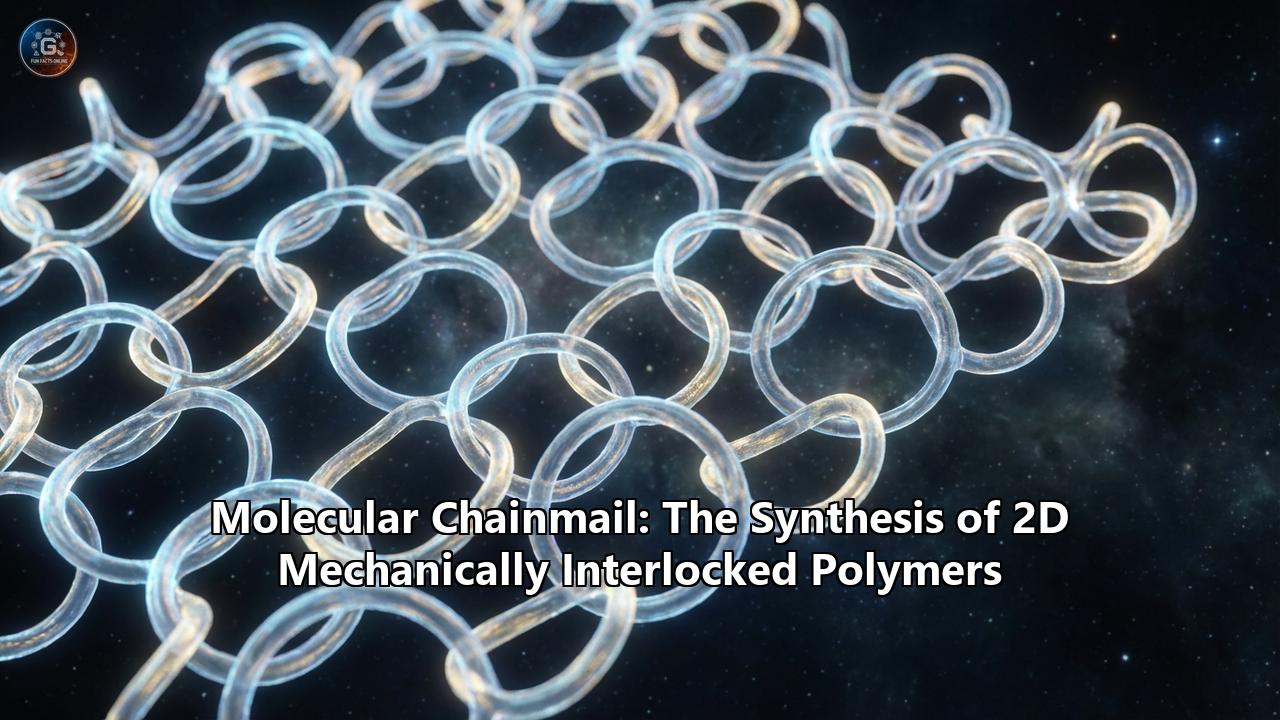
In the grand tapestry of materials science, humanity has spent millennia mastering the art of the weave. From the coarse flax tunics of the Neolithic era to the high-tensile Kevlar vests of the modern soldier, the principle has remained largely the same: long strands of material, frictionally bound, creating a surface that is greater than the sum of its parts. But for centuries, chemists have dreamed of a different kind of loom. They have dreamed of weaving not threads of cotton or polymer chains, but individual molecules. They have dreamed of "Molecular Chainmail."
This is not a story of mere textiles. It is the story of a fundamental shift in how we understand matter. It is the transition from the chemical bond—rigid, fixed, and brittle—to the mechanical bond—fluid, adaptable, and unbreakable. It is the synthesis of 2D Mechanically Interlocked Polymers (2D-MIPs), a class of materials that promises to revolutionize everything from ballistic armor to dialysis machines, bringing the medieval durability of knightly mail down to the nanometer scale.
Part I: The Weaver’s Paradox
From Steel Rings to Carbon LoopsTo understand the magnitude of "molecular chainmail," one must first appreciate the limitations of the materials we currently possess. Almost every solid material used in engineering today derives its strength from one of two sources: the covalent bond or the intermolecular force.
Diamond, the hardest natural material, is a fortress of covalent bonds. Each carbon atom is locked rigidly to its neighbors. It is immensely strong, but it is a brittle strength. Strike a diamond with a hammer, and it shatters. It cannot absorb energy; it can only resist it until it fails.
On the other hand, we have polymers—plastics, rubbers, nylons. These are long, tangled chains of molecules. They are flexible and tough because the chains can slide past one another. However, they lack the ultimate strength of diamond because they rely on weak van der Waals forces or hydrogen bonds to hold the mass together. Pull them too hard, and the chains unravel or snap.
For decades, scientists sought a "Goldilocks" material: something with the structural integrity of a crystal but the flexibility of a textile. They looked to history for the answer. Medieval chainmail protected knights not because the steel rings were harder than the swords striking them, but because the rings were interlocked. They were not welded together. They were free to move, to rotate, to collapse and expand. When a sword struck the mail, the energy was not focused on a single brittle point; it was dissipated across thousands of sliding rings. The armor flowed like a fluid but resisted like a solid.
The challenge was simple to state but impossible to execute: Could we synthesize a sheet of material where the "rings" were not steel loops, but single molecules?
The Birth of the Mechanical BondThe journey to molecular chainmail began not with a sheet, but with a single link. For most of the 20th century, the idea of linking two molecules together without a chemical bond was seen as a parlor trick. Molecules were supposed to be joined by shared electrons (covalent bonds) or electrostatic attraction (ionic bonds).
In the 1960s, a new concept emerged: the Mechanical Bond. This is a bond formed not by electron sharing, but by topology. Think of a key on a keyring. The key is not glued to the ring; it is free to slide around it. Yet, you cannot separate them without breaking the metal. They are mechanically interlocked.
The field languished until the 1980s, when Jean-Pierre Sauvage and J. Fraser Stoddart (who would later share the 2016 Nobel Prize) developed high-yield methods to create these structures. Sauvage utilized copper ions to act as "templates," gathering two half-moon-shaped molecules around a central point before sealing them into rings. Stoddart utilized electron-poor and electron-rich interactions to thread a molecular rod through a molecular bead.
They created Catenanes (two interlocking rings) and Rotaxanes (a dumbbell threaded through a ring). These were the seeds of molecular chainmail. But for thirty years, they remained zero-dimensional curiosities. They were "molecular machines" that could shuttle back and forth, but they were not materials. You could not wear a catenane. You could not build a bridge out of a rotaxane.
To make a material, you needed to go from 0D (a single link) to 2D (an infinite sheet). You needed to weave a fabric that extended for billions of molecules in every direction.
Part II: The Synthesis of the Impossible
The Dimensional LeapCreating a 2D sheet of interlocked rings is exponentially harder than making a single pair. In a standard chemical reaction, molecules collide randomly. Getting billions of rings to line up perfectly flat and interlock with their neighbors in a precise "over-under-over-under" pattern is statistically impossible in a chaotic solution. It is like throwing a pile of loose wool into the air and expecting it to land as a knitted sweater.
The breakthrough required a convergence of three distinct disciplines: Supramolecular Chemistry (the chemistry of non-covalent interactions), Reticular Chemistry (the chemistry of frameworks), and Polymer Science.
Strategy 1: The Template ApproachThe most successful method for synthesizing molecular chainmail relies on "templating." This is the molecular equivalent of using a knitting needle.
In the groundbreaking work pioneered by groups like those at Northwestern University and the University of California, Berkeley, the synthesis begins with a metal template—often copper. Copper ions (Cu+) have a unique geometric preference: they like to be surrounded by four ligands in a tetrahedral shape.
Chemists design "V"-shaped organic ligands. When these ligands are mixed with copper ions in solution, the copper acts as a magnet. It pulls two "V" shapes together at a 90-degree angle to satisfy its coordination geometry. This naturally creates a crossing point—a "weft" and a "warp."
Once these crossing points are established by the metal, the chemist adds a "linker" molecule to connect the ends of the "V"s. This closes the loops. Suddenly, you have a grid. The copper ions are holding the threads in the correct woven pattern.
The final step is the "demetallation." The chemist adds a reagent (like cyanide) that strips away the copper ions. In a normal structure, removing the glue would make the structure fall apart. But here, the loops are already closed. The copper is gone, but the entanglement remains. The molecules are now held together solely by their topology. They are free to slide, but unable to escape.
Strategy 2: The Daisy Chain PolymerizationA more recent and sophisticated approach involves the use of "[c2]daisy chains." A daisy chain in molecular terms is a hermaphriditic molecule—it contains both a "ring" part and a "rod" part.
In this synthesis, researchers design a monomer where the rod of one molecule threads through the ring of its neighbor, and vice versa. This creates a dimer that looks like a muscle filament. By carefully functionalizing the ends of these dimers and inducing crystallization, researchers can force these units to self-assemble into a flat, hexagonal honeycomb lattice.
Once the lattice is formed—held together by weak forces—light or a chemical catalyst is used to "stitch" the edges of the molecules together permanently. This locks the topology in place. The result is a 2D Polycatenane: a sheet made entirely of interlocking molecular loops.
The "Infinite" CatenaneIn 2023 and 2024, the field saw the emergence of the "Infinite Catenane." Using a specific type of Reticular Chemistry known as Covalent Organic Frameworks (COFs), researchers managed to synthesize a material where the interlocking didn't stop.
They utilized a building block based on a shape called an adamantane cage—a rigid, pyramid-like structure. By linking these cages with long, flexible struts and using copper templates, they created a structure where every single pore of the framework was threaded by another framework. It was a 3D weave, which could be exfoliated (peeled) into 2D sheets.
This material, often referred to in literature as COF-505 or similar derivatives, represented the first true "molecular cloth." It possessed a density of mechanical bonds never seen before: over 100 trillion interlocks per square centimeter.
Part III: The Physics of Molecular Cloth
The Elastic ParadoxWhy go through this immense chemical trouble? Because molecular chainmail possesses a property that no other material on Earth has: High stiffness combined with high elasticity.
In materials science, this is a contradiction.
- Stiffness (Young's Modulus) measures how hard it is to stretch a material.
- Toughness measures how much energy a material can absorb before breaking.
Usually, stiff materials (ceramics, glass) are not tough; they shatter. Tough materials (rubber, nylon) are not stiff; they are floppy.
Molecular chainmail breaks this rule. When you pull on a sheet of 2D-MIP, the initial resistance is low as the rings slide over each other to align with the force. This provides flexibility. However, once the rings are pulled taut, they lock against each other. The force is then transferred to the covalent backbones of the rings themselves.
This means the material moves like a fabric but holds like a crystal. Recent experiments have shown that these 2D polymers can be thousands of times more flexible than graphene, yet when subjected to a ballistic impact (like a bullet), they stiffen instantly.
Defect Tolerance: The "Run" in the StockingGraphene, the famous 2D sheet of carbon, has a fatal flaw: it is intolerant of defects. If a sheet of graphene has a tiny crack, and you pull it, the crack propagates at the speed of sound, ripping the sheet in two. It is catastrophic failure.
Molecular chainmail is defect-tolerant. Because the structure is held together by mechanical entanglements rather than a continuous stress-bearing wall, a rip does not propagate easily. The rings surrounding a tear can shift and rotate to close the gap or redistribute the stress. It behaves like a self-repairing mesh. If one ring breaks, the four rings interlocked with it remain intact, holding the fabric together.
Porosity and the Breathing ArmorUnlike a solid plate of steel or ceramic, molecular chainmail is inherently porous. The gaps between the interlocking rings are defined and regular. This makes the material "breathable" at a molecular level.
This property is crucial for its application in protective gear. A soldier wearing a vest made of molecular chainmail would not overheat, as air and water vapor could pass through the mesh, even while the mesh remained tight enough to stop a projectile.
Part IV: Applications – The Armor of the Future
1. Ballistic Protection (The Nano-Kevlar)The most immediate application is in body armor. Current armor relies on bulk—layers of Kevlar fiber embedded in resin, or heavy ceramic plates.
A "molecular chainmail" vest could theoretically be as thin as a T-shirt. Because of the incredible density of mechanical bonds (100 trillion per sq cm), the energy of a bullet impact would be dissipated laterally across the chest instantly. The rings would slide, converting the kinetic energy of the bullet into friction and heat at the molecular level, stopping the projectile without the wearer suffering blunt force trauma.
2. Smart Membranes and FiltrationThe "holes" in the chainmail are chemically programmable. By changing the size of the rings during synthesis, chemists can create a sieve that allows water to pass but blocks salt (desalination), or allows oxygen to pass but blocks nerve gas.
Because the pore size is defined by the topology (the weave) rather than random gaps in a polymer, the selectivity is absolute. This could lead to dialysis membranes that are ten times more efficient than current kidneys, or industrial filters that can separate isotopes.
3. Flexible Electronics and Soft RoboticsSilicon chips are brittle. If you bend your phone too much, the internal components snap.
Molecular chainmail offers a substrate for "stretchable electronics." Conductive polymers could be woven into the chainmail structure. As the material stretches, the conductive pathways would slide rather than break. This allows for the creation of "electronic skin"—sensors that can wrap around a robot's arm or a human heart, expanding and contracting with the movement of the host without losing connection.
4. Energy StorageThe porous nature of polycatenanes makes them ideal for battery electrodes. Ions (like Lithium) need to move freely in and out of the electrode material. The open weave of a 2D-MIP provides a highway for ions, potentially leading to batteries that charge in seconds rather than hours. Furthermore, the mechanical flexibility means the battery won't degrade as it swells and shrinks during charging cycles—a major cause of failure in current lithium-ion batteries.
Part V: The Future – Weaving the World
Scalability: The Final HurdleDespite the excitement, molecular chainmail is not yet on the shelves at Home Depot. The current synthesis methods are expensive. Using palladium or copper templates and complex organic ligands costs thousands of dollars per gram.
The frontier of research is now "Scalable Weaving." Chemists are looking for ways to perform these reactions using cheaper metals (like zinc or iron) or, better yet, no metals at all (organic templating).
There is also the challenge of processing. How do you take a billion microscopic flakes of molecular chainmail and stitch them into a macroscopic suit? New techniques in "bottom-up" assembly, where the chemical reaction happens on the surface of a mold, are showing promise. Imagine dipping a mannequin into a vat of chemical soup and pulling it out clad in a seamless, bulletproof, molecularly woven suit.
The Sci-Fi HorizonLooking further ahead, the concept of "Active Chainmail" is emerging. By incorporating molecular machines into the weave, we could create materials that change properties on command.
Imagine a fabric that is soft and draping like silk. But when you run an electric current through it, the molecular rings rotate and lock, instantly turning the fabric into a rigid shell. This "programmable matter" could create tents that erect themselves, casts for broken bones that harden instantly, or spacesuits that automatically stiffen to protect astronauts from micrometeoroids.
ConclusionThe synthesis of 2D mechanically interlocked polymers is more than a triumph of chemistry; it is a triumph of imagination. For all of human history, we have manipulated the bulk properties of matter—chipping stone, smelting ore, mixing polymers.
With molecular chainmail, we are finally manipulating the topology of matter. We are knitting with the very fabric of reality, tying knots in the atomic lattice. We have moved from the age of the chemical bond to the age of the mechanical bond.
The knights of the future will not ride in steel. They will ride in woven diamond, clad in a mesh of molecules that flows like water and protects like a fortress, wearing the realized dream of the alchemist and the weaver combined.
Reference:
- https://pubs.acs.org/doi/abs/10.1021/jacs.0c06416
- https://www.nsf.gov/news/chainmail-polymer-could-be-future-body-armor
- https://www.researchgate.net/publication/384907884_Mechanically_Interlocked_Macrocycles_on_Covalent_Networks_for_Energy_and_Environmental_Applications
- https://materialdistrict.com/article/chainmail-inspired-material-a-new-standard-in-strength-and-flexibility/
- https://en.wikipedia.org/wiki/Mechanically_interlocked_molecular_architectures
- https://www.researchgate.net/publication/332052035_The_Burgeoning_of_Mechanically_Interlocked_Molecules_in_Chemistry
- https://communities.springernature.com/posts/2d-shape-shifting-chainmail-mechanically-interlocked-for-next-gen-polymers
- https://news.northwestern.edu/stories/2025/01/chainmail-like-material-could-be-the-future-of-armor
- https://chemistry.berkeley.edu/news/new-%E2%80%98chain-mail%E2%80%99-material-interlocking-molecules-tough-flexible-and-easy-make
- http://www.catenane.net/pages/2020_2D_Material.html
- https://www.researchgate.net/publication/309550121_Impact_properties_of_2D_and_3D_woven_composites_A_review
- https://arxiv.org/pdf/1611.01555