
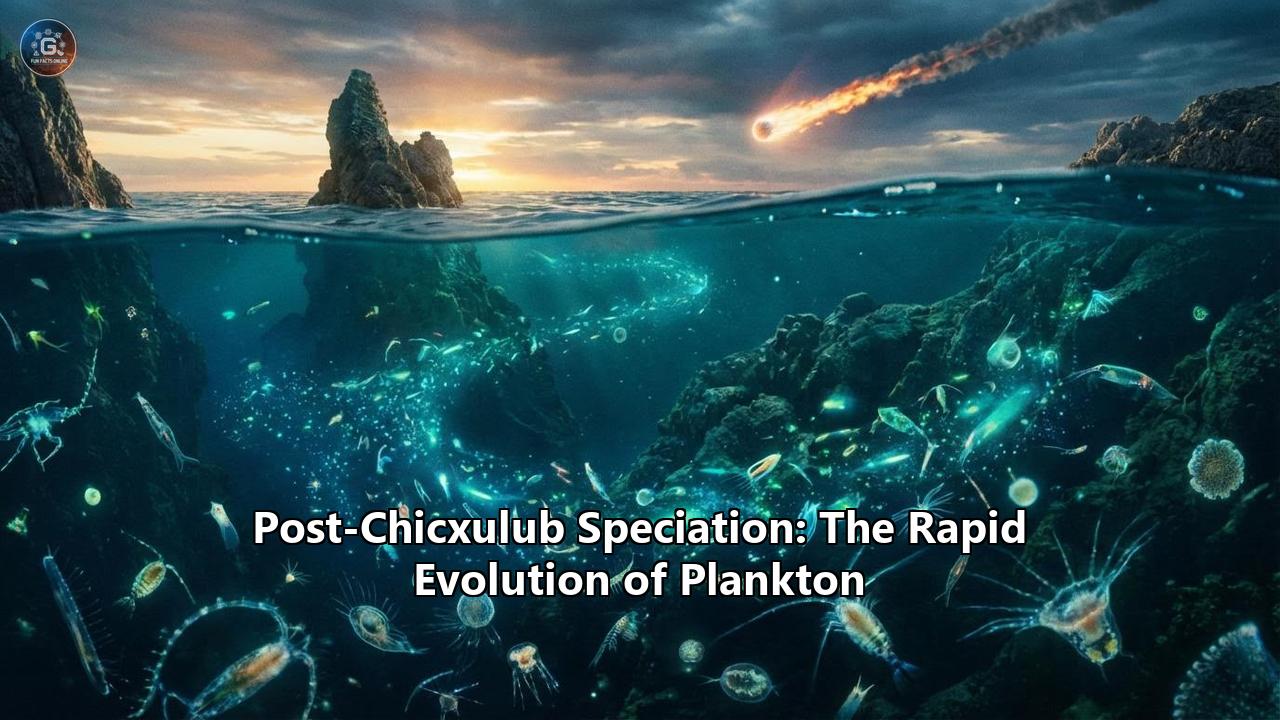
The day the Mesozoic Era ended was not marked by a gradual decline, but by a sudden, catastrophic roar that fractured the very foundation of the Earth’s biosphere. When a 120-mile-wide asteroid violently collided with the shallow waters of the Yucatán Peninsula 66 million years ago, it unleashed the energy of several million nuclear weapons detonating simultaneously. The Chicxulub impact vaporized rock, triggered towering tsunamis, and cast a shroud of soot and silicate dust into the upper atmosphere, plunging the planet into a sudden, freezing darkness. While the fate of the terrestrial realm—most notably the eradication of all non-avian dinosaurs—has long captured the human imagination, an equally profound and arguably more consequential apocalypse unfolded beneath the waves.
The marine food web, built upon the microscopic shoulders of photosynthetic plankton, experienced instantaneous collapse. As the sun was blotted out, photosynthesis ceased. Calcareous nannoplankton, the ubiquitous single-celled algae that had painted the Cretaceous oceans in vibrant blooms and formed the massive chalk cliffs of Dover, were almost entirely annihilated, suffering a staggering 93% extinction rate. Planktic foraminifera, the tiny amoeboid organisms with intricate calcium carbonate shells that grazed upon these algae, similarly faced total devastation. The biological pump—the crucial oceanic mechanism by which these organisms capture carbon at the surface and sequester it in the deep ocean upon their death—ground to a sudden halt.
For decades, paleobiologists examining the fossil record believed that the recovery from this profound ecological trauma was a slow, agonizing crawl lasting hundreds of thousands, if not millions, of years. The sheer scale of the devastation seemed to dictate a prolonged period of biological stagnation. But recent, groundbreaking analyses utilizing novel isotopic dating techniques and high-resolution microfossil examinations have radically rewritten this narrative. Rather than a sluggish return to life, the post-Chicxulub oceans became the ultimate evolutionary crucible. Within a geological heartbeat, life not only rebounded but entered a state of hyper-drive speciation. The empty, post-apocalyptic oceans provided a blank canvas for the few resilient survivors, leading to the rapid evolution of entirely new species of plankton in just a few thousand years—an evolutionary pace previously thought impossible.
The Collapse of the Biological Pump and the Carbonate Crisis
To understand the magnitude of the post-impact recovery, one must first understand the totality of the collapse. The Late Cretaceous oceans were teeming with complex, highly specialized micro-organisms. Planktic foraminifera had evolved intricate, ornate morphologies—large, multi-chambered tests (shells) adapted to specific depths, temperatures, and ecological niches. Calcareous nannoplankton thrived in a relatively stable, stratified ocean, driving the global carbon cycle.
When the Chicxulub bolide struck, the immediate aftermath was hellish. The initial blast wave and thermal radiation flash-boiled surface waters near the impact zone. This was followed by a global "nuclear winter" as atmospheric debris blocked incoming solar radiation, plummeting global temperatures and plunging the oceans into darkness. Deprived of sunlight, the phytoplankton at the base of the food web died en masse. The zooplankton that fed on them starved, as did the larger marine predators.
Furthermore, the impact struck a region rich in carbonate and sulfate rocks. The vaporization of these geologic deposits released massive quantities of sulfur dioxide and carbon dioxide into the atmosphere, leading to intense acid rain. This rapid acidification of the surface oceans dissolved the calcium carbonate shells of the surviving calcareous plankton, creating a lethal environment for those that had managed to survive the darkness and the cold.
The geological record preserves this catastrophe with stark clarity. In marine sedimentary rocks worldwide, the Cretaceous-Paleogene (K-Pg) boundary is marked by a distinct, often dark layer of clay enriched with iridium—an element rare on Earth's crust but abundant in asteroids. Immediately above this boundary, the once-thick rain of calcium carbonate shells vanishes. The biological pump had collapsed. Without the continuous "marine snow" of dead plankton sinking to the seafloor, carbon export efficiency dropped to zero. The surface oceans became a nutrient-rich, yet biologically barren wasteland, an environment devoid of the complex trophic interactions that had defined the preceding millions of years.
The Helium-3 Revolution: Resetting the Geologic Clock
The realization that life rebounded with astounding rapidity hinged upon a major breakthrough in how geologists measure time in deep history. Traditionally, biostratigraphy and sedimentary analysis relied on the assumption of relatively constant sedimentation rates. Scientists would measure the distance between the K-Pg boundary and the first appearance of a new Paleocene fossil, and calculate the elapsed time based on how fast sediment normally accumulated.
However, this methodology harbored a massive blind spot regarding the Chicxulub event. The asteroid impact fundamentally altered the physical and biological processes that create sediment. On land, the death of vast swaths of vegetation removed the root systems that held soil in place, leading to a massive spike in terrestrial erosion and runoff. In the oceans, the near-total extinction of calcareous plankton meant that the primary source of marine sediment—their microscopic shells—was suddenly gone. Assuming constant sedimentation rates across such a cataclysmic threshold was inherently flawed, leading to vast overestimations of the time it took for new species to evolve.
To solve this chronological puzzle, researchers turned to the cosmos. Earth is constantly bombarded by a light rain of cosmic dust, which contains a steady, predictable amount of the isotope Helium-3 (³He). Because this cosmic dust falls at a constant rate regardless of earthly biological or geological crises, the concentration of ³He in sedimentary rock acts as a highly accurate, independent cosmic chronometer. If sediment accumulates rapidly, the ³He is diluted; if sediment accumulates slowly, the ³He becomes highly concentrated.
When scientists, including research teams led by Chris Lowery at the University of Texas Institute for Geophysics, applied this ³He dating method to six distinct K-Pg boundary sites around the world (ranging from Europe and North Africa to the Gulf of Mexico), the results were nothing short of a paradigm shift. They focused their search on the first appearance of Parvularugoglobigerina eugubina (P. eugubina), a tiny, simple planktic foraminifera that is globally recognized as the herald of Paleocene marine recovery.
Under the old models, P. eugubina was thought to have emerged some 30,000 to 100,000 years after the impact. The ³He data, however, revealed a shocking truth: P. eugubina evolved between just 3,500 and 11,000 years after the Chicxulub event, with an average emergence time of roughly 6,400 years. In some localized sites, entirely new species of plankton were found to have evolved in fewer than 2,000 years. In the context of deep geologic time, where speciation typically unfolds over millions of years, this was an evolutionary explosion—a biological flash-bang of adaptation.
Pioneers of the Paleocene: The Survival of the Smallest
The organisms that survived the immediate aftermath of the Chicxulub impact were a highly select group. The complex, large, ornate foraminifera of the Late Cretaceous were completely wiped out. The survivors were exclusively small, primitive, and unspecialized—what paleontologists often refer to as "disaster taxa".
Why did the small survive? In an ocean stripped of primary productivity, where the food web had collapsed, larger organisms requiring high caloric intake starved. Small, simple organisms, conversely, require less energy to sustain basic metabolic functions. Furthermore, these primitive forms were likely "generalists," capable of tolerating a wider range of environmental stressors, including fluctuations in temperature, salinity, and ocean acidity.
As the skies began to clear—perhaps within months or years of the impact—and sunlight once again penetrated the ocean surface, these surviving micro-organisms found themselves in an unprecedented evolutionary scenario. The oceans were empty. The vast, stratified ecological niches that had been intensely fiercely guarded by specialized Cretaceous species were now completely vacant. Furthermore, the lack of an active biological pump meant that the surface waters were hyper-eutrophic, saturated with raw, unutilized nutrients.
This combination of abundant resources and zero competition created an evolutionary pressure cooker. Life abhors a vacuum, and the surviving foraminifera rapidly expanded to fill the void. The evolution of P. eugubina and up to 10 to 20 other new plankton species within the first few millennia of the Danian age represents an adaptive radiation of staggering velocity.
The mechanisms driving this rapid morphological change are a subject of intense scientific interest. In modern planktic foraminifera, asexual reproduction tends to result in far greater morphological variation than sexual reproduction. It is highly probable that in the devastated, low-density post-impact oceans, finding a mate was exceedingly difficult. As a result, surviving foraminifera likely favored asexual reproduction, rapidly churning out generations of offspring with high phenotypic plasticity. This accelerated genetic experimentation allowed them to quickly adapt to different micro-environments and rapidly diverge into new, distinct species.
Mutants and Monsters: The Aberrant Foraminifera of the Danian
The rapid speciation of the earliest Paleocene was not a clean, orderly march of progress; it was chaotic, highly experimental, and driven by immense environmental stress. This is vividly documented in the fossil record by a bizarre phenomenon: a massive surge in aberrant, or "mutant," foraminifera immediately following the impact.
In stable marine environments, such as the late Maastrichtian period immediately preceding the asteroid strike, abnormal shell morphologies in foraminifera are exceedingly rare, typically accounting for less than 2% of the population. However, in the dark boundary clay layers deposited in the first 200,000 years of the Danian age, paleontologists have documented a staggering proliferation of these abnormalities, with aberrant tests making up between 5% and 18% of the total assemblage.
These were not minor deviations. Microfossil analysts examining sediments from regions like El Kef and Aïn Settara in Tunisia have cataloged a veritable freak show of microscopic life. The anomalies include severe distortions in test coiling, abnormal and highly irregular chamber shapes, double or twinned ultimate chambers, multiple misplaced apertures, monstrous protuberances near the proloculus (the initial chamber), and conjoined "twinned" tests that look like microscopic Siamese twins.
What caused this dramatic spike in morphological monstrosities? The answer lies in the deeply traumatized state of the global environment. While the immediate darkness of the impact had lifted, the planet was enduring a violent climatic hangover. The release of vast amounts of CO2 from the vaporized Yucatan carbonates, coupled with the immense, long-duration volcanic outgassing of the Deccan Traps in India—which may have been accelerated or altered by the seismic shock of the Chicxulub impact—created a hyper-thermal greenhouse environment. The oceans were warm, chemically unstable, and experienced wild fluctuations in pH and heavy metal concentrations due to ongoing volcanic input.
In foraminifera, shell calcification is highly sensitive to environmental chemistry. High toxicity, extreme temperatures, and heavy metal poisoning disrupt the delicate biological mechanisms responsible for building their intricate calcium carbonate homes. The fact that these high levels of aberrations align perfectly with the massive evolutionary turnovers of the earliest Paleocene suggests that the survivors were clinging to life in an incredibly hostile environment. They were rapidly evolving not in a stable paradise, but in a toxic, fluctuating purgatory. The "monsters" of the early Danian are microscopic monuments to the intense physiological stress that life endured—and ultimately overcame—to repopulate the oceans.
Boom, Bust, and the Calcareous Nannoplankton Rollercoaster
While the planktic foraminifera were experimenting with rapid, sometimes monstrous morphological changes, the primary producers—the calcareous nannoplankton—were experiencing a violent, cyclical struggle for dominance.
Unlike the relatively steady ecosystems of the late Cretaceous, the immediate post-impact oceans were characterized by wild ecological instability. As the biological pump slowly struggled to restart, nannoplankton communities in the Northern Hemisphere engaged in a series of "boom-bust" successions. In these extreme environments, a single, newly evolved pioneer species would suddenly explode in population, monopolizing the surface waters and creating a "high-dominance, low-diversity" acme. These single-species blooms would thrive briefly, exhaust the specific nutrients they relied upon in the unstable water column, and then spectacularly crash, only to be rapidly replaced by a bloom of a different, newly evolved species.
This cyclical chaos indicates that the marine food web was profoundly broken and highly vulnerable. Without a diverse array of species to stabilize nutrient cycling, the environment was highly susceptible to runaway biological feedbacks.
Fascinatingly, the pacing of this recovery was not uniform across the globe. Detailed analyses of nannoplankton assemblages recovered directly from the peak ring of the Chicxulub impact crater itself have revealed stunning local variations. While distant oceanic sites showed a relatively quick succession of these boom-bust phases, the environment directly within the crater remained stuck in a "disaster acme" for much longer. The termination of the most severe, low-diversity disaster phase inside the Chicxulub crater was delayed by at least 500,000 years compared to other global sites.
This global diachroneity—the difference in the timing of recovery between different ocean basins—highlights the localized environmental trauma caused by the impact. The water trapped within and immediately surrounding the massive crater was likely subjected to prolonged hydrothermal activity, unique chemical toxicity, and delayed physical stabilization, making it a difficult frontier for the newly evolving nannoplankton to colonize and stabilize.
However, as the millennia ticked by, a distinct trend began to emerge. The chaotic, eutrophic (nutrient-heavy) boom-bust cycles slowly began to dampen. The correlation between shifts in the dominant foraminiferal grazers and the switchovers in nannoplankton species points to a gradual, global restoration of biological pump efficiency. As the nannoplankton successfully sequestered carbon and nutrients, sinking them to the deep ocean once more, the surface waters slowly transitioned back toward oligotrophy—a nutrient-poor, but highly stable state that favors intricate ecological specialization.
The Silica Winners: Diatoms and Radiolarians
In sharp contrast to the near-total annihilation of the calcareous (calcium-carbonate-shelled) micro-organisms, another crucial faction of the marine plankton weathered the apocalypse with remarkable success: those that built their shells out of silica.
Diatoms, the photosynthetic algae encased in intricate glass-like frustules, and radiolarians, the predatory zooplankton with complex, geometric siliceous skeletons, experienced a vastly different K-Pg boundary event. While they undeniably suffered losses, they did not face the catastrophic 90%+ extinction rates of their calcareous counterparts. Paleontological data indicates that approximately 46% of diatom species survived the transition from the Cretaceous into the Paleocene. For radiolarians, the transition is even more striking: there is virtually no evidence of a mass extinction event in their fossil record across the boundary.
Why did the silica-based lifeforms survive while the carbonate-based lifeforms perished? The answer is twofold, rooted in chemistry and climate.
First, the severe ocean acidification triggered by the impact's sulfur and CO2 emissions was highly selective. Acidic water rapidly dissolves calcium carbonate, literally melting the shells of living nannoplankton and foraminifera. Silica, however, is highly resistant to these acidic changes. The glass houses of the diatoms and radiolarians protected them from the chemical trauma that ravaged the rest of the planktic community.
Second, the climatic shifts in the aftermath of the impact favored specific geographic refuges. While the tropics were devastated by extreme temperature fluctuations and darkness, the southern high latitudes experienced a period of marked cooling in the early Paleocene. Radiolarians, and many diatoms, are particularly well-adapted to cooler, upwelling environments. As the global climate cooled, these high-latitude, silica-rich environments became vital sanctuaries. The fossil record shows a robust, high-productivity zone of radiolarians in the southern oceans during the early Paleocene, suggesting that while the tropical carbonate factories were shut down, the polar silica factories continued to hum, preserving a crucial baseline of marine biodiversity.
The Million-Year March to Stability and the Rise of the Oligotrophs
The frantic, hyper-fast speciation of the first few thousand years established the baseline for a new era of life, but it did not immediately result in a complex, stable ecosystem. Evolution can generate new species with "lightning-fast" speed to exploit vacant niches, but the intricate web of ecological interdependencies—the delicate balances between predator, prey, and environment—takes vastly longer to weave. As one paleobiologist aptly noted, evolution is capable of sudden, blinding brilliance, but it is not capable of instant repair.
It took roughly one million years for the biological pump to fully recover from its K-Pg collapse. During this prolonged recovery, the oceans gradually cleared of the heavy, unutilized nutrient loads of the disaster phase. The surface waters returned to an oligotrophic state—crystal clear, but nutrient-poor.
This transition triggered a second, more profound wave of evolutionary diversification. Between 60 and 61 million years ago, the calcareous nannoplankton underwent a major radiation, marked by the emergence of highly successful Cenozoic genera such as Fasciculithus and Sphenolithus. These new organisms were specifically adapted to thrive in low-nutrient environments, utilizing highly efficient metabolic pathways and establishing the foundation of the modern marine carbon cycle.
Simultaneously, the planktic foraminifera, which had spent the first few hundred thousand years as small, simple, opportunistic generalists, began to specialize once more. The second pulse of their evolution saw the emergence of larger, more diverse, and morphologically complex species, such as those belonging to the genus Morozovella. The timing of this radiation perfectly mirrors the stabilization of the nannoplankton, demonstrating the deeply intertwined evolutionary arms race between the primary producers and their microscopic grazers.
This million-year milestone marks the true conclusion of the K-Pg crisis in the marine realm. The "disaster taxa" faded back into obscurity, replaced by robust, highly specialized communities that would go on to define the marine ecosystems of the Cenozoic Era. The recovery of these complex marine food webs was not merely an oceanic phenomenon; it had profound ripple effects across the entire planetary biosphere. The restoration of the biological pump restabilized the global carbon cycle, regulating atmospheric CO2 and helping to moderate the global climate, which in turn paved the way for the explosive diversification of mammals on land.
Lessons from the Deep Past for a Future Ocean
The story of post-Chicxulub plankton speciation is far more than a fascinating chapter of deep-time natural history; it is a profound mirror reflecting the mechanisms of planetary resilience.
For decades, the standard scientific assumption was that nature operates slowly, that the gears of evolution grind only over millions of years, and that recovery from a mass extinction is a prolonged, agonizing epoch of biological poverty. The discovery that new, complex marine life evolved in fewer than 2,000 years shatters this assumption. It reveals an inherent, almost aggressive tenacity within the biosphere. As Vivi Vajda, a paleobiologist at the Swedish Museum of Natural History, observed regarding the K-Pg recovery: "Life really starts to rebound as soon as there is any possibility".
However, this astonishing speed of speciation comes with a stark caveat. The life that rapidly emerged in the Danian ocean was fundamentally different from what had come before. The majestic, highly specialized plankton of the Cretaceous were gone forever, just as the non-avian dinosaurs were. The hyper-rapid evolution we observe in the fossil record was driven by trauma, driven by a desperate scramble for survival in an emptied, toxic world, resulting in centuries of aberrant, mutated forms before true stability was reached.
Today, the world's oceans are facing a new crisis. Anthropogenic climate change is driving rapid ocean warming, deoxygenation, and acidification at rates that rival, and in some metrics exceed, the environmental shifts of the K-Pg boundary. We are witnessing the bleaching of coral reefs, the disruption of phytoplankton blooms, and the shifting of marine food webs.
The fossils of the earliest Paleocene offer a sobering prophecy. They guarantee that life on Earth will survive our current ecological disruptions. The biosphere is too robust, and the mechanisms of rapid evolution are too powerful, for the oceans to ever become truly sterile. However, the exact composition of that future ocean is entirely up to the whims of survival and opportunistic evolution. If we trigger the collapse of modern, specialized marine ecosystems—if we wipe out the contemporary equivalents of the complex Cretaceous plankton—the ocean that replaces it will be unrecognizable. It will be an ocean of generalists, of disaster taxa, an ocean that may take millions of years to regain the intricate beauty and stability of the one we currently possess.
The microscopic shells buried in the boundary clay of the Chicxulub aftermath stand as both a testament to life's indestructible nature and a stark warning about the permanence of extinction. They teach us that while life will always find a way to carry on, the worlds it leaves behind are lost to time forever.
Reference:
- https://en.wikipedia.org/wiki/Cretaceous%E2%80%93Paleogene_extinction_event
- https://www.ekhbary.com/news/marine-lifes-rapid-rebound-ecosystems-recovered-thousands-of-years-after-dinosaur-extinction-544-2.html
- https://www.researchgate.net/publication/397996202_Unstable_climate_for_50000_years_after_Chicxulub_impact_evidence_from_Antarctica
- https://par.nsf.gov/servlets/purl/10155312
- https://pubs.geoscienceworld.org/gsa/geology/article-abstract/47/8/753/571458/Delayed-calcareous-nannoplankton-boom-bust
- https://geoweb.princeton.edu/archival/keller/Keller_1988_Mar_Mic_Kef.pdf
- https://www.researchgate.net/publication/250083099_Evolution_of_Calcareous_Nannoplankton_and_the_Recovery_of_Marine_Food_Webs_After_the_Cretaceous-Paleocene_Mass_Extinction
- https://scitechdaily.com/life-rebounded-astoundingly-fast-after-the-dinosaur-killing-asteroid-study-finds/
- https://www.popularmechanics.com/science/environment/a70113524/cretaceous-paleogene-extinction-plankton/
- https://www.researchgate.net/publication/399847094_New_species_evolved_within_a_few_thousand_years_of_the_Chicxulub_Impact
- https://www.eurekalert.org/news-releases/1113542
- https://www.quora.com/How-long-after-the-impact-of-the-Chicxulub-asteroid-did-the-non-avian-dinosaur-s-survive-Is-there-any-evidence-that-the-non-avian-dinosaurs-persisted-anywhere-for-a-extended-period-of-time-after-the-extinction
- https://pearl.plymouth.ac.uk/cgi/viewcontent.cgi?article=1089&context=gees-research
- https://bioone.org/journals/paleobiology/volume-44/issue-3/pab.2018.16/Blooms-of-aberrant-planktic-foraminifera-across-the-K-Pg-boundary/10.1017/pab.2018.16.full
- https://timslab.princeton.edu/sites/g/files/toruqf2276/files/schoene-2019-science.pdf
- https://www.researchgate.net/publication/344744367_Delayed_calcareous_nannoplankton_boom-bust_successions_in_the_earliest_Paleocene_Chicxulub_Mexico_impact_crater