
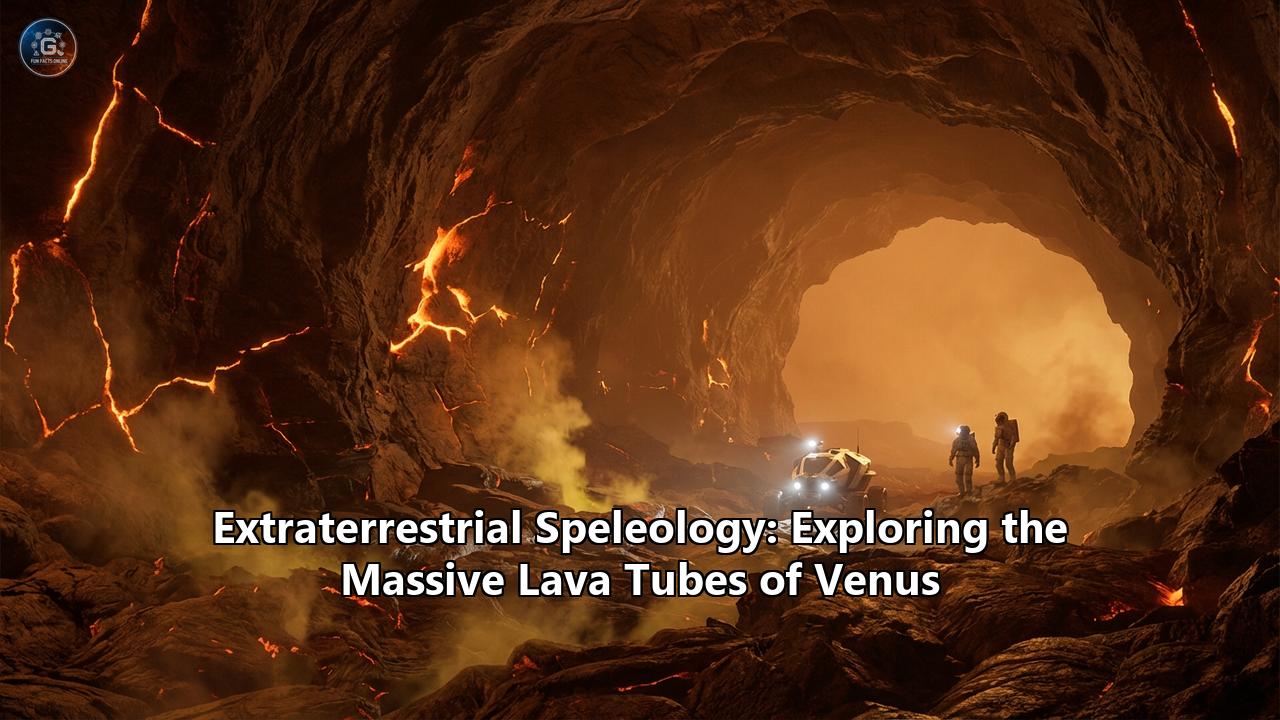
Picture a world where the surface temperature hovers at a staggering 480°C (900°F)—hot enough to melt lead. Above you, an oppressive, hyper-dense atmosphere composed of 96% carbon dioxide exerts a crushing pressure roughly 90 times that of Earth at sea level, equivalent to diving nearly a mile deep into a terrestrial ocean. The skies are choked with opaque, fast-moving clouds of highly corrosive sulfuric acid, blocking out the stars and casting a sickly, sulfurous pallor over a desolate, cracked landscape. This is Venus, Earth’s so-called "evil twin," a planet long considered a volcanic wasteland fundamentally hostile to exploration.
Yet, beneath this nightmarish, blistering exterior lies a hidden world that is forcing planetary scientists to completely rewrite their understanding of our nearest planetary neighbor. Deep beneath the basaltic plains and towering shield volcanoes, vast, dark, and hollow subterranean networks remain perfectly preserved in the silence of the planetary crust. We are standing at the dawn of a new era in planetary science—the era of Venusian extraterrestrial speleology.
For decades, the search for alien caves has primarily focused on the Moon and Mars. Subsurface voids offer a tantalizing promise for astrobiologists and space exploration architects alike: protection. On worlds without thick atmospheres or magnetic fields, lava tubes provide natural bunkers shielded from cosmic radiation, violent temperature swings, and micrometeorite bombardments. But Venus, with its hyper-thick atmosphere, doesn't need protection from space weather. Instead, its massive underground lava tubes—some recently discovered to be a staggering one kilometer in width—offer an unprecedented window into the planet's violent geological history, its thermal evolution, and perhaps even the lingering chemical ghosts of its ancient, more habitable past.
The discovery of these colossal subsurface structures marks a monumental shift in how we view Venus. Far from being a static, solid sphere of dead volcanic rock, Venus is a dynamic, hollowed-out world. The exploration of these massive lava tubes, an endeavor that pushes the absolute boundaries of our technological capabilities, represents the ultimate frontier in extraterrestrial speleology.
The Echoes of Magellan: Unveiling the Underworld
To understand how we found caves on a planet completely obscured by opaque clouds, we have to look backward to a marvel of 20th-century engineering: NASA’s Magellan spacecraft. Launched in 1989, Magellan arrived at Venus in 1990 and spent four years conducting a systematic, globe-spanning radar mapping campaign. Because traditional optical telescopes are entirely useless against the Venusian cloud deck, Magellan relied on Synthetic Aperture Radar (SAR).
SAR operates by firing microwave radio pulses down through the dense atmosphere and timing exactly how long the waves take to bounce back after interacting with the rugged terrain. By measuring the intensity and time delay of these backscattered signals, Magellan's computers could mathematically reconstruct a detailed, three-dimensional topographical map of 98% of the planet's surface. Magellan revealed a world dominated by volcanism, scarring the planet with vast plains of frozen basalt, peculiar "pancake" domes, and immense shield volcanoes.
However, the true treasures within Magellan’s data lay dormant for over three decades. Planetary scientists and geologists have long theorized that Venus should have lava tubes. After all, volcanism is the primary geologic engine of the planet. But proving their existence—let alone measuring their scale—was a monumental challenge. Subterranean voids are entirely invisible to orbital radar unless the roof of the cavern has collapsed.
It wasn't until late 2025 and early 2026 that modern computational analysis, utilizing advanced algorithms and high-resolution modeling of the decades-old Magellan data, finally cracked the case. Researchers from institutions like the University of Trento and the University of Padova painstakingly analyzed the backscatter maps, searching for specific geomorphological markers. They were looking for "pit chains"—linear sequences of circular depressions—and "skylights," which are localized sinkholes where the roof of a lava tube has caved in, exposing the dark abyss beneath.
Their persistence paid off in spectacular fashion. On the western flank of Nyx Mons, a massive shield volcano named after the Greek goddess of the night, the radar data revealed an undeniable sequence of surface collapses. The analysis uncovered a colossal, partially drained lava tube—a "pyroduct"—that shattered all previous expectations.
The Scale of the Titans: Anatomy of a Venusian Pyroduct
When we think of lava tubes on Earth, such as those in Hawaii, Iceland, or Spain, we imagine tunnels roughly the size of a subway system. The Kazumura Cave in Hawaii, one of the longest on Earth, is extensive but relatively narrow. Martian lava tubes are considerably larger, comfortably capable of housing entire subterranean research bases. Lunar lava tubes, formed in an environment with only 16% of Earth's gravity, are theoretically gargantuan, with some wide enough to fit entire terrestrial cities within their vaulted ceilings.
Venus, however, presents a profound paradox. Venusian gravity is approximately 91% of Earth's. Under normal geophysical assumptions, higher gravity pulls downward more forcefully on the ceiling of an underground cavern, meaning that wide tubes should quickly collapse under their own weight. Therefore, planetary geologists expected Venusian lava tubes to be roughly the same size as those found on Earth.
The data from Nyx Mons completely disrupted this trend. The newly discovered Venusian pyroduct is mind-boggling in its proportions. The tube measures an average of one kilometer (3,280 feet) in diameter. The roof of the cavern—the solid rock spanning this immense void—is approximately 150 meters thick. Beneath this ceiling lies a sheer, empty drop plunging no less than 375 meters (over 1,200 feet) deep. While Magellan's radar confirmed a continuous structure of at least 300 meters in length beneath the skylights, geological context and surrounding terrain analysis suggest this single tube could stretch for 45 kilometers or more.
How is this possible? How can a planet with Earth-like gravity support subterranean cavities of such monumental scale without the roofs collapsing?
The answer was published in the journal Icarus in early 2026, following exhaustive Finite Element Limit Analysis (FELA) by an international research team. FELA is an advanced engineering and geotechnical methodology used to calculate the structural stability of rock masses under immense stress. By simulating the specific conditions of Venus, researchers discovered that a perfect storm of environmental factors makes these mega-tubes possible.
Lava tubes form through a process of gradual inflation. During an eruption, rivers of low-viscosity, molten basalt rush across the landscape. The outer layer of this flowing lava comes into contact with the atmosphere and begins to cool and solidify, forming a crust. Beneath this hardened shell, the hot lava continues to flow, insulated from the outside environment. Eventually, when the volcanic eruption ceases, the molten rock drains away, leaving behind a hollow conduit.
On Venus, the dense, extremely hot, and high-pressure atmosphere plays a crucial, counterintuitive role. While the surface is 480°C, molten basalt erupts at temperatures exceeding 1,000°C. The thick, supercritical carbon dioxide atmosphere quickly forms an incredibly dense, highly insulating crust over the flowing lava. Furthermore, the extreme pressure of the Venusian atmosphere acts almost like an external scaffolding, providing a stabilizing compressive force on the newly formed rock arches.
The FELA modeling proved that under the specific rock-strength parameters and atmospheric pressure of Venus, arching roofs of basalt over voids several hundred meters to a full kilometer wide can remain completely structurally stable over geological timescales without caving in. Venus does not just have caves; it hosts some of the most extensive and voluminous subsurface cavities in the entire solar system.
A Window into a Dead World's Past
The confirmation of massive lava tubes on Venus is much more than a geographical curiosity; it is a critical key to unlocking the planet's deeply mysterious evolution.
Venus and Earth formed at the same time, in the same region of the solar nebula, and are virtually identical in size and bulk composition. Yet, Earth became a lush, water-rich haven for life, while Venus spiraled into a runaway greenhouse apocalypse. Understanding why these two twin worlds took such divergent paths is one of the most pressing questions in astrophysics.
A major piece of that puzzle lies in plate tectonics. On Earth, the crust is broken into constantly shifting tectonic plates. This movement regulates the planet's internal heat, recycles carbon, and continuously reshapes the surface. Venus, bizarrely, does not appear to have plate tectonics. Instead, it seems to possess a "stagnant lid"—a single, continuous crust.
Because it lacks the slow release valves of plate boundaries, Venus must shed its immense internal heat through other means. Many scientists believe that Venus undergoes catastrophic resurfacing events. Every few hundred million years, the trapped heat beneath the crust reaches a critical point, leading to planet-wide, cataclysmic volcanic eruptions that essentially melt and pave over the entire surface, erasing any geological record of what came before.
The lava tubes we observe today are the fossilized arteries of these cataclysmic events. By studying the size, distribution, and depth of pit chains and pyroducts, geologists can backward-engineer the viscosity, volume, and effusion rates of ancient Venusian eruptions. The immense scale of the Nyx Mons lava tube, for instance, indicates eruptions of unimaginable ferocity and volume, featuring super-heated, highly fluid magma tearing through the crust at astonishing speeds.
Furthermore, these caves act as perfectly preserved geological time capsules. On the surface of Venus, the extreme chemical weathering from sulfuric acid and supercritical carbon dioxide rapidly degrades rock formations. But inside a sealed lava tube, the basaltic walls are protected from the harsh atmospheric erosion. If we can ever manage to peer inside—or send instruments into—these caverns, we would be looking at pristine Venusian bedrock, offering the purest possible data on the planet's mantle composition and thermal history.
Astrobiology in the Dark: Could Life Exist in the Venusian Underworld?
Whenever we discover a new extreme environment in the solar system, the question of astrobiology inevitably arises. Is there any chance that life could exist, or ever existed, within these massive subterranean networks?
To be perfectly clear, the surface of Venus is entirely hostile to life as we understand it. Organic molecules instantly degrade at 480°C, and there is virtually no liquid water available. However, planetary climatologists widely believe that early in its history, Venus may have been temperate, possessing shallow liquid water oceans and a much thinner atmosphere. For perhaps a billion years, Venus could have been habitable.
As the sun gradually brightened and Venus underwent its runaway greenhouse effect, the oceans boiled away and the surface became a hellscape. If microbial life ever evolved during that temperate window, what would happen to it?
Some astrobiologists have controversially suggested that extremophile microbes might have migrated upward into the cooler cloud decks of Venus, floating in an aerial biosphere where temperatures and pressures are surprisingly Earth-like. But another theoretical refuge exists: downward.
Deep beneath the crust, temperatures are actually higher than on the surface, moving closer to the mantle. But the caves themselves present a unique micro-environment. While the ambient temperature inside a Venusian lava tube is still searingly hot, the total lack of ultraviolet radiation and the potentially unique mineralogical gradients along the cave walls offer an interesting thermodynamic playground.
Could there be a "Goldilocks zone" deep within the crust, perhaps in an ancient, deep aquifer system connected to these volcanic pipes? It is highly speculative, but in extraterrestrial speleology, every void is a potential habitat. Even if life never existed on Venus, the inner walls of these massive lava tubes may contain trapped atmospheric gases or isotopic signatures frozen in the basalt from billions of years ago—chemical fossils that tell the story of a dying world before the runaway greenhouse took full effect.
The Vanguard of Exploration: How Do We Map the Abyss?
The confirmation of the Nyx Mons pyroduct via legacy Magellan data is merely the prologue. As we move through the 2020s and into the 2030s, humanity is preparing to launch an armada of new, highly advanced spacecraft to Venus. This upcoming "Decade of Venus" will feature instruments specifically designed to peel back the planet's dense atmosphere and map its subsurface mysteries.
NASA’s VERITAS (Venus Emissivity, Radio Science, InSAR, Topography, and Spectroscopy):Scheduled to launch in the early 2030s, VERITAS is the spiritual successor to Magellan. It will carry an incredibly advanced X-band synthetic aperture radar, capable of producing high-resolution, 3D global topographies of Venus with up to 100 times the resolution of Magellan. For extraterrestrial speleologists, VERITAS is the holy grail. Its radar will easily detect subtle topographical sags—the telltale depressions that indicate a massive subterranean lava tube is lurking just beneath a perfectly intact crust. VERITAS will map the entire global network of Venusian caves.
NASA’s DAVINCI (Deep Atmosphere Venus Investigation of Noble gases, Chemistry, and Imaging):Launching alongside VERITAS, DAVINCI is primarily an atmospheric entry probe. It will plunge through the Venusian clouds, taking high-precision chemical samples. However, during its descent, it will use infrared imaging to map the surface in unprecedented detail. While not a radar mission, DAVINCI's imaging could capture visual evidence of volcanic outgassing or specific mineralogical changes around the rims of massive skylights, giving us clues about what lies within the tubes.
ESA’s EnVision:The European Space Agency’s EnVision mission is perhaps the most exciting tool for Venusian cave hunting. EnVision is equipped with the Subsurface Radar Sounder (SRS). Unlike standard SAR, which maps the surface topography, a radar sounder fires lower-frequency radio waves specifically designed to penetrate solid rock. EnVision will physically look through the Venusian crust, detecting the hollow voids, measuring the exact thickness of the cavern roofs, and mapping the volumetric depth of the pyroducts. If Magellan found the skylights, EnVision will map the tunnels.
Future Ambitions: Venera-D and Shukrayaan-1:Russia’s proposed Venera-D mission and the Indian Space Research Organisation's (ISRO) Shukrayaan-1 orbiter are also expected to carry ground-penetrating radar and emissivity sensors. This international fleet will provide an overlapping, multi-spectrum dataset that will turn our currently fragmented map of Venusian caves into a comprehensive 3D atlas.
Into the Inferno: Conceptual Robotics for Cave Exploration
Orbiters can map the roofs of lava tubes, but true speleology requires getting your boots—or rather, your treads—on the ground. The ultimate goal of extraterrestrial speleology is in-situ exploration: sending a probe directly into the belly of the beast.
But how do you explore a cave on a planet that melts conventional electronics in hours? The longest any lander has ever survived on Venus was the Soviet Union's Venera 13 in 1982, which transmitted for a mere 127 minutes before succumbing to the heat and pressure.
To explore a Venusian lava tube, engineers must embrace radical, paradigm-shifting robotic designs. Modern aerospace engineering is actively developing concepts that sound straight out of science fiction.
High-Temperature Electronics:Silicon, the backbone of modern computing, fails at around 250°C. To survive Venus, we need a new kind of brain. Researchers at NASA's Glenn Research Center have been developing integrated circuits made from Silicon Carbide (SiC). In test chambers simulating Venusian surface conditions, these SiC computer chips have operated continuously for weeks without any cooling systems. A future cave-exploring rover would be built entirely around these ultra-durable circuits.
The Clockwork Rover (AREE):NASA's Jet Propulsion Laboratory has funded research into the Automaton Rover for Extreme Environments (AREE). Recognizing that complex electronics are a liability on Venus, AREE relies on mechanical engineering. Inspired by mechanical computers and clockwork automata, AREE uses wind turbines to power internal springs, gears, and levers. It moves using complex linkages and records data on phonograph-like metal records. A fully mechanical, heat-resistant rover could theoretically crawl to the edge of a Nyx Mons skylight and lower a tethered mechanical sensor down into the void, entirely immune to the 480°C heat.
Aerobots and Drones:The incredibly dense atmosphere of Venus—which is thicker than water at the surface—makes buoyancy and flight surprisingly efficient. While helicopters on Mars (like Ingenuity) struggle to generate lift in a whisper-thin atmosphere, a drone on Venus would feel like it is swimming. Scientists have proposed high-temperature, metallic aerobots or hybrid dirigibles that could float across the Venusian plains. Upon finding a collapsed skylight, an aerobot could simply deflate slightly, descending gently down the 375-meter vertical shaft into the cavern below. Floating in the pitch black, illuminated only by its onboard searchlights, it could map the cavern walls using sonar—a technology usually reserved for underwater exploration on Earth, but perfectly suited to the ocean-like atmosphere of the Venusian underworld.
The Philosophical Shift: Venus as a Frontier
The realization that Venus harbors vast, structurally stable subterranean networks up to a kilometer wide fundamentally alters our relationship with the planet. For decades, Venus has been viewed as a cautionary tale—a terrifying warning of runaway climate change and a dead end for space exploration. Mars has dominated the public imagination as the future home of humanity and the prime hunting ground for alien life.
But the discovery of these gigantic pyroducts elevates Venus from a mere hostile wasteland to a planet of profound, rugged mystery. It reminds us that planets are not just 2D maps of craters and plains; they are complex, three-dimensional entities with history etched into every layer of their crust.
Extraterrestrial speleology teaches us that the most interesting parts of a planet are often the parts we cannot readily see. The giant caves of Venus challenge our engineering prowess, demanding that we build stronger, smarter, and more resilient machines. They challenge our geological models, forcing us to reckon with the strange physics of low-gravity equivalents on a high-pressure, high-heat world.
As we look toward the 2030s, the dark voids beneath Nyx Mons beckon. They are the silent, empty arteries of a world that boiled itself alive. They are the grandest cathedrals of natural architecture in the inner solar system. We have finally found the door to the Venusian underworld; now, we just have to figure out how to walk through it.
Reference:
- https://caliber.az/en/post/venus-may-hide-massive-lava-tubes-beneath-its-extreme-surface
- https://www.primetimer.com/features/research-suggests-large-stable-lava-tubes-may-exist-beneath-venus-surface
- https://www.indiatoday.in/science/story/radar-finds-moon-like-lava-tubes-beneath-venus-first-discovery-beyond-earth-2865875-2026-02-10
- https://www.universetoday.com/articles/massive-venus-lava-tube-detected-using-data-from-nasas-long-defunct-magellan-spacecraft
- https://futurism.com/space/venus-lava-tubes-tunnels