
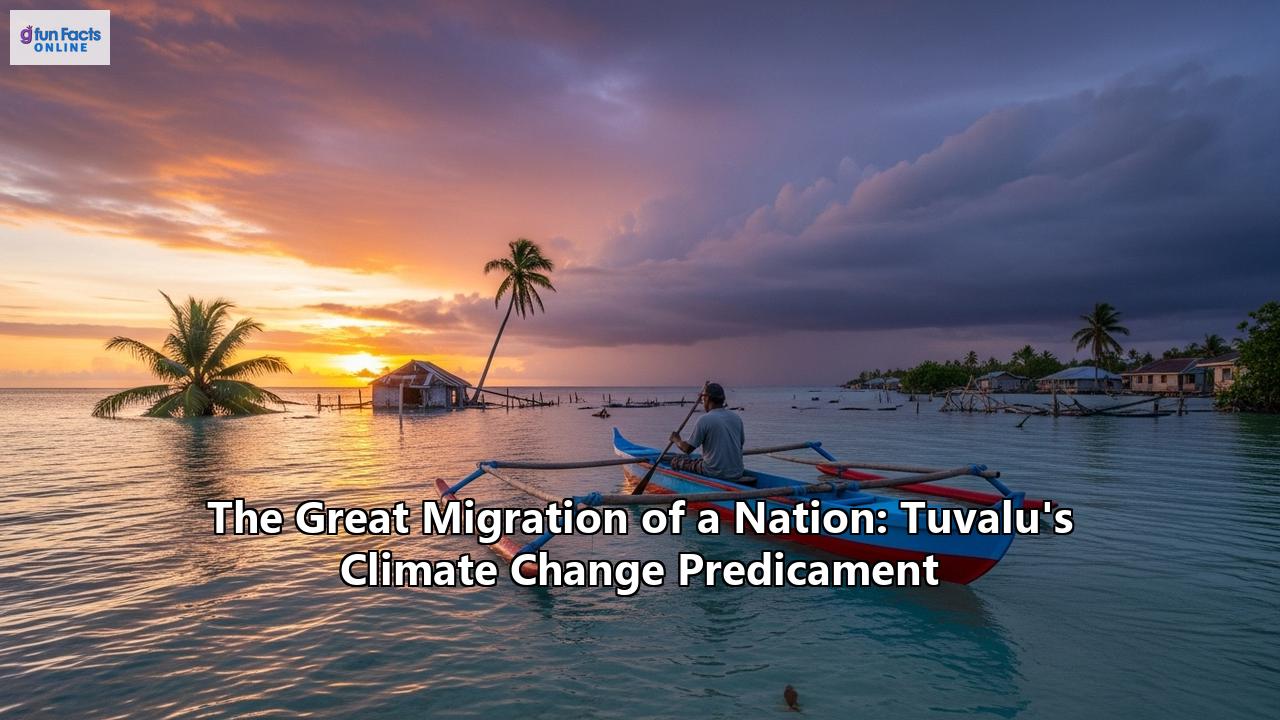
The Disappearing Nation: Tuvalu's Fight for Survival in a Warming World
In the vast expanse of the Pacific Ocean, halfway between Hawaii and Australia, lies a nation on the precipice of vanishing. Tuvalu, a collection of nine low-lying coral atolls and reef islands, is in a desperate battle against an enemy it did not create, but which threatens to erase it from the world map. This is not a story of a distant, abstract future; for the 11,000 citizens of Tuvalu, the climate crisis is a daily, lived reality, a relentless tide lapping at their homes, their culture, and their very existence.
The predicament of Tuvalu is a stark and urgent warning to the global community. It is a story of a nation's struggle for survival, the profound connection between land and identity, and the innovative, and at times audacious, measures being taken to preserve a country in the face of oblivion.
The Science of a Sinking Paradise
The geography of Tuvalu is both its beauty and its vulnerability. With a total land area of just 26 square kilometers, its highest point is a mere 4.6 meters above sea level. This makes the nation exceptionally susceptible to the impacts of climate change, particularly sea-level rise. The Intergovernmental Panel on Climate Change (IPCC) has reported an accelerated rise in global sea levels, a direct consequence of global warming melting polar ice caps and glaciers. For Tuvalu, this is not a distant threat; satellite data indicates that the sea level near Tuvalu has been rising at a rate of about 5 mm per year since 1993, a rate higher than the global average. Projections are dire, with some scientists predicting that much of Tuvalu could be submerged by the middle of this century, and the entire nation could become uninhabitable within a few decades.
The rising seas are not a gentle, gradual inundation. They manifest in increasingly frequent and severe "king tides," which flood homes, contaminate freshwater sources, and destroy crops. The ocean, once a source of sustenance and cultural identity, is now a menacing force. Saltwater intrusion is rendering the already poor soil of the atolls even less fertile, making it difficult to grow traditional staples like pulaka (a type of taro), coconuts, and bananas. This not only threatens food security but also the cultural practices associated with agriculture.
Furthermore, Tuvalu is experiencing more intense cyclones and storms, which erode the fragile coastlines and damage infrastructure. The combination of rising sea levels and more powerful storms creates a devastating synergy, accelerating the loss of land and making life increasingly precarious for the Tuvaluan people.
The Erosion of Culture and Identity
For Tuvaluans, the land, or fenua, is more than just a physical space; it is the foundation of their culture, identity, and spiritual well-being. The potential loss of their homeland is, therefore, a profound existential threat, extending far beyond the physical displacement of its people.
Tuvaluan culture is a rich tapestry of traditions woven into the fabric of daily life. The fatele, a traditional dance performed at community events, tells stories of their ancestors and their connection to the islands. Storytelling, another vital cultural practice, passes down history, myths, and moral lessons through generations. Traditional crafts, such as weaving mats and baskets from pandanus leaves and woodcarving, are not only functional but also carry deep cultural significance.
The communal living system, known as salanga, is central to Tuvaluan society. Each family has a specific role to perform for the benefit of the community, such as fishing, house building, or defense, fostering a strong sense of unity and shared responsibility. The spiritual connection to the land is also deeply ingrained, with many Tuvaluans believing that their islands were created by deities and are protected by guardian spirits. The creation myth of the eel and the flounder, for instance, explains the formation of the atolls and the origin of the coconut palms, reinforcing the sacred link between the people and their environment.
Climate change is systematically dismantling this intricate cultural ecosystem. The rising seas are not only swallowing the land but also the tangible and intangible heritage of the Tuvaluan people. Burial grounds, which are traditionally located near family homes, are being eroded, forcing families to relocate the remains of their ancestors – a deeply distressing experience. The salinization of the soil is making it harder to cultivate the plants used in traditional crafts and medicine. The changing marine environment, including coral bleaching, threatens the fish stocks that are central to the Tuvaluan diet and fishing traditions.
The very act of living on the islands is becoming a constant struggle, leaving less time and energy for cultural practices. As one Tuvaluan woman lamented, "My greatest fear is losing our identity. We're resilient, but how much can we adapt before we forget who we are?"
Voices from the Frontline: Personal Stories of Loss and Resilience
Behind the scientific data and cultural analysis are the powerful and poignant stories of the Tuvaluan people. Their personal accounts offer a raw and intimate glimpse into the human cost of climate change.
Sinkiagi Taulamati, a 64-year-old carpenter, has witnessed the relentless encroachment of the sea on his land. "I have been living here for years and I remember clearly that this plot of land, where my house is situated, was much bigger," he shared. "Coastal erosion has eroded a significant part of my land." The king tides now regularly flood his home, and the saltwater has destroyed his banana plantation. For Sinkiagi, migration is not a desirable option. "I love my country Tuvalu and my home island Funafuti wholeheartedly. I do not want to migrate or imagine myself being forced to migrate to other countries in the future because of climate change."
Younger generations also share this deep connection to their homeland, coupled with a growing anxiety about their future. Grace Maile, a 24-year-old climate activist, eloquently expresses this sentiment: "Migration is a good plan, but it's a last resort. We don't want to leave our country and go elsewhere. Our culture and identity are tied to this land. And everything is interconnected here - the land, the water, the culture, and the people who live here. We have no intention of giving up and moving away."
The youth of Tuvalu are acutely aware of the existential threat they face. The Funafuti Youth Declaration on Climate Change powerfully states, "We, the youth of Tuvalu strongly believe that we want to preserve our cultural identity and our traditional knowledge and want to see prioritised programs for youth development... It is our firm belief that we have a future on our islands and will not give up."
For many, the decision to stay or leave is a heart-wrenching one. Maani Maani, a 32-year-old IT worker, captured this dilemma: "Some will have to go and some will want to stay here. It's a very hard decision to make. To leave a country, you leave the culture you were born with, and culture is everything – family, your sister, your brother. It is everything."
These personal stories underscore the profound emotional and psychological toll of climate change. Researchers have identified significant levels of psychological distress, including anxiety, sadness, and a sense of hopelessness, among the Tuvaluan population. This is not just a response to the immediate environmental changes but also to the contemplation of a future where their nation may no longer exist. The term "solastalgia," which describes the distress caused by environmental change to one's home, is a fitting descriptor for the collective grief being experienced in Tuvalu.
A Nation Reimagined: The "Future Now" Project and the Digital Twin
Faced with the unprecedented threat of national extinction, the Tuvaluan government has embarked on a series of innovative and audacious initiatives under the umbrella of the "Future Now" project (Te Ataeao Nei). This multi-pronged strategy aims to secure Tuvalu's future through a combination of diplomatic efforts, legal innovations, and cutting-edge technology.
One of the most headline-grabbing components of the "Future Now" project is the creation of a "digital nation." Announced by Foreign Minister Simon Kofe at the COP27 climate conference in 2022, this ambitious plan involves creating a digital twin of Tuvalu in the metaverse. The goal is to preserve the country's land, culture, and history in a virtual space, and to ensure the continued functioning of the Tuvaluan state even if its physical territory is submerged.
This is not merely a symbolic gesture. The project involves the use of sophisticated technologies to create a detailed and interactive digital replica of the islands. High-resolution mapping is being conducted using drones and street cameras, and 3D models are being created with technologies like GIS and Unreal Engine. The first island to be digitally recreated was Te Afualiku, one of the smallest and most vulnerable islets. The digital twin will not only serve as a cultural archive but also as a practical tool for monitoring environmental changes, such as shoreline erosion and the impact of king tides.
The digital nation concept also includes the migration of government services to the cloud. This would allow Tuvalu to continue to function as a sovereign state, with the ability to conduct elections, issue digital passports, and maintain its legal and administrative systems, even if its population is displaced. As Simon Kofe explained, "Our hope is that we have a digital nation that exists alongside our physical territory, but in the event that we lose our physical territory, we will have a digital nation that is functioning well, and is recognized by the world as the representative of Tuvalu."
The Legal Frontier: Statehood Without Territory
The concept of a "digital nation" pushes the boundaries of international law and raises profound questions about the nature of sovereignty in the 21st century. The 1933 Montevideo Convention, which is widely regarded as the codification of the traditional criteria for statehood, requires a defined territory, a permanent population, a government, and the capacity to enter into relations with other states. Tuvalu's situation challenges the very first of these criteria.
Tuvalu is at the forefront of a new and urgent legal debate on "statehood without territory" and "ex-situ nationhood." The government is actively pursuing diplomatic and legal avenues to secure international recognition of its permanent statehood, regardless of the fate of its physical landmass. A key part of this strategy is to get other nations to sign bilateral agreements recognizing Tuvalu's sovereignty and its existing maritime boundaries as fixed, even if the islands disappear. To date, a number of countries, including Australia and members of the Pacific Islands Forum, have recognized Tuvalu's digital statehood.
In a landmark move, Tuvalu has amended its own constitution to declare that its statehood is permanent and will not be extinguished by the loss of its territory. This is a bold assertion of national will in the face of an existential threat. The government is also campaigning for an amendment to the UN Convention on the Law of the Sea (UNCLOS) to ensure that nations do not lose their exclusive economic zones (EEZs) due to sea-level rise. For Tuvalu, its EEZ is a vital economic asset, and retaining control over it is crucial for its future, whether physical or digital.
The international community's response to Tuvalu's legal and diplomatic initiatives will set a critical precedent for other low-lying nations facing a similar fate. The case of Tuvalu is forcing a re-evaluation of long-held legal norms and prompting a necessary conversation about how international law can adapt to the realities of the climate crisis.
A Call to Action from a Disappearing Land
The story of Tuvalu is a microcosm of the global climate crisis. It is a story of profound injustice, where a nation that has contributed negligibly to the greenhouse gas emissions that are causing climate change is facing the ultimate price. It is also a story of remarkable resilience, innovation, and a fierce determination to survive.
The people of Tuvalu are not passive victims. They are fighting for their homeland on multiple fronts, from building sea walls and planting mangroves to leading the charge for international climate action and pioneering new forms of digital nationhood. Their message to the world is clear and unequivocal: the time for talk is over. Urgent and ambitious action is needed to reduce global emissions and avert the catastrophic consequences of climate change.
As former Tuvaluan Foreign Minister Simon Kofe powerfully stated, "We are sinking, but so is everyone else." The fate of Tuvalu is a harbinger of what is to come for other vulnerable communities around the world if the international community fails to act decisively. Saving Tuvalu is not just about saving a small island nation; it is about saving our shared future. The world must heed the call from this disappearing land before it is too late.
Reference:
- https://www.researchgate.net/publication/341518491_The_mental_health_impacts_of_climate_change_Findings_from_a_Pacific_Island_atoll_nation
- https://www.bbntimes.com/environment/mental-healthcare-and-climate-change-in-small-island-developing-states
- https://www.unicef.org.au/stories/tuvalu-climate-change-photo-essay
- https://www.ecowatch.com/tuvalus-rising-sea-levels.html
- https://ijaps.usm.my/wp-content/uploads/2025/02/IJAPS-211_ART-6.pdf
- https://weadapt.org/knowledge-base/small-islands-and-climate-change/mental-health-and-climate-change-in-small-island-developing-states/
- https://findanexpert.unimelb.edu.au/scholarlywork/1449253-the-mental-health-impacts-of-climate-change--findings-from-a-pacific-island-atoll-nation
- https://scholarspace.manoa.hawaii.edu/items/86d51b5b-8e66-452e-b0b2-91de0d2c1dc4
- https://www.researchgate.net/publication/26625480_Sea_Level_Threat_in_Tuvalu
- https://www.emerald.com/insight/content/doi/10.1108/ijccsm-03-2022-0032/full/html
- https://healthpolicy-watch.news/small-island-developing-states-at-nexus-of-climate-unhealthy-foods-and-mental-health-challenges/
- https://toda.org/assets/files/resources/policy-briefs/t-pb-175_summary-report-canberra_boege.pdf
- https://www.lowyinstitute.org/the-interpreter/solastalgia-malady-our-age
- https://www.researchgate.net/publication/332952815_Distressing_encounters_in_the_context_of_climate_change_Idioms_of_distress_determinants_and_responses_to_distress_in_Tuvalu
- https://blogs.timesofisrael.com/tuvalus-ongoing-struggle/
- https://pubmed.ncbi.nlm.nih.gov/32485590/
- https://insideclimatenews.org/news/01072025/todays-climate-rising-seas-migration-displacement/
- https://pmc.ncbi.nlm.nih.gov/articles/PMC8208624/
- https://www.germanwatch.org/sites/default/files/publication/3632.pdf
- https://www.theashleylashleyfoundation.org/post/the-health-effects-of-climate-change-in-small-island-nations