
Imagine diving into a swimming pool, submerging yourself completely, and trying to shout to a friend standing right on the edge of the deck. No matter how much air you push from your lungs, the sound that reaches them is a barely audible, muffled distortion. Now, flip the scenario. Imagine standing on the deck and trying to talk to someone underwater. The result is the same.
For centuries, the boundary between water and air has acted as an impenetrable, invisible wall to sound. To the human eye, the surface of the ocean is a transparent window into the deep. But to an acoustic wave, the surface of the water acts more like a flawless, impenetrable mirror. This physical quirk of our universe has fundamentally fractured how we explore the planet, separating the domain of airborne vehicles and the realm of underwater submersibles into two isolated worlds.
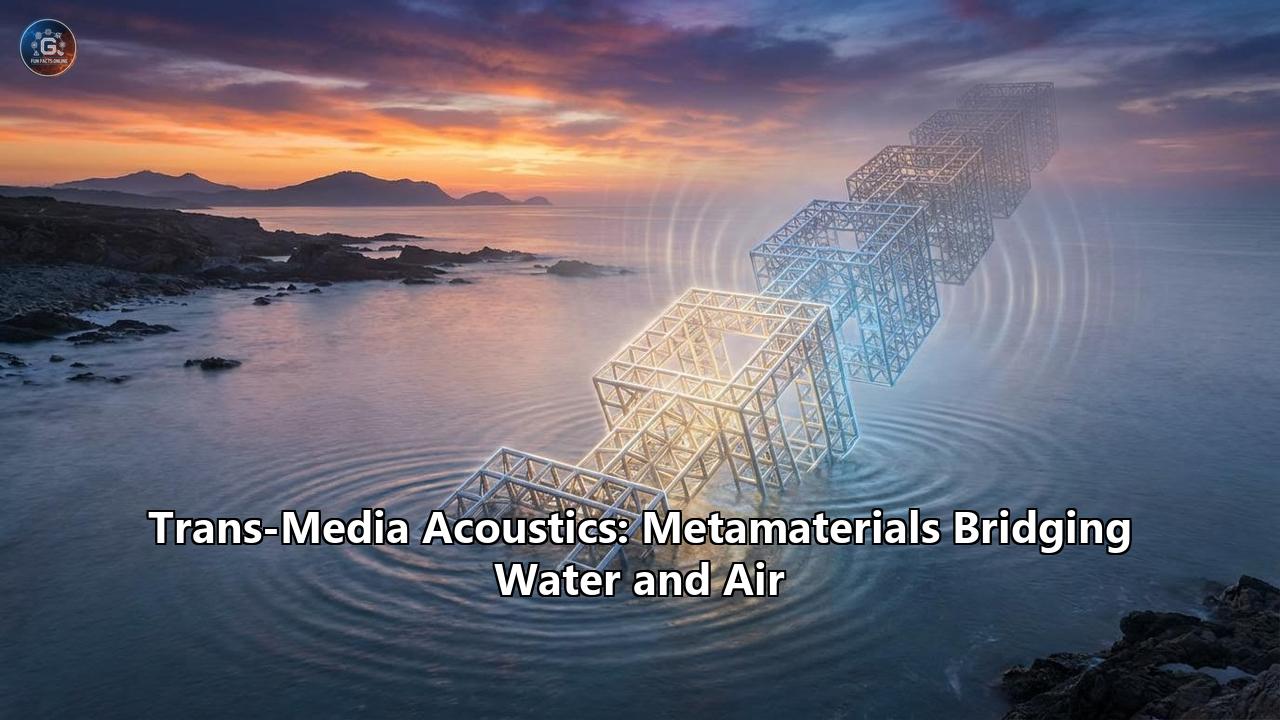
But a revolution is underway in the field of wave physics. Through the rapidly advancing science of trans-media acoustics and the deployment of "acoustic metamaterials," scientists are finally building bridges across this boundary. By engineering structures that trick sound waves into slipping through the air-water barrier, we are on the precipice of a new era of seamless communication between the sky and the sea.
The Physics of the Great Acoustic Divide
To understand the magnitude of this breakthrough, we must first understand why the water-air interface is so hostile to sound.
Sound is a mechanical wave; it requires a medium to travel through, propagating by compressing and deforming the molecules of that medium. How a sound wave travels depends entirely on the physical properties of the material it is moving through—specifically, its density and the speed of sound within it. The product of these two properties is known as "acoustic impedance".
Air is a thin, compressible gas. Water is a dense, largely incompressible liquid. Because water is roughly 800 times denser than air, and sound travels more than four times faster in water than it does in air, the acoustic impedance of water is a staggering 3,600 times greater than that of air.
When a wave encounters a boundary between two mediums, the difference in their impedance dictates how much of the wave's energy is transmitted and how much is reflected. Because the impedance mismatch between water and air is so extreme, the transmission coefficient is microscopic. When an acoustic wave hits the surface of the ocean from below, 99.9% of its energy bounces right back into the depths. Only a paltry 0.1% manages to escape into the atmosphere—a transmission loss of approximately 30 decibels. To put that in perspective, a sound wave losing 30 decibels at the ocean's surface is experiencing the exact same energy loss it would suffer after traveling through 1,200 kilometers of open seawater.
For decades, engineers tried to circumvent this problem by switching to different types of waves. If sound won't cross the barrier, what about electromagnetic radio waves, which power our terrestrial Wi-Fi, cell phones, and radar? Unfortunately, seawater is highly conductive and rapidly absorbs and attenuates radio waves; a high-frequency radio signal might penetrate only a few millimeters into the ocean before dying out entirely. Optical communication using lasers is another alternative, but light is easily scattered by suspended particles, algae, and the natural turbulence of the ocean, strictly limiting its range to a few dozen meters in pristine conditions.
Sound remains the undisputed king of underwater propagation. Whales use it to communicate across ocean basins, and submarines use sonar to map the seafloor. But until recently, any acoustic data gathered by a submarine or an underwater robot had to be physically brought to the surface, or transmitted via a floating buoy that breaches the interface to relay a radio signal to a satellite.
There was simply no way to whisper from the deep directly into the sky. That is, until physicists began to play with metamaterials.
Rewriting the Rules with Acoustic Metamaterials
A metamaterial is not defined by what it is made of, but by how it is structured. They are artificial composite materials engineered with intricate, microscopic geometries that manipulate wave phenomena in ways that do not exist in nature.
Originally, metamaterials were developed to manipulate electromagnetic waves, leading to the creation of theoretical "invisibility cloaks" that could bend light around an object. But over the last two decades, the same principles were adapted for mechanical vibrations, giving birth to the acoustic metamaterial. By using repeating subwavelength structures—such as tiny Helmholtz resonators, tensioned membranes, coiled spaces, or intricate fluid cavities—these materials can exhibit "negative mass density" or "negative bulk modulus." In simple terms, when you push on an acoustic metamaterial with a sound wave, it can push back in the opposite direction, twisting, delaying, or amplifying the sound wave in wildly counterintuitive ways.
When applied to the water-air interface, acoustic metamaterials act as an "impedance matching layer." Think of the anti-reflective coating on a pair of eyeglasses or a camera lens. Glass and air have different optical impedances, which causes glare and reflection. An anti-reflective coating is a microscopic layer of material that gently bridges this gap, allowing light to pass through smoothly. Acoustic metamaterials aim to do the exact same thing for sound, serving as a transitional stepping stone between the heavy density of water and the light density of air.
The Milestone Breakthroughs: Building the Bridge
The quest to conquer the water-air acoustic barrier has seen a rapid acceleration in recent years, driven by a series of ingenious architectural designs.
The Rubber Membrane MetasurfaceOne of the earliest major breakthroughs occurred around 2018 through a joint Korean-Japanese research collaboration. The team designed an acoustic metasurface just 5 millimeters thick—about the size of a poker chip—consisting of a metallic frame holding five tensioned rubber membranes, with a small central weight attached.
When placed at the water's surface, this device acted as an acoustic mediator. As a sound wave hit the metasurface, the device resonated. The rigid parts of the frame reflected waves in one phase, while the vibrating rubber membranes reflected waves in the exact opposite phase. These two reflections canceled each other out through destructive interference. With the reflected wave eliminated, the acoustic energy had nowhere to go but forward, resulting in an astonishing 160-fold increase in sound transmission from water to air. While groundbreaking, this early device was heavily constrained: it only worked perfectly for sound hitting it at exactly a 90-degree angle, and it was tuned to a very narrow band of frequencies (around 700 Hz).
The Fluid-Type Acoustic Metasurface (FAM) and Bubble SpringsBy 2021, an international team of researchers realized that solid metamaterials floating on the chaotic surface of the water faced immense stability issues. Their solution was brilliantly organic: they built a metamaterial entirely out of fluids.
Using a 3D-printed hydrophobic (water-repelling) frame, they locked a highly organized layer of air bubbles just below the surface of the water. In this system, the trapped air bubbles acted as a highly elastic "spring," while the thin layer of water resting above it acted as a "mass". When an underwater sound wave hit this mass-spring system, it triggered a powerful resonance that amplified the acoustic energy, enhancing transmission across the barrier by over 20 decibels. Even more remarkably, by adjusting the location and volume of the trapped bubbles, scientists could actively "tune" the metasurface to allow different frequencies of sound to pass through, proving that music could be clearly transmitted from underwater to a receiver in the air.
Biomimicry: The Lotus Leaf MetasurfaceNature often holds the best blueprints. Expanding on the mass-spring concept, researchers subsequently developed the Lotus Acoustic Metasurface (LAM). By utilizing an actual lotus leaf—which is famously superhydrophobic—as the vibrating "mass" suspended over a layer of air, researchers achieved a stunning 40% energy transmission coefficient at intermediate ultrasonic frequencies (around 28 kHz). Crucially, the LAM demonstrated "wide-angle" transmission, meaning the acoustic source no longer needed to be directly beneath the material, allowing sound to be beamed across the boundary from a variety of dynamic angles.
Broadband Gradient Impedance Matching Layers (GIML)While resonant metamaterials achieved incredible transmission spikes, they often only worked for specific musical notes or frequencies. If we wanted to transmit complex data—like an image or a live video feed—we needed "broadband" transmission.
In 2023, acousticians made a massive leap by engineering a Gradient Impedance Matching Layer (GIML). Instead of relying on a single resonant structure, they combined air-based and water-based "metafluids" to create a transition zone where the acoustic impedance changes exponentially. On the bottom of the layer, the impedance perfectly matches the heavy, dense water. As the sound wave travels upward through the millimeter-thick layer, the impedance gradually lightens until it perfectly matches the air at the top.
This continuous gradient acts as an acoustic velvet rope, ushering complex, multi-frequency data streams across the barrier without reflection. Utilizing this GIML, scientists successfully transmitted a digital picture using sound from the air, through the interface, and into a receiver in the water, proving that high-fidelity, broadband communication across the media divide was finally a reality.
The Simple Three-Plate ResonatorMost recently, presented at the late-2025 joint meeting of the Acoustical Society of America and the Acoustical Society of Japan, researchers at Rutgers University took a radical step toward commercial viability by focusing on absolute simplicity. Hesam Bakhtiary Yekta designed a completely passive metamaterial constructed from three parallel plates of common aluminum and steel, separated by carefully measured ribs.
Sitting directly on the water's surface, the mechanism captures the underwater vibration on the bottom plate. The middle plate moves translationally, while the top plate in the air vibrates intensely, seamlessly passing the mechanical energy from the heavy liquid to the thin gas. “One of the reasons our design stands out from others is its simplicity,” Yekta noted. By utilizing cheap, easily accessible metals rather than complex laboratory metafluids or delicate rubber membranes, this three-plate design opens the door for mass-produced, rugged acoustic bridges that can be deployed on the hulls of boats, the bellies of aerial drones, or floating buoys across the globe.
Beyond Communication: Remote Acoustic Manipulation
The ability to pass sound effectively between water and air does more than just enable a conversation; it unlocks physical manipulation. Because sound is a mechanical wave, it carries momentum. When focused intensely, sound waves exert "acoustic radiation force".
For years, scientists have used focused ultrasound to shatter kidney stones inside the human body or to acoustically levitate small water droplets in mid-air. But as presented in May 2025 by researchers from the University of Wisconsin-Madison, acoustic metamaterials have now advanced to the point where they can remotely manipulate large objects underwater without ever touching them.
Dajun Zhang and his team engineered an underwater metamaterial with a unique sawtooth-patterned surface. By attaching this millimeter-scale, metal-resin composite to submerged or floating objects—like wood, wax, or plastics—researchers could fire targeted sound waves at them from external speakers. Because of the metamaterial's subwavelength geometric design, the sound waves reflected divergently off the microscopic "teeth," exerting incredibly precise localized forces.
Through this technique, scientists successfully pushed, pulled, and rotated objects in three-dimensional underwater space, purely through the invisible power of sound. While currently being tested on floating objects, this technology, when combined with trans-media metasurfaces, heralds an astonishing future. Imagine an aerial drone hovering over a lake, beaming a sound wave down through a floating impedance-matching metasurface. The sound seamlessly crosses the barrier and strikes an acoustic metamaterial patch on an underwater robotic arm, triggering it to physically rotate or actuate a valve on the seafloor. It represents a paradigm shift where operators in the atmosphere can physically interact with the underwater environment, completely non-invasively.
Furthermore, Zhang's work hints at revolutionary medical applications. Because the human body is primarily composed of water, the interface between human skin, tissue, and external air represents its own acoustic boundary. Highly refined metamaterial patches could one day be utilized to steer micro-robotic surgical tools or precisely deliver targeted drug capsules inside the human bloodstream, all manipulated by soundwaves generated by a machine hovering over the patient's body.
Rewriting the Blueprint of Ocean Operations
The implications of breaking the water-air acoustic barrier extend far beyond academic laboratories. Trans-media metamaterials are set to disrupt multiple global industries, transforming how we interact with our blue planet.
Seamless Drone-to-Submarine NetworksHistorically, an Autonomous Underwater Vehicle (AUV) mapping the ocean floor had to operate in total isolation. To share its data or receive new waypoints, it had to abort its dive, slowly ascend to the surface, establish a GPS and radio link, and then dive again—wasting precious battery life and operational time.
With trans-media acoustic metasurfaces, an airborne drone can simply hover a few feet above the ocean's surface. The AUV, hundreds of feet below, aims its acoustic sonar pinger upward at a floating metamaterial node (or a node dropped by the drone). The drone listens, instantly receiving broadband telemetry, video feeds, or topographical maps from the deep, and can immediately reply with new search parameters. This real-time, cross-domain synergy is vital for time-sensitive operations like deep-sea search and rescue, detecting unexploded munitions, or coordinating multi-vehicle exploration of treacherous underwater cave systems.
Revolutionizing Marine Biology and Environmental Sensing"A fish can hardly hear a bird and the reverse is also true," noted researchers when describing the isolation of oceanic habitats. For marine biologists, monitoring the vocalizations of whales, the snapping of shrimp, or the hum of coral reefs currently requires dropping expensive hydrophones deep underwater via boats or cables.
By utilizing trans-media metamaterials, scientists could outfit low-altitude solar drones or stationary floating blimps with sensitive aerial microphones and an acoustic metasurface lens. These aerial sentinels could continuously monitor the health of marine ecosystems, track the migratory paths of endangered marine mammals, and measure underwater noise pollution caused by commercial shipping—all without the logistical nightmare of maintaining submerged, bio-fouled hardware.
Defense and SecurityIn the realm of global security, the ocean surface has always provided a tactical acoustic shadow. Submarines rely on the impedance mismatch to ensure their engine noises do not escape into the air, where they could be easily tracked by enemy aircraft.
However, advanced trans-media acoustic metamaterials open the door to "remote water-to-air eavesdropping." Military researchers are actively investigating phase-engineered impedance matching metasurfaces that can act as acoustic funnels, pulling the faint, low-frequency rumbles of deep-sea submarines up through the barrier and into the listening sensors of anti-submarine warfare (ASW) helicopters or uncrewed aerial vehicles. Conversely, this technology ensures hyper-secure, direct communication links between submerged nuclear deterrents and command centers without the submarine ever having to surface and expose its location.
The Tempest: Challenges and Future Frontiers
While the theoretical physics and laboratory demonstrations of trans-media metamaterials are flawlessly elegant, the actual ocean is a chaotic, violent environment. The biggest hurdle facing this technology is the dynamic instability of the water-air interface.
In a pristine laboratory tank, the water surface is as flat as glass, allowing an engineered gradient layer or a delicate mass-spring membrane to sit perfectly flush and align with incoming sound waves. In the open ocean, the surface is roiling with waves, whitecaps, tidal swells, and wind shear. An acoustic metamaterial that relies on precise subwavelength geometry can rapidly lose its effectiveness if it is being violently tossed, submerged, and inverted by a three-meter swell.
To overcome this, engineers are currently developing self-stabilizing meta-buoys—gyroscopically balanced platforms that maintain a pristine, artificially flattened patch of water within a shielded chamber, allowing the metasurface to function optimally regardless of external weather conditions. Furthermore, bio-fouling remains a ubiquitous enemy. Anything placed in the ocean is swiftly colonized by algae, barnacles, and bacterial biofilms. Because acoustic metamaterials rely on exact structural mass and density to achieve their resonant magic, a heavy layer of barnacles can alter the impedance curve and effectively "blind" the acoustic bridge. Integrating advanced, non-toxic, superhydrophobic nanomaterials—much like the biomimetic lotus leaf—will be essential to keep these acoustic windows clear over long deployments.
There is also the ongoing challenge of omnidirectionality. While early devices required the sound source to be directly below the metamaterial (a one-directional environment), newer fluid-type and gradient designs have achieved wide-angle reception. Pushing this to a full 360-degree hemispherical acceptance angle is the current holy grail for physicists, ensuring that an underwater robot moving miles away on the periphery can still bounce its voice off the ceiling of the ocean and be heard by a drone miles away in the sky.
The Breaking of the Acoustic Veil
For millennia, the surface of the ocean has been the ultimate dividing line on Earth. It has dictated the evolution of life, sequestering the songs of the deep from the winds of the sky. It has defined the limits of human engineering, forcing our machines to operate in strictly segregated domains.
But science is not bound by the natural limitations of the environment; it is bound only by the limits of our imagination. Through the elegant manipulation of subwavelength geometry, resonant fluids, gradient impedances, and metallic plates, trans-media acoustics is systematically dismantling the great acoustic wall.
By teaching sound how to jump gracefully from water to air, and air to water, we are doing more than just solving a mathematical impedance mismatch. We are giving the ocean a voice that can finally be heard in the sky. As these acoustic metamaterials evolve from delicate laboratory prototypes to rugged, mass-produced components, the boundary between our world and the deep blue will blur. The drones of the air and the rovers of the abyss will speak the same language, ushering in a profoundly interconnected era of planetary exploration, understanding, and technological mastery.
Reference:
- https://acoustics.org/a-metamaterial-that-bridges-air-and-water/
- https://www.sciencenews.org/article/new-device-can-transmit-underwater-sound-air
- https://english.cast.org.cn/RESEARCH/2021/art/2021/art_dfeb9d18d8354715803ed8182bc08635.html
- https://www.youtube.com/watch?v=icuGXznu1FI
- https://academic.oup.com/nsr/article/10/6/nwac246/6795304
- https://pmc.ncbi.nlm.nih.gov/articles/PMC8501414/
- https://thedebrief.org/breakthrough-metamaterial-leverages-sound-waves-for-touch-free-control-of-submerged-objects/
- https://www.sciencedaily.com/releases/2025/05/250520224428.htm
- https://kino-ap.eng.hokudai.ac.jp/water.html
- https://pubs.acs.org/doi/10.1021/acsami.1c16043
- https://pubs.aip.org/aip/apl/article/123/19/191701/2920103/Water-air-acoustic-communication-based-on
- https://www.semanticscholar.org/paper/Metasurface-for-Water-to-Air-Sound-Transmission.-Bok-Park/8001b4642d6f4c718edb01a91be57c4813e03172