
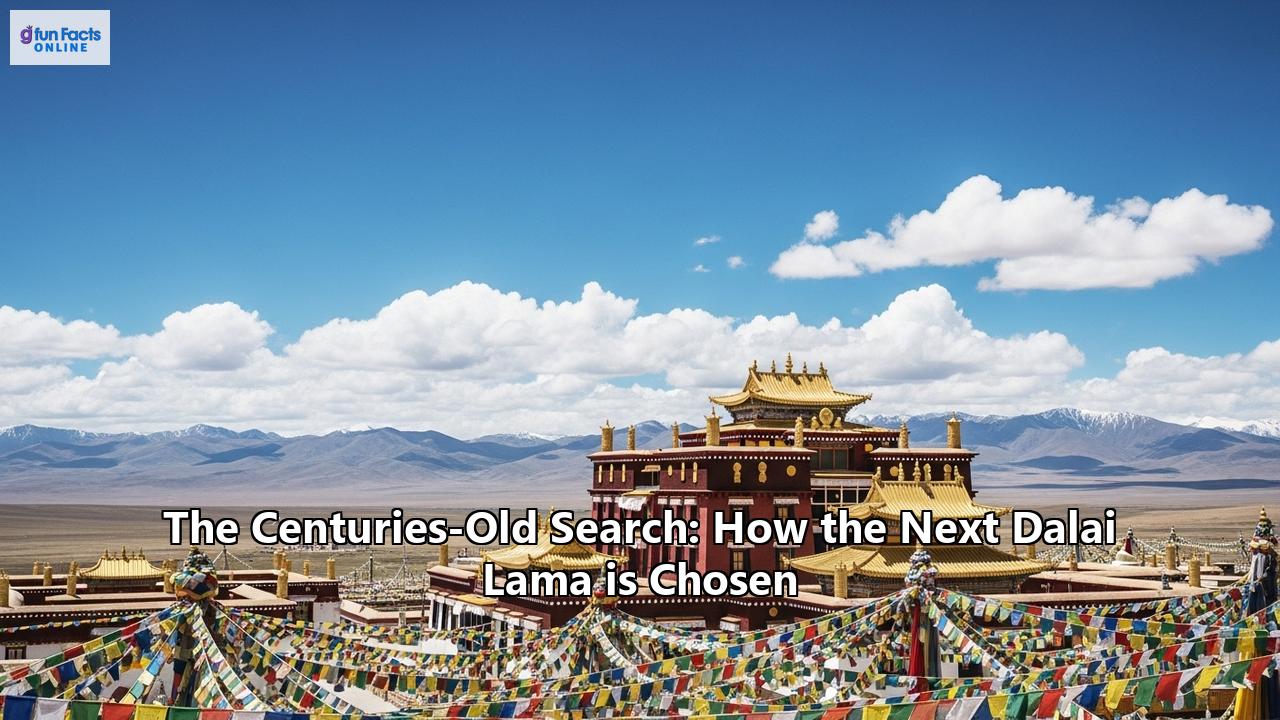
In the snow-capped peaks of the Himalayas, an ancient tradition steeped in mysticism and profound faith endures: the search for the next Dalai Lama. This is no ordinary selection process; it is a spiritual quest that transcends the boundaries of life and death, a belief that the essence of a compassionate being can choose to be reborn to continue a life of service. The Dalai Lama, for Tibetan Buddhists, is the earthly manifestation of Avalokiteshvara, the bodhisattva of compassion, who for centuries has been the spiritual and, until recently, the temporal leader of Tibet.
The current Dalai Lama, Tenzin Gyatso, the 14th in his lineage, has been a global figure of peace and a symbol of the Tibetan struggle for autonomy. As he advances in age, the question of his succession looms large, not just for the six million Tibetans who revere him, but for the wider world that has been captivated by his message of non-violence and compassion. The search for his reincarnation, a process that is both deeply spiritual and intensely political, is set to be one of the most significant events of the 21st century for Tibetan Buddhism, with the future of this ancient tradition hanging in the balance.
The Spiritual Foundation: The Doctrine of Reincarnation
At the heart of the selection process lies the Buddhist concept of reincarnation, or tulku in Tibetan. Tibetan Buddhists believe that certain enlightened beings, known as bodhisattvas, can choose the time and place of their rebirth to continue their mission of alleviating the suffering of all sentient beings. The Dalai Lamas are considered to be such beings, each a continuation of the same stream of consciousness that began with the first Dalai Lama, Gendun Drup, in the 14th century.
The title "Dalai Lama," meaning "Ocean of Wisdom," was first bestowed upon Sonam Gyatso, the third in the lineage, by the Mongol ruler Altan Khan in 1578. His two predecessors were posthumously given the title, solidifying a lineage that is believed to stretch back even further, with as many as sixty individuals considered to be earlier incarnations of Avalokiteshvara.
This belief in conscious reincarnation is the bedrock upon which the entire selection process is built. It is not a matter of electing a successor, but of finding the child who is the unmistakable rebirth of the previous Dalai Lama.
The Traditional Search: A Mystical and Methodical Quest
The search for a new Dalai Lama traditionally begins only after the passing of the current one. It is a meticulous and often lengthy process, sometimes taking several years, led by high-ranking lamas and trusted disciples. The process is a fascinating blend of mystical signs, prophetic visions, and rigorous verification.
Clues from the Predecessor: The first clues often come from the deceased Dalai Lama himself. His disciples pay close attention to his final words and any indications he may have given about his future rebirth. The orientation of his body after death is also considered significant. For instance, after the 13th Dalai Lama, Thubten Gyatso, passed away, his head, which was initially facing south, was found to have turned to the northeast, suggesting the direction in which his reincarnation might be found. If the body is cremated, the direction of the smoke is also monitored as a potential pointer. Visions and Oracles: Dreams and visions play a crucial role in the search. High lamas will often meditate at sacred sites, most notably at the oracle lake of Lhamo La-tso in central Tibet. It is believed that visions can appear on the surface of this lake, providing specific details about the location of the reincarnation, such as the landscape, a house, or even the names of the parents. The Regent of Tibet, a senior lama, had a vision of a monastery with a golden-green roof and a house with turquoise tiles, which was instrumental in locating the current 14th Dalai Lama.The Nechung Oracle, the state oracle of Tibet, is also traditionally consulted. Through a medium in a trance state, the oracle can provide cryptic but valuable clues to guide the search party.
The Search Party: Based on these signs and visions, a search party composed of high lamas is dispatched. They travel, often incognito, to the region indicated by the prophecies to look for children born around the time of the previous Dalai Lama's death.The Tests of Recognition: Confirming the Tulku
Once a potential candidate is identified, a series of rigorous tests are conducted to confirm if the child is indeed the true reincarnation. These tests are designed to see if the child has any memory of their previous life.
One of the most famous tests involves presenting the child with a collection of objects, some of which belonged to the previous Dalai Lama and others that are replicas. The true reincarnation is expected to correctly identify the items that were his in his past life. The current Dalai Lama, as a young boy named Lhamo Dhondup, is said to have correctly identified a rosary, a walking stick, and a drum that belonged to the 13th Dalai Lama, exclaiming, "It's mine, it's mine!".
Beyond the object recognition test, the child's physical features and personality are also carefully examined. They may be asked to recognize former attendants and disciples. In some cases, more esoteric and secret tests based on meditative insight are conducted by experienced masters to confirm the choice.
If multiple promising candidates emerge, a process of drawing lots from a golden urn was historically used to make the final decision, although this was rarely employed for the selection of the Dalai Lamas.
Once the reincarnation is confirmed, the child and his family are escorted to Lhasa, the capital of Tibet. The young Dalai Lama then begins a long and intensive period of monastic education, studying Buddhist philosophy, scriptures, and the responsibilities of a spiritual leader.
The Political Quagmire: China's Interference
The centuries-old tradition of selecting the Dalai Lama has been thrust into the modern political arena due to the complex and often fraught relationship between Tibet and China. Since the 1959 Tibetan uprising, which led to the 14th Dalai Lama fleeing into exile in India, the Chinese government has sought to assert its control over Tibetan affairs, including the process of reincarnation.
The Chinese Communist Party (CCP), which is officially atheist, has made the audacious claim that it has the sole authority to approve the reincarnation of the Dalai Lama. This position was formalized in a 2007 law that mandates all reincarnations of "living Buddhas" in Tibet must be approved by the state. Chinese officials have repeatedly stated that the next Dalai Lama must be born within China's borders and that any successor chosen by Tibetans in exile will be deemed "illegitimate."
The Golden Urn Controversy: A key element of China's strategy is the promotion of the "golden urn" lottery system. This method, introduced by the Qing Dynasty in the 18th century, involves placing the names of potential candidates into a golden urn and drawing one at random. The Chinese government insists that this method must be used to select the next Dalai Lama, a stance firmly rejected by the current Dalai Lama and the Tibetan government-in-exile. The Dalai Lama has argued that the golden urn method lacks "spiritual quality" and has pointed out that it was not used in his own identification, nor that of his immediate predecessor. The Case of the Panchen Lama: The Tibetan community's fears of Chinese interference are not unfounded. In 1995, the Dalai Lama identified a young boy in Tibet, Gedhun Choekyi Nyima, as the reincarnation of the Panchen Lama, the second most important figure in Tibetan Buddhism. Shortly after, the boy and his family disappeared and have not been seen since. The Chinese government then appointed its own Panchen Lama, Gyaltsen Norbu, who is not recognized by most Tibetans. This episode is seen by many as a dress rehearsal for what could happen with the Dalai Lama's succession.China's motives are widely seen as political. By controlling the selection of the next Dalai Lama, Beijing aims to install a "tame" leader who will legitimize its rule over Tibet and sever the deep connection between the Dalai Lama and the Tibetan people.
The 14th Dalai Lama's Stance: A Modern Approach to an Ancient Tradition
Faced with this unprecedented challenge, the 14th Dalai Lama has taken a proactive and remarkably modern approach to the question of his succession. He has made it clear that the ultimate authority on his reincarnation rests with him and the Tibetan Buddhist tradition, not with any political power.
In a significant move, he has declared that his reincarnation will be found outside of Chinese-controlled Tibet, likely in India, which is home to the largest Tibetan exile community. In his book, "Voice for the Voiceless," he wrote, "the new Dalai Lama will be born in the free world."
The Dalai Lama has also floated several other possibilities that break with tradition. He has suggested that the institution of the Dalai Lama may not even need to continue after him, and that the decision rests with the Tibetan people. He has also raised the possibility of appointing his successor while he is still alive, transferring his spiritual realization to that individual. This would be a radical departure from the traditional process of finding a child reincarnation.
Furthermore, he has not ruled out the possibility of being reborn as a woman, stating that if a female Dalai Lama would be more useful, then that could happen. He has even humorously suggested he could be reborn as a "mischievous blonde woman."
To safeguard the process from political interference, the Dalai Lama established the Gaden Phodrang Trust in 2015. This trust is tasked with overseeing the search for and recognition of his successor, independent of any government influence.
In a recent announcement marking his 90th birthday, the Dalai Lama reaffirmed that the institution of the Dalai Lama will continue and that the search for his reincarnation should be carried out according to Buddhist traditions, explicitly signaling that China should not be involved. He has stated that the responsibility for the search lies solely with the Gaden Phodrang Trust, and that "no one else has any such authority to interfere in this matter."
A Future of Uncertainty: The Potential for Rival Dalai Lamas
The starkly contrasting positions of the Dalai Lama and the Chinese government have set the stage for a potential crisis. Many observers fear that upon the 14th Dalai Lama's passing, there could be two rival Dalai Lamas: one recognized by the Tibetan government-in-exile and the global Tibetan community, and another appointed by Beijing.
This would create a deep and painful schism within Tibetan Buddhism, with profound implications for the future of Tibetan identity and culture. The international community, particularly countries like India and the United States, would be faced with a delicate diplomatic challenge in deciding which Dalai Lama to recognize.
The United States has already passed the Tibetan Policy and Support Act of 2020, which states that the selection of the Dalai Lama is a religious matter that should be made by the Tibetan Buddhist community without government interference. The act also threatens sanctions against any Chinese official who attempts to name their own Dalai Lama.
Conclusion: The Enduring Spirit of a People
The centuries-old search for the Dalai Lama is more than just a religious custom; it is a powerful symbol of the Tibetan people's resilience and their unwavering faith in the face of immense adversity. The process, with its blend of ancient mysticism and profound spiritual conviction, has endured for centuries, adapting to changing times while holding fast to its core principles.
As the world awaits the next chapter in this extraordinary saga, the future of the Dalai Lama institution remains uncertain. Will the ancient traditions be able to withstand the pressures of modern politics? Will the Tibetan people be free to choose their own spiritual leader? The answers to these questions will not only determine the fate of one of the world's most revered religious figures but will also be a testament to the enduring power of faith and the unyielding spirit of a people determined to preserve their unique cultural and spiritual heritage. The search for the 15th Dalai Lama will undoubtedly be a defining moment for Tibet and for the world.
Reference:
- https://www.dalailama.com/the-dalai-lama/biography-and-daily-life/brief-biography
- https://www.aljazeera.com/features/2025/7/2/how-will-the-next-dalai-lama-be-chosen-and-could-there-be-two
- https://news.sky.com/story/dalai-lama-says-he-plans-to-reincarnate-but-how-is-a-successor-chosen-and-why-is-it-controversial-13391392
- https://en.wikipedia.org/wiki/Succession_of_the_14th_Dalai_Lama
- https://en.wikipedia.org/wiki/Dalai_Lama
- https://www.quora.com/How-is-the-new-Dalai-Lama-chosen-and-what-is-the-process-for-becoming-one
- https://www.newsweek.com/dalai-lama-reincarnation-tibet-china-2092427
- https://www.etvbharat.com/en/!international/how-is-the-dalai-lama-chosen-tibetan-spiritual-leader-may-announce-his-successor-on-90th-birthday-enn25063005729
- https://economictimes.indiatimes.com/news/india/the-mystical-process-of-finding-dalai-lamas-reincarnation/articleshow/122206256.cms?from=mdr
- https://www.tibetguru.com/tibetan-buddhism/confirmation-of-reincarnation.htm
- https://faithcounts.com/how-the-dalai-lama-is-chosen/
- https://www.quora.com/How-do-they-always-find-the-next-Dalai-Lama
- https://arunachaltimes.in/index.php/2025/06/25/dalai-lamas-reincarnation-system/
- https://www.shambhala.com/snowlion_articles/tibetan-tradition-reincarnation/
- https://www.cbsnews.com/news/dalai-lama-says-hell-have-a-successor-after-all-meaning-hed-be-reincarnated/
- https://www.foxnews.com/world/dalai-lama-lays-out-succession-plan-pledging-reincarnation-china-eyes-interference
- https://www.dalailama.com/the-dalai-lama/biography-and-daily-life/reincarnation
- https://www.sbs.com.au/news/article/how-the-dalai-lamas-successor-is-chosen-and-why-the-stakes-are-high/3fuohjvug
- https://theweek.com/religion/succession-planning-as-the-dalai-lama-turns-90