
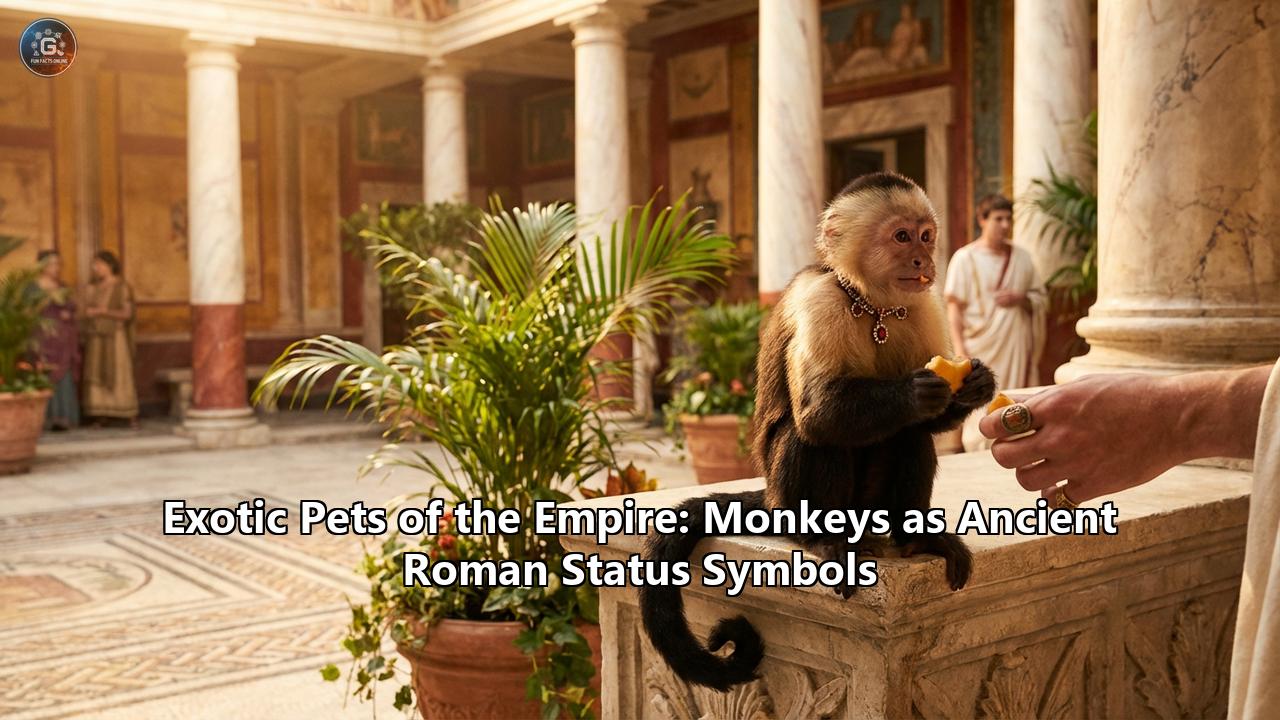
The ancient world was not merely a place of marble statues and stoic philosophers; it was a vibrant, chaotic, and often bizarre tapestry of excess, and nowhere was this more visible than in the living rooms of the Roman elite. While a loyal dog or a working cat might suffice for the common plebeian, the masters of the Mediterranean craved something more—something living, breathing, and delightfully unpredictable to signal their mastery over nature itself.
Enter the monkey.
Far from being simple curiosities, monkeys in Ancient Rome were complex symbols of wealth, cosmopolitan reach, and distinct social status. They were the "ultimate accessory" for the Roman who had everything, a creature that straddled the uncomfortable line between wild beast and little human. From the wind-swept ports of the Red Sea to the imperial palaces on the Palatine Hill, the story of the Roman pet monkey is a saga of luxury, cruelty, affection, and the immense lengths to which an empire would go to amuse itself.
The Berenike Revelation: A Window into Ancient Affection
For centuries, historians pieced together the life of Roman pets through scattered literary fragments—a biting line from a satirist here, a mention in a natural history text there. But the sands of Egypt recently offered up a discovery that revolutionized our understanding of this practice.
At the ancient port of Berenike on the Red Sea coast, archaeologists uncovered a pet cemetery that defied expectation. Dating to the 1st and 2nd centuries AD, this site was not a dumping ground, but a place of tender, almost desperate reverence. Among the graves of cats and dogs lay the skeletons of monkeys. But these were not just any monkeys.
The Indian ConnectionFor a long time, it was assumed that most Roman pet monkeys were Barbary macaques (Macaca sylvanus), a species native to North Africa and relatively easy to import across the Mediterranean. The Berenike skeletons told a different story. DNA and morphological analysis revealed them to be Rhesus macaques (Macaca mulatta) and Bonnet macaques (Macaca radiata)—species native to India.
This distinction is monumental. It means that these animals were not just captured in the nearby Atlas Mountains; they were shipped thousands of miles across the Indian Ocean. They were passengers on the perilous trade routes that brought spices, silks, and gems to the Empire. To own an Indian monkey was to possess a living breathing piece of the "uttermost East," a testament to a trade network that spanned the known world.
The Tragedy of the Doll and the PigletThe graves themselves spoke of a deep, anthropomorphic love. One monkey was found buried with a woven basket and a folded piece of cloth, arranged uncannily like a rag doll. It suggests the owner saw the creature not as an animal, but as a child who needed its toys in the afterlife.
Another burial was even more touching and bizarre: a monkey interred alongside a piglet and a kitten. It paints a picture of a household menagerie where these animals lived, played, and perhaps died together. These were not livestock; they were companions.
However, the bones also whispered a darker truth. Many of the skeletons showed signs of severe rickets and malnutrition. The wealthy officers who owned them clearly loved them—they buried them with expensive imported blankets and pottery—but they had no idea how to care for them. In the harsh, sun-baked desert of a Roman port, these jungle creatures withered, fed perhaps on human scraps of bread and wine rather than the fresh fruits and insects they needed. It is a heartbreaking paradox of the Roman pet trade: an abundance of affection coupled with a fatal lack of biological knowledge.
The Logistics of Luxury: The Monkey Trade Route
To understand the status of a pet monkey, one must understand the journey it took to get to a Roman atrium. This was no simple trip to a local market.
The CaptureThe journey began in the lush canopies of the Indus Valley or the rocky outcrops of the Atlas Mountains. Professional hunters, often locals employed by Roman agents, used nets and snares to capture the animals alive. The goal was to take them young—infants were easier to tame, easier to transport, and far more appealing to buyers who wanted a "living doll."
The VoyageFor the Indian macaques found at Berenike, the voyage was a nightmare of logistics. They would have been crated and loaded onto merchant vessels sailing with the monsoon winds. The Periplus of the Erythraean Sea, an ancient shipping log, details the goods moving between India and Roman Egypt. Amidst the sacks of pepper and bales of cotton sat crates of frightened primates.
The sea voyage could take weeks. Mortality rates were likely high. A monkey that survived the ocean crossing then had to endure the desert trek from the Red Sea to the Nile, and finally, a boat ride downriver to Alexandria, before potentially being shipped across the Mediterranean to Ostia, the port of Rome.
The CostBy the time a Rhesus macaque reached the slave markets of Rome, its price had skyrocketed. It was a luxury item in the truest sense. Buying one was a public declaration that you could afford to waste resources on a creature that provided no wool, no meat, and no guard duty—only amusement.
Living with the "Semi-Human": Daily Life in the Domus
Once purchased, the monkey entered the Roman domus (household), where it occupied a unique and often unsettling niche. The Romans did not view animals with the same sentimental detachment we often do today; their view was pragmatic, yet they were fascinated by the monkey’s resemblance to humans.
The "Simian" MirrorPliny the Elder, the great naturalist, famously wrote of the monkey's "semi-human" status. He noted their ability to imitate, their hands which looked so much like a man's, and their intelligence. But this resemblance was a double-edged sword. To the Romans, the monkey was a caricature of humanity—a funhouse mirror that reflected human traits in a grotesque, comedic form.
Housing and DressIn wealthy villas, monkeys were rarely kept in cages all day. They were often allowed to roam the garden peristyles, tethered by long chains to keep them from destroying the expensive frescoes.
But the ultimate flex was to dress them.
Art and literature from the period describe monkeys dressed in miniature soldier’s uniforms, complete with tiny helmets and wooden swords. Others were dressed in the silk robes of a senator or the saffron tunics of a bride.
- Jewelry: It was common for pet monkeys to wear gold torques, earrings, and bracelets. A monkey dripping in gold was a mobile display of the master's disposable income.
- The "Pocket" Monkey: Small species were sometimes carried in the folds of a toga or the sleeve of a tunic, functioning as a living accessory for noblewomen, much like the "purse dogs" of the modern era.
The misunderstanding of their biology extended to their diet. Romans often fed their monkeys from their own tables. This meant a diet heavy in grain, cooked meats, and—surprisingly often—wine.
Pliny mentions that monkeys were fond of wine, and anecdotes exist of monkeys being given cups to drink at dinner parties for the amusement of guests. The sight of a tipsy monkey stumbling around the dining couch was considered the height of comedy. Unfortunately, this diet of alcohol and human food contributed heavily to the skeletal deformities found by archaeologists.
The Performing Primate: Entertainment and Intellect
A monkey in Rome was expected to sing for its supper, or at least dance for it. Training monkeys was a specialized skill, and a well-trained animal could fetch a price ten times that of a wild one.
Board Games and PranksOne of the most delightful details from Pliny is the mention of monkeys playing "latrunculis", a popular Roman board game similar to chess or checkers. While it is unlikely they understood the strategy, they were trained to move the pieces, mimicking the intense concentration of two senators at play.
The "Soldier" SatireA popular entertainment trope was the "Monkey Soldier." A monkey would be strapped into a miniature chariot drawn by goats or puppies. They would be handed a whip and reins and trained to "drive" around a track.
This was more than just a circus trick; it was often a satirical bite at the military or political class. Seeing a monkey in a general’s cloak pompously leading a "charge" of goats was a safe way to laugh at authority without committing treason.
The Dinner Party NoveltyAt a convivium (dinner party), the monkey was a conversation starter. Guests might be amused by the animal’s ability to crack nuts—Pliny notes their skill in distinguishing empty nuts from full ones by shaking them—or by their thieving antics. A monkey stealing a fig from a guest's plate was not a nuisance; it was an icebreaker.
Emperors and their Apes: The Ultimate Status Symbol
If a senator had a monkey, the Emperor had a menagerie. For the rulers of Rome, exotic animals were tools of statecraft and personal indulgence.
Tiberius and the Intellectual ApeThe Emperor Tiberius, known for his gloom and retreat to the island of Capri, was said to have a fascination with exotic beasts. He kept a collection of animals and was reportedly intrigued by the intelligence of primates, viewing them less as clowns and more as biological curiosities.
Nero: The King of KitschNero, a man who never understood the concept of "too much," famously adored the theatricality of exotic pets. He is said to have paraded animals through the palaces. For Nero, a monkey wasn't just a pet; it was a prop in the grand play of his life. Legends (likely exaggerated by his enemies) speak of him treating favorite animals with honors reserved for state officials, blurring the lines between beast and courtier.
Elagabalus: The Chaos BringerPerhaps the most eccentric owner was the teenage emperor Elagabalus. His reign was a fever dream of excess. Historical accounts (often hostile) claim he would let tame lions and leopards roam his dining halls to terrify his guests, who would die of fright thinking they were about to be eaten, only to find the beasts had been defanged and declawed. He supposedly kept monkeys in religious temples, mixing the sacred with the profane in a way that horrified the conservative Roman priesthood.
The Satirists' Weapon: The Monkey as Moral Decay
While the elite loved their monkeys, the moralists hated them. To the stoic Roman writers, the obsession with these animals was a symptom of a society that had lost its way.
Plutarch’s ScornThe most famous rebuke comes from a story recounted by Plutarch. He tells of Caesar (or sometimes the North African King Massinissa) seeing wealthy foreign women in Rome carrying puppies and monkeys in their bosoms, cuddling them like infants.
The ruler stopped and asked, "Do the women of your country not bear children?"
The sting was clear: The Romans were wasting their love and resources on beasts while their own birth rates declined. The monkey became a symbol of misplaced maternal affection, a substitute for the "virtuous" duty of raising Roman citizens.
Juvenal and the Vanity of WealthThe satirist Juvenal, who hated almost everything about cosmopolitan Rome, used the monkey to mock the vanity of the rich. In his satires, he paints a picture of wealthy women who would weep more over the death of a pet sparrow or monkey than over the death of their own husband.
To Juvenal, the monkey represented luxury without substance—an ugly, useless thing dressed in gold, much like the courtiers he despised.
Martial’s "Cronius"The poet Martial, known for his witty epigrams, wrote a savage verse about a man named Cronius. He mocks Cronius for loving a monkey that "looks just like him." It’s a classic playground insult elevated to high art: the owner and the pet are both ugly, both foolish, and both indistinguishable.
A Grim Reality: The Darker Side of Ownership
We must not romanticize this relationship. For all the woven baskets and gold earrings, the life of a Roman monkey was fraught with suffering.
The Climate MismatchThe rickets found in the Berenike monkeys confirms that they suffered chronic pain. Rhesus macaques require specific vitamins and sunlight exposure that they were not getting in the indoor, grain-heavy environment of a Roman house. They were slowly dying of luxury.
Cruel PunishmentsWhile not related to pet keeping, the monkey holds a horrific place in Roman legal history in the poena cullei (punishment of the sack).
For the crime of parricide (killing one's parent), the condemned was sewn into a leather sack with four live animals: a dog, a rooster, a viper, and a monkey. The sack was then thrown into the river.
Why a monkey? Because it was seen as a caricature of a human—a "counterfeit" man. Just as the parricide had perverted the natural order by killing a parent, the monkey was a perversion of the human form. It was a symbolic inclusion that doomed the animal to a terrifying, drowning death alongside the criminal.
The Artistic Legacy
The Roman fascination with monkeys is immortalized in their art.
- Mosaics: In museums across Italy and North Africa, you can see floor mosaics depicting monkeys. They are often shown in human scenarios: fishing from a boat, driving a chariot, or sitting at a table. These were likely placed in dining rooms to amuse guests.
- The "Blue Monkeys" of Akrotiri: Though pre-Roman (Minoan), the famous frescoes of blue monkeys in Santorini show that the Mediterranean fascination with these animals ran deep. By the Roman era, the realism had improved. We see distinct species—the tail-less Barbary macaque vs. the long-tailed Indian langur—proving that artists were working from live models brought in by the trade.
Conclusion: The Mirror of Empire
The Roman pet monkey was never just an animal. It was a canvas upon which the Romans projected their anxieties, their wealth, and their humanity.
To the soldier in Berenike, the monkey was a reminder of the vast, conquered world he served. To the lonely noblewoman, it was a child that never grew up. To the satirist, it was a sign that Rome was rotting from within, obsessed with trivialities.
Today, looking at the tiny skeleton in the Egyptian sand, curled up next to a rag doll that has long since disintegrated, we don't see a status symbol. We see a small, frightened creature that was loved fiercely, if clumsily, by a human who lived 2,000 years ago. In that strange, tragic bond, the distance between the ancient Roman and the modern pet owner vanishes. We are left with the enduring human desire to bridge the gap between ourselves and the wild—even if we have to drag it across an ocean and dress it in a toga to do so.
Reference:
- https://www.youtube.com/watch?v=AB8AIYAVXdk
- https://www.reddit.com/r/todayilearned/comments/5652sl/til_when_monkeys_were_taught_the_concept_of_money/
- https://www.youtube.com/watch?v=hzOF6nTnF8o
- https://www.youtube.com/watch?v=U8r5HXk0eyQ
- https://www.zmescience.com/research/how-scientists-tught-monkeys-the-concept-of-money-not-long-after-the-first-prostitute-monkey-appeared/
- https://www.youtube.com/watch?v=ALOy9Gi15co
- https://www.ancient-origins.net/news-history-archaeology/roman-pet-monkeys-00102355
- https://www.cambridge.org/core/books/abs/world-archaeoprimatology/place-of-nonhuman-primates-in-ancient-roman-culture/299BDC9D97032417FD5500D0E1BB9685
- https://sajjad-choudhury.medium.com/the-secret-lives-of-pet-monkeys-in-antiquity-e7e85406bd71
- https://en.wikipedia.org/wiki/Poena_cullei
- https://www.iflscience.com/roman-military-officers-had-pet-monkeys-and-the-pet-monkeys-had-pet-piglets-81764
- https://roman-empire.net/quizzes-and-trivia/roman-emperors-pets
- https://imperiumromanum.pl/en/article/pets-of-ancient-romans/
- https://www.heritage-history.com/index.php?c=read&author=guerber&book=romans&story=cruelty
- https://romanempiretimes.com/did-ancient-romans-have-pets/