
Every time you look in the mirror, you witness the biological reality of aging. Wrinkling skin, graying hair, and shifts in physical vitality are undeniable, universally understood markers of the passage of time. Yet, nestled securely within the vault of the skull, your brain is undergoing its own highly secretive aging process. For centuries, this internal biological clock ticked away entirely hidden from view. A person could possess a remarkably youthful physique while harboring a neurologically aged brain, or conversely, a frail body carrying a brain demonstrating the neuroplasticity of someone decades younger. Until recently, unveiling this hidden timeline required incredibly expensive, hard-to-access, and resource-intensive structural imaging techniques like MRI scans.
Today, we are standing at the precipice of a medical and technological renaissance. The convergence of neuroinformatics, high-fidelity sleep analysis, and advanced artificial intelligence (AI) has unlocked a profound new reality. By analyzing the faint, chaotic electrical whispers your brain emits while you sleep, AI can now decode your true "Brain Age."
This article delves deep into the fascinating world of neuroinformatic sleep analysis. We will explore how deep learning algorithms are translating the micro-architectures of our sleep into predictive maps of cognitive decline, uncovering early signs of dementia years before symptoms manifest, and fundamentally reshaping our understanding of human longevity.
The Neuroinformatic Revolution: Redefining the Science of Slumber
To understand how a computer can determine your brain’s age from a night of sleep, we must first understand the field of neuroinformatics. Neuroinformatics is the intersection of neuroscience, data science, and computational modeling. It is the discipline of applying highly sophisticated mathematical models and machine learning frameworks to massive, complex neurological datasets.
Historically, sleep science was a largely observational field. Since the invention of the electroencephalogram (EEG) by Hans Berger in 1929, clinicians have evaluated sleep by visually inspecting waveforms on a screen or paper. The clinical "gold standard" for sleep evaluation is polysomnography (PSG)—a comprehensive study that records brain waves (EEG), muscle movements (EMG), eye movements (EOG), heart rate, and respiratory effort. For decades, human experts, known as sleep technologists, manually scored these studies, dividing the night into broad macro-stages: Wake, Non-Rapid Eye Movement (NREM) stages 1 through 3, and Rapid Eye Movement (REM) sleep.
However, human vision is profoundly limited. A sleep technologist looks at a 30-second epoch of sleep and assigns it a single stage. But the human brain is infinitely more complex. Within that 30 seconds, there are millions of data points representing non-linear, non-stationary electrical dynamics. There are micro-architectures—fleeting bursts of high-frequency energy, subtle shifts in spectral power, and momentary phase-amplitude couplings—that flash by in fractions of a millisecond. To the human eye, this looks like static or noise. To a trained artificial intelligence, it is a rich, multidimensional tapestry of data containing the exact biological signature of your brain's health.
By feeding tens of thousands of overnight polysomnography recordings into high-powered AI systems, neuroinformatics has shifted sleep analysis from a subjective, macro-level observation into an objective, micro-level computational science.
Decoding the Brain Age Index (BAI)
The central pillar of this new frontier is the concept of "Brain Age" and the "Brain Age Index" (BAI).
Every human being has a chronological age—the strict number of years you have been alive. But your biological age, dictated by cellular health, DNA methylation, and organ function, can vary wildly from your chronological age. When we apply this concept specifically to the central nervous system, we get the Brain Age.
Researchers realized that as the brain ages, its electrical output during sleep predictably changes. Using machine learning, scientists trained deep neural networks (DNNs) on the sleep EEGs of tens of thousands of healthy individuals. By showing the AI the sleep data and the chronologic age of the patients, the AI learned to associate highly specific, invisible electrical patterns with specific ages.
Once trained, these AI models achieved something spectacular: they could look at a brand-new patient's sleep EEG and accurately guess their age, often with a mean absolute error of just over 4 years. More advanced models utilizing modern AI architectures, such as multi-flow Swin Transformers, have pushed this precision even further, reducing the error rate to parallel the accuracy of costly neuroimaging.
But the true breakthrough wasn't just predicting age accurately; it was what happened when the AI was wrong.
When the AI predicted that a 60-year-old patient actually had the brain electrical patterns of a 70-year-old, this 10-year discrepancy wasn't a failure of the algorithm. It was a revelation about the patient's health. This discrepancy—calculated as the AI-predicted brain age minus the actual chronological age—is the Brain Age Index (BAI).
A positive BAI means your brain is aging faster than your body. A negative BAI means your brain is maintaining a youthful resilience. Today, the BAI is emerging as one of the most powerful, non-invasive biomarkers for hidden neurodegeneration and systemic health in modern medicine.
The Micro-Architectures That Betray Aging
What exactly is the AI looking at while we sleep? How do brain waves betray our age? The artificial neural networks are isolating specific phenomena within our sleep micro-architecture that degrade as our neurons and synapses weather the storm of time.
1. The Deterioration of Slow-Wave Sleep (SWS)During deep NREM Stage 3 sleep, the brain enters a state dominated by delta waves—massive, slow-rolling electrical oscillations. This stage is the biological equivalent of a system reboot. During slow-wave sleep, the brain clears out toxic metabolic byproducts, including amyloid-beta plaques, through the glymphatic system. Furthermore, slow waves play a critical role in memory consolidation, transporting short-term memories from the hippocampus to long-term storage in the prefrontal cortex.
As we age, our prefrontal cortex begins to naturally deteriorate, leading to a drastic reduction in the generation and quality of these slow waves. AI detects the exact morphological changes in these delta waves—loss of amplitude, altered frequency, and fragmented occurrence. The algorithm correlates this diminished slow-wave activity directly with cognitive aging and an increasing BAI.
2. The Fading of Sleep SpindlesSleep spindles are sudden, rapid bursts of high-frequency brain activity (typically 11 to 16 Hz) that occur primarily in NREM Stage 2 sleep. Think of spindles as the brain's internal filing system actively working. They are heavily linked to sensory processing, learning, and integrating new information into existing neural networks.
Neuroinformatics has revealed that neurodegeneration physically damages the thalamic reticular nucleus, the brain structure responsible for generating spindles. AI models evaluating sleep EEG carefully map the density, duration, and spectral power of these spindles. A sharp decline in sleep spindle activity is a glaring red flag for the deep learning model, signaling advanced brain aging and a higher risk of cognitive decline.
3. Kurtosis and Gamma WavesModern AI analysis doesn't just look for what is missing; it looks for subtle morphological changes in the waveform shape. For instance, kurtosis measures the "peakedness" or sharpness of brain wave spikes. Studies show that specific sharp brain wave spikes are actually neuroprotective signals, and their absence correlates with an older brain age. Similarly, advanced information theory applied to AI sleep analysis has pinpointed changes in high-frequency gamma waves during deep sleep as an incredibly early indicator of memory loss, appearing years before clinical symptoms manifest.
Unmasking Neurodegeneration Before It Strikes
The most profound application of the AI-derived Brain Age Index is its ability to act as a crystal ball for neurological diseases, particularly dementia and Alzheimer's disease.
For decades, the tragedy of Alzheimer's has been that by the time a patient begins forgetting names or misplacing keys, the brain has already suffered irreversible, catastrophic structural damage. The pathology builds in the dark for 10 to 20 years before the clinical threshold is crossed. Neuroinformatic sleep analysis offers a way to shine a light into that darkness.
In groundbreaking research led by the University of California San Francisco (UCSF) and Beth Israel Deaconess Medical Center, scientists utilized machine learning to analyze the sleep EEGs of thousands of community-dwelling adults. The participants had no signs of dementia at the start of the study. The AI calculated their Brain Age Index from a single night of sleep, and researchers tracked their cognitive health for years.
The results were staggering. For every 10-year increase in the Brain Age Index (meaning the brain looked 10 years older than the chronologic age), the risk of developing dementia skyrocketed by nearly 40 percent. The AI had successfully identified the invisible, preclinical stages of cognitive decline simply by interpreting the electronic hum of a sleeping brain.
Furthermore, AI algorithms are revolutionizing the diagnosis of other neurodegenerative precursors. REM Sleep Behavior Disorder (RBD)—a condition where the natural paralysis of sleep fails, causing patients to act out their dreams—is considered a strong prodromal marker for Parkinson's disease and Lewy Body Dementia. AI systems trained on video-polysomnograms can now analyze the microscopic muscle twitches and sleep architectures associated with RBD, achieving over 90% accuracy in detecting the disorder. This allows neurologists to identify patients on the Parkinson's trajectory years, or even decades, before the onset of classic motor symptoms like tremors.
The Accelerated Aging Matrix: Comorbidities and the Brain
The Brain Age Index is not exclusively a marker for dementia; it serves as a holistic "vital sign" reflecting the total systemic burden of disease on the central nervous system. When the body suffers, the brain ages, and the AI sees this trauma etched into your sleep EEG.
Extensive studies analyzing vast clinical datasets (such as the 126,000+ sleep studies analyzed by EnsoData) have shown that the AI-derived Brain Age gap widens in the presence of numerous comorbidities.
Sleep Disordered Breathing: Conditions like Obstructive Sleep Apnea (OSA) subject the brain to repetitive nighttime choking events. This creates a hypoxic burden—recurring oxygen starvation—combined with constant micro-arousals that shatter the continuity of sleep. Neuroinformatic analysis reveals that individuals with severe sleep apnea possess significantly higher BAIs than healthy sleepers. The brain is quite literally suffocating and aging at an accelerated pace due to the lack of oxygen and the destruction of restorative slow-wave sleep. Metabolic and Cardiovascular Disease: Patients with diabetes, hypertension, and a history of stroke consistently demonstrate an older EEG-predicted brain age. Vascular damage reduces micro-circulation in the brain, subtly altering the electrophysiological signaling pathways. The deep neural networks detect these downstream vascular effects as premature aging in the sleep architecture. Psychiatric and Mood Disorders: There is a bi-directional relationship between mental health and sleep. AI models have identified that patients with clinical depression, severe anxiety, and chronic insomnia display elevated Brain Age Indices. The hyperarousal of the nervous system and the alteration of REM latency seen in major depressive disorder leave a distinct, aging footprint on the EEG that machine learning algorithms can easily quantify.The Transformer Era: How Modern AI Learns the Brain
The leap from standard statistical analysis to highly accurate brain age prediction is driven by the rapid evolution of artificial intelligence architectures.
Initially, neuroinformatics relied on feature engineering. Human scientists would write code to explicitly extract specific features—like spindle count or delta wave power—and feed those into basic machine learning models like Random Forests or Support Vector Machines. While effective, this approach was limited by human bias; the model only looked at the features humans thought were important.
The paradigm shifted with the advent of Deep Neural Networks (DNNs) and Convolutional Neural Networks (CNNs). CNNs, originally designed for image recognition, were adapted to read EEG spectrograms (visual representations of frequencies over time). The CNN could look at the raw, unfiltered EEG wave and learn its own features, discovering patterns that human scientists hadn't even named yet.
Today, we are entering the era of Brain Foundation Models (BFMs) and Transformer architectures. Originally built for natural language processing (like the models powering advanced text generators), Transformers use "attention mechanisms" to weigh the importance of different data points across long sequences. In sleep analysis, multi-flow Swin Transformers can analyze the entire 8-hour overnight EEG sequence simultaneously. They can understand how a brief micro-arousal at 2:00 AM contextually relates to a loss of slow-wave sleep at 4:30 AM.
These massive AI models undergo "contrastive learning" on hundreds of thousands of unlabelled neural recordings. They learn the fundamental language of the human brain. When tasked with predicting Brain Age, these Transformer models achieve unparalleled accuracy, pushing the mean absolute error down to around 4.19 years, effectively rendering sleep EEG as diagnostic as an MRI but at a fraction of the cost.
From the Clinical Lab to the Bedroom: The Wearable Revolution
Historically, obtaining an overnight sleep EEG required a patient to go to a specialized sleep clinic, have dozens of electrodes glued to their scalp, and sleep in an unfamiliar bed while being monitored by technicians. This is expensive, highly inconvenient, and subject to the "first-night effect," where the stress of the lab alters the patient's natural sleep.
Neuroinformatics and AI have democratized brain health monitoring by making portable, at-home EEG a viable clinical tool. Because deep learning algorithms are so exceptionally good at extracting signals from noise, we no longer need 32-channel, clinical-grade EEG setups to calculate the Brain Age Index.
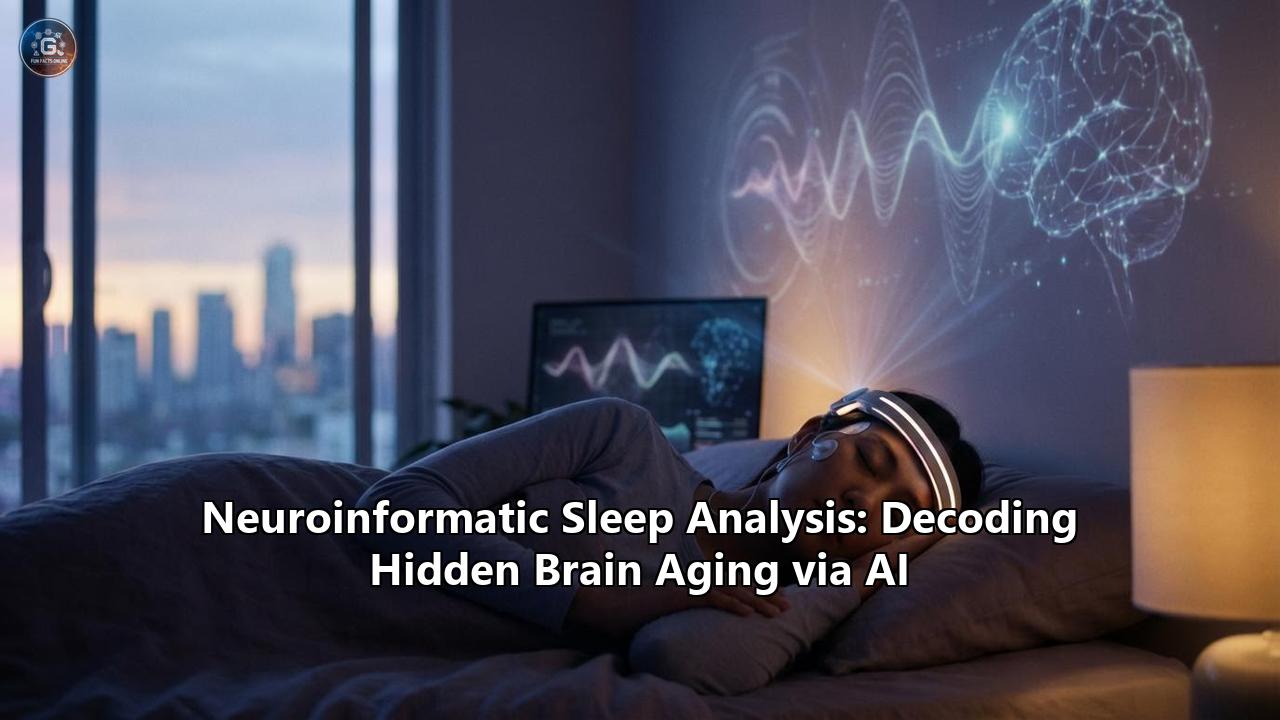
Consumer and medical-grade wearable technologies, such as the Muse headband, utilize simple, single-channel or sparse-channel dry EEG sensors. These comfortable headbands are worn in the patient's own bed. The raw electrical data is recorded, synced to a smartphone, and uploaded to the cloud, where it is instantly processed by machine learning algorithms.
A massive study utilizing consumer-grade EEG recordings from over 5,200 individuals demonstrated that AI can accurately calculate real-time brain age using data gathered in an at-home environment. This capability is transformative. It moves neuroinformatic analysis out of the exclusive realm of clinical diagnostics and into the realm of daily health tracking. Just as a smart watch tracks your resting heart rate and step count, wearable EEG combined with AI can provide a daily, longitudinal track of your biological brain aging. It allows for continuous monitoring of cognitive health, creating a dense, rich dataset that a single night in a sleep lab could never replicate.
Rewinding the Clock: Can We Reverse Brain Aging?
The ultimate question remains: If an AI informs you that your brain is biologically ten years older than your chronological age, is your fate sealed? Can the hidden aging of the brain be reversed?
The emerging consensus in neuroinformatics is optimistic. Because the Brain Age Index is a dynamic electrophysiological measure rather than a static structural one, it is highly sensitive to interventions. If you improve the physiology of the brain, the AI-predicted age can decrease.
Targeting Slow-Wave Sleep: Neuroscientists are actively exploring ways to artificially boost the quality and quantity of deep slow-wave sleep to restore youthful memory consolidation. One promising avenue is Transcranial Direct Current Stimulation (tDCS). By applying a very mild, imperceptible electrical current to the frontal lobes during sleep, researchers have successfully amplified slow-wave activity, functionally mimicking a younger brain and resulting in doubled overnight memory retention in trials. Acoustic Stimulation: Another non-invasive approach is closed-loop acoustic stimulation. Wearable devices monitor the EEG in real-time, waiting for the exact moment a slow wave begins. The device then plays a soft burst of "pink noise" synchronized with the upward phase of the brain wave, physically enhancing the amplitude of the delta wave and deepening the restorative state. Treating the Comorbidities: Reversing brain aging is also heavily dependent on treating the underlying causes. For individuals whose advanced Brain Age is driven by sleep apnea, the introduction of CPAP (Continuous Positive Airway Pressure) therapy eliminates the hypoxic burden. Subsequent AI analysis of their sleep often shows a dramatic reduction in the Brain Age Index. Similarly, rigorous cardiovascular exercise, dietary adjustments, and metabolic control directly influence cerebral micro-circulation, which translates into healthier, "younger" sleep architectures.The Future of Preventive Neurology
We are moving away from reactive medicine and entering the era of predictive, preventive neurology. The integration of neuroinformatics, AI, and sleep analysis gives us the ultimate early warning system.
In the near future, longitudinal sleep EEG tracking will be a routine part of primary care. Wearable headbands or non-obtrusive smart sleep mats will quietly record your brain waves night after night. Cloud-based Brain Foundation Models will monitor the subtle evolution of your sleep micro-architectures. If the AI detects a fading of sleep spindles or a decay in delta wave amplitude that pushes your Brain Age Index past a critical threshold, it will alert your physician years before you ever experience a memory lapse.
Interventions will begin decades before the clinical onset of dementia. You might be prescribed acoustic sleep stimulation, precision pharmacology to enhance neural plasticity, or targeted lifestyle interventions, all guided by the objective feedback of your nightly AI brain scan.
Conclusion: Waking Up to the Power of Sleep
For all of human history, sleep was viewed as a passive state of vulnerability—a mysterious void where consciousness faded and the body simply rested. Neuroinformatics has shattered this illusion. We now know that sleep is arguably the most active, complex, and diagnostically revealing state of the human brain.
The marriage of artificial intelligence and polysomnography has unlocked a profound biological language. Through the meticulous analysis of spindles, slow waves, and electrical oscillations, AI has given us a mirror in which to finally view the hidden aging of our minds.
The discovery that a single night of sleep contains the predictive blueprint of our future cognitive health is one of the most significant medical breakthroughs of the 21st century. It transforms our understanding of neurodegeneration from an inevitable, silent thief into a measurable, predictable, and potentially interceptable process. By decoding the hidden aging of the brain, neuroinformatic sleep analysis is not just predicting the future of our minds—it is giving us the power to change it.
Reference:
- https://open-research-europe.ec.europa.eu/articles/3-152
- https://www.sleepmeeting.org/artificial-intelligence-predicts-brain-age-from-eeg-signals-recorded-during-sleep-studies/
- https://www.mdpi.com/2076-3425/15/8/789
- https://pmc.ncbi.nlm.nih.gov/articles/PMC12486002/
- https://neurosciencenews.com/sleep-eeg-brain-age-dementia-30339/
- https://arxiv.org/abs/1805.06391
- https://www.ensodata.com/research/eeg-based-deep-neural-network-model-for-brain-age-prediction-and-its-association-with-patient-health-conditions/
- https://www.tandfonline.com/doi/full/10.2147/NSS.S463495
- https://www.earth.com/news/sleep-brain-waves-can-predict-dementia-risk-years-in-advance/
- https://www.todaysgeriatricmedicine.com/news/030813_news.shtml
- https://www.thebrighterside.news/post/breakthrough-ai-system-detects-early-signs-of-memory-loss-during-sleep/
- https://www.news-medical.net/news/20250109/AI-enhanced-algorithm-improves-diagnosis-of-REM-sleep-behavior-disorder.aspx
- https://www.biorxiv.org/content/10.1101/2022.01.24.477464v1.full.pdf
- https://arxiv.org/pdf/2510.16658
- https://choosemuse.com/blogs/news/predicting-your-brain-age-with-portable-eeg-and-machine-learning