
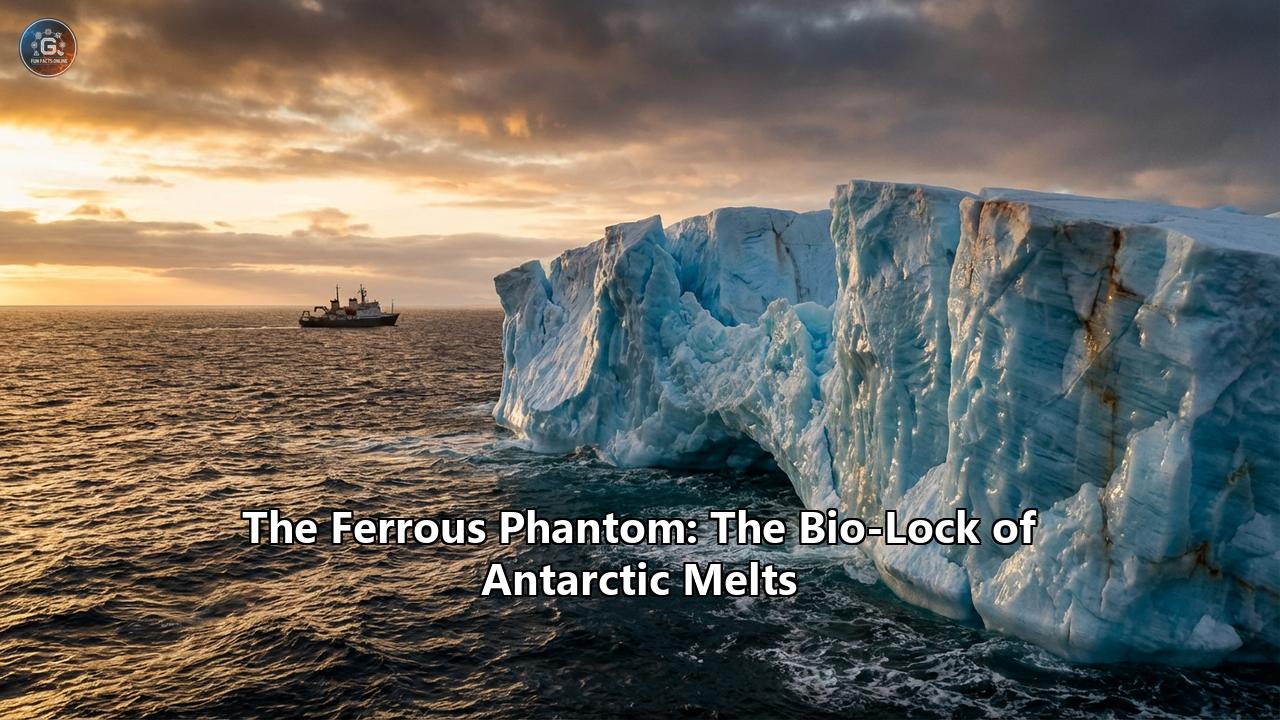
This is the story of the Ferrous Phantom: the iron that bleeds from the dying Antarctic ice, and the Bio-Lock—the microscopic biological mechanism that might just hold the key to our climate’s future.
For decades, scientists have looked to the skies to understand global warming. We measured carbon dioxide in parts per million, tracked the thickening blanket of greenhouse gases, and watched the mercury rise. But the true battle for the planet’s thermal equilibrium is being fought in the dark, cold waters of the Antarctic, where a microscopic war for nutrients is triggering a feedback loop that could either accelerate our demise or offer a desperate, last-ditch salvation.
At the heart of this battle is a simple atom: Iron. Fe. Atomic number 26. In the vast, nutrient-rich soup of the Southern Ocean, iron is the limiting factor, the one ingredient missing from the feast. Without it, the ocean’s potential to absorb carbon is locked away. But as the Antarctic melts, the ice is releasing its ancient hoard of iron—the "Phantom"—triggering blooms of life that could lock that carbon away forever.
This is the science of the Bio-Lock. And it is far more complex, and far more dangerous, than we ever imagined.
Part I: The Iron Hypothesis and the HNLC Paradox
To understand the Ferrous Phantom, we must first understand the stage upon which it walks: the Southern Ocean.
For early oceanographers, the Antarctic waters were a baffling contradiction. By all chemical logic, these waters should have been teeming with life. They were rich in nitrates, phosphates, and silicates—the "macronutrients" that fuel the growth of phytoplankton, the microscopic plants that form the base of the marine food web. In most oceans, if you dump these nutrients into the water, you get an explosion of algae.
But the Southern Ocean remained desolate. It was a "High-Nutrient, Low-Chlorophyll" (HNLC) zone. The table was set, the food was piled high, but the guests—the phytoplankton—refused to eat. The waters remained a clear, sterile blue, rather than the murky, life-filled green of a productive ocean.
For years, this paradox haunted marine biologists. Was it the cold? The lack of light? The turbulence of the "Screaming Sixties" winds?
In the late 1980s, an oceanographer named John Martin proposed a radical solution. He suggested that the ocean wasn't missing food; it was missing a vitamin. It was missing iron.
Iron is essential for photosynthesis. It forms the core of the enzymes that allow plants to harvest energy from sunlight and fix nitrogen. Without iron, phytoplankton cannot process the abundant nitrates and phosphates around them. They starve in the midst of plenty.
Martin’s hypothesis was famously bold. In a lecture that would become legendary, he declared, "Give me a half tanker of iron, and I will give you an ice age."
His logic was terrifyingly simple: If you add iron to the Southern Ocean, the phytoplankton will finally be able to bloom. They will consume the nutrients, grow exponentially, and in doing so, suck massive amounts of carbon dioxide out of the atmosphere to build their bodies. When they die, they will sink to the ocean floor, dragging that carbon down with them—a process known as the "biological pump." If you did this on a large enough scale, Martin argued, you could scrub the atmosphere of CO2 and cool the planet, mimicking the natural dust events that triggered ice ages in the distant past.
Martin died before he could see his theory fully tested, but his "Iron Hypothesis" birthed the concept of the Ferrous Phantom. We realized that iron was the ghost in the climate machine—invisible, trace, but omnipotent.
And now, nature is conducting John Martin's experiment for us.
Part II: The Bleeding Continent
Antarctica is not just a block of ice; it is a continental vault. For millions of years, the ice sheet has been scraping against the bedrock of the continent, pulverizing mountains into dust. This "glacial flour" is rich in minerals, including iron.
As long as the ice remained frozen, this iron was locked away, entombed in the glaciers. But the vault is cracking.
Anthropogenic climate change has destabilized the Antarctic ice sheets. The Thwaites Glacier—the "Doomsday Glacier"—is retreating. The Pine Island Glacier is thinning. As these behemoths melt, they are not just releasing fresh water; they are releasing the Ferrous Phantom.
The Mechanism of the Release
There are three main ways the Phantom escapes its icy prison:
- Subglacial Runoff: Beneath the ice sheets, rivers of meltwater lubricate the glaciers' slide into the sea. These rivers scour the bedrock, picking up dissolved iron and iron-rich particulates. When this "subglacial discharge" bursts out from under the ice shelf, it shoots a plume of nutrient-rich water into the ocean.
- Iceberg Rafting: As ice shelves fracture, they birth massive icebergs that drift north into the Southern Ocean. These icebergs are "dirty." They carry trapped sediment and dust. As they melt in warmer waters, they leave a trail of iron filings behind them—a process known as "fertilization by rafting." Satellite imagery often shows bright green streaks of phytoplankton trailing behind melting icebergs, like a ghost’s footprint.
- Atmospheric Dust: The retreating ice exposes bare land. The fierce katabatic winds that roll off the Antarctic plateau whip this newly exposed soil into the air, carrying iron-rich dust hundreds of miles out to sea, where it settles on the waves like manna from heaven.
This is the great irony of the climate crisis: The melting of the ice is triggering a mechanism that tries to save the ice. The heat melts the glacier -> the glacier releases iron -> the iron feeds the plankton -> the plankton suck up CO2 -> the atmosphere cools.
It sounds like a perfect negative feedback loop. A planetary safety valve. A Bio-Lock.
But biology is never that simple.
Part III: The Bio-Lock Mechanism
The "Bio-Lock" is the theoretical capacity of this iron-fueled ecosystem to sequester carbon permanently. For the Ferrous Phantom to save us, it’s not enough to just make the ocean green. The carbon has to sink.
Here is how the Bio-Lock operates, step by step:
1. The Bloom (The Awakening)
When the iron hits the water, the response is almost instantaneous. Diatoms, the jewels of the sea, are the first to respond. These microscopic algae, encased in ornate silica shells, begin to divide rapidly. Within days, a patch of blue ocean turns into a thick, murky soup of biological activity. This is the Algal Bloom.
During this phase, the diatoms are aggressively harvesting CO2 from the surface water. This lowers the partial pressure of CO2 in the water, causing more gas to dissolve into the ocean from the atmosphere. The bloom acts as a giant sponge, scrubbing the sky.
2. The Graze (The War)
A bloom does not go unnoticed. The "grazers" arrive. Copepods, krill, and salps swarm the bloom. Antarctic krill (Euphausia superba), arguably the most successful animal species on the planet by biomass, feast on the diatoms.
This is a critical juncture for the Bio-Lock. If the krill eat the algae and respire the carbon back out as CO2, the lock fails. The carbon returns to the cycle. But krill are messy eaters, and they produce massive, heavy fecal pellets.
3. The Export (The Descent)
For the Bio-Lock to engage, the carbon must cross the "sequestration depth"—usually defined as 1,000 meters down. This is the Twilight Zone.
There are two main vehicles for this descent:
- Marine Snow: Dead diatoms, krill poop, and other organic debris clump together. As they fall, they are colonized by bacteria, making them sticky, gathering more dust and debris. This "snow" drifts down, carrying the carbon locked in its chemical bonds.
- The Diatom Die-off: Sometimes, a bloom grows so fast it exhausts all the silica in the water. The diatoms, suddenly unable to build their shells, die en masse. Their heavy glass shells act as ballast, dragging their organic bodies rapidly to the abyss.
4. The Burial (The Lock)
If the material reaches the abyssal plain, miles deep, it can be buried in the sediment. Once there, that carbon is removed from the atmospheric cycle for geological timescales—millions of years. This is the final click of the Bio-Lock.
The Ferrous Phantom has delivered the key. The diatoms have turned the key. But the door doesn't always lock.
Part IV: The Broken Latch – Why the Phantom Might Fail
Recent studies, including groundbreaking work published in early 2026, have cast a shadow over the optimistic "Iron Hypothesis." It turns out the Ferrous Phantom is fickle.
The "Rusty" disconnect
A major study analyzing sediment cores from the Pacific sector of the Southern Ocean revealed a shocking disconnect. Researchers found periods in Earth's history where iron levels were incredibly high—the Phantom was present in force—yet algae growth did not increase. The Bio-Lock did not engage.
Why?
1. The Ligand Limit: Iron in seawater is tricky. It doesn't like to stay dissolved; it wants to rust and sink as useless particles. To stay bio-available for plankton, iron needs to bind to organic molecules called "ligands." If there aren't enough ligands (often produced by bacteria), the extra iron from the glaciers just precipitates out of the water before the plankton can use it. It’s like raining food on a population that has no hands to catch it. 2. The Dark limit: As the ice melts, it releases iron, but it also releases fresh water. This fresh water is lighter than salt water, so it sits on top, creating a "stratified" layer. While this keeps the plankton near the sun, it can also trap them in a layer that quickly runs out of other nutrients, like silicate. If the diatoms run out of glass for their shells, the iron doesn't matter. They crash before they can sequester significant carbon. 3. The Zooplankton Short-Circuit: In some recent observation events, the krill and salps were too efficient. They ate the bloom so fast that the carbon remained in the upper ocean, recycled through respiration. Instead of a carbon sink, the bloom became a carbon roundabout.The Bacterial Hijack
There is another player in the dark: bacteria. When a bloom dies, bacteria attack the sinking carcasses. This decomposition process consumes oxygen and releases CO2. If the bacteria are too active in the upper water column, they convert the organic carbon back into gas before it can sink. This is known as "remineralization."
Warmer oceans boost bacterial metabolism. So, as the ocean warms, the bacteria work faster, unlocking the Bio-Lock before it can be secured. The Phantom brings the iron, but the heat brings the thief.
Part V: The Geoengineering Temptation
Despite these uncertainties, the allure of the Ferrous Phantom is irresistible to policymakers and corporations desperate for a climate "magic bullet." If nature is doing it slowly, why don't we do it faster?
This is the controversial world of Ocean Iron Fertilization (OIF).
Several unauthorized and semi-authorized experiments have already taken place. The most infamous was the 2012 Haida Gwaii project, where a businessman dumped 100 tons of iron sulphate off the coast of Canada, triggering a bloom visible from space. He claimed it restored the salmon fishery and sequestered carbon. The scientific community called it rogue geoengineering.
But as of 2025, the conversation has shifted. With the climate crisis accelerating, legitimate research institutions are revisiting OIF. They are looking at "precision fertilization"—using autonomous drones to release small, controlled amounts of iron in eddies where it is most likely to trigger a "locking" bloom.
The ethical and ecological risks are massive:
- Toxic Blooms: What if the iron triggers the wrong kind of algae? Pseudo-nitzschia, a diatom that produces the neurotoxin domoic acid, thrives on iron. A massive, artificial bloom could poison the entire food chain, killing whales, seals, and seabirds.
- Nutrient Robbing: If we force a massive bloom in the Southern Ocean, it consumes all the macronutrients (nitrates/phosphates). These nutrients would normally drift north to feed the fisheries of the equator. By locking them up in the Antarctic, we might starve the tropics.
- The Anoxic Zones: If the bloom is too big, the decaying matter sinking down could suck all the oxygen out of the deep ocean, creating "dead zones" where nothing can survive.
We are attempting to harness a phantom we barely understand.
Part VI: The Antarctic Feedback – A Race Against Time
The most gripping part of this story is the race currently happening on the Antarctic coast.
As you read this, the Thwaites Glacier is pumping meltwater into the Amundsen Sea. This water is rich in dissolved iron. Satellites are picking up "anomalous chlorophyll events"—massive blooms in polynyas (open water areas surrounded by sea ice).
Scientists are observing a phenomenon called the "Green Ring"—a band of intense biological activity encircling the continent, expanding as the ice retreats.
This Green Ring is the Bio-Lock trying to close.
New research from 2024-2025 has shown that this ring is indeed drawing down carbon, but it is also changing the albedo (reflectivity) of the ocean. Green water absorbs more heat than blue water. By darkening the ocean with life, the Ferrous Phantom might inadvertently be warming the water around the ice, accelerating the melt.
It is a double-edged sword of the sharpest variety.
- Blade 1: The bloom sucks CO2, cooling the atmosphere.
- Blade 2: The bloom darkens the water, warming the ocean surface and melting more ice.
Which blade cuts deeper? Current models are conflicted. Some suggest the cooling effect dominates; others fear the albedo change could tip the scales toward faster melting.
Part VII: The Future of the Phantom
What happens next?
We are entering the "Ferrous Era" of the Southern Ocean. As the ice sheet collapse becomes irreversible in certain sectors, the influx of iron will increase by orders of magnitude. We are moving from a scarcity economy to a surplus economy in the Antarctic ecosystem.
This will fundamentally restructure the food web.
- The Rise of the Gelatinous: Some models predict that the new chemistry will favor salps and jellyfish over krill. Salps are efficient carbon sequesters (their pellets sink fast), but they are poor food for whales and penguins. We might get a Bio-Lock, but at the cost of the charismatic megafauna. The Southern Ocean could become a silent, jelly-filled carbon factory.
- The Deep Carbon Burp: There is a terrifying possibility that as the deep ocean circulation changes (the slowing of the Antarctic Bottom Water), the ancient carbon stored in the abyss might be "burped" back up. The Ferrous Phantom is trying to push carbon down, but the changing currents are trying to push it up.
The Human Element
We are no longer passive observers. The "Ferrous Phantom" is now a variable in our climate models, a line item in our carbon budgets.
Startups are already modeling "Iron Credits." They propose that if they can prove a specific glacier melt event sequestered X tons of carbon, that nation should get a carbon credit. It’s a perverse incentive: Let the ice melt, because the melt saves the planet.
This logic is flawed, dangerous, and seductive. It ignores the loss of habitat, the sea-level rise, and the chaotic unpredictability of the Bio-Lock.
Conclusion: The Ghost in the Machine
The Ferrous Phantom is not a savior. It is a symptom.
The massive blooms of green swirling off the coast of Antarctica are the bruises of a battered planet. They are the immune system of the Earth kicking into overdrive, trying to clot the wound of rising CO2 with biological mass.
The Bio-Lock is real, but it is fragile. It is a rusty, biological mechanism trying to hold back the tide of the Anthropocene. To pin our hopes on it is folly. We cannot rely on the bleeding of the glaciers to clean up our mess.
Yet, there is a sublime beauty in the mechanism. The fact that the death of an ice sheet can birth a trillion lives in the ocean; that a single atom of iron, eroded from a mountain peak millions of years ago, can be the catalyst for a microscopic diatom to capture a molecule of carbon exhausted from a tailpipe in London or Beijing.
It connects us all. The rust in the rock, the ice in the south, the gas in the air, and the blood in our veins (which, after all, runs red with the very same iron).
The Ferrous Phantom will continue to haunt the Southern Ocean. Whether it acts as a friendly ghost, locking away our excess carbon, or a poltergeist, disrupting the food web and darkening the seas, depends on the delicate, chaotic dance of biology and physics.
But one thing is certain: The Antarctic is not silent. It is speaking to us in the language of blooms and currents, of iron and ice. And we need to listen, before the lock breaks for good.
Deep Dive Sections
To fully appreciate the scope of this phenomenon, we must explore the specific components of the Ferrous Phantom’s domain.
1. The Chemistry of "Glacial Flour"
When a glacier moves, it acts like massive sandpaper. It grinds rocks into a fine powder known as glacial flour. This powder is so fine that when it enters the water, it doesn't sink immediately; it remains suspended, creating a milky turquoise appearance.
Chemically, this flour is a treasure trove. It contains bio-available iron species—Iron(II) and Iron(III).
- Iron(II) (Ferrous iron): This is the highly soluble form, the "candy" for phytoplankton. It is easily absorbed but unstable in oxygen-rich water, quickly oxidizing into rust.
- Iron(III) (Ferric iron): The oxidized "rust" form. Harder for life to use, but it can persist longer.
Recent studies show that glacial meltwater is surprisingly rich in Iron(II), protected by organic complexes that prevent it from rusting too fast. This "stabilized phantom" allows the iron to travel further from the coast, extending the bloom's reach.
2. The Diatom: The Glass House Architect
The primary beneficiary of the Ferrous Phantom is the diatom. These are not simple algae; they are master architects. They build cell walls out of silica (opal), creating intricate, jewel-like cases.
Why silica? Because it makes them heavy.
This heaviness is the secret to the Bio-Lock. Unlike soft-bodied algae that float and rot near the surface, diatoms sink like stones when they die. A heavy iron-fueled diatom bloom is the equivalent of an express elevator to the seafloor.
However, diatoms need a 1:1 ratio of Nitrogen to Silica. If the iron makes them grow too fast, they might strip the water of silica before they strip it of nitrogen. This results in "thin-shelled" diatoms that don't sink as well, weakening the lock.
3. The "Whale Pump" Loop
The Ferrous Phantom has an accomplice: the Baleen Whale.
Blue whales, Humpbacks, and Fin whales consume massive amounts of krill. Krill are rich in iron (which they got from the diatoms). When whales defecate, they release plumes of iron-rich manure at the surface.
This is the Whale Pump. The whales recycle the iron, keeping the Phantom active in the surface waters longer.
Commercial whaling in the 20th century decimated this pump. By killing 99% of the blue whales, we broke the recycling loop, making the Southern Ocean more iron-poor and less able to absorb carbon.
The recovery of whale populations is, strangely, a geoengineering project. More whales = more iron recycling = more blooms = more carbon sequestration.
4. The Shadow of Deoxygenation
There is a dark potential outcome known as "ocean deoxygenation."
If the Ferrous Phantom triggers truly massive blooms in a warming ocean, the bacterial decay of that biomass consumes oxygen.
We are already seeing expanding "Oxygen Minimum Zones" (OMZs) in the global ocean. If the Southern Ocean—the engine of global ocean circulation—develops large anoxic zones, it could suffocate deep-sea life.
Imagine a layer of the ocean where fish cannot breathe, created by our desperate hope for carbon capture. It is a stark reminder that in ecology, there are no free lunches.
The "Ferrous Phantom" in Culture and Future Science
The metaphor of the Ferrous Phantom is gaining traction in the scientific community (metaphorically speaking) because it represents the Unknown Variable.
Climate models are excellent at physics (heat, fluid dynamics) but struggling with biology (blooms, viruses, grazing). The Phantom represents this biological uncertainty.
The 2030 Horizon
Looking ahead, several major missions are planned to track the Phantom:
- Autonomous Bio-Argo Floats: A fleet of robotic diving buoys equipped with chemical sensors to map the 3D structure of iron plumes in real-time.
- The "Ice-Eater" Satellites: Next-gen satellites capable of detecting not just chlorophyll, but the specific fluorescence signature of healthy vs. iron-stressed phytoplankton.
- Sediment Traps: Deep-sea collectors that will physically catch the "marine snow" to weigh exactly how much carbon is hitting the bottom.
We are building a surveillance network for a ghost.
A Final Thought on Fragility
The Ferrous Phantom serves as a humbling reminder of Earth's complexity. We are worried about gigatons of ice and petagrams of carbon, but the entire system pivots on nanomolars of iron. A pinch of dust decides the fate of the climate.
As the Antarctic melts, it is singing its swan song. It is releasing its stored vitality, its iron blood, in a final burst of life-giving energy. It is up to us to interpret this signal correctly. Is it a gift? A warning? Or simply the inevitable entropy of a warming world?
The Bio-Lock is turning. The Phantom is loose. The rest is up to history.
Reference:
- https://www.whoi.edu/ocean-learning-hub/ocean-topics/climate-weather/ocean-based-climate-solutions/iron-fertilization/
- https://en.wikipedia.org/wiki/Iron_fertilization
- https://news.mongabay.com/2023/11/is-ocean-iron-fertilization-back-from-the-dead-as-a-co%E2%82%82-removal-tool/
- https://research.american.edu/carbonremoval/2020/05/12/southern-ocean-iron-fertilization-an-argument-against-commercialization-but-for-continued-research-amidst-lingering-uncertainty/
- https://pmc.ncbi.nlm.nih.gov/articles/PMC12125279/
- https://www.frontiersin.org/journals/marine-science/articles/10.3389/fmars.2022.942799/full
- https://www.youtube.com/watch?v=33UqMQR5Y5A
- https://scitechdaily.com/melting-antarctic-ice-did-the-opposite-of-what-scientists-expected/