
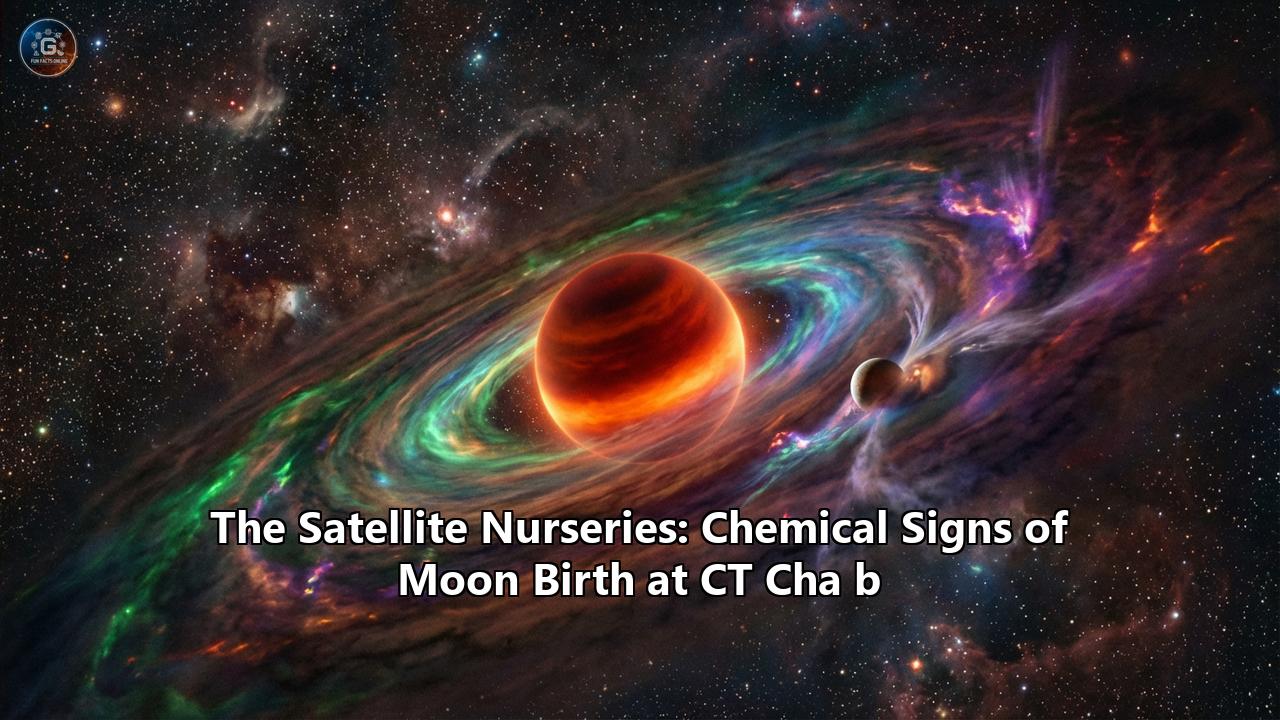
In the grand tapestry of the cosmos, planets are often the protagonists, the celestial bodies that capture our imagination with promises of alien landscapes and potential habitability. Yet, in our own solar system, the moons often steal the show. From the subsurface oceans of Europa and Enceladus to the methane lakes of Titan and the volcanoes of Io, moons represent some of the most dynamic and chemically diverse environments known to science. For decades, astronomers have asked a fundamental question: different as they are, do these satellite systems form via a universal process, or is every moon system a unique chemical recipe cooked up by the chaotic kitchens of the early universe?
Until recently, the "nurseries" where moons are born—the swirling disks of gas and dust surrounding young giant planets—were invisible to us. They were too small, too faint, and too close to the blinding glare of their parent stars to be resolved by even the most powerful telescopes. We were left to infer their properties by looking at the fossilized remains in our own backyard: the Galilean moons of Jupiter and the extensive satellite system of Saturn. We had no direct evidence of how the ingredients of these worlds were mixed in real-time.
That era of inference has ended. A groundbreaking observation using the James Webb Space Telescope (JWST) has peeled back the veil on a distant world known as CT Chamaeleontis b (CT Cha b). For the first time, humanity has chemically characterized a "satellite nursery"—a circumplanetary disk—outside our solar system. The results have shattered expectations, revealing a chemical factory teeming with carbon-rich organic molecules, a stark contrast to the water-rich environments we believed were the standard for moon formation. This discovery not only rewrites the textbook on how satellite systems evolve but also opens a new chapter in the search for life, suggesting that the universe may be populated by exotic, hydrocarbon-rich moons unlike anything we have ever dared to imagine.
The Target: A Giant in the Chameleon’s ShadowTo understand the magnitude of this discovery, we must first look at the system itself. Located approximately 625 light-years from Earth in the southern constellation of Chamaeleon, the star system CT Chamaeleontis is a stellar toddler. At just two million years old, the primary star (CT Cha A) is a T Tauri star—a variable, active object that has not yet settled onto the main sequence. It is still surrounded by the remnants of its birth, a circumstellar disk of material from which planets might eventually form.
Orbiting this young star is the object of interest: CT Cha b. Discovered in 2008, CT Cha b is an object that straddles the boundary between a giant planet and a brown dwarf. With a mass estimated at roughly 17 times that of Jupiter, it occupies a fascinating middle ground. It is massive enough to burn deuterium in its core, yet it likely formed via mechanisms similar to planets.
What makes CT Cha b a perfect laboratory for astronomers is its architecture. Unlike the "Hot Jupiters" found hugging their parent stars in other systems, CT Cha b orbits at a vast distance—approximately 440 to 500 astronomical units (AU) from its host star. To put this in perspective, Pluto orbits the Sun at an average distance of about 39 AU. CT Cha b is so far from its star that it orbits in a realm of perpetual twilight, thermally and dynamically isolated from the primary star's immediate influence.
This wide separation was the key that allowed astronomers to study it. Because it sits so far from the blinding light of CT Cha A, the James Webb Space Telescope could resolve it as a distinct object. More importantly, it allowed the telescope's instruments to isolate the thermal glow of the material surrounding the planet itself—the circumplanetary disk.
The Concept of the Satellite NurseryBefore diving into the chemical revelations, it is crucial to understand what a circumplanetary disk (CPD) is. When a giant planet forms, it grows by accreting gas and dust from the larger disk surrounding the star. As material falls onto the growing planet, conservation of angular momentum causes this infalling matter to spin up and flatten into a mini-disk surrounding the planet.
This disk, the CPD, is the "satellite nursery." It is the structure that regulates the final growth of the planet and serves as the reservoir of material from which moons will coalesce. Just as planets form from the dust circling a star, moons form from the dust circling a planet.
For decades, models of these disks were based on the Jovian system. Jupiter's moons show a clear density gradient: the inner moons are rocky and dense, while the outer moons contain more ice. This suggested a "water-rich" formation history, where the disk was cool enough for water ice to condense and become the primary building block of the satellites. Consequently, astronomers expected that when we finally saw a CPD around an exoplanet, it would be dominated by water vapor and oxygen-rich chemistry.
The universe, however, had a surprise in store.
The Webb Revelation: A Carbon Chemistry FactoryThe study, led by astronomers Gabriele Cugno of the University of Zurich and Sierra Grant of the Carnegie Institution for Science, utilized the Mid-Infrared Instrument (MIRI) on board the JWST. MIRI is a marvel of engineering, capable of detecting the faint heat signatures of molecules vibrating in the cold depths of space.
When the team pointed MIRI at CT Cha b, they were looking for the tell-tale spectral fingerprints of the gas surrounding the planet. They expected to see the familiar signatures of silicates (dust) and perhaps water vapor, mirroring the composition of the star's larger disk.
Instead, the spectrum that came back was unlike anything seen in a planet-forming environment before. The light from CT Cha b’s disk was dominated by intense emission lines from carbon-bearing molecules. The chemical inventory read like the manifest of an organic chemistry lab:
- Acetylene (C2H2): A highly reactive hydrocarbon often associated with soot formation and high-energy chemical processes.
- Diacetylene (C4H2): A more complex chain of carbon and hydrogen, rarely seen in such abundance in protoplanetary disks.
- Propyne (C3H4): Another member of the alkyne family, indicating active synthesis of complex organics.
- Benzene (C6H6): Perhaps the most shocking discovery. Benzene is a stable ring of six carbon atoms and is a fundamental building block for Polycyclic Aromatic Hydrocarbons (PAHs)—complex organic matter that is often cited as a precursor to prebiotic chemistry.
- Methane (CH4) and Ethane (C2H6): Simple hydrocarbons that provide the feedstock for larger molecules.
- Hydrogen Cyanide (HCN): A deadly poison to us, but a critical molecule for prebiotic chemistry, as it is a key precursor for amino acids and nucleobases.
Conspicuously absent from this chemical soup was the one molecule everyone expected: Water (H2O).
While the parent star’s disk was rich in oxygen-bearing molecules like water and hydroxyl (OH), the planet’s disk was dry and choked with hydrocarbons. The ratio of carbon to oxygen (C/O ratio) in the satellite nursery was significantly higher than 1, meaning there was more carbon than oxygen available in the gas phase. In standard astrochemistry, a high C/O ratio radically changes the types of rocks and ices that can form.
A Tale of Two Disks: The Great DivergenceThe discovery of a carbon-rich satellite nursery inside an oxygen-rich stellar system presents a profound mystery. How can a planet and its moons essentially be made of different "stuff" than the star they orbit? The system of CT Cha is only 2 million years old, meaning the chemical divergence happened rapidly, on astronomical timescales.
Several theories have been proposed to explain this "Great Divergence" observed at CT Cha b, and they offer a glimpse into the complex physics of planet formation.
- The Pebble Accretion Hypothesis:
One leading theory involves the way solid material moves through a star system. In the cold outer regions of the stellar disk, carbon and oxygen are locked up in icy grains (pebbles). Oxygen is typically locked in water ice, while carbon is locked in more volatile ices like carbon monoxide (CO). As these pebbles drift inward toward the star, they encounter "snow lines"—boundaries where the temperature rises enough to sublimate specific ices.
If CT Cha b formed at a specific location where oxygen-rich water ice was frozen onto large pebbles (which drift inward quickly and bypass the planet's capture zone) but carbon-rich gas was abundant, the gas accreting onto the planet would be depleted of oxygen and enriched in carbon. The planet essentially "breathes" gas that has been filtered of its water by the physics of dust transport.
- The "Soot Line":
Another possibility is related to the thermal processing of dust grains. The detection of benzene and other complex hydrocarbons suggests an active "soot chemistry." As carbon-rich dust grains from the interstellar medium fall into the circumplanetary disk, they are heated. If the disk is hot enough to destroy oxygen-rich silicate grains or water ice, but retains carbon in the gas phase, the local chemistry can flip. The intense radiation from the young, hot super-Jupiter (which glows at temperatures of thousands of degrees) could drive photochemical reactions that destroy water molecules while synthesizing complex hydrocarbon chains, effectively turning the satellite nursery into a factory for organic smog.
Rewriting the History of MoonsThe implications of the CT Cha b discovery for our understanding of moon formation are staggering. If moons form in this disk, they will not look like the moons of Jupiter.
In the Jovian system, Europa and Ganymede are "water worlds," consisting of silicate cores surrounded by massive mantles of water ice and subsurface oceans. This structure implies they formed in an environment where oxygen (in the form of water) was the dominant solid-forming volatile.
However, any moons forming around CT Cha b right now would be "carbon worlds." Instead of water ice, their mantles might be composed of frozen methane, ethane, and complex tar-like organics (tholins). Their "rocks" might not be silicates but rather carbides—minerals where silicon bonds with carbon instead of oxygen.
We do have one analog for this in our own solar system: Titan, the largest moon of Saturn. Titan is the only moon in the solar system with a substantial atmosphere, and that atmosphere is rich in nitrogen and methane, creating a thick orange haze of organic photochemical smog. On its surface, liquid methane and ethane rain down into hydrocarbon lakes. Titan is essentially a "carbon world" in a system otherwise dominated by water ice.
The discovery at CT Cha b suggests that Titan-like worlds might not be rare anomalies. In fact, for massive planets orbiting far from their stars, carbon-rich satellite systems might be the norm. The "Titan-forming" channel of moon birth might be just as common, if not more so, than the "Europa-forming" channel.
Implications for Habitability: Life in the Oil?The question of habitability naturally follows. When we search for life in the universe, we typically "follow the water." We look for liquid water oceans like those on Enceladus or Europa because water is the solvent for life as we know it.
But the chemistry of CT Cha b challenges our geocentric view of biology. The detection of benzene, cyanides, and abundant hydrocarbons indicates that the ingredients for prebiotic chemistry are present in staggering quantities.
- Benzene and PAHs: These are the scaffolding for complex organic chemistry. On Earth, similar structures are precursors to biological molecules.
- Hydrogen Cyanide (HCN): In the presence of water, HCN can polymerize to form amino acids (the building blocks of proteins) and adenine (a base of DNA/RNA). While the disk at CT Cha b appears "dry" (water-poor) in the gas phase, this does not mean water is entirely absent. It may be locked away in the deep interiors of forming moons, or delivered later by cometary impacts.
- Solvent Alternatives: If moons at CT Cha b have liquid surfaces, those liquids would likely be hydrocarbons like methane, similar to Titan. While terrestrial biology cannot function in liquid methane, hypothetical "azotosomes" (membranes made of nitrogen and carbon) have been modeled as potential structures for life in such environments.
Therefore, while a moon around CT Cha b might be a poor candidate for human life, it could be a paradise for alternative life. A satellite system formed from this disk would be a laboratory for organic synthesis on a planetary scale, potentially hosting "weird life" that relies on hydrocarbon solvents rather than water.
The Technological Triumph of JWSTIt is impossible to overstate the technological achievement that this observation represents. Detecting the chemical composition of a circumplanetary disk is akin to spotting a specific type of smoke rising from a candle flame that is sitting next to a spotlight, while viewing both from miles away.
CT Cha b is faint, and although it is widely separated from its host star, the glare of the primary star is still a formidable obstacle. Furthermore, the disk itself is not a solid object; it is a tenuous veil of gas. The light from the disk is mixed with the light from the planet itself.
To tease out these signals, the team used the MIRI Medium Resolution Spectrograph (MRS). They employed high-contrast imaging techniques and sophisticated data processing algorithms to subtract the light of the host star and isolate the thermal emission of the companion. The specific emission lines of molecules like benzene and diacetylene are fingerprints that cannot be faked; they appear at very specific wavelengths in the mid-infrared. The strength of these lines allowed the researchers to calculate not just the presence of these molecules, but their abundance and the temperature of the gas (which was found to be warm, consistent with a disk heated by a young, contracting planet).
This success serves as a proof-of-concept for the future of exoplanet science. It demonstrates that JWST can do more than just analyze the atmospheres of transiting planets; it can dissect the formation environments of non-transiting worlds and their potential moons.
Comparative Planetology: The Solar System in ContextThis discovery forces us to look at our own solar system with fresh eyes. Why are Jupiter and Saturn so different from CT Cha b?
- Migration History: Jupiter and Saturn likely formed closer to the Sun and migrated, interacting with a richer supply of oxygen-bearing ices. CT Cha b is located 400+ AU out, in the deep freeze of the stellar periphery. Its formation location dictated its chemical feedstock.
- Mass and Temperature: CT Cha b is 17 times the mass of Jupiter. It is hotter and more luminous than Jupiter ever was. This intense heat might drive the "soot chemistry" we observe, preventing water vapor from remaining stable in the upper layers of its disk where MIRI can see it.
- Timescales: CT Cha b is 2 million years old. Jupiter and Saturn formed 4.5 billion years ago. We are seeing CT Cha b in its infancy. It is possible that as the system cools, the chemistry will evolve. Perhaps oxygen trapped in grains will eventually be released, or perhaps cometary bombardment will hydrate the system later.
By comparing CT Cha b to the giants of our solar system, we begin to build a "periodic table" of planet formation scenarios. We learn that there isn't one single way to build a moon system. There is a spectrum, ranging from the oxygen-rich, icy nurseries of the inner solar system to the carbon-rich, soot-filled nurseries of the outer stellar fringe.
Future Prospects: From Disks to MoonsThe detection of the disk is just the beginning. The ultimate goal is to detect the moons themselves. While JWST has revealed the "nursery," the "infants" are still hidden within the dust.
However, the presence of the disk is a smoking gun. Circumplanetary disks have short lifetimes; the material must either accrete onto the planet, be blown away by radiation, or condense into moons. The fact that we see a massive, chemically active disk around a 2-million-year-old object strongly implies that satellite formation is happening right now.
Future observations will focus on:
- ALMA Follow-up: The Atacama Large Millimeter/submillimeter Array (ALMA) in Chile can observe the cold dust component of the disk. While JWST sees the warm gas, ALMA can see the solid grains. Combining these views will give us a 3D picture of the nursery, telling us the total mass of material available to build moons.
- Kinematics: By measuring the Doppler shift of the gas lines detected by JWST, astronomers might be able to map the rotation of the disk. Irregularities in the rotation could betray the presence of a massive moon clearing a gap in the disk, similar to how planets clear gaps in stellar disks.
- Temporal Monitoring: Watching how the brightness of these molecular lines changes over time could reveal "clumps" of material orbiting the planet—proto-moons in the process of accretion.
The discovery of the carbon-rich satellite nursery at CT Cha b is a watershed moment in planetary science. It is a reminder that the universe is far more creative than our models often give it credit for. For years, we searched for "another Europa" or "another Ganymede," assuming that water was the universal currency of moon formation. Now, we know that nature is equally adept at minting "super-Titans"—worlds born from smoke and fire, swimming in hydrocarbons, and possessing a chemistry that is alien yet undeniably rich in the building blocks of complexity.
As we continue to point our gold-plated mirrors into the dark, we are not just finding new worlds; we are discovering that the recipes for world-building are as diverse as the stars themselves. The satellite nursery of CT Cha b stands as a vibrant, carbon-rich beacon, signaling that in the hunt for exomoons, we should expect the unexpected. The era of exomoon characterization has arrived, and it has begun not with a whisper of water, but with a symphony of carbon.
Reference:
- https://karlobag.eu/en/space/webb-discovers-a-carbon-rich-circumplanetary-disc-around-ct-cha-b-and-provides-insight-into-the-birth-of-a-moon-in-a-distant-system-8og3v
- https://esawebb.org/news/weic2521/
- https://earthsky.org/space/moon-forming-disk-exoplanet-ct-cha-b/
- https://science.nasa.gov/missions/webb/nasas-webb-telescope-studies-moon-forming-disk-around-massive-planet/
- https://www.skyatnightmagazine.com/news/webb-moon-forming-disc-ct-cha-b
- https://www.webpronews.com/jwst-discovers-carbon-rich-disk-around-exoplanet-ct-cha-b/
- https://carnegiescience.edu/news/astronomers-get-first-ever-peek-gas-giants-moon-forming-environment
- https://scholarlypublications.universiteitleiden.nl/access/item%3A3719447/download
- https://www.earth.com/news/moon-forming-dust-disk-discovered-around-a-massive-planet-ct-cha-b/
- https://www.sci.news/astronomy/webb-exomoon-forming-circumplanetary-disk-gas-giant-exoplanet-14247.html
- https://www.universetoday.com/articles/the-jwst-spies-the-raw-materials-for-exomoons
- https://arxiv.org/abs/2509.15209
- https://en.wikipedia.org/wiki/CT_Chamaeleontis