
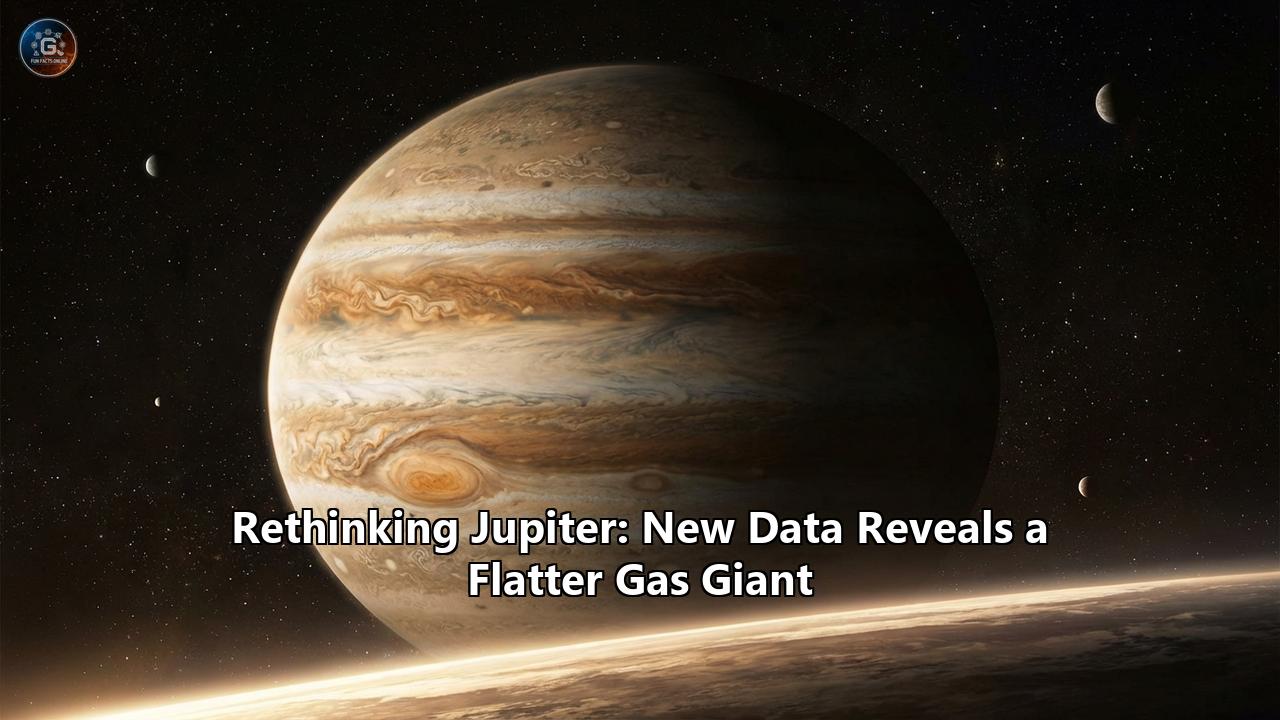
For centuries, Jupiter has reigned as the immutable monarch of our solar system—a striped, storm-racked colossus that serves as the standard by which all other gas giants are measured. We thought we knew its dimensions. We thought we understood its geometry. But data streaming back from NASA’s Juno spacecraft has just shattered a fifty-year-old consensus.
In a revelation that is sending ripples through the planetary science community this week, researchers have confirmed that Jupiter is not the planet we thought it was. It is smaller, denser, and significantly "flatter" than the textbooks have claimed for half a century.
This isn’t just a matter of updating a few digits on a Wikipedia page. The discovery, published earlier this week in Nature Astronomy, fundamentally alters our understanding of how gas giants hold themselves together, how their atmospheres churn, and how they form in the dark nurseries of deep space.
The Illusion of the Sphere
To the naked eye, and even through a backyard telescope, planets appear as perfect circles—celestial marbles rolling against the black velvet of space. But physics tells a different story. Any rotating body, from a spinning water balloon to a galaxy, fights a war between two opposing forces: gravity, which tries to pull everything into a compact sphere, and centrifugal force, which tries to fling everything outward.
Jupiter spins with terrifying speed. Despite having a circumference 11 times that of Earth, it completes a full rotation in just under 10 hours. This violent spin makes Jupiter bulge at the center and flatten at the top and bottom, a shape known as an oblate spheroid.
We have known about this "squashed" shape for centuries. But until this week, we didn’t realize just how squashed it truly is.
"We are essentially putting Jupiter on a diet," says Dr. Eli Galanti, a lead researcher on the study from the Weizmann Institute of Science. "The planet hasn't changed, but our ability to see it has sharpened by an order of magnitude. And what we see is a world that is more compact and more dynamically shaped by its own weather than we ever dared to model."
The Voyager Error
To understand why this is a shock, we have to look back to the 1970s. Most of the "standard" physical data for Jupiter—the numbers printed in every astronomy textbook since the disco era—came from the Pioneer and Voyager missions.
As those probes zipped past the gas giant, they performed what are called "radio occultation" experiments. They beamed radio waves back to Earth just as they slipped behind Jupiter. By measuring how those radio waves bent and slowed as they passed through Jupiter's atmosphere, scientists calculated the planet's radius.
But Pioneer and Voyager only provided six data points. They were brief snapshots taken from specific angles. Scientists took those six points and extrapolated a shape, assuming the planet was relatively uniform.
"It was a best-guess scenario," explains Dr. Sarah Miller, a planetary dynamicist not involved in the new study but who has utilized Juno data in her research. "We assumed Jupiter was a simple fluid body. We didn't account for the fact that the winds on Jupiter aren't just surface decoration—they are massive physical structures that actually warp the shape of the planet."
The Voyager numbers set the equatorial radius at 71,492 km. The new Juno data, however, shaves off approximately 4 kilometers from that width. More dramatically, the polar radius has been reduced by nearly 12 kilometers (about 7.5 miles).
In planetary terms, missing the mark by 24 kilometers (15 miles) pole-to-pole is like a surveyor measuring Mount Everest and forgetting to include the summit.
The Juno Technique: Seeing with Radio
The Juno mission, which arrived at Jupiter in 2016, was designed to peel back the layers of the onion. Unlike Voyager, which did a "flyby," Juno is an orbiter. It dives in close, skimming the cloud tops, and then swings far out to avoid the deadly radiation belts.
Over the last few years, as Juno’s orbit has evolved, it has performed a campaign of radio occultation experiments that dwarf everything from the 20th century. The spacecraft has passed behind Jupiter dozens of times, beaming radio waves through different latitudes and depths of the atmosphere.
This allowed scientists to build a 3D map of the planet's limb (edge) with unprecedented precision. But the real breakthrough came when they combined this shape data with the gravitational data Juno has been collecting.
They found that the winds of Jupiter—those iconic red and white bands—are not shallow breezes. They are deep, cylindrical shells of gas rotating at different speeds, extending thousands of kilometers down into the dark abyss of the planet. These "zonal winds" carry so much momentum that they physically push the planet out of shape, contributing to the flattening effect in ways the 1970s models never anticipated.
The Barotropic Reality
The new study confirms a concept that fluid dynamicists call "barotropic flow." In simple terms, this means the cylinders of gas rotating inside Jupiter are incredibly stable and aligned with the planet's rotation axis.
Imagine Jupiter not as a solid ball, but as a stack of nesting cylinders, like a telescoping spyglass. The gas at the equator is spinning at one speed, while the gas at mid-latitudes spins at another. The centrifugal force exerted by these differing speeds sculpts the planet's physical surface (defined as the 1-bar pressure level, usually where we see the cloud tops).
Because the winds at the equator are whipping around so fast, they push outward harder, creating a sharper "ledge" than a simple solid body would have. Conversely, the poles, which are relatively calmer but subject to the overall contraction of the planet's immense gravity, are pulled in tighter.
The result is a Jupiter that is "flatter" and more angular than the smooth oblate spheroid of our previous models. It is a shape defined not just by gravity, but by the violence of its own weather.
A New Cosmic Yardstick
Why does it matter if Jupiter is 15 miles flatter than we thought?
For astronomers, Jupiter is more than just a planet; it is a ruler. It is the "standard candle" for giant planets. When we find an exoplanet orbiting a distant star 500 light-years away, we describe it as "1.2 Jupiter radii" or "0.8 Jupiter masses."
"If your ruler is wrong, your measurements of the universe are wrong," says Dr. Miller. "By refining the radius of Jupiter, we are instantly refining the density estimates of thousands of exoplanets we've discovered. A smaller Jupiter means a denser Jupiter. That implies that 'Hot Jupiters' elsewhere in the galaxy might be more compact and metal-rich than we assumed."
This adjustment also solves a lingering mystery closer to home. For years, there was a slight mismatch between Jupiter's gravitational field (measured by how it tugs on spacecraft) and its atmospheric shape. Models of the interior—the core and the metallic hydrogen ocean—couldn't quite reconcile the two.
By shrinking the planet's radius in the models to match the new Juno findings, the math suddenly clicks into place. The gravity data and the shape data now harmonize, providing a clearer window into the deep interior.
The Heart of the King
The "flatter" Jupiter supports the growing consensus that the planet's core is not a solid rock like Earth's, but a "fuzzy" or "dilute" core.
In the old model, you had a rock in the middle, overlaid by metallic hydrogen, then molecular hydrogen, then clouds. The new shape data suggests a far more gradual transition. Heavy elements (metals, rock, and ices) are dissolved into the metallic hydrogen ocean, extending nearly half the radius of the planet.
This "fuzzy core" model explains why the planet is so malleable. If Jupiter had a solid, rigid core, it might resist the flattening effect of the rotation more stubbornly. A fluid, mixed interior, however, complies with the centrifugal forces, stretching and squashing exactly as the laws of hydrodynamics dictate.
Echoes of a Flat Past
Interestingly, this week's news about a "flatter" current Jupiter parallels a separate theoretical bombshell dropped just two years ago regarding the infant Jupiter.
In 2024, simulations by astrophysicists at the University of Central Lancashire suggested that gas giants might not form as spheres at all. The "disk instability" theory proposed that protoplanets form as flattened, pancake-like disks of cooling gas that only later puff up into spheres as they accrete matter and spin up.
While the new Juno data describes the current mature shape of the planet, it creates a poetic symmetry. Jupiter may have been born flat, and as it turns out, it remains stubbornly resistant to becoming perfectly round.
Future Horizons
The Juno mission has been a workhorse, surviving years longer than its initial lifespan. It has battered its way through radiation that would fry a standard satellite in minutes. But its work is not done.
With this new precise shape model, mission controllers can now navigate even closer to the cloud tops during future flybys, shaving seconds off the communication delays and refining the gravitational maps even further.
Furthermore, this data lays the groundwork for the European Space Agency’s JUICE (Jupiter Icy Moons Explorer) mission and NASA’s Europa Clipper, both en route or preparing for operations in the Jovian system. While their primary targets are the moons, they will rely on the gravitational and geometric models of the parent planet to navigate the complex dance of the Jovian orbits.
Conclusion: The Dynamic Giant
We often think of the planets as static backdrop—unchanging marbles of the gods. The "Great Flattening" discovery is a reminder that these are dynamic, living worlds. Jupiter is a fluid engine of unimaginable scale, where winds scream at 300 miles per hour and crush the planet itself into a new geometry.
As we look up at the bright point of light in the night sky this month, we must shift our mental image. It is not the perfect sphere of Aristotle. It is a squat, spinning, wind-warped oblate world—a testament to the violent beauty of physics at the grandest scale.
The King of Planets has not lost his crown, but he has certainly tightened his belt.
Reference:
- https://universemagazine.com/en/jupiter-is-narrower-at-the-equator-than-previously-thought/
- https://scienmag.com/jupiters-massive-size-and-unique-shape-revealed/
- https://www.livescience.com/space/planets/textbooks-will-need-to-be-updated-jupiter-is-smaller-and-flatter-than-we-thought-juno-spacecraft-reveals
- https://science.nasa.gov/blogs/science-news/2026/02/04/nasas-juno-mission-redefines-size-shape-of-jupiter/
- https://www.sci.news/space/jupiter-size-shape-14536.html
- https://en.wikipedia.org/wiki/Jupiter
- https://www.techexplorist.com/jupiter-smaller-squashier-thought/102051/
- https://www.smithsonianmag.com/smart-news/scientists-say-that-jupiter-the-solar-systems-largest-planet-might-be-slightly-smaller-than-previously-thought-180988143/