
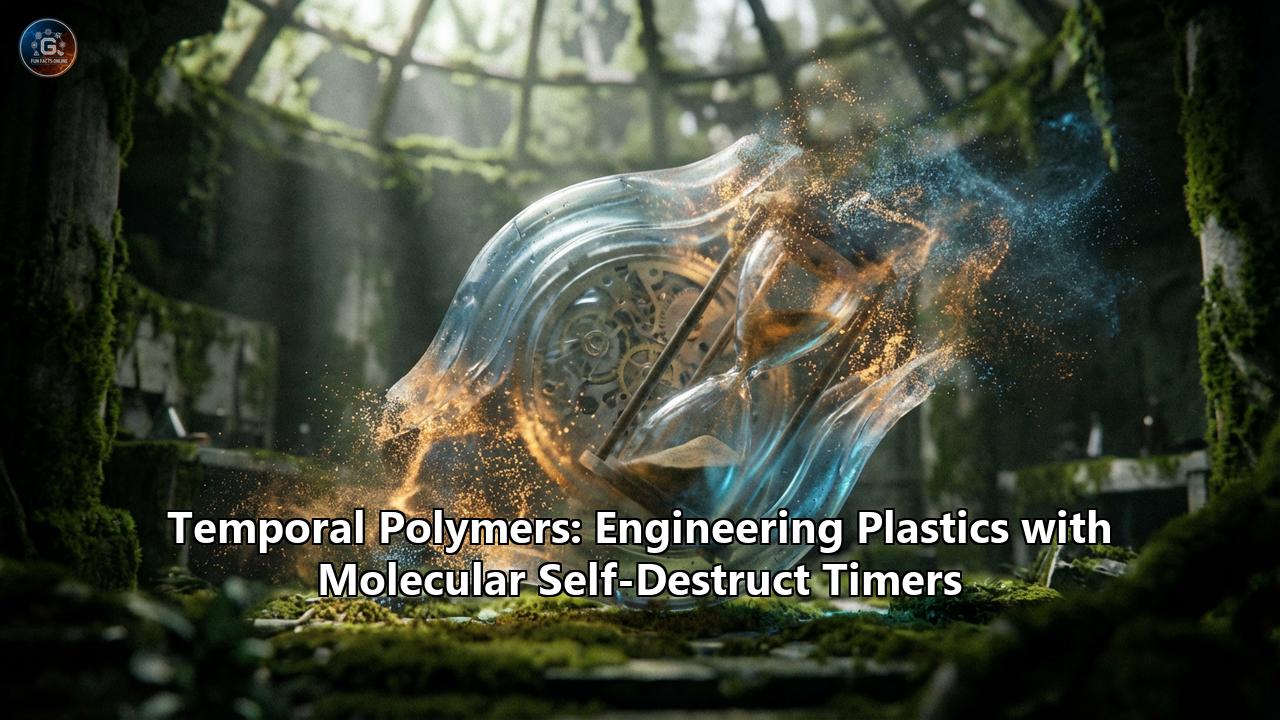
In the history of materials science, the ultimate goal has almost always been permanence. We have engineered steel to resist rust, concrete to withstand centuries of weathering, and plastics to survive effectively forever. The triumph of the 20th century was the creation of synthetic polymers that were impervious to bacteria, water, and time. But today, this triumph has curdled into a crisis. We are drowning in our own success, surrounded by materials that outlive their utility by thousands of years.
Now, a quiet revolution is dismantling this paradigm. A new class of materials is emerging from the laboratories of the world’s most advanced military and academic institutions. They are not built to last; they are built to die. They are Temporal Polymers—plastics engineered with molecular self-destruct timers.
These are not merely "biodegradable" plastics that slowly rot over decades. These are "transient materials" designed to function at peak performance for a specific duration—be it a year, a day, or a microsecond—and then, upon receiving a specific trigger, vanish completely. They can depolymerize in seconds, turning from a rigid computer chip into a puddle of harmless byproducts, or unspool into vapor, leaving no trace behind. From spycraft and vanishing sensors to temporary pacemakers and waste-free consumer electronics, temporal polymers represent a fundamental shift in how we interact with the physical world: the move from the Era of Permanence to the Era of Transience.
Part I: The Chemistry of Vanishing
To understand how a solid object can be engineered to disappear on command, we must look at the molecular architecture of plastics. Traditional polymers, like the polyethylene in a water bag or the polycarbonate in a laptop case, are stable because their long molecular chains are held together by robust carbon-carbon bonds that require immense energy to break. They are thermodynamically stable at room temperature.
Temporal polymers, particularly a class known as Self-Immolative Polymers (SIPs), operate on a different thermodynamic precipice. They are "metastable." They are chemically frustrated, like a coiled spring held in place by a single pin. The moment that pin is pulled, the stored energy is released, and the entire structure unravels.
The Unzipping Mechanism
The defining characteristic of a self-immolative polymer is the "unzipping" mechanism. In a standard degradable plastic, like polylactic acid (PLA), degradation occurs randomly. Water molecules slowly chop the long polymer chains into shorter and shorter fragments over months. It is a chaotic, slow, and often incomplete process that leaves behind microplastics.
SIPs are different. They are designed with a "head-to-tail" architecture. The polymer chain is capped at the end with a specific "trigger" molecule. As long as this cap is in place, the polymer is stable. But once a specific stimulus removes this cap, the first monomer becomes unstable and detaches. This exposes the second monomer, which becomes unstable and detaches, exposing the third, and so on.
This domino effect travels down the entire length of the polymer chain with explosive speed. A single bond breakage event at the "head" of the molecule causes the entire macromolecule to disassemble into its constituent monomers. This is not rotting; it is molecular disassembly.
Cyclic Poly(phthalaldehyde): The Poster Child of Transience
One of the most promising candidates in this field is cyclic poly(phthalaldehyde), or cPPA. Unlike linear polymers that have two ends, cyclic polymers are rings. This shape offers unique stability benefits, but the chemistry of PPA is where the magic lies.
PPA has a "ceiling temperature" of roughly -40°C. The ceiling temperature ($T_c$) is the threshold above which a polymer thermodynamically prefers to exist as a monomer. For most commercial plastics, the $T_c$ is hundreds of degrees Celsius—they want to stay solid. For PPA, at room temperature, it desperately wants to turn back into a gas/liquid monomer. It is only held in its solid polymer state by kinetic trapping—essentially, the chemical equivalent of a door jammed shut.
Researchers at institutions like the Georgia Institute of Technology and the Army Research Laboratory have engineered cPPA variants that remain stable solids at room temperature but, when triggered, revert to their monomer state instantly. Because the monomer of phthalaldehyde has a high vapor pressure, the material doesn't just melt; it can effectively sublimate. A rigid drone wing made of cPPA composites could be triggered to vanish, leaving behind nothing but a faint smell of almonds.
The Triggers: Programming the Timer
The "timer" in a temporal polymer is not a clock, but a specific chemical sensitivity. Engineers can cap the polymer chains with different functional groups to create specific triggers:
- Light (Phototriggering): By capping the polymer with a photosensitive group (like an o-nitrobenzyl moiety), the material remains stable in the dark. Exposure to a specific wavelength of UV light cleaves the cap, initiating the unzipping. This allows for "daylight-sensitive" supply drops that vanish at dawn.
- Heat (Thermal Triggering): Polymers can be designed to remain stable up to 49°C but self-destruct at 50°C. This is critical for medical implants that must remain solid at body temperature but dissolve if a localized fever is induced or external heat is applied.
- Chemical Agents: Specific sensors can be designed to dissolve only when they encounter a specific chemical—for example, a sensor detecting a nerve agent could be programmed to dissolve instantly upon contacting that agent, simultaneously destroying the evidence and signaling the presence of the toxin.
- Radio Waves: By embedding nanoparticles that heat up under specific radio frequencies, a user can remotely trigger the degradation of a device from kilometers away.
Part II: The Military Imperative – "Leave No Trace"
The primary funding engine for this technology has been the defense sector, specifically agencies like DARPA (Defense Advanced Research Projects Agency) in the US. The strategic motivation is simple: hardware security.
In modern warfare, sensors are ubiquitous. Thousands of cheap, connected sensors are dropped over battlefields to monitor troop movements, chemical signatures, and audio. But every sensor dropped is a piece of technology that can be recovered by the enemy. A captured drone reveals cryptographic keys, frequency hopping algorithms, and sensor capabilities.
The Vanishing Glider
Consider the "ICARUS" (Inbound, Controlled, Air-Releasable, Unrecoverable Systems) program. The goal was to create delivery vehicles—gliders—that could drop critical supplies (blood, batteries, ammo) to special forces behind enemy lines and then disappear.
Using temporal polymers, researchers created prototypes of gliders where the structural spars were made of rigid PPA composites. Upon landing, the stress of impact or a built-in chemical trigger initiates the depolymerization. Within hours of the sun rising, the glider is gone. The enemy patrol that arrives at the coordinates finds only a patch of damp soil and the supplies that were delivered.
Transient Electronics and Sensors
Beyond the structure, the electronics themselves are becoming transient. Standard electronics are built on silicon wafers (glass) and fiberglass boards (FR4), which last forever. Temporal electronics replace these substrates with materials like silk, cellulose, or thin films of molybdenum and magnesium.
Magnesium is a conductor, but unlike copper, it is water-soluble over time. Silicon, if made thin enough (nanomembranes), dissolves in water (hydrolysis) to form harmless silicic acid. By printing magnesium circuits onto a film of temporal polymer, you create a "transient circuit."
DARPA has demonstrated chips that function normally until they receive a "kill command" via a radio signal. The current heats a micro-resistor, which triggers the thermal degradation of the polymer substrate. The chip physically crumbles into dust, severing all connections and destroying the silicon logic gates. This is the ultimate defense against reverse engineering.
Part III: The Medical Revolution – Bioresorbable Electronics
While the military wants things to disappear to hide secrets, doctors want things to disappear to save lives. The field of Bioresorbable Electronics is the humanitarian twin of military transient tech.
The Problem of the "Explant"
Today, if you need a temporary medical device—like a pacemaker after heart surgery, or screws for a broken bone—you often face two surgeries: one to put it in, and one to take it out. The "explant" surgery carries risks of infection, anesthesia complications, and tissue damage.
Temporal polymers offer a "implant and forget" solution.
Transient Pacemakers and Nerve Stimulators
Researchers at Northwestern University, led by pioneers like John Rogers, have developed transient pacemakers. These are thin, flexible devices containing no batteries (powered wirelessly) and made of PLGA (polylactic-co-glycolic acid) and ultra-thin tungsten or magnesium.
The device sits on the heart, providing pacing for the critical post-operative period (usually a few weeks). As the heart heals, the body’s fluids slowly dissolve the polymer packaging and the metal electrodes. The materials are chosen specifically because their breakdown products are biologically benign. Magnesium is an essential mineral; the amount released by a dissolving pacemaker is less than what you’d get from a daily multivitamin.
Intracranial Monitors
For patients with traumatic brain injury, monitoring intracranial pressure (ICP) is vital. Currently, this requires a wired probe drilled into the skull, which is a permanent infection pathway until removed. A temporal polymer sensor can be implanted completely inside the skull. It transmits pressure data wirelessly. After the critical swelling period passes (usually a week), the sensor dissolves into the cerebrospinal fluid and is flushed out by the body's natural metabolic processes. No wires, no removal surgery, no infection risk.
Part IV: The Environmental Paradigm – Ending E-Waste
The most expansive application of temporal polymers lies in consumer electronics. We generate over 50 million metric tons of electronic waste (e-waste) annually. Smartphones, vapes, smartwatches, and RFID tags are used for a few years (or weeks) and persist for centuries.
The "Transient PCB"
Printed Circuit Boards (PCBs) are the backbone of e-waste. They are flame-retardant fiberglass bricks that are nearly impossible to recycle economically. Temporal polymers offer a path to the Recyclable-by-Design PCB.
Imagine a smartphone where the circuit board is held together by a PPA-based binder. When the phone reaches its end of life, you don't need to shred it and burn it to extract the gold (a dirty process). Instead, you place the phone in a specific "trigger bath" or expose it to a specific thermal cycle. The polymer board depolymerizes, turning into a liquid monomer that can be collected and re-polymerized for a new phone. The valuable components—chips, capacitors, gold connectors—simply fall off the board, undamaged and ready for reuse.
This is "programmatic recycling." It shifts the economic model of recycling from "shred and smelt" to "dismantle and reuse."
Smart Packaging and Sensors
We are moving toward a world of the "Internet of Everything," where milk cartons warn you when they spoil and shipping labels track themselves. If we build billions of these sensors using standard plastics, we create an ecological catastrophe.
Temporal polymers allow for high-performance "smart labels" that function for the 30-day supply chain of a product and then degrade into harmless organic byproducts in a landfill. Startups are already exploring "paper electronics" where the conductive traces are printed on cellulose substrates that dissolve in rain, ensuring that single-use electronics don't become permanent pollution.
Part V: Challenges and The Future
Despite the immense promise, the path to a transient future is paved with obstacles.
The Stability-Sensitivity Paradox
The central engineering challenge is the "Stability-Sensitivity Paradox." A material that is designed to fall apart is inherently risky. You do not want your biodegradable pacemaker to dissolve a week early because the patient ran a fever. You do not want your vanishing drone to disintegrate mid-flight because it got too hot in the sun.
Achieving the perfect balance—rock-solid stability during the operational life and rapid, total degradation upon the trigger—requires incredible precision in chemical synthesis. It requires "logic gates" in the material itself (e.g., the material only degrades if it is BOTH 60°C AND exposed to high humidity).
The Economics of Transience
Currently, temporal polymers are expensive. Synthesizing high-purity cyclic PPA or specialized magnesium nanomembranes costs orders of magnitude more than stamping out PET plastic. However, the "cost" calculation changes when you factor in the lifecycle. If a vanishing sensor saves a $50,000 explant surgery, the material cost is negligible. If a self-dismantling phone reduces recycling costs by 90%, the expensive polymer pays for itself.
A Philosophically New Material Age
We are entering an age where materials are defined by their lifespan, not just their strength. We are encoding "time" into matter.
In the future, we may buy a phone with a guaranteed physical lifespan. We may deploy forest fire sensors that monitor a single dry season and then feed the soil. We may introduce medical nanobots that swim through our blood to deliver a drug and then dissolve into electrolytes.
Temporal polymers represent a humility in engineering—an admission that our creations should not outlast their purpose. By building self-destruct timers into the molecular fabric of our world, we are not destroying value; we are preserving the future, ensuring that the technological footprint of the 21st century is one of innovation, not debris.
Section 1: The Molecular Architecture of Self-Destruction
To appreciate the sophistication of temporal polymers, one must delve into the polymer physics that differentiates them from the plastics currently clogging our oceans.
1.1 The Thermodynamics of Ceiling Temperature ($T_c$)
All polymers have a "ceiling temperature" ($T_c$). This is the temperature at which the rate of polymerization (monomers linking up) equals the rate of depolymerization (chains breaking down).
- High $T_c$ Polymers: Common plastics like PTFE (Teflon) or Polyethylene have $T_c$ values well above 300°C-400°C. They are thermodynamically stable at Earth's surface temperatures. You have to burn them to break them.
- Low $T_c$ Polymers: Temporal polymers are chosen for their low $T_c$. Poly(phthalaldehyde) (PPA) has a $T_c$ of approximately -40°C. This means that at room temperature (20°C), PPA is thermodynamically unstable. It wants to entropy-drive itself back into a monomeric cloud.
The engineering feat is not making them degrade; it is keeping them stable. We achieve this through "kinetic stabilization." We cap the ends of the polymer chains with bulky, stable chemical groups (like acetates or specific photocleavable moieties). These caps act like the bookends on a shelf of books that are leaning over. As long as the bookends hold, the books (monomers) stay aligned. Remove one bookend, and gravity (thermodynamics) takes over—the entire shelf collapses.
1.2 Self-Immolative Mechanisms
The term "self-immolative" is borrowed from the concept of a robot that destroys itself to protect secrets. Chemically, it refers to a specific cascade reaction.
The Quinone-Methide Cascade:A common mechanism involves a linker that, upon cleavage, forms a "quinone-methide" intermediate. This molecule is highly unstable and rapidly rearranges, expelling the attached drug or polymer chain.
- Step 1: Signal Detection. An enzyme or photon breaks a specific bond at the "head" of the polymer.
- Step 2: Electronic Rearrangement. The electrons in the head group shift positions, becoming a quinone methide.
- Step 3: Scission. This shift forces the bond connecting the head to the first monomer to break.
- Step 4: Domino Effect. The first monomer is now exposed with a reactive end. It undergoes the same shift, popping off and exposing the second.
- Result: A high-molecular-weight plastic turns into a soup of small molecules in minutes or seconds.
1.3 Cyclic vs. Linear Topologies
Researchers have found that cyclic polymers (loops) are often superior to linear ones for temporal applications.
- Linear Polymers: Have two ends. If the "tail" end is accidentally damaged by heat or mechanical stress, it might trigger premature unzipping. They are vulnerable.
- Cyclic Polymers: Have no ends. They are infinite loops. This makes them more thermally stable and resistant to accidental degradation. To trigger them, you must break the ring at any point. Once the ring is snapped (linearized), the inherent instability takes over, and it unzips. This offers a "safety off" switch that is much harder to trip accidentally.
Section 2: The Toolbox of Triggers
The versatility of temporal polymers lies in the "triggers"—the specific stimuli that initiate the self-destruct sequence. This programmability is what separates them from simple compostable plastics.
2.1 Photochemical Triggers (Light)
Application: Supply gliders, environmental sensors. Mechanism: The polymer is doped with a photo-acid generator (PAG). When UV light hits the PAG, it releases a proton ($H^+$). This acid attacks the acetal linkages in the PPA backbone. Scenario: A drone delivers a package at night. The drone is made of PPA with a PAG additive. As long as it is dark, it is rigid. When the sun rises, UV rays hit the wing. The PAG releases acid. The acid catalyzes the depolymerization. The wing dissolves into liquid/vapor.2.2 Chemical Triggers (Specific Analytes)
Application: Nerve agent detection, fluoride sensing. Mechanism: The end-caps are designed to be cleaved only by a specific molecule. For example, a silyl-ether end-cap is stable until it encounters Fluoride ions. Scenario: A sensor is placed in a water supply. If the water is clean, the sensor remains. If fluoride levels (or a specific toxin) spike, the chemical reacts with the end-cap. The sensor dissolves. The disappearance of the sensor is the signal. Alternatively, the dissolution releases a dye contained inside the polymer matrix, turning the water red to warn of contamination.2.3 Mechanical Triggers (Force/Piezoelectric)
Application: Tamper-proofing. Mechanism: "Mechanophores" are molecules that change color or break when physically stretched or compressed. Scenario: A secure hard drive casing is made of a mechano-responsive temporal polymer. If someone tries to drill into it or pry it open, the mechanical stress snaps the trigger bonds. The casing instantly depolymerizes, releasing a corrosive agent stored within that destroys the magnetic platter inside. The data is safe because the device committed suicide.2.4 Biological Triggers (Enzymes)
Application: Drug delivery. Mechanism: Polymers are capped with a peptide sequence that matches a specific enzyme found in tumors or bacteria. Scenario: A nanoparticle made of temporal polymer carries a chemotherapy drug. It travels through the blood (pH 7.4) safely. When it reaches a tumor, it encounters an enzyme (like Cathepsin B) that is overexpressed by cancer cells. The enzyme cleaves the cap. The particle explodes (depolymerizes), releasing a high concentration of the drug exactly where it is needed, minimizing side effects.Section 3: Applications in Defense and Espionage
The Defense Advanced Research Projects Agency (DARPA) launched the VAPR (Vanishing Programmable Resources) program with a clear vision: electronics that do not persist.
3.1 The Problem of "Tech Harvesting"
When a US drone crashes in hostile territory, it is a goldmine for adversaries. They harvest the optics, the communication modules, and the cryptographic chips. Current protocol requires airstrikes to destroy downed gear, which is expensive and politically messy.
Temporal polymers solve this. A "self-destructing" chip doesn't need explosives (which are heavy and dangerous). It just needs to stop being a chip.
- Transience on Demand: A pilot can press a button that sends a signal to all deployed sensors to "vaporize."
- Zero-Power Scuttling: Even if the power fails, the material can be designed to degrade after a set time (e.g., 24 hours) chemically, ensuring that a dead drone eventually becomes a dust pile regardless of intervention.
3.2 Ephemeral Swarms
The military envisions "swarms" of micro-sensors—thousands of seeds scattered by air. Today, we don't do this because it would be littering the landscape with batteries and silicon.
With temporal polymers, we can deploy "Smart Dust."
- The Battery: A magnesium-air battery that runs for 48 hours and then dissolves into magnesium oxide (inert dirt).
- The Body: A cellulose or PPA shell that degrades into compost.
- The Circuit: Molybdenum interconnects on a transient substrate.
This allows for "saturate and forget" surveillance. You can cover a valley in sensors for a specific operation, and a month later, the valley is pristine.
Section 4: The Medical Frontier – "Transient Medicine"
The body is a dynamic, healing environment. Permanent hardware is often a liability.
4.1 The Transient Stent
Stents are metal tubes used to keep arteries open. However, metal stents can cause long-term inflammation or thrombosis. Often, the artery only needs support for 6 months while it heals.
Solution: A bioresorbable stent made of a temporal polymer composite (like PLA/PLLA blends or magnesium alloys). It holds the artery open with radial strength equal to steel for 6 months. Then, it begins to lose integrity and is metabolized by the vascular wall. The patient is left with a healed, natural artery, not a permanent metal cage.4.2 "Smart" Sutures and Wound Dressings
Smart sutures made of temporal polymers can not only dissolve (which we have had for years) but dissolve intelligently.
- Infection Sensing: If the suture detects the pH change associated with a bacterial infection, it can increase its degradation rate to release an antibiotic payload encapsulated within its fibers.
- Timed Release: A wound dressing can be programmed to release pain medication (Day 1), then anti-inflammatory agents (Day 3), and then growth factors (Day 5) by having layers of polymers with different "timer" triggers.
4.3 Neural Dust and Brain Interfaces
One of the most futuristic applications is "Neural Dust"—tiny, wireless sensors sprinkled onto the brain to monitor neural activity. Using temporal polymers, these could be used for diagnostic mapping of epilepsy. Once the map is complete and the seizure focus identified, the sensors dissolve, removing the need to surgically pick them out of the delicate brain tissue.
Section 5: The Economic & Industrial Landscape
The transition to temporal materials is not just scientific; it is an economic shift.
5.1 The Market for Transience
The market for "Transient Electronics" is projected to grow from a niche $100 million sector to a multi-billion dollar industry over the next decade. The drivers are:
- Healthcare Cost Reduction: Eliminating secondary surgeries saves insurance companies billions.
- E-Waste Compliance: The EU's "Right to Repair" and strict e-waste laws are pushing manufacturers to find ways to recycle electronics. A phone that disassembles itself is the holy grail of the "Circular Economy."
5.2 Key Players and Startups
- Rogers Research Group (Northwestern University): The academic epicenter of transient electronics.
- Sibel Health / Rhaeos: Startups spinning out of these labs, commercializing bioresorbable sensors for neonates and hydrocephalus monitoring.
- Apricus Biosciences & Others: Investigating SIPs for drug delivery vehicles.
- Major Tech Firms: Companies like IBM and Xerox PARC have researched "chip-disintegration" technologies for data security, though much remains behind closed doors (proprietary).
5.3 The Manufacturing Hurdle
You cannot just put PPA in a standard injection molding machine.
- Thermal Sensitivity: Standard plastic molding happens at 200°C. PPA degrades at 100°C (or lower depending on the trigger). This requires new low-temperature processing techniques, such as solvent casting or specialized 3D printing.
- Shelf Life: How do you ship a product that wants to die? Temporal polymers require specialized packaging (vacuum sealed, UV shielded) to prevent premature death. This adds cost to the logistics chain.
Section 6: The Green Horizon – Beyond Biodegradable
Current "biodegradable" plastics (like PLA cups) are often a lie. They require industrial composting facilities (60°C heat) to degrade. If thrown in the ocean, they last for years.
Temporal polymers offer True Environmental Degradability.
- Triggered by Salinity: A plastic bag made of a specific temporal polymer could be robust on land but programmed to unzip upon contact with the specific ionic strength of seawater. It wouldn't just break into microplastics; it would chemically revert to harmless food for microbes within days of entering the ocean.
- Programmable Life: Agricultural films (plastic sheets used to cover crops) are a huge waste problem. Farmers have to rip them up after harvest. Temporal films could be timed to last exactly 90 days (the growing season) and then disintegrate into the soil, tilled in as fertilizer for the next crop.
Conclusion: The Beauty of Ephemerality
We are culturally conditioned to equate quality with durability. We build stone monuments and write on archival paper. But nature teaches us a different lesson. A flower is beautiful because it blooms and then fades. Its transience allows for renewal. A forest that never decayed would choke itself.
Temporal polymers are the first step toward a technological ecosystem that mimics this natural rhythm. They allow us to create high-performance tools—spy planes, supercomputers, medical implants—that serve their purpose with excellence and then bow out with grace.
In the end, the greatest achievement of materials science may not be the plastic that lasts forever, but the plastic that knows exactly when to quit.
Reference:
- https://www.researchgate.net/publication/276846064_Status_of_Polymer-Flooding_Technology
- https://www.researchgate.net/publication/378433476_Self-Immolative_Polymers_From_Synthesis_to_Applications
- https://etech.iec.ch/issue/2025-01/the-magic-of-transient-electronics
- https://cacm.acm.org/news/vanishing-electronics/
- https://uwo.scholaris.ca/server/api/core/bitstreams/7acdb5f4-2a8a-4eda-84be-a4c06fa54f6c/content
- https://pubs.acs.org/doi/10.1021/jacs.1c11410
- https://www.idw.or.jp/finalprogram.html
- https://globalventuring.com/corporate/9-startups-reshaping-the-packaging-sector/
- https://www.forbes.com/sites/amyfeldman/2024/05/03/this-startups-ai-designs-enzymes-that-can-eat-plastic-waste/
- https://wyss.harvard.edu/news/plastic-degradation-company-breaking-emerges-from-stealth-with-naturally-derived-solution-to-degrade-multiple-plastics-with-10-5m-in-seed-funding/