
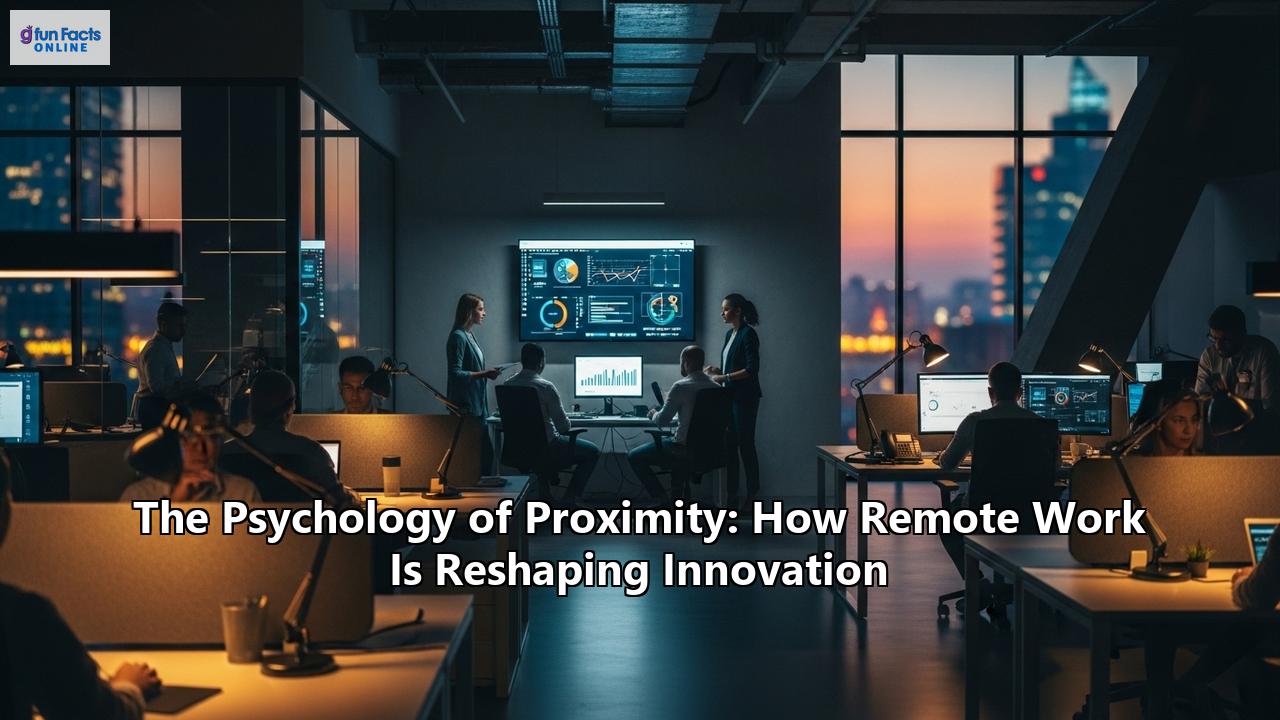
The Unseen Force: How Remote Work is Redefining the Psychology of Proximity and Sparking a New Wave of Innovation
For decades, the engine of innovation was thought to be fueled by physical closeness. The shared office, the bustling hallway, the chance encounter at the water cooler—these were the crucibles where ideas were forged, refined, and brought to life. This belief is rooted in the psychology of proximity, a concept that explores how physical distance influences our interactions, relationships, and even our creative output. Yet, the global shift to remote and hybrid work has thrown a fascinating wrench into this long-held paradigm, forcing us to question the very nature of collaboration and ingenuity. As we navigate this new landscape, we're discovering that while the principles of proximity still hold weight, their application is undergoing a radical transformation, reshaping the future of innovation in the process.
The Allen Curve and the Era of Hallway Conversations
At the heart of the traditional understanding of workplace innovation lies the Allen Curve. Developed in the 1970s by MIT professor Thomas J. Allen, this concept reveals a powerful negative correlation between the physical distance separating colleagues and the frequency of their communication. Allen's research demonstrated that we are exponentially more likely to communicate with someone sitting a few feet away than with a colleague on a different floor or in a separate building. Specifically, the curve shows a sharp drop in regular communication when the distance exceeds a critical threshold of about 50 meters.
This phenomenon isn't just about idle chit-chat; it's about the spontaneous, unplanned interactions that are often the seeds of groundbreaking ideas. These "productive accidents," as they're sometimes called, are less likely to occur when employees are not physically co-located. Proximity fosters a sense of familiarity, trust, and shared experience, which are the bedrock of effective teamwork and collaborative problem-solving. When we work near others, we are more likely to exchange information, align on goals, and build the kind of social capital that fuels both individual and collective creativity.
The traditional office was designed, often implicitly, to maximize these serendipitous encounters. Open-plan layouts, communal areas, and even the strategic placement of coffee machines were all intended to increase the probability of casual collisions and conversations. The underlying belief was simple: innovation is a contact sport.
The Great Disruption: Remote Work and the Challenge to Proximity
The widespread adoption of remote work has fundamentally challenged this long-held belief. With teams scattered across cities, countries, and even continents, the physical proximity that the Allen Curve champions has all but vanished. This has led to a number of well-documented challenges to innovation:
- The Decline of Spontaneous Interaction: The most immediate casualty of remote work is the loss of unplanned conversations. Without the shared physical space of an office, the "water cooler" moments that often spark new ideas have become scarce. Digital communication tends to be more scheduled and purpose-driven, leaving less room for the kind of free-flowing, informal exchanges that can lead to unexpected breakthroughs.
- Communication Barriers and Misinterpretations: While technology has made remote communication possible, it's not without its limitations. Virtual interactions can lack the richness of face-to-face communication, with non-verbal cues and subtle nuances often lost in translation. This can lead to misunderstandings and a more constrained cognitive focus, which may hinder the associative thinking that underpins creative idea generation.
- A Sense of Isolation and Disconnection: The lack of regular, in-person contact can lead to feelings of social isolation and a diminished sense of belonging among remote workers. This can erode the trust and psychological safety that are essential for a thriving, innovative culture. When employees feel disconnected from their colleagues and the broader company culture, they may be less willing to take interpersonal risks, such as sharing nascent or unconventional ideas.
- Proximity Bias in Hybrid Models: In hybrid work environments, a new challenge has emerged: proximity bias. This cognitive bias leads managers to favor employees who are physically present over those who are remote, often based on the outdated notion that presence equates to productivity. This can result in remote employees being overlooked for opportunities, receiving less feedback, and feeling excluded from important decisions, ultimately stifling their innovative potential.
Forging a New Path: Strategies for Remote and Hybrid Innovation
Despite these challenges, the shift to remote and hybrid work is not the death knell for innovation. On the contrary, it has forced organizations to be more intentional and creative in how they foster collaboration and new ideas. A new "psychology of digital proximity" is emerging, one that leverages technology and strategic practices to replicate and even enhance the benefits of physical closeness.
Cultivating Psychological Safety in a Virtual World
The foundation of any innovative culture, whether in-person or remote, is psychological safety—the shared belief that team members can take interpersonal risks without fear of negative consequences. In a virtual setting, where trust can be harder to build, leaders must be deliberate in creating a safe and inclusive environment.
This involves:
- Leading by Example: Leaders who are open about their own struggles and failures encourage vulnerability in their teams. By not interrupting, welcoming all feedback (especially the critical kind), and celebrating effectiveness over mere efficiency, leaders can model the behaviors that foster psychological safety.
- Promoting an Inclusive Culture: Encouraging equal participation from all team members, regardless of their location, is crucial. This includes actively soliciting input from quieter individuals and ensuring that remote participants in hybrid meetings have an equal voice.
- Establishing Clear Communication Norms: Setting explicit guidelines for how the team communicates can reduce ambiguity and anxiety. This includes defining expectations for response times and the appropriate channels for different types of conversations.
The Virtual Water Cooler: Engineering Serendipity
To counteract the loss of spontaneous interactions, companies are creating "virtual water coolers"—digital spaces designed for informal, non-work-related conversations. These can take many forms:
- Dedicated Chat Channels: Creating channels in platforms like Slack or Microsoft Teams for hobbies, interests, or general chit-chat can help replicate the casual conversations that happen in an office.
- Virtual Coffee Breaks and Happy Hours: Scheduling regular, informal video calls where team members can connect on a personal level can help build rapport and strengthen relationships.
- Gamification and Fun Activities: Incorporating activities like virtual trivia, online games, or themed photo-sharing challenges can inject a sense of fun and camaraderie into the remote work experience. Teams at companies like Spotify, Amazon, and Strava use tools like Water Cooler Trivia to spark laughter and lighthearted conversation.
Asynchronous Brainstorming: A New Paradigm for Idea Generation
While traditional, in-person brainstorming sessions have their merits, they can also be dominated by the loudest voices in the room. Asynchronous brainstorming, where team members contribute ideas independently on their own time, has emerged as a powerful alternative for remote and hybrid teams.
This approach offers several advantages:
- Deeper Reflection and Higher Quality Ideas: By allowing individuals to contribute at their own pace, asynchronous brainstorming encourages more thoughtful and well-developed ideas. It provides the space for deeper reflection, away from the pressure of on-the-spot thinking.
- Increased Inclusivity: This method gives introverted or more reserved team members an equal opportunity to contribute their ideas without having to compete for airtime in a real-time meeting.
- Diverse Perspectives: Asynchronous brainstorming can lead to a more diverse range of ideas, as it reduces the impact of "groupthink" and allows for a wider array of perspectives to be shared.
Tools like Mural, Miro, and Google Docs can be used to facilitate asynchronous brainstorming, allowing team members to add, comment on, and build upon each other's ideas over an extended period. The process typically involves defining the problem, allowing for a period of individual idea generation, and then coming together to discuss and refine the collected ideas.
The Evolving Role of Leadership and the Future of the Office
Leading an innovative team in a remote or hybrid setting requires a new set of skills. Leaders must shift their focus from monitoring activities to measuring outcomes, fostering a culture of trust and autonomy. They need to be adept at using digital tools to facilitate collaboration and communication, and they must be intentional about creating a sense of connection and shared purpose among their distributed teams.
The physical office itself is also undergoing a transformation. No longer the default place of work, the office of the future is being reimagined as a "social destination"—a hub for the kinds of collaborative and creative activities that are more challenging to conduct remotely. This means designing spaces that are flexible and adaptable, with a variety of settings to support different types of work, from focused individual tasks to large-scale brainstorming sessions. The emphasis is on creating environments that encourage interaction, relationship-building, and a strong sense of community.
Case Studies in Remote Innovation
Several forward-thinking companies have demonstrated that a remote-first approach can not only be successful but can also be a powerful driver of innovation.
- Basecamp: A pioneer of remote work for over two decades, Basecamp has built its entire philosophy around a results-oriented culture. Their success demonstrates that with the right tools and a focus on autonomy, remote teams can be highly productive and innovative.
- Zapier: This platform, which connects thousands of web applications, has embraced a remote-first model to access a global talent pool. This has allowed them to build a diverse team with a wide range of skills and perspectives, which in turn fuels their innovative capacity. GitLab is another company that has seen tremendous success with a fully remote workforce, going public with a high valuation. Their key to success lies in meticulous documentation and transparent processes, which enable their team to function seamlessly across different locations.
- Shopify: The e-commerce giant transitioned to a "digital by default" approach, viewing remote work as a strategy to attract top talent from around the world.
- Automattic: The parent company of WordPress.com, Automattic has been a remote-first company since its inception in 2005. With a globally distributed workforce, they have proven that a decentralized team can not only operate efficiently but also scale globally and make significant acquisitions.
- Airbnb: While not fully remote, Airbnb has successfully encouraged cross-functional collaboration in a virtual environment by hosting online hackathons where employees from different departments brainstorm solutions to company challenges. This approach has led to the development of several successful new features and service improvements.
The Dawn of a New Proximity
The transition to remote and hybrid work has not negated the psychology of proximity but rather has expanded our understanding of it. We are learning that proximity is not just about physical distance; it's also about psychological and social closeness. In the absence of a shared physical space, we are finding new and innovative ways to create a sense of connection, shared purpose, and creative energy.
The future of innovation will likely not be a binary choice between the office and remote work. Instead, it will be a hybrid model that leverages the best of both worlds—the focused, deep work that can be done remotely and the collaborative, social energy of the physical office. By being intentional about building psychological safety, engineering opportunities for informal interaction, embracing new methods of brainstorming, and adapting leadership styles and office designs, organizations can not only survive but thrive in this new era of work. The great remote work experiment has demonstrated that innovation is not confined to the four walls of an office; it is a dynamic process that can be nurtured and cultivated in any environment, as long as we are willing to rethink our assumptions and embrace the possibilities of a more flexible and connected future.
Reference:
- https://lusidea.com/blog/managing-innovation-in-a-remote-work-environment
- https://www.watercoolertrivia.com/blog/virtual-water-cooler-ideas
- https://hsi.com/blog/5-ways-to-boost-innovation-in-remote-workers
- https://onediversified.com/insights/blog/hybrid-office-design
- https://maven.com/articles/foster-creativity-remote-team
- https://teambuilding.com/blog/virtual-water-cooler
- https://zoetalentsolutions.com/foster-innovation-in-remote-work-environments/
- https://cdn.fedweb.org/fed-115/2/Create%2520a%2520Virtual%2520Watercooler%2520for%2520Your%2520Remote%2520Team.pdf
- https://ideanote.io/blog/brainstorming-techniques
- https://www.scalewind.com/case-studies-success-stories-from-companies-using-remote-teams/
- https://www.mural.co/blog/asynchronous-brainstorming
- https://www.turing.com/kb/digital-collaboration-tools
- https://www.monitask.com/en/business-glossary/asynchronous-brainstorming
- https://www.leaderfactor.com/learn/psychological-safety-virtual-teams
- https://plan.io/blog/psychological-safety-on-remote-teams/
- https://www.parabol.co/blog/remote-team-psychological-safety/
- https://thedecisionlab.com/insights/hr/zooming-in-on-psychological-safety-in-virtual-team
- https://hrone.cloud/blog/psychological-safety-in-virtual-teams/
- https://www.forbes.com/sites/rhettpower/2024/07/29/the-future-of-work-innovations-shaping-remote-and-hybrid-models/
- https://medium.com/@ruchirathor_23436/fostering-innovation-in-remote-teams-challenges-and-solutions-cae8b7ee14ff
- https://krisp.ai/blog/virtual-water-cooler/
- https://sergioschuler.com/using-asynchronous-brainstorming-for-better-product-ideation-7be8178d2c56?gi=4b14568aa661
- https://blog.iil.com/innovative-tools-for-remote-team-collaboration-and-productivity/
- https://collossio.com/blog/challenges-and-opportunities-in-the-hybrid-work-model/
- https://hyqoo.com/remote-work/the-role-of-leadership-in-remote-work
- https://siliconvalley.center/blog/leadership-in-the-age-of-remote-work
- https://area.co.uk/news-knowledge/hybrid-office-design
- https://intentionalinsights.org/the-office-of-the-future-how-workspaces-must-adapt-for-the-hybrid-era/
- https://rightrecruitagency.com/5-big-companies-thriving-in-the-era-of-remote-work-success-stories-and-lessons-learned/