
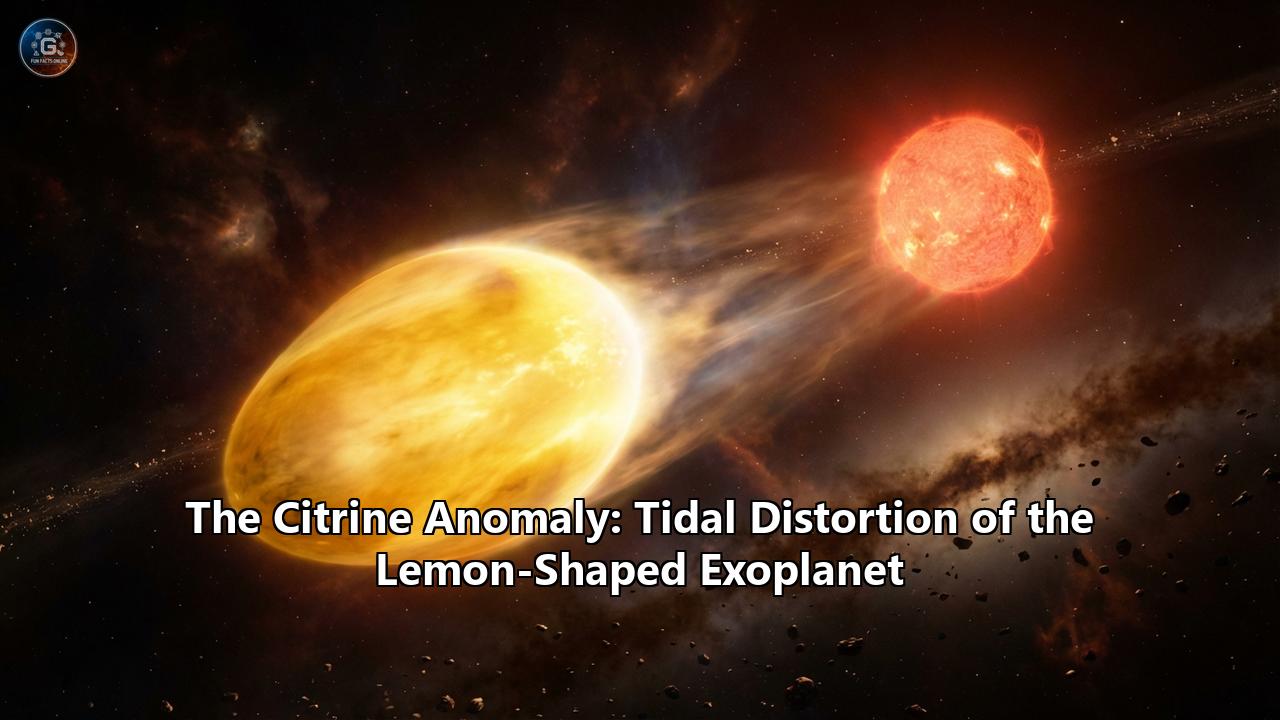
Introduction: The Shape of Things to Come
In the grand, silent gallery of the cosmos, planets have long been the spherical masterpieces of gravity. From the marble-like blue of Earth to the banded majesty of Jupiter, our conception of a "planet" has been inextricably linked to the sphere. It is a shape born of equilibrium, a geometric inevitability where mass pulls equally in all directions, smoothing out mountains and filling in valleys until a world settles into a hydrostatic roundness. But the universe, in its infinite capacity for surprise, has revealed a rebellion against this symmetry. Deep in the constellation of Hercules, some 1,800 light-years from where you sit reading this, lies a world that defies the spherical standard. It is a world stretched, pulled, and tortured by gravity into a form that resembles not a marble, but a rugby ball—or, more colloquially, a lemon.
This is WASP-103b, a gas giant that has become the protagonist of one of the most compelling detective stories in modern astrophysics. Dubbed the "Citrine Anomaly" by some for its spectral glow and its citrus-like geometry, this exoplanet offers more than just a visual oddity. It is a laboratory of extreme physics, a place where the polite tug-of-war of gravity we experience in our solar system becomes a violent, structural wrestling match.
For the first time in history, astronomers have detected the tidal deformation of a planet outside our solar system. This is not merely a measurement of size or mass; it is a measurement of shape, and through that shape, a measurement of the very soul of the planet—its internal rigidity, its density distribution, and its potential fate. The discovery of WASP-103b’s distortion forces us to rewrite the textbooks on planetary formation, tidal interaction, and the ultimate destiny of "Hot Jupiters."
In this comprehensive exploration, we will journey to the edge of the Roche limit. We will dissect the subtle flicker of light that betrayed the planet's secret form. We will delve into the arcane physics of "Love numbers"—parameters that quantify the squishiness of worlds. And we will confront the deepening mystery of WASP-103b’s orbit, which, against all predictions, appears to be drifting away from its star rather than spiraling into it.
Part I: The Discovery of the Citrine World
The WASP Legacy
To understand WASP-103b, we must first understand the lineage from which it hails. The "WASP" in its name stands for "Wide Angle Search for Planets," a ground-based consortium that has been one of the most prolific hunters of gas giants in the history of astronomy. Using an array of relatively small, robotic telephoto lenses, WASP monitors millions of stars, looking for the telltale dip in brightness that indicates a planet passing in front of, or transiting, its host star.
WASP-103b was first cataloged in 2014, identified as a "Hot Jupiter"—a class of exoplanets with masses similar to Jupiter but orbital periods of less than 10 days. But WASP-103b was extreme even among this extreme class. It is an "Ultra-Short Period" (USP) planet, whipping around its star in less than a single Earth day—approximately 22 hours.
The host star, WASP-103, is an F-type main-sequence star, hotter, larger, and more luminous than our Sun. The proximity of the planet to this blazing inferno is terrifying to contemplate. While Earth sits a comfortable 150 million kilometers from the Sun, WASP-103b orbits at a distance of less than 3 million kilometers. To put this in perspective, if WASP-103b were in our solar system, it would be orbiting inside the corona of the Sun, skimming the surface of the star with a speed that defies imagination.
The CHEOPS Revelation
For years, WASP-103b was just another data point in the growing catalog of Hot Jupiters. We knew its mass (about 1.5 times that of Jupiter) and its radius (almost twice that of Jupiter). We knew it was hot, likely glowing with a thermal emission of over 2,500 Kelvin. But the true nature of its geometry remained hidden in the noise of ground-based observations.
The breakthrough came with the launch of CHEOPS (CHaracterising ExOPlanet Satellite), a European Space Agency mission dedicated not to finding new planets, but to studying known ones with unprecedented precision. unlike Kepler or TESS, which stare at thousands of stars to find new dips, CHEOPS is a sniper. It points at a single star and stares with an unblinking, photometrically stable eye.
In 2020, a team of astronomers led by Susana Barros of the Instituto de Astrofísica e Ciências do Espaço in Portugal trained CHEOPS on WASP-103. They observed twelve separate transits of the planet. By combining this high-fidelity data with archival observations from the Hubble Space Telescope and the Spitzer Space Telescope, they achieved a signal-to-noise ratio that allowed them to see the shape of the transit curve in minute detail.
A spherical planet produces a specific "U-shaped" dip in light as it crosses the star. But a deformed planet—one that is elongated at the equator—produces a subtly different signature. Its projected area changes slightly as it rotates and moves across the stellar disk. The team looked for these minute deviations, and they found them. The data favored a deformed, ellipsoidal shape over a spherical one with a statistical confidence of 3-sigma.
The planet was not round. It was a rugby ball. It was a cosmic lemon.
Part II: The Physics of Squishiness
The Tidal embrace
Why is WASP-103b shaped like a lemon? The answer lies in the fundamental force of gravity, specifically the differential force we call tides.
We are familiar with tides on Earth. The Moon’s gravity pulls harder on the side of Earth facing it than on the center of Earth, and harder on the center than on the far side. This differential pull stretches the Earth slightly, creating a bulge of water (and solid rock) along the Earth-Moon line.
On WASP-103b, this effect is magnified by a factor of trillions. The planet is so close to its massive star that the gravitational pull on the "dayside" (the side facing the star) is significantly stronger than the pull on the "nightside." This colossal gradient creates a stretching force that overcomes the planet's own self-gravity—the force trying to pull it into a sphere.
The planet is effectively being spaghettified, though not to the point of destruction—yet. It is held in a state of hydrostatic equilibrium where the outward pressure of its hot gas and the inward pull of its gravity are balanced by the stretching force of the star. The result is a "triaxial ellipsoid," a shape defined by three axes: a long axis pointing toward the star, a shorter axis in the direction of motion, and the shortest axis passing through the poles.
The Love Number ($h_f$)
To quantify this deformation, astrophysicists use a dimensionless parameter with a surprisingly poetic name: the Love number. Named after the mathematician Augustus E. H. Love, who first described them in 1909 to model Earth's elasticity, Love numbers measure the rigidity of a planetary body and its susceptibility to tidal deformation.
There are different types of Love numbers ($k_2$, $h_2$, etc.), but in the context of the CHEOPS discovery, the team measured the fluid Love number, denoted as $h_f$.
- $h_f = 0$: A perfectly rigid body. Imagine a planet made of diamond or solid iron that refuses to deform no matter how hard you pull on it.
- $h_f = 1.5$: A perfect fluid body. A homogeneous ball of liquid or gas with no central concentration of mass, which deforms instantly and maximally in response to tidal forces.
- $h_f = 2.5$: A fluid body with inverted density (denser on the outside), physically impossible for stable planets.
Real planets fall somewhere between 0 and 1.5. A planet with a massive, dense core (like Earth) will have a lower Love number because the mass is concentrated in the center, making the outer layers "harder" to pull into a bulge. A planet that is "fluffy" throughout will have a higher Love number.
For Jupiter, the Love number is approximately 0.59. This value tells us about Jupiter's internal structure: it has a core, but it is largely a fluid body.
For WASP-103b, the CHEOPS team measured an $h_f$ of 1.59 ± 0.5.
This result is staggering. While the error bars are large (allowing for values between ~1.1 and ~2.0), the central value suggests that WASP-103b is extremely deformable. It behaves almost like a perfect fluid, perhaps even more so than Jupiter. This high Love number implies that WASP-103b might have a relatively small core compared to its total size, or that its internal atmosphere is so inflated and hot that it behaves with extreme fluidity.
Knowing the Love number allows us to do something akin to an MRI scan of the planet from 1,800 light-years away. It tells us that despite having 1.5 times the mass of Jupiter, WASP-103b is not just a denser version of our neighbor. It is "inflated"—puffed up by the intense heat of its star to a radius nearly twice that of Jupiter. This inflation makes the outer layers tenuous and easily dragged by the stellar gravity, contributing to the high deformation.
Part III: The Roche Limit and the Edge of Doom
To appreciate the precarity of the Citrine Anomaly, we must introduce the concept of the Roche Limit.
The Roche limit is the theoretical distance from a star (or any massive body) within which a second body, held together only by its own gravity, will disintegrate. Inside this limit, the tidal forces pulling the planet apart are stronger than the gravitational forces holding it together.
WASP-103b orbits at a distance that is less than 20% larger than its Roche limit. It is dancing on the edge of a volcano. If it were to move just slightly closer, the star would win the tug-of-war. The planet would cease to be a planet; mass would stream off its surface like a river, forming an accretion disk around the star before eventually being consumed.
This proximity is what gives WASP-103b its shape. The "surface" of the planet (defined by the photosphere where the gas becomes opaque) is nearly coincident with its Roche Lobe. The Roche Lobe is a teardrop-shaped region of space around the planet where the planet's gravity dominates. At the pointed end of the teardrop, facing the star, lies the First Lagrangian Point (L1). If the planet swells enough to fill this lobe, gas can spill through the L1 point and fall onto the star.
Comparative planetology gives us a grim forecast for worlds in this position. WASP-12b, another famous hot Jupiter, is known to be spiraling inward. Observations have confirmed that WASP-12b is losing mass and its orbit is decaying by about 29 milliseconds per year. It is a dying world, with perhaps only a few million years left before it is ripped apart.
Astronomers expected WASP-103b to follow the same tragic script. With such extreme tidal deformation, the friction generated inside the planet should be dissipating orbital energy rapidly. This "tidal dissipation" usually robs the planet of angular momentum, causing it to spiral inward.
But when the team analyzed the transit timing data for WASP-103b, they found something shocking.
Part IV: The Mystery of the Widening Orbit
In a plot twist worthy of a sci-fi novel, the data from CHEOPS, combined with older data, did not show orbital decay. It showed the opposite.
The orbital period of WASP-103b appears to be increasing.
This means the planet is drifting away from its star. In our solar system, tidal forces cause the Moon to drift away from Earth (at a rate of about 3.8 cm per year). This happens because Earth rotates faster than the Moon orbits; the tidal bulge on Earth gets dragged ahead of the Moon, and its gravity pulls the Moon forward, boosting its orbit.
However, for a Hot Jupiter like WASP-103b, this mechanism shouldn't work. The planet orbits in 22 hours, while the star rotates much more slowly (likely over several days or weeks). In this configuration, the tidal bulge on the star should lag behind the planet, creating a drag that slows the planet down and drops it into a lower orbit. This is the standard model of tidal decay that dooms worlds like WASP-12b.
So why is the Citrine Anomaly drifting away? Astronomers have proposed three main theories:
1. The Applegate Effect
The most leading non-gravitational theory is the Applegate Effect, named after James Applegate who proposed it in 1992 to explain period variations in binary stars. This effect links orbital changes to the magnetic activity cycle of the host star.
As a star goes through its magnetic cycle (like the Sun's 11-year cycle), the distribution of angular momentum within the star's interior shifts. Layers of the star may speed up or slow down, changing the star's "quadrupole moment"—essentially, its gravitational shape. This subtle change in the star's gravitational field can periodically alter the orbit of a close-in planet.
If the Applegate Effect is the cause, the "widening" of the orbit is likely temporary. Over a decade or two, as the star's magnetic cycle turns, the period might start decreasing again. This would mean WASP-103b isn't escaping; it's just wobbling in a long-term magnetic dance.
2. A Hidden Companion
The second possibility is the presence of a third body in the system—another star or a massive planet on a wider orbit. The gravity of this hidden companion could be tugging on the center of mass of the system, causing the transit times to vary in a way that mimics an orbital period increase (the "Light Travel Time Effect"). Or, it could be physically perturbing WASP-103b’s orbit.
3. Statistical Artifact
Science is a discipline of skepticism. The detection of the period increase is statistically significant, but it relies on data stretched over a relatively short baseline of a few years. It is possible that what looks like a trend is just noise or short-term jitter. However, given the precision of CHEOPS, this "boring" explanation is becoming less likely.
Part V: Atmosphere and Environment of a Lemon World
What would it be like to hover in the cloud tops of WASP-103b? "Hellish" is an understatement.
The Thermal Regime
The dayside of WASP-103b is tidally locked, permanently facing the star. Temperatures here soar to over 2,500 Kelvin (approx. 4,000°F). This is hotter than the melting point of most metals; iron would exist as a vapor in the upper atmosphere.
On the nightside, temperatures are cooler but still blistering. The heat distribution depends heavily on the atmospheric circulation. On spherical Hot Jupiters, we observe "super-rotating jets"—equatorial winds that scream around the planet at speeds of up to 7,000 kilometers per hour, carrying heat from the day side to the night side.
Circulation on a Deformed Sphere
But WASP-103b is not a sphere. Its rugby-ball shape introduces complex new variables into the equations of fluid dynamics.
On a spherical planet, the Coriolis force (caused by rotation) shapes the winds. On a triaxial ellipsoid, the varying radius of curvature means the effective gravity changes as you travel from the pole to the equator, and from the substation point (facing the star) to the terminator.
The "bulge" facing the star acts like a gravitational mountain. Winds trying to cross from the dayside to the nightside have to climb this geopotential hill. This could disrupt the super-rotating jets, potentially causing strange stationary waves or localized eddies that we don't see on rounder planets.
Furthermore, the deformation creates a phenomenon known as Gravity Darkening. Because the planet is elongated, the poles are closer to the center of mass than the "tips" of the rugby ball. According to von Zeipel's theorem, the regions with higher effective gravity (the poles) should be hotter and brighter, while the distended equator should be cooler and dimmer. This adds a "thermal stripes" effect to the already complex day-night temperature contrast.
The "Citrine" Glow
The name "Citrine" implies a yellow hue. Is this accurate?
Hot Jupiters are often thought of as dark blue (due to Rayleigh scattering, like Earth's sky) or pitch black (due to lack of reflective clouds). However, at 2,500 Kelvin, WASP-103b is radiating its own light. It behaves like a dim star (a brown dwarf). The thermal emission spectrum of a body at this temperature peaks in the infrared but bleeds into the visible red and orange.
Combined with the potential for silicate clouds (clouds made of sand/glass) or titanium oxide gas which absorbs blue light, the visual appearance of the planet to a human eye would likely be a glowing, ember-orange or deep yellow—a terrifying, bloated gemstone hanging in the void. The low geometric albedo measured (~0.13 or lower) confirms it is not a reflective mirror like Venus; it is a dark, glowing coal.
Part VI: Comparative Planetology – The Gallery of Grotesques
WASP-103b does not exist in a vacuum. To understand its anomaly, we must compare it to its siblings in the "Ultra-Hot Jupiter" family.
WASP-12b: The Dying Brother
WASP-12b is the closest analog. It is slightly larger than Jupiter and orbits in just 26 hours. As mentioned, its orbit is decaying. WASP-12b is so close that it is actively losing mass; it has a "tail" of gas streaming onto the star. It is darker than fresh asphalt, absorbing 94% of incident light. The key difference? WASP-12b is clearly dying. WASP-103b, with its widening orbit, seems to be fighting back.
WASP-121b: The Heavy Metal World
WASP-121b is another football-shaped world, confirmed via Hubble observations to be losing heavy metals like iron and magnesium into space. Its atmosphere is so hot that water molecules are torn apart (photodissociation) on the dayside, only to recombine on the nightside. It rains liquid gems (corundum/rubies) on the nightside. WASP-121b provides the best model for what the atmosphere of a deformed planet looks like, while WASP-103b provides the best constraint on the internal structure via the Love number.
Jupiter: The Control Group
Compared to these monsters, our Jupiter is a frozen, spherical marvel. Its rotation (9 hours) causes it to bulge slightly at the equator (it is an oblate spheroid), but this is due to spin, not tides. The fact that WASP-103b has a similar Love number to Jupiter suggests that despite the extreme heat and radiation, the fundamental "equation of state" (how matter behaves at high pressure) inside WASP-103b is not radically different from Jupiter. It is still a gas giant, just one living in a blast furnace.
Part VII: The Future of the Anomaly
The detection of WASP-103b's shape is just the beginning. The "Citrine Anomaly" has been flagged as a Priority 1 target for the James Webb Space Telescope (JWST).
JWST’s infrared capabilities will allow it to do two crucial things:
- Refine the Love Number: By measuring the "phase curve" (the brightness of the planet as it rotates) with higher precision, JWST can tighten the error bars on the Love number. This will tell us definitively if the planet has a large core or is "core-less."
- Map the Atmosphere: JWST can detect the spectral fingerprints of water, carbon monoxide, and perhaps more exotic species like gaseous titanium or vanadium. Seeing how these chemicals are distributed can validate models of "rugby ball circulation."
Beyond JWST, the European Space Agency’s PLATO mission (launching 2026) will study bright stars and their planets. It will be able to monitor the orbital period of WASP-103b over years, confirming whether the orbit is truly widening or if the Applegate Effect is just teasing us.
Conclusion: The Fluidity of Worlds
The Citrine Anomaly teaches us a humbling lesson about the universe. We often think of planets as solid, immutable objects—static stages upon which history plays out. But WASP-103b reveals that planets are dynamic, fluid things. They are drops of water held together by the fragile tension of gravity, easily molded by the hands of their parent stars.
This lemon-shaped world serves as a bridge between the study of planets and the study of stars. It blurs the line between a rigid body and a fluid stream. It challenges our understanding of tidal dynamics, showing us that even at the edge of destruction, a planet can defy the expected spiral into oblivion.
As we continue to stare into the constellation of Hercules, measuring the minute dimming of a distant star, we are not just mapping the galaxy. We are testing the limits of physics itself, watching how matter behaves when it is stretched to its breaking point, glowing like a hot coal in the dark, refusing—for now—to be round.
Glossary of Key Terms
- Love Number ($h_f$): A measure of a planet's rigidity. Lower numbers mean a rigid/solid planet; higher numbers (up to 1.5) mean a fluid/deformable planet.
- Roche Limit: The minimum distance a planet can approach its star before tidal forces rip it apart.
- Tidal Locking: When a planet rotates at the same speed it orbits, keeping one face permanently toward the star.
- Applegate Effect: Variations in a binary system's orbital period caused by the magnetic activity cycle of the host star.
- Transit Method: Detecting planets by measuring the dip in brightness as they pass in front of their star.
- Hot Jupiter: A gas giant planet with a mass similar to Jupiter but an orbital period of less than 10 days.
Data sources: Astronomy & Astrophysics (Barros et al., 2022), ESA CHEOPS Mission reports, NASA Exoplanet Archive.
Reference:
- https://www.cnet.com/science/scientists-discover-deformed-exoplanet-shaped-like-a-rugby-ball/
- https://www.inverse.com/science/egg-shaped-planet
- https://www.forbes.com/sites/jamiecartereurope/2022/02/08/found-the-first-squashed-planet-with-an-oval-shape-welcome-to-hellish-and-deformed-wasp-103-b/
- https://wasp-planets.net/2022/01/12/tidal-deformation-of-wasp-103b/
- https://www.youtube.com/watch?v=R2mitCp78Eg
- https://www.space.com/hot-jupiter-exoplanet-football-shape
- https://academic.oup.com/mnras/article/405/3/2037/967737
- http://www.astro.yale.edu/jwang/Project5.html
- https://en.wikipedia.org/wiki/Hot_Jupiter