
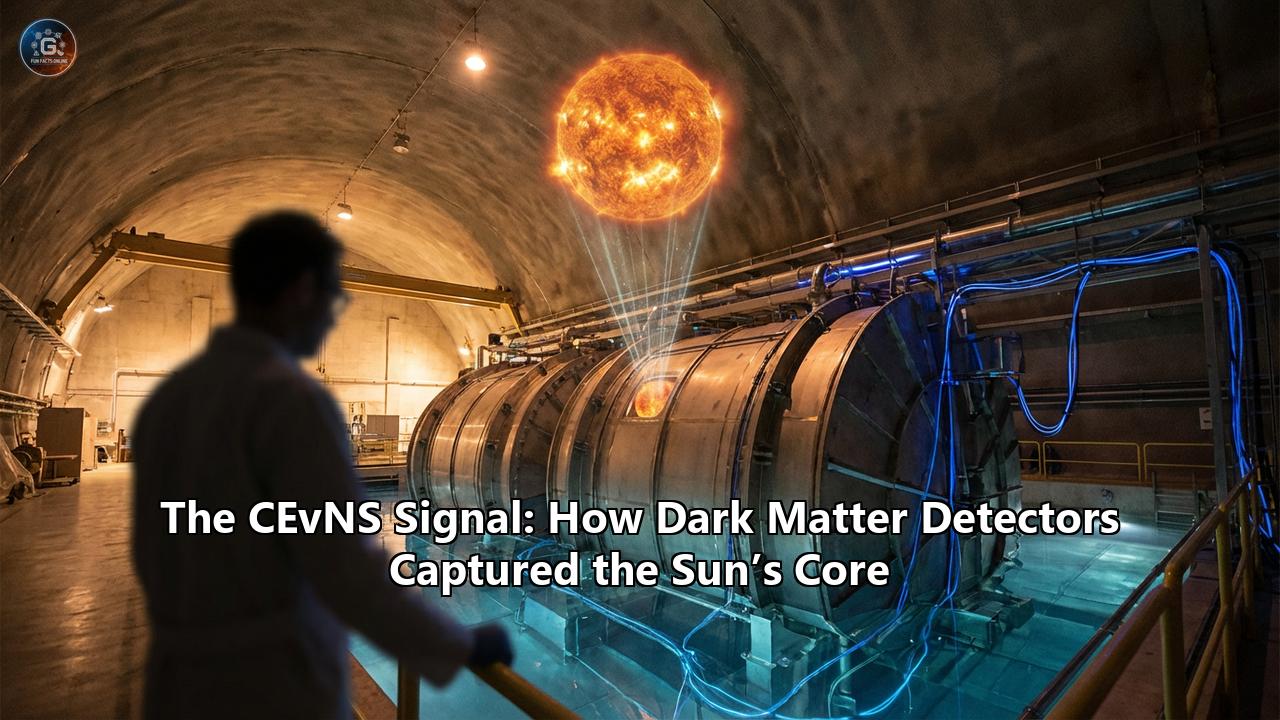
Deep underground, in caverns shielded from the cosmic rays that bombard the Earth’s surface, a quiet revolution has just occurred. It is a story of irony, engineering triumph, and the blurring of lines between two of the greatest mysteries in physics.
For decades, physicists have built ever-larger, ever-quieter detectors in a desperate game of hide-and-seek with Dark Matter—the invisible scaffold of our universe. They constructed vats of ultra-pure liquid xenon, cooled to cryogenic temperatures and buried beneath mountains, waiting for a hypothetical particle called a WIMP (Weakly Interacting Massive Particle) to bump into a xenon nucleus. They built these cathedrals of silence to listen for a whisper from the dark sector.
Instead, they heard the Sun.
As of December 2025, the leading dark matter experiments—LZ (LUX-ZEPLIN), XENONnT, and PandaX-4T—have not yet found the WIMP. But they have found something else: a ghostly signal from the heart of our own star, confirming a prediction made half a century ago and ushering physics into a new era known as the "Neutrino Fog."
This is the story of how the world’s most sensitive dark matter detectors became the world’s newest solar observatories, and what the detection of the CEvNS signal (Coherent Elastic Neutrino-Nucleus Scattering) means for the future of physics.
Part I: The Physics of the "Gentle Bump"
To understand the magnitude of this discovery, one must first understand the elusive nature of the neutrino and the violence of the mechanism used to catch it.
Neutrinos are the ghosts of the Standard Model. Born in the nuclear fires of stars, supernovae, and reactors, they travel at near light-speed and interact so weakly with matter that a light-year of lead would barely stop them. Trillions pass through your fingertip every second, leaving no trace.
For most of history, detecting a neutrino required a process akin to a head-on collision. A neutrino would strike a neutron or proton, transforming it into a different particle (inverse beta decay) and emitting a flash of light. This process, while reliable, is relatively rare and requires massive energies.
But in 1974, a physicist named Daniel Freedman predicted a more subtle interaction. He theorized that if a neutrino's energy was low enough (specifically, if its wavelength was comparable to the size of an atomic nucleus), it wouldn't just hit a single proton or neutron. Instead, it would "see" the entire nucleus as a single, coherent object.
Freedman predicted that the neutrino would bounce off the nucleus like a ping-pong ball hitting a bowling ball. The neutrino would fly off in one direction, and the heavy nucleus would recoil ever so slightly in the other. He called this Coherent Elastic Neutrino-Nucleus Scattering, or CEvNS (pronounced "sevens").
The "Coherent" part is the key. Because the neutrino interacts with all the nucleons (protons and neutrons) in sync, the probability of this interaction (the cross-section) is amplified by the square of the number of neutrons. For a heavy element like Xenon, which has around 77 neutrons, this amplification is massive. CEvNS should be the dominant way neutrinos interact with heavy matter.
There was just one problem: the "Elastic" part. When a ping-pong ball hits a bowling ball, the bowling ball barely moves. The energy transferred to the nucleus in a CEvNS event is infinitesimally small—a tiny heat vibration, a whisper of a signal that is easily drowned out by the noise of a single radioactive atom decaying nearby.
Freedman himself was pessimistic. In his original paper, he wrote: "Our suggestion may be an act of hubris, because the inevitable constraints of interaction rate, resolution, and background pose grave experimental difficulties."
For 43 years, he was right. It wasn't until 2017 that the COHERENT experiment at Oak Ridge National Laboratory finally observed CEvNS. But they did it using a particle accelerator, which produces intense, high-energy bursts of neutrinos that are easier to spot.
The Holy Grail remained uncaptured: detecting CEvNS from a natural source, specifically the lower-energy neutrinos produced by the Sun. To do that, you wouldn't need an accelerator. You would need the quietest place in the Universe.
Part II: The Cathedrals of Silence
This brings us to the "Big Three" of the dark matter hunt: LZ (South Dakota, USA), XENONnT (Gran Sasso, Italy), and PandaX-4T (Jinping, China).
These experiments are technological marvels known as Time Projection Chambers (TPCs). Though they are thousands of miles apart, their designs are remarkably similar, driven by the ruthless physics of background reduction.
Imagine a cylindrical tank filled with tonnes of liquid xenon. Xenon is chosen for a specific reason: it is a heavy, noble gas. "Noble" means it doesn't bond chemically, making it easier to purify. "Heavy" means it has a large nucleus—perfect for stopping WIMPs and, crucially, perfect for the CEvNS effect.
The principle of operation is elegant:
- The Interaction: A particle (be it a WIMP or a neutrino) strikes a xenon nucleus.
- The Flash (S1): The collision creates a prompt flash of scintillation light. Photomultiplier tubes (PMTs) lining the tank detect this instantly.
- The Charge (S2): The collision also knocks loose a few electrons. A strong electric field drifts these electrons to the top of the tank, where they are extracted into a gas layer, creating a second, brighter flash of electroluminescence.
By measuring the time delay between the S1 and S2 flashes, scientists can determine the depth of the event (Z-coordinate). By looking at the pattern of light on the top sensors, they can determine the X-Y position. This allows them to define a "fiducial volume"—a core section of the liquid xenon, far from the radioactive walls of the container, where the background noise is virtually zero.
But "virtually zero" wasn't good enough for CEvNS. To see the solar signal, these detectors had to achieve purity levels that border on the absurd.
- LZ (LUX-ZEPLIN): Located nearly a mile underground in the Sanford Underground Research Facility (the former Homestake gold mine), LZ holds 10 tonnes of liquid xenon. Its "veto" system is surrounded by a tank of gadolinium-loaded water to spot neutrons that could mimic dark matter.
- XENONnT: Situated deep inside the Gran Sasso mountain in Italy, it uses 5.9 tonnes of sensitive xenon. It features a novel neutron veto and a radon distillation column that scrubs radioactive radon atoms out of the liquid continuously.
- PandaX-4T: Located in the deepest laboratory in the world, under 2,400 meters of rock in the Jinping mountains of China, it utilizes 4 tonnes of xenon.
For years, these detectors stared into the darkness, filtering out cosmic rays, gamma radiation from the rock, and the internal hum of the detector components. They pushed the "noise" down so low that a new floor appeared.
Part III: The Solar Messenger (Boron-8)
The Sun is a nuclear fusion reactor. Deep in its core, protons are crushed together to form helium, releasing energy and neutrinos. The vast majority of these are "pp neutrinos," which are low energy and incredibly numerous.
But there is a rarer breed of solar neutrino, born from a side-chain reaction involving the element Boron. These are the $^{8}$B (Boron-8) neutrinos. They are energetic enough to cause a detectable recoil in a xenon nucleus, but rare enough that catching them requires immense patience.
The $^{8}$B flux is a critical number. It tells astrophysicists exactly what is happening in the localized, hottest part of the Sun's core. While experiments like Super-Kamiokande and SNO (Sudbury Neutrino Observatory) had measured these neutrinos before, they did so using different interactions (scattering off electrons or breaking apart deuterium).
Measuring $^{8}$B neutrinos via CEvNS provides an independent, pristine confirmation of the Standard Solar Model. It is a pure test of the weak nuclear force.
Part IV: The Race to the Fog (2024-2025)
The race to capture the Sun's core with a dark matter detector was a nail-biter that culminated in the results we see today in late 2025.
The Hints (2024):The first whispers came in mid-2024.
- PandaX-4T was the first to break the silence. In July 2024, the collaboration reported a "hint" of the signal. They observed events that looked exactly like CEvNS, with a statistical significance of roughly 2.64 sigma. In physics, 3 sigma is considered "evidence," and 5 sigma is a "discovery." 2.64 was tantalizing—a strong indication, but not a smoking gun.
- XENONnT followed closely. With their incredibly low background, they analyzed their data and found a similar excess of low-energy nuclear recoils. Their significance was around 2.73 sigma.
The physics community was buzzing. Two independent experiments, using different hardware in different parts of the world, were seeing the same thing. The "fog" was rolling in.
The Breakthrough (December 2025):The definitive moment arrived this week, in December 2025, with the release of the latest results from the LZ experiment.
LZ, having run for longer with a larger volume of xenon, finally smashed through the statistical threshold. The collaboration announced the observation of $^{8}$B solar neutrinos via CEvNS with a significance of 4.5 sigma.
While technically just shy of the "gold standard" 5 sigma for a standalone discovery, in the context of the previous PandaX and XENONnT results, this is accepted as conclusive confirmation. The combined weight of evidence is overwhelming.
LZ observed the tell-tale spectral shape: a pile-up of tiny energy depositions at the very bottom of the detector's sensitivity window (around 1 keV of recoil energy). The rate of these events matched the Standard Model's predictions for CEvNS almost perfectly.
We have now officially "seen" the Sun using the nuclei of a dark matter detector.
Part V: Entering the "Neutrino Fog"
Why is this triumph also a "problem"?
To a dark matter hunter, a neutrino is a nuisance. It is an impostor.
The signal produced by a CEvNS event—a single, low-energy nuclear recoil—is indistinguishable from the signal expected from a WIMP of a certain mass (specifically, WIMPs with masses around 6 GeV/c²).
For decades, we built better detectors to lower the background noise. We shielded them from rock radiation, we purified the xenon, we went deeper underground. We removed all the "controllable" backgrounds.
But you cannot shield a detector from neutrinos. They pass through the Earth as if it were glass.
Now that LZ, PandaX-4T, and XENONnT have reached the sensitivity to see solar neutrinos, they have hit the Neutrino Floor (now more accurately called the Neutrino Fog).
This means that for any future dark matter search in this mass range, the "background" is no longer zero. The background is the Sun itself. To find a WIMP now, we don't just need to see a signal; we need to see a signal on top of the neutrino signal. We have to subtract the Sun from our data.
This changes the statistics of discovery. We are no longer searching in the dark; we are searching in the glare of a neutrino headlight. To make a discovery in the Fog, detectors must become vastly larger and run for much longer to distinguish the subtle statistical excess of Dark Matter over the steady hum of solar neutrinos.
Part VI: The Silver Lining
However, characterizing this as merely a "background" does a disservice to the physics. We have effectively turned our dark matter detectors into multipurpose observatories.
- Solar Metrology: The precise measurement of the $^{8}$B flux helps resolve the "Solar Metallicity Problem"—a long-standing debate about the composition of the Sun.
- Supernova Watch: If a supernova were to occur in our galaxy today, these liquid xenon detectors would light up with CEvNS events. Because CEvNS is sensitive to all flavors of neutrinos (electron, muon, and tau) equally, they would provide a unique, unbiased view of the dying star's energy release, complementary to the water-based detectors like Super-Kamiokande.
- New Physics: Any deviation in the CEvNS rate could signal "New Physics." If neutrinos interact with quarks via some unknown force carrier (a "Z-prime" boson) or if they have a "non-standard interaction," the recoil rate would differ from the Standard Model prediction. The current results from LZ and its peers place strict limits on these exotic theories.
Part VII: What Comes Next?
The detection of solar CEvNS marks the end of the "background-free" era and the beginning of the "precision" era.
The next generation of detectors is already being designed. The collaborations are merging. XENON and DARWIN are joining forces, while LZ is looking toward a future scale-up. The goal is a massive, planetary-scale detector—XLZD (XENON-LUX-ZEPLIN-DARWIN)—which would contain perhaps 40 to 60 tonnes of liquid xenon.
XLZD will not just be a dark matter hunter; it will be a supreme neutrino observatory. It will be able to measure solar neutrinos with <1% precision, peer deeper into the Neutrino Fog to hunt for heavy WIMPs (where the fog is thinner), and search for the rarest nuclear decay in the universe (neutrinoless double beta decay).
Conclusion
In the winter of 2025, the physics community stands at a crossroads. We built machines to find the dark, and we found the light.
The detection of the Sun’s core by LZ, XENONnT, and PandaX-4T is a testament to human ingenuity. It confirms that the ghostliest interaction predicted by the Standard Model—the coherent bounce of a neutrino off a nucleus—is real and observable.
We have entered the Fog. It is thick and luminous with solar neutrinos. But rather than obscuring our view, it has given us a new set of eyes. The dark matter hunt has become more difficult, yes, but it has also become richer. We are no longer just looking for a new particle; we are listening to the heartbeat of the Sun, one atomic recoil at a time.
Reference:
- https://www.imperial.ac.uk/news/articles/natural-sciences/physics/2025/dark-matter-search-sets-new-limits-and-achieves-neutrino-breakthrough/
- https://news.liverpool.ac.uk/2025/12/08/lz-sets-a-worlds-best-in-hunt-for-dark-matter-and-gets-new-look-at-neutrinos-from-suns-core/
- https://www.brown.edu/news/2025-12-08/lz-dark-matter
- https://interactions.org/press-release/first-measurement
- https://noticias.uc.pt/en/articles/scientists-confirm-first-observation-of-solar-neutrinos-by-dark-matter-detector/
- https://research.rug.nl/files/1351781546/PhysRevLett.133.191002.pdf
- https://science.psu.edu/news/lz-hunt-dark-matter
- https://tdli.sjtu.edu.cn/en/post/14884
- https://www.physik.uzh.ch/en/groups/baudis/News/2024/XENONnT-cevns.html
- https://indico.global/event/12888/
- https://www.einpresswire.com/article/873589049/lz-sets-a-world-s-best-in-the-hunt-for-galactic-dark-matter
- https://indico-tdli.sjtu.edu.cn/event/2672/
- https://newscenter.lbl.gov/2025/12/08/lz-sets-a-worlds-best-in-the-hunt-for-galactic-dark-matter/