
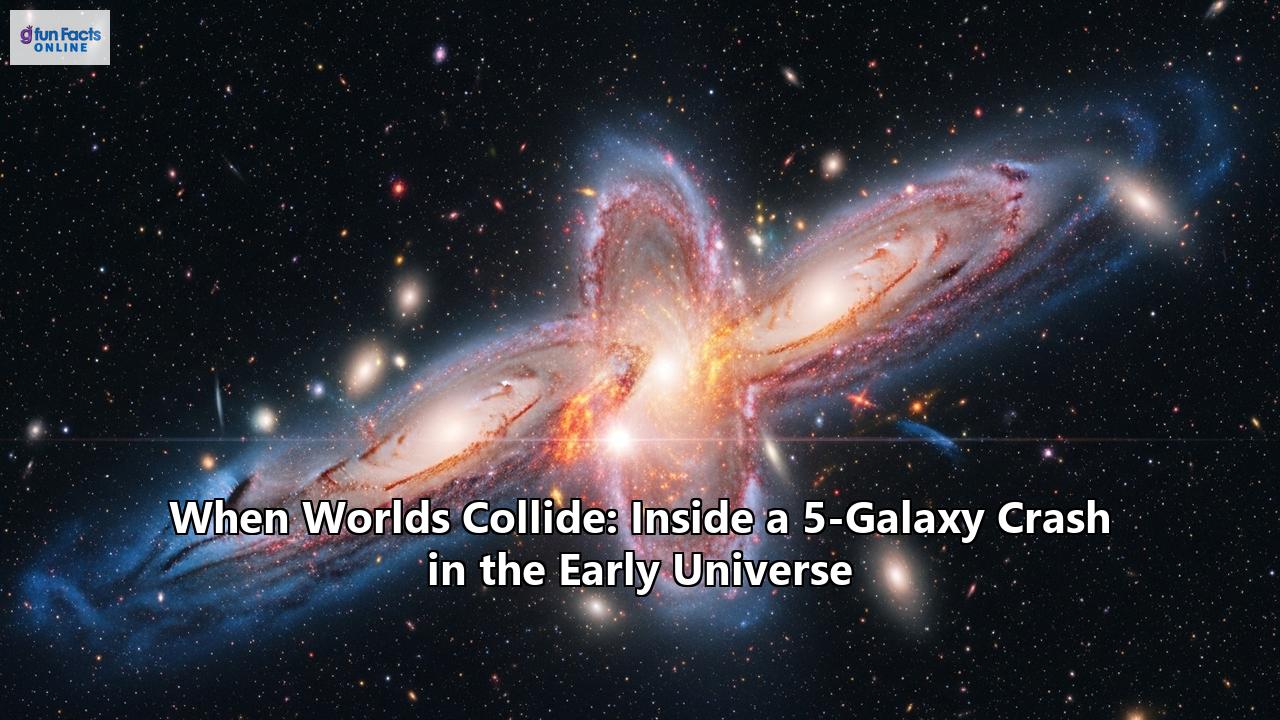
In the vast, silent expanse of the nascent cosmos, a drama of epic proportions unfolded. Imagine a time when the universe was but a fraction of its current age, a turbulent and chaotic epoch where the first stellar giants ignited, and the very building blocks of the cosmos were being forged. It is in this primordial darkness that astronomers have witnessed a breathtaking spectacle: the collision of not two, not three, but five galaxies, a cosmic car crash of monumental scale that offers a rare glimpse into the violent birth of the universe as we know it. This discovery, a testament to the power of modern astronomy, forces us to reconsider our understanding of how the grandest structures in the cosmos came to be.
The story of these colliding worlds takes us back to a time when the universe was a mere 800 million years old, a period shrouded in mystery and the faint, reddened light of the most ancient stars. It is here that the James Webb Space Telescope (JWST), with its unparalleled infrared vision, pierced through the cosmic dawn to reveal a system so rare, it has been nicknamed "JWST's Quintet." This is not merely a chance alignment of galaxies in the sky; these five stellar systems are physically bound, caught in a gravitational dance that will ultimately lead to their merger into a single, massive galaxy.
The discovery of such a complex and crowded galactic get-together so early in the universe's history is both a triumph and a puzzle. Finding a system of five interacting galaxies is an exceptionally rare event, challenging the predictions of current cosmological simulations. It suggests that the processes of galaxy assembly and the formation of massive structures may have been far more rapid and intense than previously thought.
But the tale of cosmic collisions in the early universe doesn't end with this quintet. Lurking even further back in time, at a point when the universe was about 1.4 billion years old, lies an even more astounding congregation of galaxies. Known as SPT2349-56, this is not just a handful of galaxies meeting, but a veritable cosmic pile-up, a protocluster containing at least 14, and possibly more, young, star-forming galaxies all hurtling towards each other in a region of space only about three times the size of our own Milky Way galaxy. The sheer density and frenzy of star formation within this structure are staggering, presenting a formidable challenge to our understanding of cosmic structure formation.
These two discoveries, the "JWST's Quintet" and the protocluster SPT2349-56, serve as cosmic laboratories, allowing us to witness the processes of galaxy evolution in their most extreme and formative stages. They are the archaeological sites of the cosmos, where the relics of the universe's youth are not cold, dead stones, but blazing, dynamic furnaces of creation. This article will delve into the heart of these cataclysmic events, exploring their discovery, their mind-boggling characteristics, and the profound questions they raise about the origins of the universe's grand design.
The JWST's Quintet: A Five-Galaxy Dance at the Dawn of Time
The James Webb Space Telescope, launched on Christmas Day 2021, was designed to be a time machine, capable of peering back to the very first flickers of light in the universe. One of its most remarkable findings to date is the direct observation of a compact group of at least five galaxies in the process of merging. This system, identified through a combination of data from JWST and the Hubble Space Telescope, is located at a redshift that corresponds to a time when the universe was just 800 million years old.
An Exceptionally Rare Find
The significance of this discovery lies in its rarity. While galaxy mergers are a fundamental aspect of the hierarchical model of galaxy formation, where smaller galaxies coalesce over time to form larger ones, finding a merger of this complexity so early in the universe is unexpected. Cosmological simulations, our primary tools for modeling the evolution of the universe, predict that such events should be exceedingly uncommon. The lead author of the study, Weida Hu, a postdoctoral researcher at Texas A&M University, emphasized the improbability of this discovery, suggesting that astronomers may have been "lucky" to have spotted it.
The system, more than just the five primary galaxies, also contains an astonishing 17 galaxy clumps within a large halo of gas. The presence of this encompassing halo, revealed by JWST's Near-Infrared Camera (NIRCam), is the smoking gun that proves these galaxies are not just a chance alignment but are physically interconnected and destined to merge.
The Violent Nursery of a Giant
The galaxies within JWST's Quintet are not placid islands of stars. They are undergoing a period of intense, "bursty" star formation, a characteristic feature of interacting galaxies. The gravitational tug-of-war between the merging galaxies triggers shockwaves and compresses vast clouds of gas, igniting a furious storm of star birth. The study of this quintet suggests that the immense mass and high rate of star formation within this system will likely lead to the creation of a massive, quiescent galaxy.
Quiescent galaxies are those that have ceased forming new stars, effectively becoming "dead" or "passive." The discovery of such "red and dead" galaxies in the early universe has been a long-standing puzzle for astronomers. How could galaxies run out of their star-forming fuel so quickly? The JWST's Quintet offers a compelling answer: the intense, rapid burst of star formation triggered by a massive merger could consume the available gas reservoir in a relatively short period, leading to the early quenching of star formation. This observation provides a direct link between the violent processes of galaxy mergers and the subsequent "death" of massive galaxies.
SPT2349-56: A Galactic Megalopolis Under Construction
If the JWST's Quintet is a chaotic five-car pile-up, then the protocluster SPT2349-56 is a full-blown, multi-lane highway catastrophe of cosmic proportions. Discovered by the South Pole Telescope and later studied in detail by the Atacama Large Millimeter/submillimeter Array (ALMA) and the Atacama Pathfinder Experiment (APEX), this structure is a behemoth in the making. It is located approximately 12.4 billion light-years away, meaning we are observing it as it was when the universe was only 1.4 billion years old.
A Starbursting Metropolis
SPT2349-56 is a dense concentration of at least 14 young, dusty, star-forming galaxies packed into a region of space only about three times the size of our Milky Way. The term "star-forming" is a dramatic understatement. The individual galaxies within this protocluster are churning out stars at rates up to 1,000 times that of our own galaxy. The combined star formation rate of the entire system is estimated to be a staggering 10,000 times that of the Milky Way.
This frenetic activity is fueled by a vast reservoir of cosmic gas. Recent observations have revealed a massive, previously hidden "fuel tank" of cool molecular gas surrounding the protocluster's core. This reservoir contains enough raw material to sustain the intense burst of star formation for an estimated 400 million years. This discovery of a significant amount of molecular gas outside of the individual galaxies was unexpected, as this gas is typically found concentrated within galaxies themselves.
A Challenge to Cosmological Models
The very existence of SPT2349-56 poses a significant challenge to our current understanding of how cosmic structures form. According to the standard hierarchical model, the formation of such massive galaxy clusters should be a gradual process, taking billions of years. However, SPT2349-56 appears to have assembled its immense mass remarkably quickly, in what astronomers describe as a "bit of a mystery."
Tim Miller, a lead author of one of the studies on this protocluster, noted, "How this assembly of galaxies got so big so fast is a bit of a mystery, it wasn't built up gradually over billions of years, as astronomers might expect." This rapid formation suggests that our models of the early universe may be incomplete, and that there may be mechanisms for accelerated structure formation that we have yet to fully comprehend.
The galaxies within SPT2349-56 are also of a specific type known as dusty star-forming galaxies (DSFGs), which are characterized by their high star formation rates and large amounts of dust. Finding so many of these galaxies, which are thought to have relatively short lifespans, shining at the same time is particularly puzzling.
The Birth of a Giant
Numerical simulations predict that the numerous galaxies in the core of SPT2349-56 will eventually merge into a single, gargantuan galaxy, known as a brightest cluster galaxy (BCG). This colossal galaxy will reside at the heart of what will become one of the most massive galaxy clusters in the present-day universe, similar in scale to the Coma Cluster.
The study of SPT2349-56, therefore, provides an unprecedented opportunity to witness the birth of a massive galaxy cluster and its central giant. By observing this system in its infancy, astronomers can test and refine their theories of galaxy evolution in the most extreme environments the universe has to offer.
The environment within this protocluster is also thought to be a breeding ground for supermassive black holes (SMBHs). The same dense gas that fuels the intense star formation is also expected to feed the growth of SMBHs at the centers of these galaxies. Indeed, observations with the Chandra X-ray Observatory have detected the presence of at least two active galactic nuclei (AGNs) within SPT2349-56, indicating that the central black holes in these galaxies are actively accreting matter. One of these AGNs is a radio-loud AGN, which is injecting a significant amount of energy into the surrounding medium, potentially influencing the future evolution of the entire cluster.
The Bigger Picture: Rethinking Galaxy Formation
The discoveries of the JWST's Quintet and the SPT2349-56 protocluster are not just isolated curiosities; they are key pieces of a larger puzzle that is forcing a re-evaluation of our models of galaxy formation and evolution. For decades, the dominant paradigm has been the hierarchical model, where small structures form first and gradually merge to create larger ones. While this model has been successful in explaining many aspects of the universe's large-scale structure, the existence of such massive and mature structures so early in cosmic history presents a significant challenge.
These findings lend weight to the idea of "downsizing," a phenomenon where the most massive galaxies appear to have formed their stars earlier and over a shorter period than less massive galaxies. This seems to contradict the purely bottom-up nature of the hierarchical model. The rapid collapse of large gas clouds, leading to intense starbursts, as suggested by the "monolithic collapse" scenario, may play a more significant role in the formation of the most massive galaxies than previously thought.
The intense, "bursty" nature of star formation observed in these early, massive galaxies may also explain another recent puzzle from the JWST. The first images from the telescope revealed galaxies in the early universe that appeared to be surprisingly massive and mature. However, new simulations suggest that these galaxies may not be as massive as they appear. Instead, their brightness could be due to these intense, short-lived bursts of star formation, making them appear more luminous and thus more massive than they truly are.
Furthermore, the very complexity of the universe, with its intricate web of galaxy clusters and vast voids, may have a more profound impact on cosmic evolution than our simplified models have accounted for. New mathematical models that incorporate this "lumpiness" of the universe are beginning to suggest that some of the current mysteries in cosmology, such as the "Hubble tension" (the discrepancy in measurements of the universe's expansion rate), might be resolved by properly accounting for the influence of these large-scale structures.
The Tools of Discovery: Peeking into the Cosmic Past
The ability to witness these ancient cosmic collisions is a testament to the remarkable technological advancements in astronomy. The discoveries of both the JWST's Quintet and SPT2349-56 were made possible by a suite of powerful telescopes, each playing a crucial role in piecing together the story.
The James Webb Space Telescope (JWST), with its large primary mirror and sensitivity to infrared light, is uniquely suited to observing the early universe. The light from the most distant galaxies is stretched to longer, redder wavelengths as it travels across the expanding universe, a phenomenon known as redshift. JWST's infrared instruments, such as the Near-Infrared Camera (NIRCam) and the Near-Infrared Spectrograph (NIRSpec), allow it to capture this faint, ancient light and analyze the properties of the first galaxies.
The Atacama Large Millimeter/submillimeter Array (ALMA), a collection of 66 radio telescopes in the Chilean Andes, has been instrumental in the study of SPT2349-56. ALMA is designed to detect the faint millimeter and submillimeter wavelength light emitted by cold gas and dust, the raw materials for star formation. It was ALMA's high-resolution observations that resolved the single smudge of light seen by earlier telescopes into a bustling metropolis of 14 individual galaxies.
The South Pole Telescope (SPT), a 10-meter telescope located at the Amundsen-Scott South Pole Station, played the initial role in identifying SPT2349-56. By scanning large areas of the sky at millimeter wavelengths, the SPT is adept at finding distant, dusty, star-forming galaxies and galaxy clusters.
Other telescopes, such as the Hubble Space Telescope, the Atacama Pathfinder Experiment (APEX), and the Chandra X-ray Observatory, have also provided crucial data, from optical imaging to X-ray detections of active galactic nuclei, contributing to a multi-wavelength understanding of these complex systems. The use of gravitational lensing, where the immense gravity of a foreground galaxy cluster acts as a natural magnifying glass, has also been employed to see even more distant objects.
The Future of Cosmic Archaeology
The discoveries of the JWST's Quintet and the protocluster SPT2349-56 have opened a new window into the chaotic and transformative youth of our universe. They have shown us that the formation of the grandest cosmic structures was a violent and accelerated process, a dramatic collision of worlds that laid the foundation for the universe we inhabit today.
As our telescopes become even more powerful and our theoretical models more sophisticated, we can expect to uncover more of these ancient cosmic crash sites. Each new discovery will provide another piece of the puzzle, helping us to refine our understanding of the fundamental processes that governed the birth and evolution of galaxies.
The study of these colliding worlds is more than just an academic exercise in astronomy. It is a journey back in time to our own cosmic origins. The atoms that make up our planet, our bodies, and everything we see around us were forged in the hearts of stars, stars that were born in galaxies that were themselves shaped by these titanic collisions. By witnessing these worlds collide in the distant past, we are, in a very real sense, witnessing the birth of our own cosmic heritage. The story of the universe is a story of creation through destruction, of order emerging from chaos, a story that is still being written in the faint, ancient light that travels across billions of years to reach our telescopes.
Reference:
- https://www.livescience.com/space/astronomy/james-webb-telescope-discovers-exceptionally-rare-5-galaxy-crash-in-the-early-universe
- https://www.sci.news/astronomy/two-massive-protoclusters-young-galaxies-early-universe-05948.html
- https://www.sciencealert.com/galaxy-megamergers-in-the-early-universe-protoclusters-spt2349-56-dusty-red-core
- https://www.eurekalert.org/news-releases/656539
- https://www.universetoday.com/articles/those-impossibly-massive-early-galaxies-might-just-be-surprisingly-bright
- https://kids.alma.cl/en/cosmic-traffic-accident-in-the-early-universe/
- https://scitechdaily.com/astronomers-detect-massive-clusters-of-galaxies-in-the-early-universe/
- https://www.space.com/the-universe/this-baby-galaxy-cluster-is-powering-extreme-star-formation-with-a-hidden-fuel-tank
- https://www.universetoday.com/articles/revolutionary-model-reveals-how-real-universe-structure-affects-cosmic-evolution
- https://academic.oup.com/mnras/article/512/3/4352/6449398
- https://science.nasa.gov/missions/webb/webb-reveals-early-universe-prequel-to-huge-galaxy-cluster/
- https://arxiv.org/abs/2301.01375
- https://arxiv.org/html/2505.04687v1
- https://arxiv.org/pdf/2505.04687
- https://eng.pressbee.net/show4185857.html?title=james-webb-telescope-discovers-exceptionally-rare-5-galaxy-crash-