
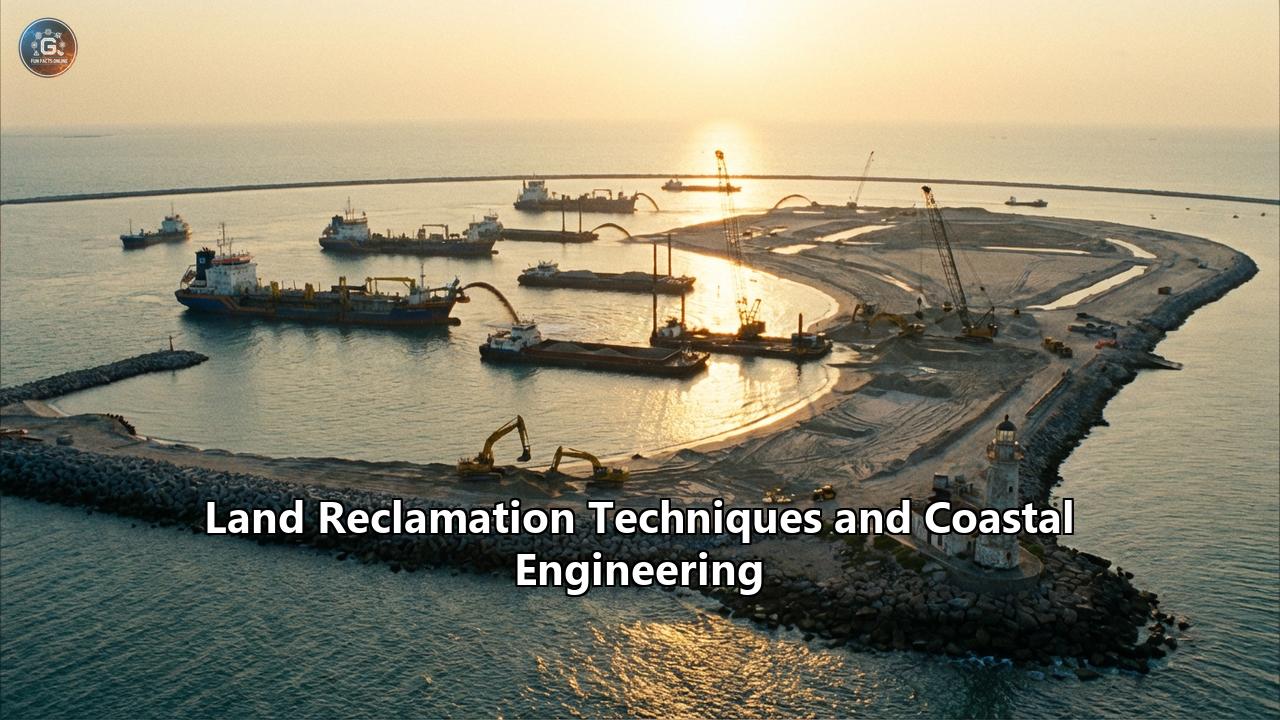
The ocean has always been humanity's most formidable boundary—a vast, fluid frontier that dictates where civilizations can settle and where they must stop. Yet, for millennia, we have refused to accept this limit. From the ancient dykes of the Netherlands to the glittering archipelagos of Dubai, land reclamation stands as one of the most audacious feats of civil engineering. It is the act of redrawing the map, of turning water into stone, and of claiming territory from the relentless grasp of the tides.
But this conquest is not without consequence. The interface between land and sea is a zone of high energy and profound ecological complexity. To build here requires not just brute force, but a deep understanding of fluid dynamics, soil mechanics, and environmental science. As we face a future of rising sea levels and exploding coastal populations, the science of land reclamation and coastal engineering has never been more critical. This is the story of how we build on the abyss.
Part I: The Physics of the Edge
Before a single grain of sand is dredged, the coastal engineer must understand the invisible forces at play. The coast is not a static line; it is a battlefield of energy transfer.
1. Hydrodynamics and Wave MechanicsThe primary antagonist in coastal engineering is the wave. Waves are not merely moving water; they are moving energy, traveling thousands of miles from their generation point. When a deep-water wave approaches the coast, it undergoes shoaling. As the seabed rises, the wave slows down, its wavelength shortens, and its height increases until it becomes unstable and breaks.
The energy released during breaking is immense. A single cubic meter of seawater weighs 1,025 kilograms. A storm wave crashing against a seawall delivers an impact force that can shatter unreinforced concrete like glass. Engineers use the Morison Equation and Linear Wave Theory to calculate these forces, ensuring that structures are designed not just for the average day, but for the "100-year storm"—a statistical event of extreme severity.
2. Sediment Transport and MorphologyThe coastline is in a state of constant flux. Waves striking the shore at an angle generate a longshore current, a river of water moving parallel to the beach. This current carries sand with it, a process known as longshore drift.
If an engineer builds a groin or a jetty without understanding this transport, they can destroy a coastline. By blocking the drift, sand accumulates on the "up-drift" side of the structure but is starved from the "down-drift" side, causing massive erosion. This phenomenon has plagued many early reclamation projects, where creating land in one spot caused the beach to disappear in another. Modern engineering relies on complex computational fluid dynamics (CFD) models to predict how every new structure will alter the flow of sediment.
3. The Geotechnical Nightmare: Soft ClayBuilding on land is easy; the ground is solid. Building in the sea is a geotechnical nightmare. The seabed is often composed of marine clay—a soft, high-plasticity soil that behaves more like yogurt than solid ground. It has high water content and low shear strength.
When a heavy load (like a new airport island) is placed on this clay, the water trapped inside the soil pores supports the weight initially. This creates "excess pore water pressure." Over time, this water slowly squeezes out, and the soil particles rearrange into a denser configuration. This process is called consolidation.
The problem is time. Consolidation in marine clay can take decades. If you build a runway on top of it too quickly, the land will sink unevenly—a phenomenon known as differential settlement—cracking the tarmac and warping buildings.
Part II: The Toolkit of Creation
How do we actually turn the sea into land? The methods vary from simple earth-moving to high-tech chemical stabilization.
1. Hydraulic Fill and "Rainbowing"The most iconic image of modern reclamation is the Trailing Suction Hopper Dredger (TSHD). These massive vessels act as giant vacuums, dragging a draghead along the seabed to suck up a mixture of water and sand (slurry).
Once the ship is full, it sails to the reclamation site. If the water is deep enough, it opens bottom doors to dump the sand. If the water is shallow, it connects to a floating pipeline or uses a bow jet to spray the sand in a high arc through the air—a technique poetically called "rainbowing."
This method allows for the rapid creation of massive land masses. The sand settles quickly, providing a stable base. However, this relies on the availability of "borrow areas"—seabeds with good quality, coarse sand. As global sand supplies dwindle, this method is becoming more expensive and controversial.
2. The Polder System (Empoldering)The Dutch approach is different. Instead of raising the land above the sea, they push the sea away.
A polder is a piece of low-lying land reclaimed from a body of water by building dikes (levees) around it and then pumping the water out. The land remains below sea level, kept dry by a perpetual system of pumps and canals.
This method is incredibly efficient for creating agricultural land because it preserves the nutrient-rich seabed soil. However, it is a high-risk game. If the dikes fail, the sea returns instantly. The Zuiderzee Works in the Netherlands, a project spanning the 20th century, created the province of Flevoland (the largest artificial island in the world) using this method, turning a saltwater inlet into a freshwater lake and vast tracts of farmland.
3. The Caisson MethodFor deep-water ports and breakwaters, pouring sand isn't enough; it would just wash away. Here, engineers use caissons—massive, hollow concrete boxes, often the size of apartment buildings.
These are constructed on dry land, floated out to sea, and then sunk into position by filling them with water or sand. Once settled on a prepared gravel bed, they form an instant, immovable wall. This technique is favored for constructing seawalls and heavy-duty wharves where vertical docking faces are needed for ships.
Part III: Ground Improvement – The Invisible Engineering
Dumping sand is the easy part. Making it strong enough to hold a skyscraper is where the true engineering lies. Freshly reclaimed land is loose and prone to liquefaction—where the soil turns to liquid jelly during an earthquake. To prevent this, the ground must be improved.
1. Vibro-CompactionThis was the secret weapon behind The Palm Jumeirah in Dubai. The island was built from loose sand which, in its natural state, would settle significantly and liquefy during a tremor.
To fix this, engineers used giant vibrating probes suspended from cranes. The probe penetrates the sand to depths of 12-15 meters. It vibrates radially, shaking the sand particles into a tighter, denser arrangement, while water jets at the tip help the probe descend. As the sand compacts, the ground level drops, and more sand is added from the top.
On the Palm, millions of cubic meters of sand were compacted this way, drilling over 200,000 holes to ensure the villas wouldn't slide into the Gulf.
2. Prefabricated Vertical Drains (PVDs)When reclaiming over soft clay (as opposed to sand), vibration doesn't work. You need to speed up the consolidation process (squeezing the water out).
PVDs are flat, plastic tubes with a grooved core wrapped in a filter fabric. They are stitched into the soft clay every 1 to 2 meters, creating millions of vertical highways for water to escape.
Once the drains are in, a heavy layer of temporary sand (surcharge) is placed on top. The weight squeezes the clay, and the water rushes out through the PVDs. What would take 50 years to settle naturally can be achieved in 6 to 12 months.
3. Deep Cement Mixing (DCM)This is the cutting-edge "non-dredge" solution, famously used in the Hong Kong International Airport Three-Runway System (3RS).
Traditionally, engineers would dredge up the soft, contaminated marine mud and dump it elsewhere—an environmental disaster. With DCM, the mud stays in place. Special barges lower mixing blades into the seabed, injecting cement slurry and churning it with the soft clay.
The result is a grid of cement-soil columns that look like a honeycomb. These columns are hard and strong, transferring the weight of the new land down to deeper, firmer soil layers without disturbing the surrounding marine ecology.
Part IV: Case Studies in Titans
To understand the scale of these challenges, we must look at the projects that defined the industry.
1. Kansai International Airport (Japan): The Sinking IslandIn the 1980s, Osaka needed a new airport but had no land and noisy neighbors. The solution: build an island 5km offshore in Osaka Bay.
The engineering challenge was immense. The seabed consisted of a 20-meter thick layer of soft alluvial clay, sitting on top of hundreds of meters of Diluvial clay. Engineers knew it would sink, but they underestimated how much.
They used sand drains (the predecessor to PVDs) to consolidate the upper layer. However, the deeper Diluvial layers began to compress in ways soil mechanics theory hadn't fully predicted.
Since opening in 1994, the island has sunk over 13 meters. The terminal building was designed with this in mind—it sits on adjustable "jack-up" columns. Sensors monitor the tilt, and hydraulic jacks insert metal plates to level the building, millimeter by millimeter. It is a constant battle against gravity, costing billions, but it keeps one of the world's busiest airports afloat.
2. The Palm Jumeirah (Dubai): Shaping the SeaIf Kansai was a battle for stability, The Palm was a battle for geometry. Sheikh Mohammed bin Rashid Al Maktoum wanted to double Dubai’s coastline. A simple round island wouldn't do it; a palm tree shape offered maximum beachfront.
The scale is staggering: 94 million cubic meters of sand and 5.5 million cubic meters of rock.
The breakwater, an 11km crescent, was the first line of defense. It uses a "dynamic revetment" design, allowing rocks to shift slightly with the waves rather than resisting them rigidly. Inside the crescent, the water needed to circulate to prevent stagnation. Engineers cut two 100-meter gaps in the breakwater to allow tidal flushing, ensuring the water remained blue and clear.
GPS technology was pushed to its limits. Dredgers were guided by satellites to spray sand with pinpoint accuracy, creating the curved fronds that are visible from space.
3. Hong Kong 3RS: The Green ReclamationHong Kong’s latest reclamation for its third runway faced a different constraint: the Chinese White Dolphin. Dredging up the seabed would release toxic plumes and destroy the dolphins' habitat.
The project adopted the Deep Cement Mixing (DCM) method on a massive scale. By stabilizing the contaminated mud in situ rather than removing it, they avoided the need for open-sea dumping.
To protect the dolphins further, they used "bubble curtains"—walls of air bubbles pumped from the seabed that absorb underwater noise from construction vessels, creating a silent zone for the marine life.
Part V: The Paradigm Shift – Building with Nature
For a century, coastal engineering was about "Holding the Line"—building higher walls and stronger dikes. But as sea levels rise, this "Hard Engineering" approach is becoming unsustainable. Walls reflect wave energy, scouring the beach in front of them and eventually undermining their own foundations.
The new philosophy is "Soft Engineering" or "Building with Nature."
1. The Sand Engine (De Zandmotor)In 2011, the Netherlands conducted a world-first experiment. Instead of replenishing their eroding beaches every five years with small amounts of sand, they dumped a massive volume—21.5 million cubic meters—in one location, creating a huge hook-shaped peninsula.
They then stepped back and let nature take over.
Wind, waves, and currents began to erode the "Sand Engine," spreading the sediment along the coast over the next 20 years. This natural distribution creates wider beaches and new dunes, providing robust flood defense and new habitats for seals and birds. It transforms the ocean from an enemy into a construction partner.
2. Mangroves as Bio-ShieldsConcrete seawalls are brittle; if they crack, they fail. Mangroves are living shorelines. Their dense, tangled root systems dissipate wave energy rather than blocking it. A 100-meter belt of mangroves can reduce wave height by up to 66%.
Engineers are now designing hybrid structures—"Eco-engineering"—where concrete seawalls are textured with crevices to encourage oysters and mangroves to grow on them. The oysters calcify, making the wall stronger over time, while the vegetation traps sediment, raising the land level naturally as sea levels rise.
Part VI: The Future – Floating Cities and Beyond
As our coastal megacities—New York, Jakarta, Shanghai—face the threat of submersion, reclamation may not be enough. The future might lie in Floating Structures.
Projects like Oceanix City (proposed for Busan, South Korea) envision modular, hexagonal platforms anchored to the seabed but free to rise and fall with the tides. These are not ships, but floating real estate, built from "Biorock" (conductive concrete that stimulates coral growth).
This is the ultimate evolution of coastal engineering: moving from claiming land from the sea to living on the sea itself.
Conclusion
Land reclamation is a testament to human ingenuity. We have learned to liquefy the earth and pour it into new shapes, to stitch the seabed with drains, and to turn mud into stone. But the lesson of the last century is that we cannot simply conquer the coast. The forces of the ocean are too vast, too relentless.
The future of coastal engineering lies not in fighting the sea, but in dancing with it—using the energy of the waves to build our defenses, and respecting the dynamic, fluid nature of the edge of the world. From the sinking islands of Japan to the sand engines of the North Sea, we are learning that the strongest wall is not made of concrete, but of understanding.
Reference:
- https://nespclimate.com.au/wp-content/uploads/2019/05/2.11-1_A4_4pp_Brochure_Eco-Engineering_NCCC_ESCC_Feb26_2020_WEB.pdf
- https://biomimicry.org.nz/mangrove-inspired-seawalls-a-biomimetic-approach-to-coastal-protection/
- https://env.threerunwaysystem.com/ep%20submissions/201607%20DPDCM/DPDCM_rev6.htm
- https://eu-opensci.org/index.php/ejeng/article/view/63188
- https://www.hongkongairport.com/en/sustainability/environment/greenest-airport-updates/Recognitions_for_3RS_Projects_sustainable_construction
- https://sfcs.cic.hk/en/BestPracticesHub/55
- https://en.wikipedia.org/wiki/Sand_engine
- https://dezandmotor.nl/en/about-the-sand-motor/