
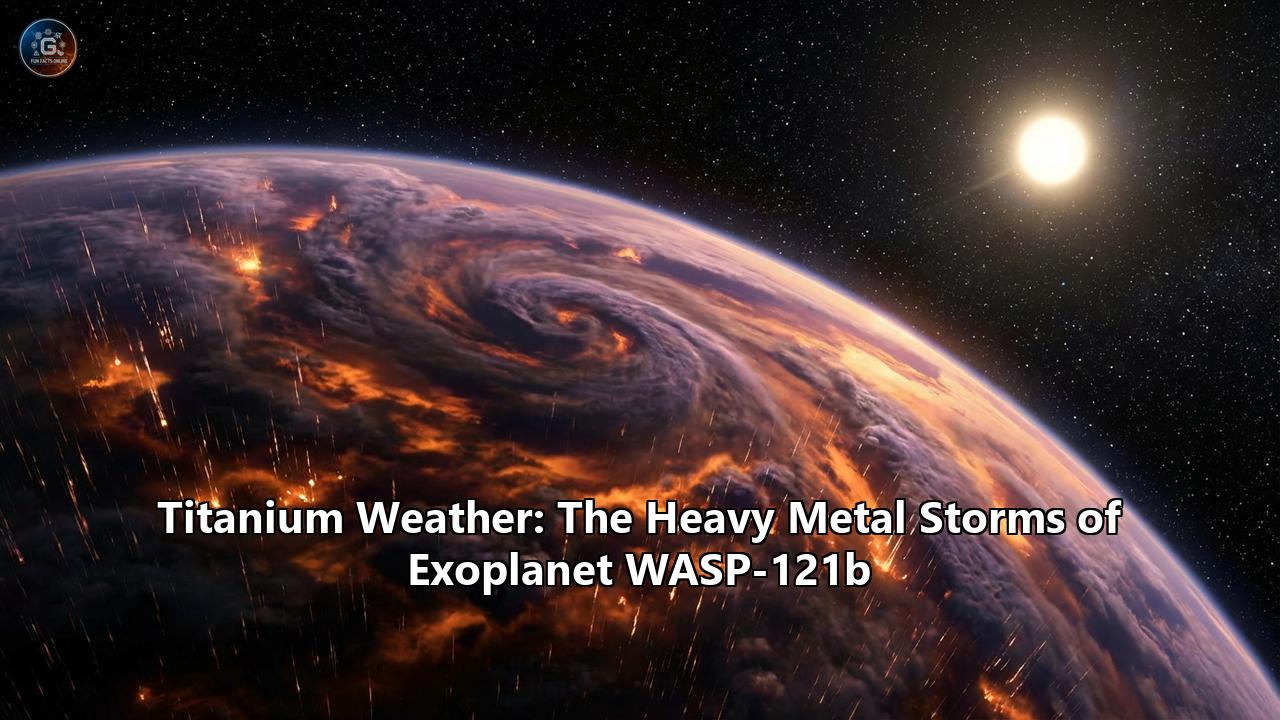
I. Introduction: The Impossible Planet
In the vast, silent theater of the cosmos, where stars burn in solitary splendor and galaxies spiral in the deep dark, there exists a world that defies the gentle imagination of Earth-bound poets. It is a world where the morning dew is made of liquid iron. It is a place where the clouds are not fluffy tufts of water vapor, but towering anvils of vaporized metal. And when the storms break on the dark side of this world, the rain that falls is not water, but a torrential downpour of liquid gemstones and molten titanium.
This is WASP-121b, a planet that astronomers have come to know as the "Heavy Metal" world. Located approximately 850 light-years away in the constellation Puppis, the Stern of the ship Argo, this exoplanet has become the Rosetta Stone for understanding the most extreme atmospheric physics in the universe. It is a "hot Jupiter"—a gas giant that orbits so close to its parent star that it teeters on the brink of destruction.
For years, WASP-121b was just another data point in the growing catalog of thousands of exoplanets. But recent breakthroughs, powered by the Hubble Space Telescope and the Very Large Telescope (VLT) in Chile, have peeled back the layers of its atmosphere to reveal a climate system so violent, so alien, and so chemically complex that it challenges our fundamental models of how planets work.
This is the story of Titanium Weather. It is a journey into a global storm that never ends, where winds scream at 11,000 miles per hour, and where the boundary between a planet and a star begins to blur. To understand WASP-121b is to understand the limits of nature itself.
II. The Anatomy of a Hellscape
To comprehend the weather on WASP-121b, one must first understand the geometry of its existence. In our solar system, Jupiter orbits the Sun at a comfortable distance of about 484 million miles, taking nearly 12 Earth years to complete a single circuit. It is a cold, majestic king, ruling its moons in the frigid outer reaches.
WASP-121b is Jupiter's twisted cousin. It orbits its host star, WASP-121—a bright, F-type star hotter and larger than our Sun—at a distance of just 2.4 million miles. This is not an orbit; it is a death spiral. The planet completes a full revolution once every 1.27 days (about 30 hours). If you were to stand on its surface (an impossible feat, as it has no solid surface), the star would dominate the sky, appearing colossal and terrifying, pouring radiation onto the planet with an intensity thousands of times greater than what Earth receives.
The Tidal Lock
This perilous proximity has a profound consequence: tidal locking. Just as our Moon always shows the same face to Earth, WASP-121b is gravitationally locked to its star. One hemisphere, the "dayside," faces the star in an eternal, blistering noon. The other hemisphere, the "nightside," faces the frozen void of space in perpetual darkness.
This dichotomy creates the engine for the planet's weather. The temperature difference between the two sides is staggering, though "cool" on WASP-121b is a relative term. The dayside roasts at temperatures exceeding 2,500 degrees Celsius (4,500 degrees Fahrenheit)—hotter than some small stars. It is so hot that water molecules cannot exist; they are ripped apart into their constituent atoms of hydrogen and oxygen. The nightside, by contrast, "cools" down to about 1,500 degrees Celsius (2,700 degrees Fahrenheit).
It is this fierce thermal gradient—the difference between the roasting day and the glowing night—that drives the winds. The planet is trying to equalize its temperature, sending superheated gas from the day side rushing toward the night side. But because the planet is spinning, these winds are whipped into ferocious jet streams that circle the equator, creating a global super-storm that never dissipates.
The Football Shape
The gravitational forces at play here are so immense that WASP-121b is not even a sphere. The tidal pull of the star stretches the planet into an egg or rugby-ball shape. The atmosphere is puffed up, "inflated" by the extreme heat, making the planet nearly twice the size of Jupiter despite having only about 20% more mass. Its outer layers are so loosely held that heavy metals like magnesium and iron gas are escaping into space, trailing behind the planet like a comet's tail.
III. The Chemistry of the Day: Molecular Shredding
On Earth, our weather is defined by the phase changes of water: solid ice, liquid water, and gaseous vapor. The energy source is the Sun, which gently warms our oceans and drives the cycle.
On the dayside of WASP-121b, the chemistry is driven by brute force thermal destruction. The radiation is so intense that the atmosphere behaves more like the outer layer of a star than the atmosphere of a planet.
The Dissociation Zone
Spectroscopic analysis—the study of light interacting with matter—has revealed that the dayside is a graveyard for molecules. Water (H2O), the most robust of atmospheric markers, is shredded. The photons from the star smash into the water vapor, breaking the chemical bonds and leaving behind free radicals of hydroxyl (OH) and singular atoms of hydrogen and oxygen.
But the destruction doesn't stop at water. Metals that we on Earth encounter only as solid ingots—iron, magnesium, vanadium, and chromium—are vaporized. On the dayside of WASP-121b, the air itself is a metallic smog. If you could breathe this atmosphere, you would be inhaling gaseous iron.
These metal vapors are excellent absorbers of UV and visible light. This creates a "stratosphere" on the planet—a layer where temperature increases with altitude, similar to Earth's ozone layer, but made of vaporized metals instead of ozone. This thermal inversion is one of the definitive signatures of "ultra-hot Jupiters," and WASP-121b is the prototype.
IV. The Nightside: Where Metal Rains
The real magic—and the horror—happens when these superheated, metal-rich winds scream across the planetary terminator (the line between day and night) and enter the dark hemisphere.
As the gas crosses into the eternal night, the temperature drops by over 1,000 degrees. While 1,500°C is still incredibly hot (hot enough to melt solid rock), it is below the condensation point for many of the refractory materials that were vaporized on the dayside.
The Gemstone Clouds
One of the most poetic discoveries regarding WASP-121b involves aluminum. On the dayside, aluminum exists as a gas. But on the nightside, it condenses. Chemical models suggest that the aluminum condenses with oxygen to form corundum (Al2O3).
On Earth, corundum is the mineral that forms rubies and sapphires. The color depends on trace impurities: a little chromium makes it a red ruby; a little iron or titanium makes it a blue sapphire.
Because the atmosphere of WASP-121b is rich in these "impurities"—vaporized iron, chromium, and titanium are everywhere—the clouds that form on the nightside are literally made of the stuff of gemstones. These are not solid crystals, however. The temperatures are likely too high for solids to form in the upper atmosphere. Instead, scientists believe the nightside is drenched in a rain of liquid gems.
Imagine a thunderstorm where the droplets are molten ruby and sapphire, falling from metallic clouds, glowing red and blue in the infrared dark.
The Titanium Revelation
For a long time, titanium was the missing puzzle piece. In ultra-hot Jupiters, titanium oxide (TiO) is expected to be a major player in atmospheric chemistry because it is a potent absorber of starlight. However, early observations of WASP-121b showed a puzzling lack of titanium in the upper atmosphere.
Recent high-resolution observations using the ESPRESSO instrument on the VLT solved the mystery and added a new layer of violence to the planet's reputation. The titanium wasn't missing; it was raining.
The study revealed that titanium is depleted in the upper atmosphere because it condenses so efficiently on the nightside. The winds carry the titanium gas away from the dayside. As it cools in the dark, it rains out of the sky, falling into the deeper, denser layers of the planet where it is trapped.
This "Titanium Weather" is the hallmark of WASP-121b. It represents a heavy metal cycle that mimics Earth's water cycle, but at temperatures that would vaporize a spacecraft. Iron, magnesium, and titanium evaporate on the hot side, blow to the cold side, condense into liquid rain, fall, and are eventually recycled back to the deep atmosphere or circulated back to the dayside to be vaporized again.
V. The 3D Weather Map: Cyclones and Jet Streams
Until very recently, our view of exoplanets was one-dimensional. We could tell what chemicals were there, but not exactly where they were or how they moved. That changed with the detailed study of WASP-121b.
By observing the planet for three full years and watching it pass in front of (transit) and behind (eclipse) its star, and measuring the "phase curve" (how the planet's brightness changes as it rotates), astronomers have constructed the first 3D weather map of an exoplanet's atmosphere.
The results are terrifyingly dynamic.
- The Equatorial Jet: The dominant feature is a massive jet stream that girdles the planet's equator. This wind roars eastward at speeds exceeding 17,000 kilometers per hour (about 5 kilometers per second). To put that in perspective, a bullet fired from a high-powered rifle travels at about 1 kilometer per second. The wind on WASP-121b is five times faster than a speeding bullet.
- The Shifting Hotspot: The hottest point on the planet is not the point directly beneath the star (the substellar point). Because the winds are so fast, they physically shove the heat to the east. The "hotspot" is shifted by several degrees, a tell-tale sign of the fierce atmospheric circulation.
- Cyclonic Storms: The 3D modeling suggests that the weather is not just a smooth flow. There are massive cyclones and storm fronts that form and dissipate. These are not like Earth's hurricanes, which are powered by water condensation. These are thermal storms, eddies of turbulence created by the collision of superheated gas and the slightly cooler nightside air.
- Vertical Verticality: The map reveals that the weather changes with altitude. The "rain" of gems and metals happens in specific layers. Above the clouds, hydrogen and helium escape into space. Below the clouds, the pressure mounts, and the heat becomes trapped, likely creating a magma-like ocean of supercritical fluid deep in the interior.
VI. How We Know: The Triumph of Spectroscopy
How can we possibly know that it rains liquid titanium on a planet 850 light-years away? We cannot see the planet as more than a dot, even with our best telescopes. The answer lies in the technique of transmission and emission spectroscopy.
Transmission Spectroscopy (The Silhouette)
When WASP-121b passes in front of its star, a tiny fraction of the starlight filters through the planet's atmosphere on its way to Earth. The atoms and molecules in the atmosphere absorb specific wavelengths of light, leaving dark "fingerprints" in the spectrum.
By analyzing this filtered light, astronomers found the fingerprints of water vapor, iron, magnesium, and vanadium. The "depth" of these fingerprints tells us how high in the atmosphere these elements are. If a fingerprint is missing (like titanium in the upper layers), it suggests the element has been removed—rained out.
Emission Spectroscopy (The Glow)
When the planet passes behind the star, we can measure the light of the star alone. By subtracting that from the light of the star plus the planet (just before it disappears), we can isolate the light emitted by the planet itself.
This "thermal emission" tells us the temperature of the dayside. By measuring how this light changes as the planet rotates (the phase curve), we can map the temperature of the nightside and detect the presence of clouds.
High-Resolution Doppler Shifts
The newest tool in the arsenal is high-resolution spectroscopy (like ESPRESSO). As the winds whip around the planet, the gas moves toward Earth (on one side) and away from Earth (on the other). This motion causes a Doppler shift in the light—the same effect that makes a siren change pitch as it passes.
By measuring these tiny shifts in the position of the spectral lines, astronomers clocked the wind speeds at 17,000 km/h. They literally measured the speed of the wind from 5 quadrillion miles away.
VII. Comparative Planetology: Earth, Jupiter, and the Ultra-Hot
WASP-121b serves as a dark mirror to our own solar system.
- Jupiter: Our Jupiter has bands of ammonia and water clouds. It is cold, governed by complex hydrodynamics but relatively "inert" chemistry compared to WASP-121b. Jupiter retains all its atmosphere.
- WASP-121b: This planet is losing its atmosphere. The UV radiation is so intense that the planet is "evaporating." This provides a glimpse into the future of many close-in planets—they may eventually be stripped down to their rocky cores, becoming "Chthonian planets."
- Earth: Earth's weather is a closed loop of water. It is gentle, life-sustaining, and chemically stable. WASP-121b’s weather is an open loop of destruction and reconstitution. It is sterilizing and chaotic.
However, studying WASP-121b helps us understand Earth. The same fluid dynamics equations that describe the trade winds in the Pacific Ocean describe the iron jets on WASP-121b. By testing our climate models in this extreme laboratory, we see where they break and how to fix them, making them more accurate for predicting climate change on Earth.
VIII. The Future: JWST and the ELT
The story of WASP-121b is far from over. The James Webb Space Telescope (JWST) and the upcoming Extremely Large Telescope (ELT) are poised to look even deeper.
JWST operates in the infrared, the perfect range for seeing heat and identifying complex molecules. Astronomers hope to use JWST to map the carbon-to-oxygen ratio on WASP-121b. This ratio is a cosmic fingerprint that tells us where the planet formed. Did it form far out, like Jupiter, and migrate inward? Or did it form in situ, right next to the fire? The ELT, with its massive 39-meter mirror, will be able to map the atmosphere with even higher resolution, perhaps detecting weather changes in real-time—watching a titanium storm front move across the face of the planet over the course of a single night.IX. Conclusion: The Heavy Metal Symphony
WASP-121b is a reminder that the universe is not limited by our local experience. It is a world of superlatives: the hottest, the windiest, the most metallic. It challenges our definitions of "weather." On Earth, a heavy metal storm is a loud concert. On WASP-121b, it is a literal meteorological event.
The discovery of titanium rains and liquid gem clouds captures the human imagination not just because it is scientifically significant, but because it is aesthetically overwhelmed. It paints a picture of a universe that is wilder, fiercer, and more beautiful in its terror than we ever dared to dream.
As we continue to gaze into the constellation Puppis, analyzing the faint photons that have traveled 850 years to reach us, we are doing more than measuring wind speeds and chemical abundances. We are witnessing the raw, chaotic power of planetary physics untethered. We are watching a world burning, evaporating, and raining jewels in the dark, spinning eternally in the heavy metal storm of the century.
Reference:
- https://www.advancedsciencenews.com/astronomers-track-weather-on-an-exoplanet-that-rains-gemstones/
- https://en.wikipedia.org/wiki/WASP-121b
- https://www.sci.news/astronomy/3d-structure-wasp-121b-atmosphere-13680.html
- https://science.nasa.gov/universe/exoplanets/nasas-hubble-observes-exoplanet-atmosphere-changing-over-3-years/
- https://www.astronomy.com/observing/the-alien-weather-of-wasp-121-b/
- https://www.extremetech.com/extreme/331932-it-rains-gemstones-on-this-sweltering-exoplanet
- https://www.space.com/metal-clouds-rain-hot-jupiter-exoplanet-wasp121b
- https://www.sciencealert.com/this-wild-planet-has-metal-clouds-and-rains-liquid-jewels
- https://www.qb50.eu/index.php/en/exoplanets-weather-includes-metallic-clouds-and-gem-rain
- https://www.youtube.com/watch?v=jdqbfffivJU
- https://www.seti.org/news/exploring-a-hot-jupiter-s-atmosphere/
- https://www.forbes.com/sites/elizabethhowell1/2022/03/02/hot-exoplanet-rains-gems-from-its-atmosphere/
- https://www.miragenews.com/scientists-discover-exotic-water-cycle-and-728766/
- https://www.space.com/wasp-121b-violent-winds-science-fiction
- https://www.bgr.com/science/scientists-observed-violent-titanium-rainstorms-on-an-alien-world/
- https://www.sci.news/astronomy/hubble-massive-cyclones-atmosphere-wasp-121b-12598.html
- https://www.space.com/hubble-space-telescope-hot-jupiter-exoplanet-storm