
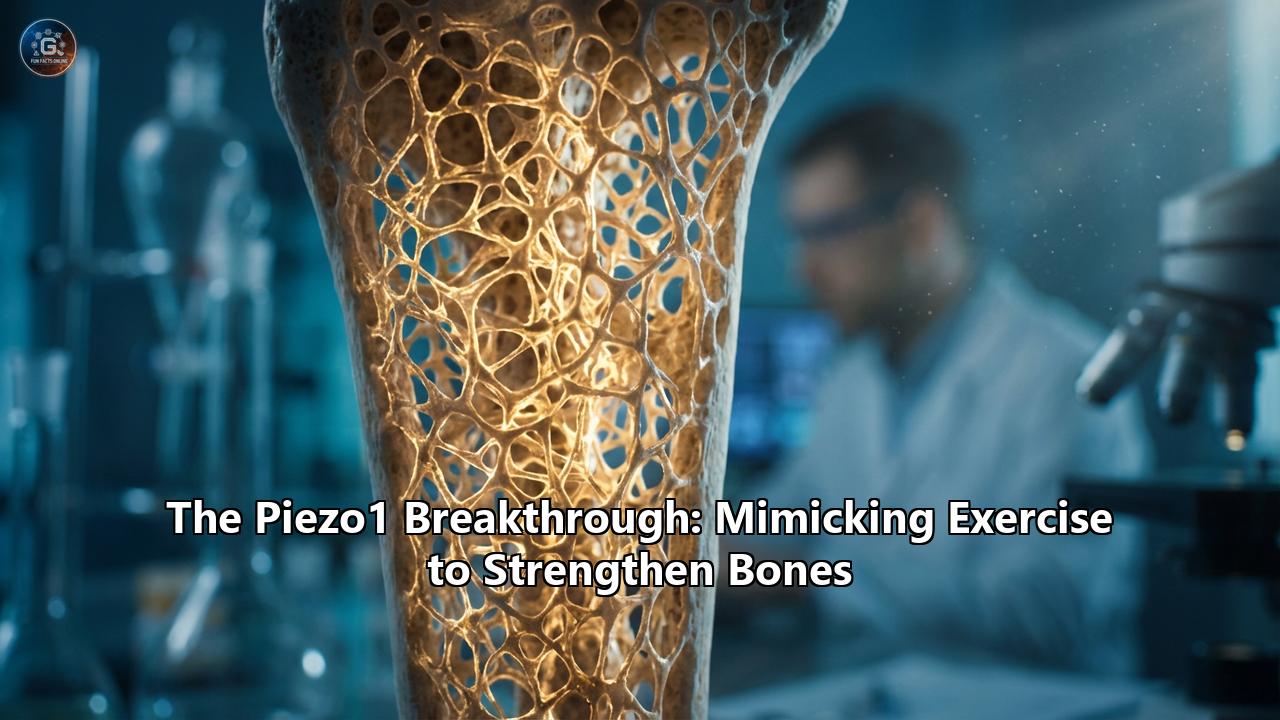
In the quiet hum of a research laboratory, a mouse sits motionless in a cage. It hasn’t run on a treadmill. It hasn’t climbed a tower. It hasn’t engaged in the vigorous resistance training that any personal trainer would prescribe for building strong, dense bones. Yet, deep within its skeletal structure, a remarkable transformation is taking place. Its femur is thickening, its marrow is shedding fat cells, and its structural density is rivaling that of a marathon runner.
This mouse is the harbinger of a medical revolution. It is living proof of a concept that has taunted scientists for decades: the "exercise mimetic"—a pharmaceutical intervention that tricks the body into believing it has performed physical work, reaping the benefits without the sweat.
For years, this concept was the stuff of science fiction or weight-loss infomercials. But in 2026, a breakthrough emerging from the University of Hong Kong (HKUMed) and collaborating international institutes turned the fiction into tangible biology. They didn't just find a drug; they found the switch. They identified a protein called Piezo1, a molecular sensor that translates the physical force of a foot hitting the pavement into the chemical signal that tells a bone to grow.
This is the story of that breakthrough. It is a journey that takes us from the macroscopic reality of an aging population facing a fracture epidemic, down to the atomic geometry of a three-bladed propeller protein spinning in the membrane of a stem cell. It is the story of how we might finally decouple the health of our bones from the mobility of our bodies, offering a lifeline to the bedridden, the elderly, and even astronauts venturing into the gravity-free void.
Part I: The Silent Crumbling
The Paradox of Modern Skeletal Health
To understand the magnitude of the Piezo1 breakthrough, one must first confront the crisis it aims to solve. The human skeleton is an engineering marvel, a scaffold of living tissue that is as dynamic as muscle or skin. It is not, as often visualized, a dry, calcified frame that stops changing once we hit adulthood. It is a construction site that never closes.
Every day, specialized crews of cells are at work. Osteoclasts excavate old, micro-damaged bone, dissolving the mineral matrix with acid. Osteoblasts follow in their wake, laying down fresh collagen and cementing it with calcium and phosphate. This cycle, known as remodeling, replaces our entire skeleton roughly every ten years.
However, this system relies on a critical input: mechanical load.
In the 19th century, German anatomist Julius Wolff formulated what is now known as Wolff’s Law. He observed that healthy bone adapts to the loads under which it is placed. If loading increases, the bone will remodel itself over time to become stronger to resist that sort of loading. If loading decreases, the bone will become less dense and weaker due to the lack of the stimulus required for continued remodeling.
For millions of years, this was an evolutionary advantage. It meant that resources weren't wasted building heavy bones for a creature that sat still. If you were active, you got strong bones; if you were sedentary, you conserved energy.
But in the 21st century, this evolutionary feature has become a bug. We are living longer than ever, yet we are moving less. The result is osteoporosis, a condition often called the "silent thief." It strips bone density away without symptoms until the sudden, catastrophic snap of a hip or a vertebra.
For the elderly, the link between mobility and bone health creates a vicious cycle. A senior citizen feels frail, so they move less to avoid falling. Because they move less, their bones receive fewer mechanical signals to stay strong. The bones thin, making them more likely to break. If they break a hip, they become immobilized, leading to rapid, severe bone loss. It is a physiological death spiral.
For decades, the only advice was: "Do weight-bearing exercise." But telling a paralyzed patient, a frail 90-year-old, or someone with severe arthritis to "jump rope" is not just ineffective; it is cruel.
Medicine needed a way to hack the system. We needed to send the signal "I am running" to the bone cells, without the person actually running. We needed to find the interpreter—the specific molecule that feels the impact of a step and translates it into the command: "Build bone."
Part II: The Nobel Connection
The Discovery of the "Sense of Touch"
The search for this molecular interpreter didn't start in a bone clinic. It started with a fundamental question about human existence: How do we feel?
We knew how we saw (photons hitting retinal cells). We knew how we smelled (chemicals binding to receptors). But the sense of touch—the ability to convert physical pressure into an electrical signal—was a black box.
Enter Ardem Patapoutian, a neuroscientist at Scripps Research. In the early 2010s, he and his team embarked on a painstaking quest to find the gene responsible for mechanosensation. They poked cells with a microscopic pipette, looking for an electrical spike. They silenced genes one by one, waiting for the cell to go numb.
After scanning dozens of candidates, they found it. When they silenced a specific gene, the cell no longer reacted to being poked. They named the protein Piezo1, from the Greek word píesi, meaning "pressure."
The discovery was seismic. It earned Patapoutian the 2021 Nobel Prize in Physiology or Medicine. Piezo1 was revealed to be a massive ion channel, shaped beautifully like a three-bladed propeller. When the cell membrane stretches (due to touch, blood flow, or muscle movement), the blades flatten, opening a central pore that allows calcium ions to rush into the cell.
It was the first true "mechanotransducer"—a biological machine that turns physics into chemistry.
Initially, the excitement focused on touch sensation and the regulation of blood pressure (Piezo proteins sense the stretch of blood vessels). But bone researchers sat up and took notice. If Piezo1 is the body's pressure sensor, could it be the mechanism behind Wolff’s Law? Is Piezo1 the reason exercise makes bones strong?
Part III: The HKUMed Breakthrough
Decoding the "Exercise Switch"
By 2024 and 2025, the hypothesis that Piezo1 was involved in bone health was floating in the academic ether. But it was the team at the University of Hong Kong (HKUMed), led by Professor Xu Aimin and Dr. Wang Baile, who provided the definitive proof and the mechanism in their landmark 2026 publication.
Their study focused on a specific population of cells: Bone Marrow Mesenchymal Stem Cells (BMSCs).
These stem cells are the "parents" of the skeletal system. They have a choice to make. They can differentiate into osteoblasts (bone builders) or they can differentiate into adipocytes (fat cells).
In a young, active person, the mechanical force of movement stimulates these stem cells to choose the "bone" path. But as we age or become sedentary, the stem cells increasingly choose the "fat" path. This is why the bones of elderly people are not just thin; they are filled with yellow marrow fat. This fat accumulation is toxic to the bone, releasing inflammatory signals that further degrade the skeleton.
The HKUMed team asked: Is Piezo1 the switch that controls this decision?
To find out, they engineered mice that lacked the Piezo1 gene specifically in their bone marrow stem cells. The results were stark. Even if these mice were young and otherwise healthy, their bones were frail and brittle. Worse, their marrow was packed with fat. Without Piezo1, the stem cells were "deaf" to the signals of movement. They defaulted to becoming fat cells, believing the body was in a state of permanent rest.
The researchers then did the reverse. They took sedentary mice—mice that did no exercise—and chemically activated their Piezo1 channels.
The result was the "exercise mimetic" effect. The stem cells in the sedentary mice stopped becoming fat and started building bone. The marrow adiposity vanished. The cortical bone thickened. The immune system, usually inflamed by the presence of marrow fat, calmed down.
The study revealed the precise molecular cascade:
- Mechanical Force (or chemical mimicry) hits the cell.
- Piezo1 Opens: Calcium rushes into the stem cell.
- The Signal: This calcium influx triggers a pathway (involving markers like YAP/TAZ and Wnt signaling) that screams "Build Bone!"
- The Suppression: Simultaneously, it suppresses the genes that say "Store Fat."
- The Result: Stronger bone, less marrow fat, without a single step taken on a treadmill.
Part IV: Enter Yoda1
The Molecule with the Force
To activate Piezo1 in their experiments, the scientists didn't use a tiny massage gun. They used a small molecule compound.
When Patapoutian’s lab first screened for chemicals that could open the Piezo1 channel, they found a potent agonist. In a nod to the wise, small, and powerful Jedi master from Star Wars, they named it Yoda1.
Yoda1 acts like a molecular wedge. It binds to the Piezo1 channel and lowers the threshold required for it to open. Essentially, it makes the channel hypersensitive. A channel that might normally require a hard stomp to open might, in the presence of Yoda1, open with the slightest fluid shift—or even open spontaneously.
In the HKUMed study, Yoda1 was the star. When injected into mice, it mimicked the effects of fluid shear stress (the physical force bone cells feel during impact). It tricked the stem cells into thinking the mouse was running a marathon.
This is the holy grail of "Exercise Mimetics." Most drugs work by inhibiting enzymes or blocking receptors. Yoda1 works by mechanically modifying a sensor. It is a drug that substitutes for physics.
The implications of the Yoda1 success in mice are staggering. It suggests that we can bypass the requirement for gravity and impact. For a bedridden patient, a Yoda1-based therapy wouldn't just stop bone loss; it could theoretically reverse it, turning the fatty, yellow marrow back into a bone-generating factory.
Part V: The Mechanics of the Miracle
How a Squeeze Becomes a Cell
To truly appreciate this breakthrough, we must zoom in to the cellular level. How does a mechanical force actually turn into a bone?
Bones are porous. Inside the hard cortical shell and the spongy trabecular mesh, there are millions of tiny fluid-filled channels called canaliculi. Living inside these caves are osteocytes (mature bone cells) and nearby are the mesenchymal stem cells.
When you walk, your bone slightly deforms—it bends. It’s microscopic, but it happens. This bending squeezes the fluid in the canaliculi. The fluid rushes past the cells.
This "fluid shear stress" is the trigger. The Piezo1 propeller blades on the surface of the cell are dragged by the flowing fluid. They twist and flatten.
Click. The channel opens.Calcium (Ca2+) is the cell's universal messenger. Its concentration outside the cell is thousands of times higher than inside. When Piezo1 opens, calcium floods in like water through a burst dam.
This calcium spike activates an enzyme called Calcineurin, which dephosphorylates a transcription factor called NFAT. Simultaneously, the structural changes activate the YAP/TAZ pathway—often called the "hippopotamus pathway" (biology names are whimsical). YAP and TAZ are mechanosensors that tell the nucleus: "Things are stiff and moving out here. Build structure."
These factors march into the nucleus of the stem cell and land on specific DNA sequences. They turn ON the genes for Runx2 (the master regulator of bone formation) and turn OFF the genes for PPAR-gamma (the master regulator of fat storage).
In the absence of this signal—in an astronaut floating in the ISS, or a grandmother in a wheelchair—the Piezo1 channel stays closed. The calcium tide is low. The YAP/TAZ factors degrade. The nucleus defaults to the "fat program." The stem cell becomes an adipocyte, filling the marrow space with lipids. These lipids secrete cytokines like RANKL, which actually summon the bone-eating osteoclasts.
It is a double whammy: No new bone is built, and the fat cells encourage the destruction of existing bone.
The Piezo1 breakthrough proves that this is not just "wear and tear." It is an active decision made by cells based on sensor input. And if the sensor is the problem, the sensor can be the solution.
Part VI: The Clinical Horizon
Who Will This Help?
The transition from a mouse study to a human therapy is the "Valley of Death" in pharmaceutical development. However, the specificity of the Piezo1 mechanism gives researchers hope. The potential applications are vast:
1. The Osteoporosis Epidemic:Current osteoporosis drugs fall into two camps: Antiresorptives (like bisphosphonates) which stop bone from being eaten, and Anabolics (like parathyroid hormone analogs) which build new bone. Antiresorptives often have side effects like "frozen bone" (where the jaw bone dies because it stops remodeling). Anabolics are expensive and require daily injections.
A Piezo1 activator offers a third path: Restoring the natural "exercise" signal. It targets the root cause of age-related bone loss—the stem cell's drift toward fat. It could be the first drug to truly rejuvenate the bone marrow environment.
2. The Bedridden and Paralyzed:For patients with spinal cord injuries, bone loss is rapid and severe. Their legs, sensing no weight, dissolve. This leads to fractures from minor bumps, known as "fragility fractures." A Piezo1 agonist could maintain their bone density at "walking levels" despite their paralysis.
3. Space Travel:NASA and ESA have struggled with bone loss since the Apollo missions. In microgravity, there is no "load." Astronauts lose 1% to 2% of their bone mass per month in space—a rate ten times faster than severe osteoporosis. They exercise for two hours a day on the ISS, strapped to bungee cords, but it's not enough. A "Yoda Pill" could be standard issue for the Mars mission, chemically substituting for the gravity of Earth.
4. Fracture Healing:Bones heal faster when they are loaded. That’s why doctors tell you to walk on a cast once the break is stable. For complex fractures or "non-unions" (breaks that won't heal), local injection of a Piezo1 activator could jumpstart the remodeling process, simulating the mechanical stress needed to knit the bone back together.
Part VII: The Challenges Ahead
Taming the Propeller
If Yoda1 is so miraculous, why aren't we taking it today?
The challenge lies in the ubiquity of Piezo1. This protein is not just in bone. It is in our skin (sensing touch), our bladder (sensing fullness), our lungs (sensing inflation), and critically, our red blood cells and blood vessels.
In red blood cells, Piezo1 regulates volume. Too much activation can cause the cells to dehydrate and shrivel, leading to anemia. In blood vessels, Piezo1 senses blood pressure. Systemic activation of Piezo1 could potentially wreak havoc on blood pressure regulation or cause vascular inflammation.
The HKUMed study and others have noted that systemic administration of Yoda1 in mice seemed safe in the short term, but a human therapy will likely need to be targeted.
This is the next frontier of the research:
- Bone-Targeted Delivery: Can we attach the Piezo1 activator to a molecule that only sticks to bone mineral (like tetracyclines or bisphosphonates)? This would deliver the drug strictly to the skeleton, sparing the heart and blood cells.
- Nanoparticles: Encapsulating the drug in nanoparticles that are taken up specifically by bone marrow stem cells.
- The "Yoda2" Quest: Researchers are currently synthesizing derivatives of Yoda1 (dubbed Yoda2, Jedi, etc.) to find versions that are more specific to the bone-variant of the signaling pathway or have better pharmacological properties.
Part VIII: The Broader Context
The Era of "Mimetics"
The Piezo1 breakthrough sits at the vanguard of a larger shift in medicine: the move toward Exercise Mimetics.
For a long time, we treated diseases by attacking pathogens or supplementing deficits (insulin for diabetes). But we are now realizing that the most powerful "drug" we have is our own behavior—specifically, physical activity. Exercise changes the expression of thousands of genes. It lowers inflammation, improves cognition, strengthens bone, and regulates metabolism.
We are now identifying the molecular handles that exercise pulls.
- AICAR and GW501516 were early attempts to mimic exercise in muscle (activating AMPK and PPAR-delta).
- Irisin is a hormone released by exercising muscle that turns white fat into healthy brown fat.
- Piezo1 is the handle for bone.
The goal is not to replace exercise for the lazy. No pill will ever replicate the cardiovascular, mental, and social benefits of a morning run. But for those who cannot run—the sick, the aged, the broken—these mimetics are not a luxury; they are a necessity.
Part IX: A Future Without Frailty?
Imagine a future twenty years from now. A 75-year-old woman trips on a rug. In 2026, this might result in a hip fracture, surgery, pneumonia, and a loss of independence.
In 2046, perhaps she has been taking a quarterly "Skeletal Signal Booster"—a bone-targeted Piezo1 agonist. Her stem cells, despite her age, have been receiving a chemical hum of "activity." Her marrow is red and rich in osteoblasts, not yellow with fat. Her femur is dense. She trips, she falls, she bruises... and she stands up.
The discovery of Piezo1 and the validation of its role as the exercise switch is more than just a biological curiosity. It is a fundamental unmasking of the code of life. It reveals that our bodies are listening to the world around them, waiting for the pressure, the impact, the squeeze that tells them: "We are here. We are moving. We must be strong."
Thanks to the work of the teams at HKU, Scripps, and labs around the world, we have finally learned how to speak that language. We have found the words to tell our bones to stay young, even when our legs can no longer carry the weight.
Part X: Conclusion
The journey from Ardem Patapoutian’s Nobel-winning discovery of a touch sensor to a potential cure for osteoporosis is a testament to the power of basic science. We didn't set out to cure bone loss; we set out to understand how we feel a hug. But biology is efficient. It uses the same tools—the same beautiful, three-bladed propellers—to feel a gentle touch on the skin and the heavy impact of a stride in the bone.
The "Piezo1 Breakthrough" is a mimetic of hope. It promises a world where the physical decline of aging is not inevitable, where the strength of our skeleton is not solely dictated by the mobility of our muscles. By mimicking the mechanics of life, we may just extend the quality of it for millions. The exercise pill for bones is no longer a fantasy; it is a molecule, sitting in a lab, waiting to be refined into a cure.
Reference:
- https://scitechdaily.com/breakthrough-bone-discovery-could-lead-to-exercise-in-a-pill-for-osteoporosis/
- https://pmc.ncbi.nlm.nih.gov/articles/PMC6685704/
- https://www.researchgate.net/figure/Piezo1-activation-in-osteoblasts-induces-the-expression-of-mechanoresponsive-genes-A_fig1_345777833
- https://www.naturalnews.com/2026-01-02-exercise-sensor-builds-bone-strength-without-physical-activity.html
- https://www.fchampalimaud.org/news/meet-ardem-patapoutian-who-discovered-molecules-root-our-exquisite-sense-touch-and-won-nobel
- https://pmc.ncbi.nlm.nih.gov/articles/PMC8733883/
- https://www.miragenews.com/hkumed-reveals-exercises-role-in-bone-strength-1597766/
- https://www.nobelprize.org/uploads/2024/11/patapoutian-lecture.pdf
- https://elifesciences.org/articles/49631
- https://profiles.wustl.edu/en/publications/stimulation-of-piezo1-by-mechanical-signals-promotes-bone-anaboli/
- https://www.researchgate.net/publication/397101627_Piezo-type_mechanosensitive_cation_channel_1_in_bone_biomechanics_and_its_multidimensional_distribution_characteristics_in_skeletal_tissue
- https://www.mdpi.com/1422-0067/22/12/6429