
An Unveiling of Cosmic Proportions: What Interstellar Messengers Reveal About the Galaxy
For millennia, humanity has gazed at the night sky, a canvas of celestial bodies confined to our own solar system. We have studied our planetary neighbors, charted the courses of comets, and analyzed the composition of asteroids, all born from the same primordial cloud of gas and dust as our Earth. But what if a traveler from a distant star system were to pay us a visit? What secrets could such a cosmic messenger unveil about its far-flung home? This once-hypothetical scenario became a breathtaking reality in 2017, ushering in a new era of astronomical discovery. The detection of the first interstellar object, and subsequent visitors, has shattered the confines of our solar system, offering us tantalizing glimpses into the nature of worlds beyond our own.
These celestial nomads are more than mere curiosities; they are time capsules, carrying with them the chemical blueprints of their birthplaces. By studying their trajectories, compositions, and behaviors, we can begin to piece together the puzzle of planet formation in other star systems, compare the building blocks of alien worlds to our own, and perhaps even ponder the possibility of life's ingredients traversing the cosmic ocean. This article delves into the captivating stories of these interstellar interlopers, exploring the mysteries they have presented, the groundbreaking science they have inspired, and the thrilling future of a field that promises to redefine our place in the galaxy.
The Dawn of a New Era: The Discovery of Interstellar Objects
The concept of objects wandering between the stars has long been a theoretical staple in astronomy. Models of our own solar system's formation predict that a vast number of planetesimals—the small bodies that coalesce to form planets—were ejected into interstellar space through gravitational interactions with the giant planets, particularly Jupiter. It stood to reason that if our solar system flung its early building blocks into the void, so too would other planetary systems. The space between stars, therefore, is likely teeming with billions upon billions of these cosmic castaways.
For decades, however, the detection of these objects remained beyond our technological grasp. Interstellar visitors were expected to be small, faint, and moving at incredible speeds, making them exceedingly difficult to spot against the backdrop of the cosmos. That all changed on October 19, 2017.
A Messenger from Afar: 1I/ʻOumuamua
On that fateful day, the Panoramic Survey Telescope and Rapid Response System (Pan-STARRS1) in Hawaii, a NASA-funded observatory tasked with finding potentially hazardous near-Earth objects, detected a faint point of light streaking across the sky. Canadian astronomer Robert Weryk, while reviewing the observatory's data, was the first to identify the object. Initially designated A/2017 U1, it was its trajectory that immediately set alarm bells ringing in the astronomical community.
Unlike the elliptical orbits of asteroids and comets bound to our sun, this object followed a steeply hyperbolic path. This meant it was moving too fast to be captured by the sun's gravity, a clear indication that it was not from our solar system. This was it—the first confirmed interstellar object. In honor of its discovery in Hawaii, it was given the name ʻOumuamua, a Hawaiian term meaning "a messenger from afar arriving first."
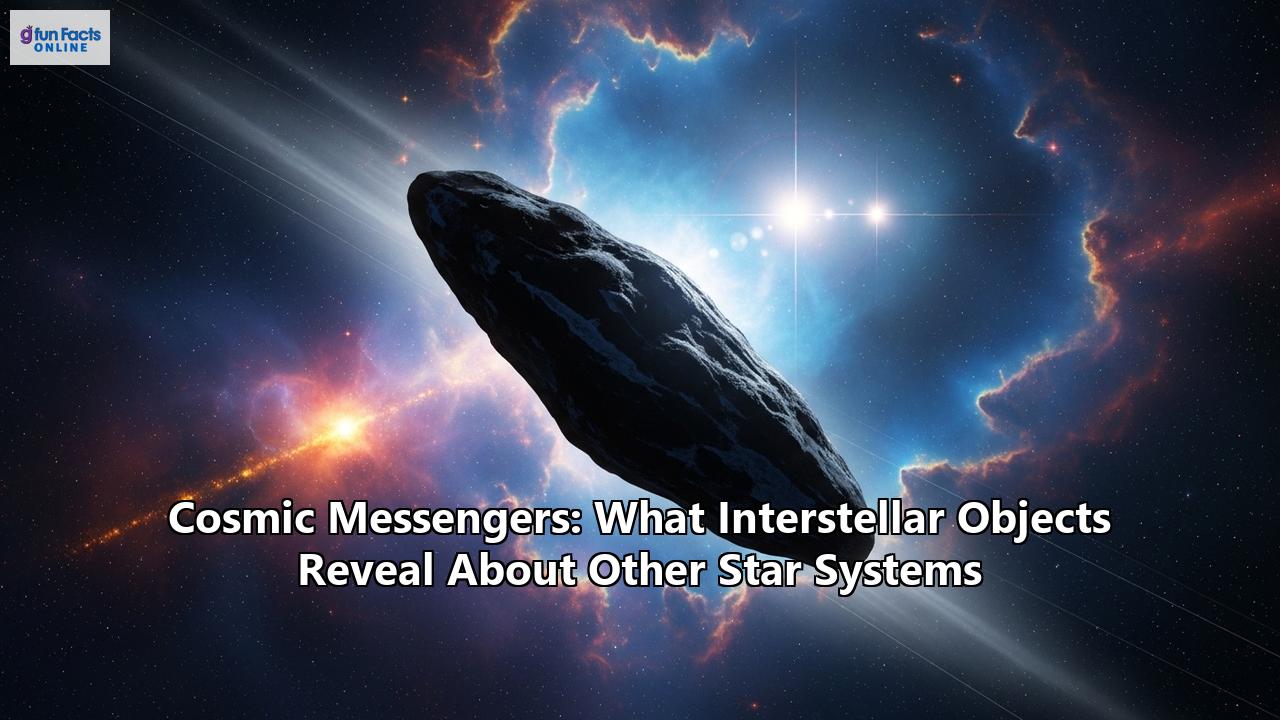
ʻOumuamua was a celestial enigma from the very beginning. As telescopes around the world scrambled to observe it before it faded into the interstellar distance, a picture of a truly bizarre object began to emerge. Its brightness varied dramatically and rapidly, suggesting a highly elongated, cigar-like or pancake-like shape, perhaps ten times longer than it was wide. This was unlike any known asteroid or comet in our solar system.
Further compounding the mystery was its behavior. While its trajectory showed a slight non-gravitational acceleration—a gentle push away from the sun—it lacked any visible signs of a cometary tail or outgassing. This "rocket effect" is common in comets, where the sun's heat vaporizes ices, but the absence of a detectable coma of gas and dust around ʻOumuamua was deeply puzzling. This unique combination of characteristics sparked a flurry of scientific debate and a range of extraordinary theories to explain the nature of our first interstellar visitor.
The Curious Case of ʻOumuamua: A Flurry of Theories
The peculiarities of ʻOumuamua sent scientists back to the drawing board, forcing them to consider a host of possibilities, some of which pushed the boundaries of our understanding of celestial objects.
Natural Explanations: From Nitrogen Icebergs to Cosmic Dust Bunnies
One of the leading natural explanations for ʻOumuamua's strange behavior is the nitrogen iceberg theory. Proposed by astrophysicists Steven Desch and Alan Jackson, this theory suggests that ʻOumuamua could be a fragment of a Pluto-like exoplanet, rich in nitrogen ice. In a young, distant solar system, collisions between planetary bodies could have chipped off a chunk of this nitrogen ice, sending it on a long journey through the Milky Way.
As this nitrogen iceberg approached our sun, the solar radiation would have caused the nitrogen to sublimate, or turn directly from a solid to a gas. This outgassing of nitrogen would be invisible to telescopes, explaining the lack of a visible coma, yet it would provide the gentle push observed in its acceleration. The theory also accounts for its flattened, pancake-like shape, suggesting that as it traveled, its surface would have eroded in a way that made it wider and thinner, much like a bar of soap wears down with use.
Another intriguing, though less widely supported, idea is the hydrogen iceberg theory. This hypothesis, put forward by Darryl Seligman and Gregory Laughlin, posited that ʻOumuamua was composed of solid molecular hydrogen. Such an object would also outgas invisibly, explaining the non-gravitational acceleration without a visible tail. However, this theory has faced significant challenges. Later studies by Thiem Hoang and Avi Loeb argued that a hydrogen iceberg would be too fragile to survive a journey of hundreds of millions of years through interstellar space, as the heat from starlight would cause it to evaporate too quickly.
In a more recent development, a hydrogen-water iceberg theory was proposed by Jennifer Bergner and Darryl Seligman. They suggested that cosmic rays could have turned a portion of a water-ice object into trapped molecular hydrogen. As this object neared the sun, the escaping hydrogen would provide the observed acceleration. However, this theory has also been met with skepticism, with critics like Avi Loeb arguing that the calculations for the surface temperature were inaccurate and that it's unclear how such a large amount of hydrogen could escape without also releasing visible water vapor.
Other, more exotic natural explanations have also been floated, including the idea that ʻOumuamua could be a "cosmic dust bunny"—a highly porous and lightweight fractal aggregate of dust and ice grains. Such a structure could be fragile enough to be pushed by solar radiation, but this theory has not gained as much traction as the nitrogen iceberg hypothesis.
A More "Exotic Scenario": The Alien Probe Hypothesis
Perhaps the most headline-grabbing theory surrounding ʻOumuamua came from Harvard astronomer Avi Loeb, who, along with his colleague Shmuel Bialy, proposed a more "exotic scenario." Loeb has argued that ʻOumuamua's characteristics are consistent with it being an artifact of an extraterrestrial civilization.
Loeb points to several key anomalies: its extreme shape, its non-gravitational acceleration without a visible coma, and its trajectory, which he describes as being unusually close to the local standard of rest—the average motion of stars in our galactic neighborhood. He suggests that the object could be a solar sail, a form of propulsion that uses the pressure of starlight to travel through space. For this to be the case, the object would have to be incredibly thin, less than a millimeter thick, which could explain why it was pushed by the sun's radiation. Loeb has even speculated that it could be a piece of defunct alien technology, perhaps a fragment of a larger craft, tumbling through space.
This theory has, unsurprisingly, been met with considerable skepticism from the broader scientific community. Many astronomers argue that while ʻOumuamua is certainly unusual, there is no direct evidence to support an artificial origin. Critics of the alien probe theory maintain that a natural explanation, while still being debated, is far more likely. They point out that we have only just begun to observe interstellar objects, and it is premature to jump to extraordinary conclusions based on a single, puzzling example. Radio telescopes, including the Green Bank Telescope, listened for any signals emanating from ʻOumuamua but detected none.
The debate over ʻOumuamua's true nature continues to this day. While the nitrogen iceberg theory has gained significant support, the mystery is far from solved. What is certain is that our first interstellar visitor has challenged our assumptions about what kinds of objects populate the galaxy and has opened our minds to a universe that is far stranger and more varied than we ever imagined.
A More Familiar Face: The Arrival of 2I/Borisov
Just as the dust was beginning to settle on the initial flurry of excitement and debate surrounding ʻOumuamua, the cosmos sent us another messenger. On August 30, 2019, amateur astronomer Gennady Borisov, using a homemade telescope in Crimea, spotted a new object with an unusual trajectory. Subsequent observations confirmed that this object, now named 2I/Borisov, was indeed our second known interstellar visitor.
In stark contrast to its enigmatic predecessor, 2I/Borisov looked much more familiar. It was clearly a comet, sporting a visible coma and tail as it approached the sun. This was, in fact, what most astronomers had expected the first interstellar object to look like. The discovery of a "normal" interstellar comet lent weight to the idea that the building blocks of planetary systems elsewhere in the galaxy might not be so different from our own.
A Window into an Alien Comet's Composition
The presence of a coma and tail around 2I/Borisov was a boon for scientists. The outgassing of ices and dust provided a precious opportunity to study the chemical composition of an object from another star system using a technique called spectroscopy. By analyzing the light that passes through the coma, astronomers can identify the chemical fingerprints of different molecules.
Observations with powerful telescopes like the Atacama Large Millimeter/submillimeter Array (ALMA) and the Hubble Space Telescope revealed a chemical makeup that was both familiar and strangely alien. Borisov's coma contained hydrogen cyanide, a molecule commonly found in solar system comets, and in similar amounts. However, the comet was also found to be unusually rich in carbon monoxide (CO). The concentration of CO was estimated to be between nine and 26 times higher than that of the average solar system comet at a similar distance from the sun.
This high abundance of CO suggests that 2I/Borisov likely formed in an extremely cold environment, at temperatures below -250 degrees Celsius (-420 degrees Fahrenheit). In our solar system, such conditions are found in the frigid outer reaches, beyond the orbit of Neptune in the Kuiper Belt. The chemical makeup of Borisov hints that its home system may have had a very different temperature gradient and composition than our own. One possibility is that it formed around a red dwarf, a type of star that is smaller and fainter than our sun. The low temperatures and luminosities of red dwarf systems could provide the ideal conditions for the formation of CO-rich comets.
Another theory is that Borisov could be a fragment of a small, carbon monoxide-rich planet that was shattered in a collision. Regardless of its precise origin, the unique composition of 2I/Borisov provides a crucial data point in our quest to understand the diversity of planetary systems in the galaxy. While some of its properties, such as the ratio of nickel to iron, were remarkably similar to solar system comets, its high CO content marks it as a product of a distinctly different environment.
The Growing Family of Interstellar Visitors: 3I/ATLAS and Beyond
The discoveries of ʻOumuamua and Borisov were not isolated events. They were the harbingers of a new frontier in astronomy, and it wasn't long before another potential interstellar traveler made its appearance.
The Third Confirmed Interloper: 3I/ATLAS
In July 2025, the Asteroid Terrestrial-impact Last Alert System (ATLAS) telescope in Chile spotted an object with a highly unusual trajectory. Follow-up observations confirmed that this object, designated 3I/ATLAS, was indeed interstellar, making it the third confirmed visitor from beyond our solar system.
Like Borisov, 3I/ATLAS appears to be a comet, showing signs of a fuzzy coma and a short tail. It is estimated to be traveling at a blistering speed of over 60 kilometers per second (about 134,000 miles per hour) and is thought to be up to 20 kilometers (12 miles) in diameter, which would make it the largest interstellar object detected so far.
What makes 3I/ATLAS particularly intriguing is its trajectory. While ʻOumuamua and Borisov came from different directions, 3I/ATLAS appears to be approaching from near the galactic center, in the constellation Sagittarius. This suggests it may have originated in a very different environment from the first two visitors, possibly from the Milky Way's thick disk.
Astronomers are now racing to study 3I/ATLAS in as much detail as possible before it, too, heads back into the interstellar void. The James Webb Space Telescope and even NASA's Mars rovers have been suggested as potential tools for observing this rare cosmic guest.
The Science of a Cosmic Welcome: How We Find and Study Interstellar Objects
The detection and characterization of these fleeting visitors is a testament to the power of modern astronomical technology and techniques.
The Eyes on the Sky: Detection and Tracking
The discovery of interstellar objects is a challenging endeavor. They are typically small, faint, and moving at incredibly high speeds. Wide-field survey telescopes like Pan-STARRS and ATLAS, which scan large swathes of the sky on a regular basis, are our first line of defense. These surveys are designed to spot moving objects, and their automated systems can flag those with unusual trajectories for further investigation.
Once a potential interstellar object is identified, the key is to confirm its hyperbolic trajectory. Unlike the closed, elliptical orbits of objects bound to our sun, interstellar visitors have open, hyperbolic paths that demonstrate they are moving fast enough to escape the sun's gravitational pull. This requires a series of precise measurements of the object's position over time to accurately calculate its orbit.
Unlocking Chemical Secrets: Spectroscopy and Polarimetry
Beyond just tracking their paths, scientists are keen to understand what these objects are made of. This is where spectroscopy comes into play. By splitting the light from an object into its constituent colors, or spectrum, astronomers can identify the chemical elements and molecules present in its coma or on its surface. This technique was crucial in determining the high carbon monoxide content of 2I/Borisov.
Another powerful tool is polarimetry. This technique measures the polarization of light reflected from an object's surface, which can provide clues about the texture and composition of the dust grains in a comet's coma. Studies of 2I/Borisov using polarimetry revealed that its dust was made of pristine material, suggesting it had likely not passed close to a star before entering our solar system. In fact, it was found to be even more pristine than the famously well-preserved Hale-Bopp comet from our own solar system.
What These Cosmic Messengers Tell Us: A New Window into the Galaxy
The study of interstellar objects is revolutionizing our understanding of the cosmos in several profound ways.
The Building Blocks of Alien Worlds
For the first time, we have access to physical samples of material from other star systems. These objects are the remnants of planet formation, the very building blocks of exoplanets. By analyzing their composition, we can start to understand the chemical diversity of protoplanetary disks across the galaxy. The high CO content of Borisov, for example, suggests that the conditions for planet formation can vary significantly from one star system to another. Some scientists even propose that interstellar objects could act as "seeds" for planet formation, getting trapped in young protoplanetary disks and jump-starting the process of accretion.
The Galactic Population of Nomadic Objects
The discovery of ʻOumuamua, Borisov, and now 3I/ATLAS allows us to begin to estimate the population of these interstellar wanderers. Based on the detection rates so far, some astronomers estimate that there could be thousands of ʻOumuamua-sized objects within our solar system at any given time, and perhaps as many as 10,000 interstellar objects of various sizes drifting through our cosmic neighborhood. The discovery of just two of these objects implies a galaxy-wide population of around 10^26 similar bodies.
The tantalizing prospect of Panspermia
The idea that life could be transported between star systems, known as panspermia, has long been a topic of speculation. Interstellar objects provide a potential mechanism for this to occur. If these objects carry organic molecules, the chemical precursors to life, they could deliver these vital ingredients to young, forming planets. The detection of precursors to life, such as amino acids, on an interstellar object would significantly boost our confidence that the conditions for life exist in other star systems.
The Future of Interstellar Exploration: A New Age of Discovery
The discoveries of the first few interstellar objects have opened the floodgates, and we are on the cusp of a new era of exploration.
New Eyes on the Cosmos: The Vera C. Rubin Observatory
The upcoming Vera C. Rubin Observatory, set to begin its Legacy Survey of Space and Time (LSST) in 2025, is poised to revolutionize the study of interstellar objects. With its powerful 8.4-meter mirror and a massive 3.2-gigapixel camera, the observatory will image the entire southern sky every few nights, detecting objects that are far fainter and more distant than what is currently possible. It is expected to find dozens of interstellar objects each year, transforming our understanding of this population from a few isolated examples to a statistically significant sample.
A Mission to Intercept: The Comet Interceptor
While ground-based observations are invaluable, nothing can replace an up-close look. The European Space Agency's (ESA) Comet Interceptor mission, slated for launch in 2029, is designed to do just that. This innovative mission will not have a predetermined target. Instead, the spacecraft will travel to a stable point in space, Lagrange point L2, and wait. When a suitable long-period comet or interstellar object is discovered on a trajectory that the spacecraft can reach, Comet Interceptor will be dispatched to fly by the object, capturing the first-ever close-up images and data from a pristine visitor from the outer solar system or beyond. The mission will consist of three separate spacecraft that will fly through the comet's coma in formation, providing a unique 3D profile of the object and its environment.
Chasing a Ghost: Project Lyra and the Quest for ʻOumuamua
Even as we look to the future, the allure of our first, most mysterious visitor remains. Project Lyra, an initiative by the Institute for Interstellar Studies, is a feasibility study for a mission to chase down ʻOumuamua. The challenges are immense, given ʻOumuamua's speed and distance, but the project has identified potential launch windows in the 2030s that could use a combination of powerful rockets and gravity assists from Jupiter and the sun to reach the enigmatic object. Such a mission would represent humanity's first deliberate journey into the local interstellar medium, a monumental undertaking that could finally solve the riddle of ʻOumuamua.
A Universe of Possibilities
The arrival of these cosmic messengers has irrevocably changed our perspective on the galaxy. We are no longer confined to studying our own cosmic backyard. The universe, it turns out, is a place of exchange, where the remnants of distant worlds can wander into our own. Each new interstellar object is a precious gift, a piece of a puzzle that we are only just beginning to assemble.
The mysteries of ʻOumuamua, the chemical clues from Borisov, and the promise of many more discoveries to come with facilities like the Vera C. Rubin Observatory and missions like the Comet Interceptor are propelling us into a new age of galactic exploration. These interstellar objects are more than just rocks and ice; they are the tangible evidence of the vast, interconnected nature of the cosmos. They are the cosmic messengers that are finally allowing us to read the letters sent from other stars.
Reference:
- https://www.researchgate.net/publication/352244097_The_similarity_of_the_interstellar_comet_2IBorisov_to_solar_system_comets_from_high_resolution_optical_spectroscopy
- https://meetingorganizer.copernicus.org/EPSC2024/EPSC2024-213.html
- https://www.dlr.de/en/wr/research-transfer/projects/planetary-research/comet-interceptor
- https://en.wikipedia.org/wiki/Project_Lyra
- https://www.sciencealert.com/turns-out-interstellar-comet-2i-borisov-is-much-more-alien-than-we-thought
- https://www.smithsonianmag.com/smart-news/new-theory-suggests-oumuamua-nitrogen-ice-pancake-180977293/
- https://public.nrao.edu/news/alma-reveals-unusual-composition-of-interstellar-comet-2i-borisov/
- https://www.nasa.gov/solar-system/interstellar-comet-borisov-reveals-its-chemistry-and-possible-origins/
- https://www.oeaw.ac.at/en/iwf/research/space-missions/future-missions/comet-interceptor
- https://www.livescience.com/oumuamua-nitrogen-iceberg.html
- https://www.universetoday.com/articles/not-saying-it-was-aliens-but-oumuamua-probably-wasnt-a-nitrogen-iceberg
- https://news.yale.edu/2020/05/29/ahoy-oumuamua-may-be-hydrogen-iceberg
- https://www.cfa.harvard.edu/news/scientists-determine-oumuamua-isnt-made-molecular-hydrogen-ice-after-all
- https://avi-loeb.medium.com/is-oumuamua-a-hydrogen-water-iceberg-a5d815f61c86
- https://avi-loeb.medium.com/oumuamua-was-not-a-hydrogen-water-iceberg-1dd2f7a6107f
- https://news.harvard.edu/gazette/story/2018/11/harvard-researchers-see-alien-potential-in-mysterious-object/
- https://www.cbsnews.com/news/alien-probe-harvard-scientists-say-oumuamua-object-may-be-probe-watch-video/
- https://www.forbes.com/sites/brucedorminey/2021/02/11/harvard-astronomer-views-interstellar-interloper-as-humanitys-wake-up-call/
- https://www.wgbh.org/news/local/2024-02-05/harvard-astronomy-professor-avi-loeb-thinks-he-has-new-evidence-of-alien-spacecraft
- https://futurism.com/harvard-professor-defends-claim-oumuamua
- https://en.wikipedia.org/wiki/1I/%CA%BBOumuamua
- https://en.wikipedia.org/wiki/2I/Borisov
- https://www.space.com/interstellar-comet-2i-borisov-strange-composition-discovery.html
- https://www.aanda.org/articles/aa/full_html/2021/06/aa41245-21/aa41245-21.html
- https://www.esa.int/Space_Safety/Planetary_Defence/ESA_tracks_rare_interstellar_comet
- https://www.livescience.com/space/comets/nasa-confirms-that-mysterious-object-shooting-through-the-solar-system-is-an-interstellar-visitor-and-it-has-a-new-name
- https://www.forbes.com/sites/startswithabang/2021/02/10/new-theory-perfectly-explains-oumuamua-naturally-from-exo-pluto-collisions/
- https://earthsky.org/space/new-interstellar-object-candidate-heading-toward-the-sun-a11pl3z/
- https://www.astronomy.com/science/astronomers-race-to-learn-more-about-third-interstellar-object/
- https://cnes.fr/en/projects/comet-interceptor
- https://physicsworld.com/a/planets-could-be-formed-by-interstellar-objects-like-oumuamua/
- https://www.universetoday.com/articles/vera-rubin-observatory-should-find-5-interstellar-objects-a-year-many-of-which-we-could-chase-down-with-spacecraft
- https://i4is.org/project-lyra-the-mission-to-resolve-a-mystery/
- https://i4is.org/what-we-do/technical/project-lyra/
- https://arxiv.org/pdf/1902.04935