
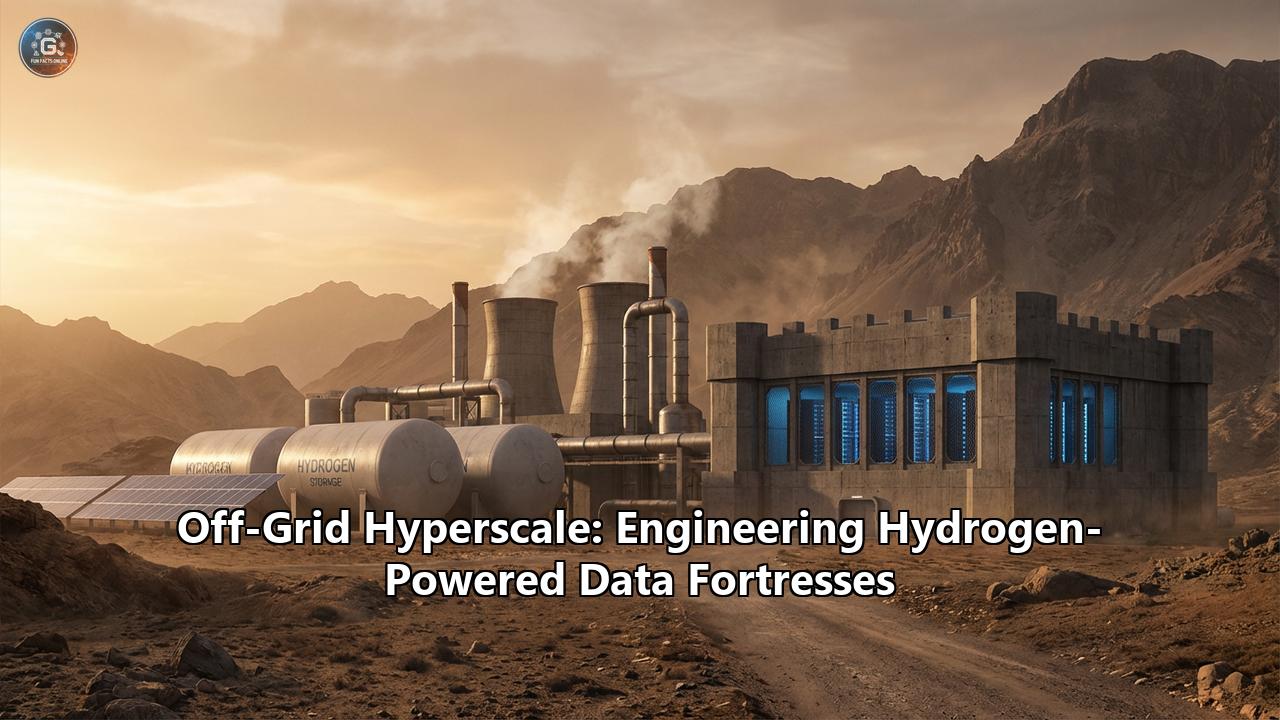
I. The Grid Collapse and the Rise of the Fortress
The year is 2026, and the digital infrastructure landscape has hit a wall—literally and metaphorically. For the past decade, the symbiotic relationship between hyperscale data centers and the public power grid was uneasy but functional. Data centers consumed massive amounts of electricity, and utilities scrambled to provide it. But the explosive rise of Artificial Intelligence, specifically the training of Large Language Models (LLMs) and the inferencing engines that power them, has shattered this compact.
We have entered the era of the "Power Gap." In Northern Virginia, Silicon Valley, and Dublin—the world’s primary data hubs—grid interconnection queues now stretch to five, sometimes seven years. Utility providers are issuing moratoriums on new connections, unable to build transmission lines fast enough to feed the insatiable appetite of AI, which is projected to consume nearly 10% of global electricity by 2030. The grid, an aging relic of the 20th century, has become the single greatest bottleneck to technological progress.
In response, a radical new architectural paradigm has emerged: the Off-Grid Hydrogen-Powered Data Fortress.
These are not merely data centers; they are sovereign islands of compute. Untethered from the fragile public grid, they generate their own power on-site using green hydrogen, store gigawatt-hours of energy in subterranean caverns, and operate with a level of physical and digital resilience previously reserved for military command bunkers. This article explores the engineering marvels, economic calculations, and security protocols that define this new class of infrastructure.
II. The Physics of Independence: Hydrogen as the New Grid
To understand the Data Fortress, one must first understand its fuel. Hydrogen has long been touted as the "fuel of the future," but in the context of the 2026 hyperscale market, it has become the fuel of the now.
The Energy Density Equation
The fundamental problem with renewable energy for data centers has always been intermittency. The sun doesn't always shine, and the wind doesn't always blow. Batteries (BESS) are excellent for bridging gaps of minutes or hours, but they are economically ruinous for multi-day outages or seasonal lulls.
Hydrogen solves the "seasonal storage" problem. A single kilogram of hydrogen contains approximately 33.3 kWh of usable energy (lower heating value). When compressed to 700 bar or liquefied, it offers an energy density that allows a facility to store weeks' worth of runtime on-site—a feat impossible with lithium-ion batteries.
The "Energy Park" Concept
Leading players like Google, Microsoft, and new entrants like ECL (EdgeCloudLink) are pioneering the "Energy Park" model. Instead of building a data center and asking the utility for a line, they find a location with abundant renewable resources—often remote deserts or wind-swept plains—and build a co-located ecosystem:
- Generation: Massive solar arrays or wind farms generate cheap electrons.
- Electrolysis: These electrons feed GW-scale PEM (Proton Exchange Membrane) electrolyzers, splitting water into oxygen and green hydrogen.
- Storage: The hydrogen is pumped into purpose-built steel tanks or, in the most ambitious designs, existing underground salt caverns, creating a "virtual battery" of almost infinite capacity.
- Re-Electrification: When the sun sets, the hydrogen is fed into fuel cells to power the servers.
This closed-loop system eliminates the "transmission risk." There are no power lines to storm-damage, no grid congestion charges, and no waiting for utility approval. The Data Fortress is born independent.
III. The Heart of the Fortress: Power Engineering for AI Workloads
The engineering challenge of powering an AI factory is vastly different from a traditional cloud data center. Traditional workloads are relatively steady. AI training workloads are "bursty," characterized by massive, instantaneous spikes in power draw as thousands of GPUs synchronize for a training pass.
The Fuel Cell Dilemma: PEM vs. SOFC
Engineers are currently deploying two primary types of fuel cells, each with distinct trade-offs:
- Proton Exchange Membrane (PEM) Fuel Cells:
Pros: Fast startup and excellent transient response. They can ramp power up and down relatively quickly (seconds to minutes), making them more agile.
Cons: Lower electrical efficiency (~50-60%) and lower operating temperature (~80°C), meaning the waste heat is "low grade" and harder to reuse.
Use Case: Often used for backup power or load-following in highly variable environments.
- Solid Oxide Fuel Cells (SOFC):
Pros: Extremely high electrical efficiency (60%+) and very high operating temperatures (700°C - 1,000°C). This high-grade waste heat is a goldmine for cooling systems (more on this in Section IV).
Cons: They are "stiff" power sources. They dislike thermal cycling and take hours to ramp up. They prefer to run flat-out.
Use Case: The "Baseload" generator. They replace the grid connection, running 24/7 at a steady state.
The Hybrid "Buffer" Architecture
To handle the violence of AI load spikes (which can jump from 20% to 100% load in microseconds) without crashing the fuel cells, the Data Fortress employs a hybrid architecture.
The "Tri-Brid" System:- Layer 1: The SOFC Array. This provides the steady baseload power, efficiently converting hydrogen to electricity.
- Layer 2: The BESS Buffer. A massive Lithium-Ion or Sodium-Ion battery bank sits between the fuel cells and the IT load. It acts as a shock absorber. When the GPUs spike, the batteries discharge instantly (millisecond response). The fuel cells then slowly ramp up to recharge the batteries, protected from the transient shock.
- Layer 3: The PEM Peakers. For sustained high-load periods that exceed the SOFC capacity but deplete the batteries too fast, banks of PEM fuel cells kick in as "peaker plants," offering a middle ground of responsiveness.
This complex orchestration requires AI of its own—a "Digital Twin" of the power plant that predicts GPU workloads and pre-positions the power systems before the computation even begins.
IV. The Thermal Moat: Turning Waste into Ice
Perhaps the most elegant engineering feature of the Hydrogen Fortress is its thermal loop. In a traditional data center, heat is the enemy. It is a waste product that costs millions to remove. In a Hydrogen Fortress, heat is a fuel.
The Waste-Heat-to-Cooling Loop
As mentioned, SOFCs operate at blistering temperatures (up to 1,000°C). This exhaust heat is typically wasted. However, using Absorption Chillers, engineers can convert this heat directly into cooling.
- How it Works: Absorption chillers use a thermochemical process (typically involving water and lithium bromide) where heat, rather than electricity, drives the cooling cycle.
- The Synergy: The hotter the data center runs (more power consumed), the more hydrogen the SOFCs burn. The more hydrogen they burn, the more waste heat they produce. The more waste heat produced, the more cooling capacity the absorption chillers generate.
- The Result: A self-balancing thermal ecosystem. The power plant is the cooling plant.
Closing the Efficiency Gap
Historically, there was a mismatch. SOFC heat was too hot, or PEM heat (60-80°C) was too cool for efficient absorption chilling. However, breakthroughs in 2024 and 2025 by companies like Panasonic and various university labs have closed this gap.
- Triple-Effect Chillers: New multi-stage chillers can utilize the high-grade SOFC heat to achieve Coefficients of Performance (COP) rivaling electric chillers, but without using a single watt of electricity.
- Low-Temp Adsorption: For PEM-based facilities, new silica-gel adsorption chillers can work with waste heat as low as 55°C, allowing even the "cool" exhaust of a PEM stack to contribute to the cooling load.
Liquid Cooling Integration
The Fortress doesn't just cool the room; it cools the chip. With NVIDIA's Blackwell and subsequent Blackwell-Ultra architectures pushing rack densities to 120kW+, air cooling is dead.
- Direct-to-Chip (DTC): Coolant is pumped directly to the GPU cold plate.
- The Loop: The warm coolant returning from the servers (now heated to ~65°C) is not just dumped. In winter, it is piped to neighboring district heating networks (if available) or used to pre-heat the hydrogen fuel before it enters the cell, improving reaction efficiency.
V. Digital Bastions: Security Architecture of the Fortress
The term "Fortress" is not hyperbole. In 2024, the UK and other nations designated data centers as Critical National Infrastructure (CNI). This elevated them to the same protection status as nuclear power plants and water reservoirs. The Hydrogen Fortress takes this mandate to the extreme.
The "Bunker" Topology
Driven by land scarcity and security needs, developers are looking down. Underground data centers, such as those in repurposed limestone mines (like the SubTropolis in Kansas City) or former military bunkers (like the Bahnhof Pionen in Sweden), are the template for the future.
- Physical Security: 100+ feet of rock provides immunity to tornados, plane crashes, and even conventional missile strikes.
- Thermal Stability: The ambient underground temperature is constant (often ~10-15°C), significantly reducing the cooling load on the absorption chillers.
- Invisibility: A Fortress buried underground has no visible footprint, making it harder to target physically or surveil.
EMP Shielding: The Faraday Cage
With geopolitical tensions rising, the threat of High-Altitude Electromagnetic Pulse (HEMP) or tactical EMP weapons is a tangible risk for CNI. The Hydrogen Fortress is designed as a comprehensive Faraday Cage.
- Shielding: The facility is wrapped in conductive shielding (copper or specialized steel mesh) that blocks electromagnetic waves.
- Point-of-Entry Protection: Every wire entering the facility (fiber optics, power lines from the solar farm) passes through "waveguides" and hardened filters that strip out EMP surges before they can fry the delicate GPUs inside.
- The Off-Grid Advantage: The public grid is the biggest antenna for an EMP. By disconnecting from it, the Fortress eliminates the primary vector for a surge to enter the facility.
AI-Driven Autonomous Defense (The "Lights-Out" SOC)
The Fortress is designed to operate with minimal human presence—a "lights-out" facility.
- Physical AI: LiDAR sensors and computer vision cameras patrol the perimeter and the halls. Unlike a human guard, they can "see" in the dark, measure heat signatures, and identify authorized personnel by gait analysis.
- The Autonomous SOC: Inside the digital realm, the Security Operations Center is run by AI agents. They ingest terabytes of log data in real-time. If an anomaly is detected (e.g., a weird data exfiltration pattern), the AI doesn't wake up an analyst; it autonomously isolates the infected server rack, severs its connection to the main cluster, and initiates a forensic snapshot. Speed is the only defense against AI-driven cyberattacks.
VI. The Economics of Autonomy
Building a Hydrogen Fortress is expensive—CapEx is significantly higher than a grid-connected shed. So why are CFOs signing the checks?
LCOE vs. LCOC
The industry metric is shifting from Levelized Cost of Energy (LCOE) to Levelized Cost of Compute (LCOC).
- Grid Reality: Grid power might be $0.08/kWh, but if you have to wait 5 years to get it, your "Cost of Delay" is measured in billions of dollars of lost AI revenue.
- Fortress Reality: Hydrogen power might cost $0.15/kWh (in 2026). But the facility can be built in 18 months. The revenue generated in those 3.5 years of "acceleration" dwarfs the higher OpEx of the fuel.
The 2026 Tipping Point
Projections for 2026 show the cost of green hydrogen dropping below $3/kg in favorable locations, while grid electricity prices in data center hubs are spiking due to congestion pricing and transmission upgrades.
- Arbitrage: During the day, the solar farm produces excess power. The Fortress sells this power back to the grid (if connected) or produces extra hydrogen to store. During peak pricing hours (4 PM - 9 PM), the Fortress runs entirely on its stored hydrogen, avoiding the exorbitant grid "peak demand" charges.
The Insurance Premium
For a company like Microsoft or AWS, an outage of an AI training cluster is catastrophic. It forces a restart of a training run that may have taken weeks. The reliability of an on-site, 2N+1 redundant hydrogen plant is an insurance policy against the rolling brownouts that are becoming common on overloaded public grids.
VII. Geopolitics and the Future
The Hydrogen Fortress is more than a building; it is a geopolitical asset.
Data Sovereignty
Nations are increasingly demanding that their citizens' data stay within their borders ("Data Residency"). However, many nations lack the grid capacity to host hyperscale clusters. The Off-Grid Fortress allows a country with poor infrastructure but good sun/wind (e.g., parts of Africa, South America, or Southeast Asia) to host world-class AI infrastructure without bankrupting their domestic power grid.
National Security
As AI becomes the defining technology of national defense, the data centers that train these models become military targets. A facility that relies on a public substation is vulnerable. A facility that is underground, self-powered, and shielded is a hardened asset. We are seeing the convergence of "Big Tech" and the "Defense Industrial Base."
Conclusion: The New Cathedral
The Data Fortress represents the maturation of the digital age. No longer a parasite on the existing infrastructure of the 20th century, the data center is evolving into a self-sufficient organism. It is a synthesis of cutting-edge thermodynamics, chemical engineering, and digital security.
As we look toward 2030, these fortresses will dot the landscape—silent, smokeless, and secure—humming with the hydrogen-fueled thought processes of the Artificial Intelligences that will define our future. They are the cathedrals of the 21st century, built not of stone and glass, but of steel, silicon, and hydrogen.
Section 1: The Engineering of Autonomy
1.1 The Hydrogen Production & Storage Loop
The premise of an off-grid hyperscale facility starts with the molecule: H2. While the concept is simple—split water with electricity—the scale required for a 100MW or 1GW campus is industrial.
Electrolyzer Arrays:The standard unit of the Fortress is the 5MW PEM electrolyzer skid. These are modular, containerized units that can be stacked. For a 100MW data center, you might need 300MW of electrolyzer capacity to ensure you can produce enough fuel during the "solar window" (the 6-8 hours of peak sunlight) to run the facility for the other 16 hours of the day.
- Innovation: 2026 has seen the rise of "Direct-Coupling." Engineers are now wiring solar arrays directly to electrolyzers via DC-DC converters, skipping the AC inversion step entirely. This saves ~5-10% of energy losses and reduces CapEx.
Above-ground tanks are insufficient for "dunkelflaute" (dark doldrums—periods of days with no wind/sun). The solution is geology.
- Technique: Engineers drill into naturally occurring salt domes, injecting water to dissolve the salt and create a void.
- Capacity: A single cavern can store 100 GWh of energy in the form of compressed hydrogen. This provides the "seasonal buffer" that makes the Fortress truly immune to weather.
- Pressure: Hydrogen is stored at roughly 100-200 bar underground. The pressure of the cavern itself aids in the extraction process.
1.2 The Prime Mover: Solid Oxide Fuel Cells (SOFC)
The workhorse of the Fortress is the SOFC. Unlike the engines of a car, these are solid-state devices—ceramic stacks that look more like server racks than generators.
- Chemistry: Oxygen from the air and hydrogen from the cavern meet on the surface of a ceramic electrolyte. The ions migrate through the ceramic, creating a flow of electrons.
- Efficiency: Modern SOFCs (like those from Bloom Energy or Mitsubishi Power) achieve 65% LHV efficiency electric-only.
- The "Bloom Box" Evolution: In 2026, these units have become denser. A single "energy server" footprint now delivers 500kW, up from 300kW just a few years prior.
SOFCs are sluggish. If the AI workload jumps, the SOFC cannot ramp up fast enough. If you push more fuel in too quickly, you risk "fuel starvation" on the anode, which can permanently crack the ceramic cells. This physics constraint dictates the entire electrical architecture of the facility.
1.3 The DC Microgrid
The Fortress abandons Alternating Current (AC) within its walls.
- The Logic: Solar panels produce DC. Fuel cells produce DC. Batteries store DC. Computer chips consume DC. Converting to AC for distribution only to convert back to DC at the server rack is wasteful (losses of ~15%).
- The Design: The Fortress operates a high-voltage DC (HVDC) bus, typically at 1000V or 1500V. The fuel cells, batteries, and solar feeds all tie into this common bus. The efficiency gain is substantial (roughly 7-10% system-wide).
Section 2: Thermal Symbiosis (The Heat Equation)
2.1 The Laws of Thermodynamics in a Fortress
Every watt of electricity that enters a GPU eventually becomes a watt of heat. In a 100MW facility, you have a 100MW heater running 24/7. Simultaneously, the fuel cells generating that 100MW are producing roughly 50MW of waste heat. The engineering challenge is managing this 150MW thermal river.
2.2 Absorption Chilling: The "Free" Cooling
The "magic" of the hydrogen design is the Absorption Chiller.
- Mechanism: It uses a solution of Lithium Bromide (LiBr) and water. The SOFC exhaust heat boils the water out of the solution at high pressure. This water vapor then condenses and evaporates in a low-pressure chamber, absorbing heat from the data center's chilled water loop.
- The 2026 Breakthrough: Triple-Effect Chillers. Older single-effect chillers had a COP (Coefficient of Performance) of 0.7 (1 unit of heat = 0.7 units of cooling). New triple-effect chillers, designed specifically for high-temp SOFC exhaust (600°C+), achieve COPs of 1.8.
- Math: 50MW of waste heat x 1.8 COP = 90MW of cooling capacity. This is often more than the data center needs, allowing the facility to run its cooling pumps almost entirely on waste heat.
2.3 Liquid-to-Liquid Heat Exchange
The air conditioning unit (CRAC) is disappearing. The Fortress uses Rear Door Heat Exchangers (RDHx) and Direct-to-Chip (DTC) cold plates.
- The Temperature Delta: Modern chips can run hotter. We used to supply 18°C water. Now, we supply 32°C water. This warmer setpoint makes the absorption chillers even more efficient and extends the hours of "free cooling" (using outside air) in cooler climates.
Section 3: The "Unbreachable" Perimeter
3.1 Defense-in-Depth
The security philosophy follows the "Onion Skin" model:
- Zone 1: The Exclusion Zone. A wide perimeter with no cover. Radar and thermal cameras track movement. Drones autonomously intercept and identify intruders.
- Zone 2: The Hardened Shell. The building itself is rated for blast resistance. Air intakes are elevated to prevent gas attacks.
- Zone 3: The Mantrap. Biometric authentication (iris + vein scanning) is required. Weight sensors ensure only one person enters.
- Zone 4: The Data Hall. "Lights Out." No humans are allowed in the server aisles during normal operation. Robotic arms (like those from AWS or specialized startups) handle drive swaps and server maintenance.
3.2 EMP Hardening (The Invisible Shield)
As data centers become instruments of national power, they become targets for electronic warfare.
- The HEMP Threat: A high-altitude nuclear detonation could induce thousands of volts into long conductors (power lines).
- The Off-Grid Defense: By cutting the grid connection, the Fortress removes the longest conductor.
- The Shielding: The building structure incorporates a continuous conductive mesh. Rebar in the concrete is welded to form a grid.
- Waveguides: Air vents are covered with honeycomb metal grilles. The honeycomb cells are sized so that the wavelength of an EMP cannot pass through them (waveguide beyond cutoff).
3.3 The Autonomous SOC
The sheer volume of security data (logs, video feeds, sensor readings) exceeds human cognitive limits.
- Behavioral AI: The security AI establishes a "pattern of life" for every user and process. If a technician's badge is used to access a room they rarely visit, or if a server starts sending data to an unusual IP address at 3 AM, the AI flags it.
- Active Response: The AI can physically lock doors, disable USB ports on specific racks, or even air-gap a compromised section of the network instantly.
Section 4: The Financial Case for Hydrogen
4.1 The Cost of Speed
Time is the most expensive commodity in the AI race.
- Grid Scenario: You secure land in Virginia. You apply for power. Dominion Energy tells you "maybe in 2029." You sit on the land, paying carry costs, with zero revenue for 4 years.
- Fortress Scenario: You buy cheap land in Texas or Nevada. You order modular fuel cells and electrolyzers. You are operational in 18 months. The 2.5 years of extra revenue from renting H100 GPUs (at $2-$3/hour each) generates billions, easily covering the CapEx premium of the hydrogen plant.
4.2 The "Green Premium" vs. Carbon Taxes
By 2030, carbon taxes and regulatory mandates (like the EU's CSRD) will heavily penalize scope 2 emissions (grid power).
- The Fortress Advantage: It is genuinely Zero Carbon (Scope 1 and 2). It doesn't rely on "carbon offsets" or "virtual PPAs" (which are increasingly viewed as greenwashing). It consumes green hydrogen and emits water vapor. This "pure" green status commands a premium from eco-conscious hyperscale customers.
4.3 Resilience as a Product
The Fortress sells "5 Nines" (99.999%) or even "6 Nines" of availability in a world where the grid is dropping to "3 Nines." For mission-critical AI (healthcare, finance, defense), this reliability is worth a massive premium.
Section 5: Case Study - The Texas Gigawatt Fortress
Note: Based on the ECL TerraSite-TX1 project and similar initiatives.In the scrublands east of Houston, a glimpse of the future is rising. A 1GW data center campus is under construction, entirely off-grid.
- Inputs: Sunlight, Wind, and Water (for electrolysis).
- Outputs: AI Compute and Distilled Water (the fuel cell exhaust is captured and condensed).
- The Cooling Twist: The facility is "water positive." It generates more water from the fuel cell exhaust than it consumes for cooling, providing fresh water to the local community—a complete reversal of the traditional "water-guzzling data center" narrative.
- The Modular Build: The entire facility is built of 1MW blocks. Each block arrives on a truck, containing its own fuel cells, battery buffer, cooling loop, and server racks. They are plugged together like LEGO bricks. This allows the facility to scale up revenue immediately as each block lands, rather than waiting for the whole building to finish.
Conclusion: The Sovereign Cloud
The Hydrogen Data Fortress is the physical manifestation of "Data Sovereignty." It is independent of the state's power grid, resilient against the state's enemies, and powered by the sun and wind of the territory it occupies.
It is a feat of multidisciplinary engineering—merging the chemical engineer's electrolyzer, the mechanical engineer's thermal loop, the electrical engineer's DC microgrid, and the software engineer's AI brain. As the AI era accelerates, these fortresses will become the most critical infrastructure on the planet, guarding the silicon brains that will think the future into existence.
Reference:
- https://avanzaenergy.substack.com/p/how-ai-is-transforming-data-center-522
- https://www.batterytechonline.com/stationary-batteries/ai-hyperscale-is-forcing-a-battery-revolution-in-data-centers
- https://www.bloomenergy.com/blog/the-ai-revolution-how-fuel-cells-are-solving-the-data-center-power-challenge/
- https://docs.lib.purdue.edu/cgi/viewcontent.cgi?article=3219&context=iracc
- https://news.panasonic.com/global/press/en240729-2
- https://www.coolingpost.com/world-news/h2-fuel-cell-generators-as-chiller-heat-source/
- https://chemrxiv.org/doi/pdf/10.26434/chemrxiv-2025-1z3cp
- https://www.mdpi.com/1996-1073/16/14/5327
- https://www.power-technology.com/features/how-energy-storage-and-battery-deals-enable-ai-data-centres-and-vice-versa/
- https://enkiai.com/ai-market-intelligence/ai-data-center-power-grid-limits-reshape-energy-in-2026
- https://www.researchgate.net/publication/328006490_Techno-economic_Analysis_of_An_Off_Grid_Hybrid_Renewable_Energy_System_for_Hydrogen_Production
- https://strategicenergy.eu/data-center/
- https://www.youtube.com/watch?v=9NpnBn54_RM
- https://www.guinnessgi.com/sites/default/files/2026-02/2026.01_Guinness%20Sustainable%20Energy%20Fund_Commentary_EN.pdf
- https://www.mines.edu/aes/wp-content/uploads/sites/320/2020/01/Braun-Kazempoor_RSC-Ch-12-Final_pp327-382_2013.pdf
- https://www.researchgate.net/publication/318666400_Integration_of_a_Solid_Oxide_Fuel_Cell_with_an_Absorption_Chiller_for_Dynamic_Generation_of_Combined_Cooling_and_Power_for_a_Residential_Application
- https://beei.org/index.php/EEI/article/view/1431
- https://escholarship.org/uc/item/9t82r134
- https://docs.lib.purdue.edu/iracc/2220/
- https://www.youtube.com/watch?v=cpttz8Q7jww
- https://www.weforum.org/stories/2025/04/data-centres-hydrogen-technology-news-april-2025/
- https://escholarship.org/uc/item/9n1049wg
- https://info.ornl.gov/sites/publications/files/Pub14546.pdf?utm_source=chatgpt.com
- https://ntrs.nasa.gov/citations/20210018094