
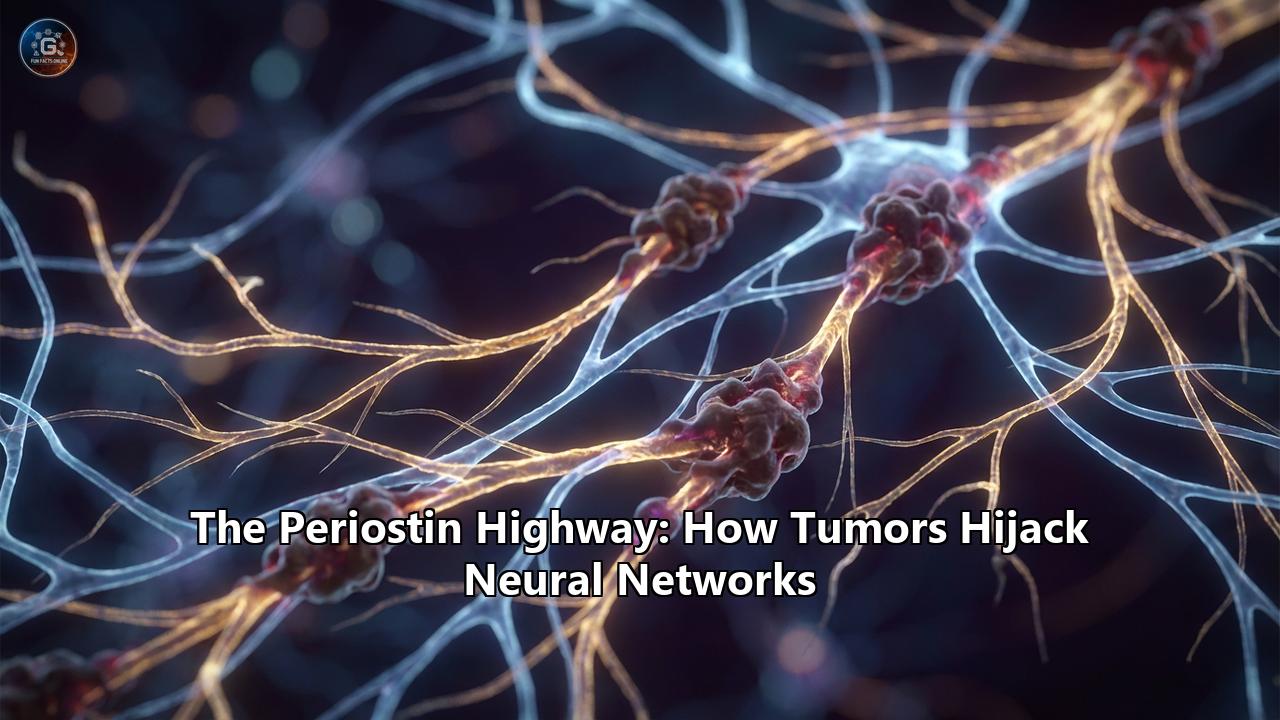
In the dim, sterile light of the laboratory, a new map of cancer is being drawn—one that resembles a subway system more than a chaotic mass of cells. For decades, we viewed tumors as isolated islands of destruction. We now know they are engineers. They do not merely grow; they build. And their most insidious construction project is a superhighway paved with a sticky, fibrous protein called periostin.
This is not just a story about a molecule. It is a story about hijacking. It is about how tumors tap into the body’s "electrical grid"—the nervous system—to power their own expansion, turning our neural networks into conduits for invasion. This is the story of the Periostin Highway.
The Architect: What is Periostin?
To understand the highway, we must first understand the asphalt. Periostin (POSTN) is a matricellular protein—a non-structural protein in the extracellular matrix (ECM) that doesn't just sit there like a brick; it acts like a signalman. In a healthy body, periostin is the "emergency repair crew." It is crucial during embryonic development to build heart valves and bones, and in adults, it wakes up only when tissue is injured, coordinating wound healing by telling cells to migrate and stick together.
But cancer is the "wound that never heals." Tumors trick the body into a perpetual state of emergency. They coerce nearby support cells—specifically Cancer-Associated Fibroblasts (CAFs) and Pancreatic Stellate Cells (PSCs)—to churn out massive amounts of periostin.
Imagine periostin as a molecular glue. It has specific domains (Fasciclin-I domains) that grab onto receptors called integrins ($α_vβ_3$, $α_vβ_5$, $α_6β_4$) on the surface of cancer cells. When periostin locks into these integrins, it flips a switch inside the cancer cell. The message is clear: “Don’t die. Move. Invade.”
The Blueprint: How the Highway is Built
The "Periostin Highway" is not a metaphor we use lightly. In cancers like Pancreatic Ductal Adenocarcinoma (PDAC), Head and Neck Squamous Cell Carcinoma (HNSCC), and Prostate Cancer, periostin literally modifies the physical landscape to create a path of least resistance.
- Paving the Road (Matrix Remodeling):
Normal tissue is soft and chaotic. Periostin binds to collagen and other matrix proteins, cross-linking them into linear, stiff bundles. This "linearization" of collagen creates physical tracks—literal rails—along which cancer cells can crawl. This stiffness is detected by the cancer cells via integrins, triggering the FAK-Src-YAP signaling pathway, which hardens the cancer cell’s internal skeleton and prepares it for travel.
- The Neural Connection (Perineural Invasion):
This is the "hijack." Nerves are the path of least resistance in the dense, fibrous jungle of a tumor. They are surrounded by a soft sheath (the perineurium) and are rich in nutrients and signals. Periostin is the key that unlocks this door.
Chemoattraction: Periostin induces the secretion of neurotrophic factors (like NGF and BDNF) from cancer cells. These molecules are "perfume" for nerves, stimulating them to grow toward the tumor (axonogenesis).
The Bridge: Periostin physically bridges the gap between the cancer cell and the nerve. It binds to the nerve sheath and the cancer cell simultaneously, anchoring the tumor to the nerve.
The Invasion: Once attached, the cancer cells use the nerve as a physical guide. They crawl along the nerve fibers (perineural invasion), traveling away from the main tumor site to invade deep into the body, often reaching the spine or brain.
The Hijack: The Neural-Tumor Crosstalk
The relationship is not one-way. It is a deadly conversation.
- Tumor to Nerve: "Grow towards me." The tumor releases NGF (Nerve Growth Factor), induced by periostin signaling. This causes the nerves to sprout new branches that infiltrate the tumor mass.
- Nerve to Tumor: "Here is fuel." The infiltrating nerves release neurotransmitters like acetylcholine and norepinephrine (adrenaline). These chemicals bind to receptors on the cancer cells.
Adrenaline activates the $\beta$-adrenergic pathway, which boosts angiogenesis (blood vessel growth) and stops the cancer cells from dying (apoptosis).
Acetylcholine (via the muscarinic receptors) can directly stimulate tumor proliferation.
This creates a feed-forward loop. The more nerves the tumor recruits, the more "fuel" it gets. The more fuel it gets, the more periostin it produces to recruit more nerves. The Periostin Highway becomes a self-sustaining ecosystem of destruction.
Case Studies: The Highway in Action
1. Pancreatic Cancer: The Lethal Labyrinth
Pancreatic cancer is notoriously painful and deadly. A 2026 study by Nakaya et al. revealed that pancreatic stellate cells are the primary engineers here. They secrete a flood of periostin that coats the nerves. This explains why pancreatic cancer has one of the highest rates of perineural invasion (up to 90% of cases). The tumor doesn't just push against the nerves; it eats along them. This neural invasion is often what makes the cancer inoperable, as it wraps around vital arteries and nerve plexuses.
2. Prostate Cancer: The Silent Spread
In prostate cancer, periostin overexpression is a red flag for aggression. The prostate is richly innervated. Research shows that periostin-rich tumors are more likely to escape the prostate capsule by riding the nerve bundles that exit the gland. This "nerve-sparing" surgery becomes a double-edged sword: if the nerves are already hijacked, saving them might mean leaving the highway open for cancer recurrence.
3. Head and Neck Cancer: The Painful Path
For HNSCC (tongue, throat, mouth cancers), pain is an early warning sign. This pain is the direct result of periostin-mediated nerve invasion. The tumor is not just pressing on the nerve; it is chemically interacting with it, sensitizing pain receptors while using the nerve body as a ladder to climb toward the brain stem.
The Counter-Attack: Tearing Up the Pavement
If periostin is the highway, can we set up a roadblock? The scientific community is racing to find out.
- Anti-Periostin Antibodies:
Experimental therapies (like the MZ-1 monoclonal antibody) have shown promise in mouse models of ovarian and breast cancer. By binding to periostin, these antibodies "cap" the sticky ends of the protein, preventing it from grabbing onto cancer cells. The highway remains, but the cars can't get on the on-ramp.
- Integrin Inhibitors:
Drugs that block the integrin receptors (like Cilengitide or newer $\beta1$-integrin blockers) effectively blind the cancer cell to the periostin signal. If the cell can't "feel" the highway, it doesn't invade.
- Breaking the Neural Link:
Some therapies aim to silence the nerves themselves. Beta-blockers (common heart medications) are being investigated for their ability to stop the "adrenaline fuel" from reaching the tumor. Other strategies involve blocking NGF (with drugs like Tanezumab, though largely experimental in cancer) to stop the nerves from growing into the tumor in the first place.
- FAK Inhibitors:
Targeting Focal Adhesion Kinase (FAK), the engine that powers the cancer cell's movement along the periostin track, is a hot area of clinical trials (e.g., Defactinib). These drugs effectively stall the car on the highway.
The Future: De-Escalating the Emergency
The discovery of the Periostin Highway changes how we treat cancer. It suggests that killing cancer cells (chemotherapy) is not enough if we leave the infrastructure (periostin and nerves) intact. We are moving toward a stromal-targeting approach—therapy that treats the soil as well as the seed*.
By dismantling the Periostin Highway, we don't just slow the tumor down; we cut off its supply lines, blind it to its escape routes, and silence the deadly conversation it holds with our own nervous system. The goal is to turn the "wound that never heals" back into a scar that fades—static, silent, and benign.
Glossary of Key Terms
- Periostin (POSTN): A sticky protein secreted by support cells that organizes the tumor matrix and promotes invasion.
- Perineural Invasion (PNI): The process of cancer cells wrapping around and traveling along nerves.
- Stellate Cells / CAFs: The "corrupted" support cells that build the periostin highway.
- Integrins: The "tires" on the cancer cell that grip the periostin road.
- Neurogenesis / Axonogenesis: The growth of new neurons or nerve fibers, often induced by the tumor.
- NGF (Nerve Growth Factor): The chemical signal the tumor uses to call nerves closer.
Reference:
- https://pmc.ncbi.nlm.nih.gov/articles/PMC12051345/
- https://www.youtube.com/watch?v=OWvZ3xl_fL4
- https://news.ssbcrack.com/new-study-reveals-mechanism-of-early-nerve-invasion-in-pancreatic-cancer/
- https://www.mdpi.com/2072-6694/16/10/1875
- https://aacrjournals.org/mct/article/10/8/1500/91068/Neutralizing-Monoclonal-Antibody-to-Periostin
- https://pmc.ncbi.nlm.nih.gov/articles/PMC11842479/
- https://www.frontiersin.org/journals/pharmacology/articles/10.3389/fphar.2024.1274209/full
- https://pubmed.ncbi.nlm.nih.gov/38410129/
- https://www.cuimc.columbia.edu/news/gastric-cancer-fueled-crosstalk-between-nerves-and-cancer-cells