
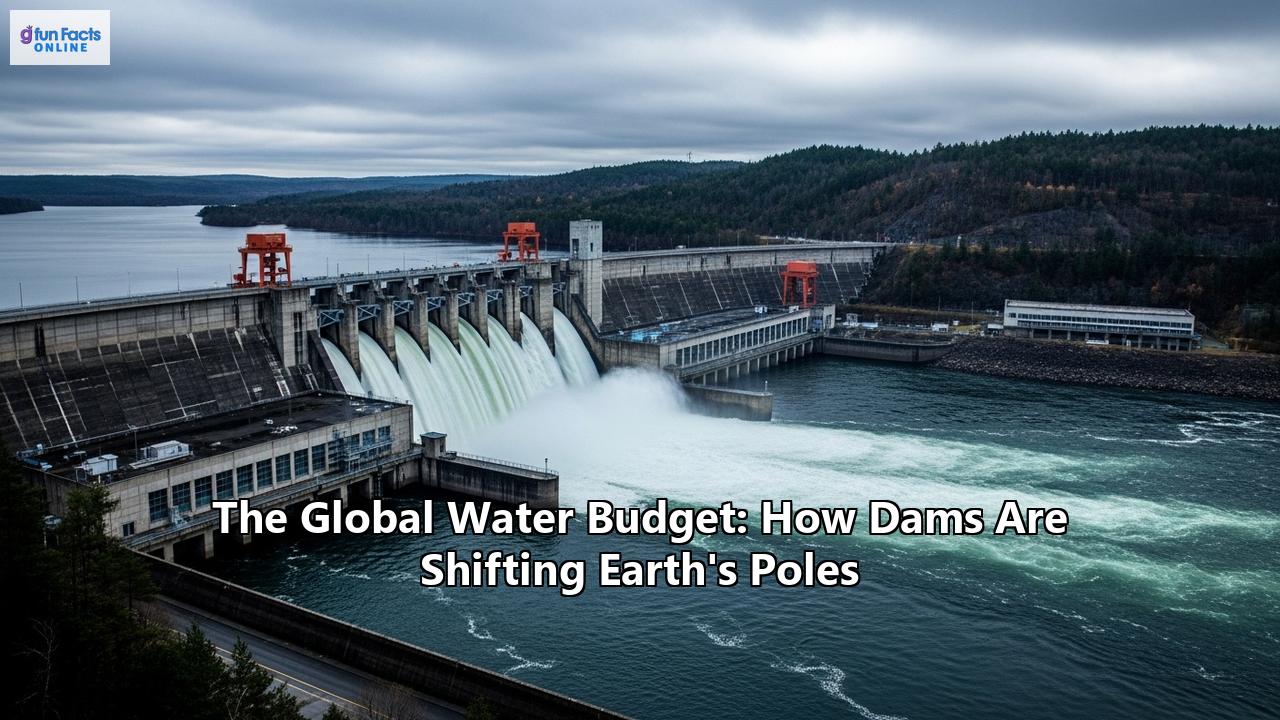
The Unseen Tilt: How Humanity's Dams Are Shifting the Earth's Poles
Imagine the Earth as a perfectly balanced spinning top. For eons, it has spun on its axis with a predictable, rhythmic grace. But what if we told you that human activity, specifically the monumental effort of building dams, has introduced a subtle, yet measurable, wobble to our planet's rotation? It sounds like the plot of a science fiction novel, but it is a scientific reality. The immense weight of water stored in thousands of reservoirs across the globe has physically shifted the Earth's rotational poles, a testament to humanity's profound and often unforeseen impact on the planet's fundamental systems.
This phenomenon, known as "true polar wander," is the result of redistributing mass on a planetary scale. A recent, landmark study has revealed that the construction of nearly 7,000 dams between 1835 and 2011 has collectively caused the Earth's poles to drift by approximately 1.1 meters (about 3.7 feet). This seemingly small shift unveils a fascinating story about the interconnectedness of the global water budget, geological forces, and the long-term consequences of our engineering marvels.
The Global Water Budget: A Delicate Planetary Balance
To understand how dams can move poles, we must first appreciate the concept of the global water budget. This refers to the continuous circulation of water in the Earth's system—a complex cycle of evaporation, condensation, precipitation, and runoff that sustains all life. Water is constantly in motion, flowing from land to sea, cycling through the atmosphere, and stored in various forms like oceans, ice sheets, groundwater, and surface water bodies.
The distribution of this water across the planet is a key factor in determining the Earth's mass distribution. Think of it like balancing a spinning basketball on your finger; adding a lump of clay to one side will cause it to wobble and shift. Similarly, any significant relocation of mass on the Earth's surface alters its moment of inertia—a measure of an object's resistance to changes in its rotation. Our planet's outermost solid layer, the crust, rests on a goopy, molten mantle, allowing it to move and adjust to these mass changes. When mass is redistributed, the crust wobbles, causing the geographic poles—the points where the rotational axis intersects the surface—to pass through different spots than before.
Dams as Planetary Engineers: Locking Up Water and Shifting Weight
For centuries, humans have been building dams for irrigation, flood control, and hydroelectric power. These structures impound colossal amounts of water, creating vast artificial lakes where none existed before. The water held in these reservoirs is water that would have otherwise flowed into the oceans. By trapping it on land, often at mid-latitudes, we are fundamentally altering the planet's mass balance.
A 2025 study published in the journal Geophysical Research Letters meticulously analyzed the impact of 6,862 dams built over nearly two centuries. The researchers found that together, these dams hold enough water to fill the Grand Canyon twice. This massive sequestration of water not only contributed to a 21-millimeter (0.83-inch) drop in global sea levels but also directly caused the observed polar drift.
The study identified two distinct phases in this human-induced polar wander:
- 1835 to 1954: During this period, extensive dam construction in North America and Europe caused the North Pole to move 20.5 centimeters (8 inches) toward the 103rd meridian east, which runs through Asia.
- 1954 to 2011: The focus of dam building then shifted to East Africa and Asia. This resulted in a more pronounced shift of 57 centimeters (22 inches) toward the 117th meridian west, a line passing through western North America and the South Pacific.
Over the entire period, the cumulative effect was a polar movement of about 113 centimeters (3.7 feet), with the vast majority of this shift occurring in the 20th century. Even a single, massive project like China's Three Gorges Dam has a measurable, albeit minuscule, effect. By holding back 39.3 billion cubic meters of water, it has been calculated to have slowed the Earth's rotation by a mere 0.06 microseconds and contributed to the axis shift.
A Wobbling World: The Broader Context of Polar Motion
The polar wander caused by dams is just one piece of a larger puzzle. The Earth's poles are not static; they naturally wander due to various geophysical processes. The most significant historical driver of polar drift is post-glacial rebound—the slow, ongoing response of the Earth's crust to the melting of the massive ice sheets that covered continents during the last Ice Age over 10,000 years ago.
However, in recent decades, human activities have become a dominant force. Scientists have identified two other major anthropogenic contributors to polar motion that work in concert with the effect of dams:
- Glacier and Ice Sheet Melt: As global temperatures rise due to climate change, glaciers and polar ice sheets are melting at an accelerating rate. This meltwater flows into the oceans, redistributing an enormous mass of water and causing the poles to drift. The accelerated melting of ice in Greenland and Antarctica has been linked to a sudden eastward drift of the axis observed since the mid-1990s.
- Groundwater Depletion: Humanity's thirst for water has led to the unsustainable pumping of vast quantities of groundwater from underground aquifers, primarily for agriculture. A groundbreaking study revealed that between 1993 and 2010, humans pumped out an estimated 2,150 gigatons of groundwater. This water eventually finds its way to the oceans, and this redistribution of mass has been identified as the single largest climate-related driver of polar drift in recent years, causing the Earth to tilt nearly 80 centimeters (31.5 inches) east in that period alone. In fact, models of polar motion only matched the observed reality when the effect of groundwater depletion was included.
Consequences of a Shifting Axis: More Than a Curiosity
While the idea of our planet tilting is unsettling, the direct consequences of this polar drift on daily life are, for now, negligible. The shift is far too small to affect the seasons or change the length of a day in any meaningful way for individuals. The planet's rotational pole normally wanders by several meters each year before returning to its mean position due to seasonal variations in atmospheric and oceanic mass.
However, the significance of this discovery lies not in immediate, catastrophic impacts, but in what it reveals about the scale of human influence. It is a powerful indicator, a planetary-scale signal of our actions.
- A New Metric for Climate Science: Understanding the drivers of polar motion provides scientists with an independent tool to verify and refine climate models. By observing the pole's wander, researchers can better understand continent-scale variations in water storage, including the rates of ice melt and groundwater depletion.
- Implications for Sea-Level Rise: The research highlights that the water impounded by dams has prevented a certain amount of sea-level rise. This means that projections for future sea-level rise must accurately account for both the ongoing construction of dams and the potential release of water from existing ones.
- A Geological Wake-Up Call: The fact that our water management practices are physically moving the planet's axis serves as a stark wake-up call. It underscores the immense power we wield and the necessity of sustainable practices. Slowing groundwater depletion, for instance, could theoretically alter the course of polar drift, though it would require decades of sustained effort.
In conclusion, the silent, steady drift of the Earth's poles is a profound narrative written by humanity. Every dam we construct, every aquifer we pump, adds a word to this story. While the wobble is gentle, the message is powerful: we are no longer passive inhabitants of Earth, but active geological agents, capable of subtly reshaping the very spin of our world. This knowledge urges us to proceed with greater wisdom and foresight, recognizing that the balance of our planet is more delicate, and more interconnected with our actions, than we ever imagined.
Reference:
- https://www.livescience.com/planet-earth/dams-around-the-world-hold-so-much-water-theyve-shifted-earths-poles-new-research-shows
- https://news.agu.org/press-release/water-storage-in-dams-has-caused-minute-shifts-in-earths-poles/
- https://www.ufa.cas.cz/DATA/publikace/2021_Kysel%C3%BD_The%20Global%20Water%20Cycle%20Budget%20A%20Chronological%20Review.pdf
- https://timesofindia.indiatimes.com/science/nasa-warns-chinas-three-gorges-dam-could-slow-earths-rotation-by-0-06-seconds-heres-how/articleshow/117012416.cms
- https://medium.com/@westwise/what-does-a-dam-do-to-the-earths-rotation-6a568d1f5f4b
- https://modernsciences.org/groundwater-redistribution-affects-earths-rotation-new-study-reveals/
- https://www.perplexity.ai/page/china-s-dam-may-shift-earth-s-6NC08GQ.Qw2XE6x9X3R.Xw
- https://www.downtoearth.org.in/climate-change/new-findings-on-human-induced-drift-of-earth-s-rotational-pole-is-a-wake-up-call-90354
- https://ntrs.nasa.gov/api/citations/19920011028/downloads/19920011028.pdf
- https://www.wartsila.com/insights/article/climate-change-knocks-earth-s-axis-off-kilter
- https://www.jpl.nasa.gov/news/nasa-funded-studies-explain-how-climate-is-changing-earths-rotation/
- https://www.earth.com/news/wildly-unexpected-consequences-polar-ice-melt-earth-rotation-spin-day-length/
- https://www.sciencedaily.com/releases/2023/06/230615183147.htm
- https://www.livescience.com/planet-earth/human-impact-on-earths-tilt-leaves-researchers-surprised-and-concerned
- https://www.geographyrealm.com/groundwater-earths-axis/
- https://www.sciencefocus.com/news/earths-rotation-soil-moisture