
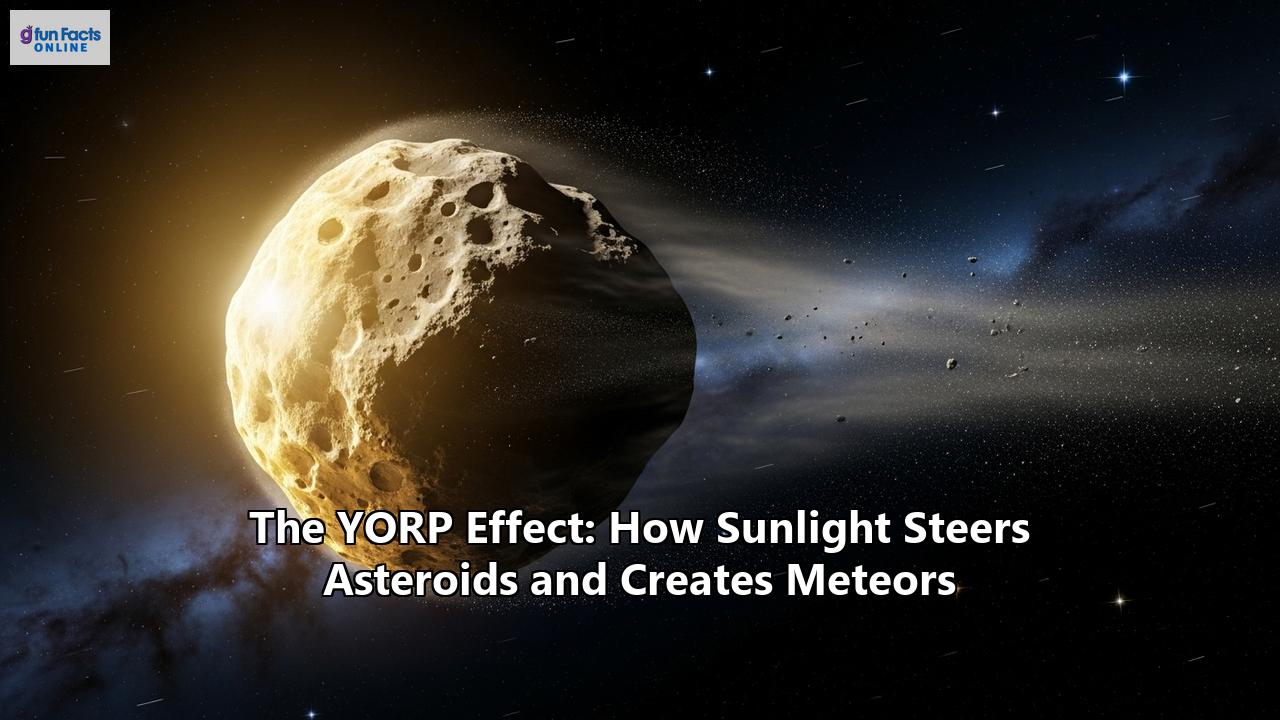
The Unseen Sculptor: How Sunlight's Gentle Push Steers Asteroids and Forges Meteors
In the vast, silent emptiness of space, a subtle yet persistent force is constantly at work, meticulously sculpting the destinies of the solar system's smallest inhabitants. It is a force born not from gravity's overwhelming embrace, but from the delicate touch of sunlight itself. This phenomenon, known as the Yarkovsky-O'Keefe-Radzievskii-Paddack (YORP) effect, is a testament to the profound influence that seemingly insignificant pressures can exert over cosmic timescales. It is a celestial ballet choreographed by photons, a thermal engine that can spin asteroids faster than a kitchen blender, cause them to wobble and tumble, shatter them into swarms of debris, and even create entirely new worlds in the form of binary asteroid systems. The YORP effect is the unseen hand that steers these ancient rocks, altering their paths and, in some cases, setting them on a collision course with planets, including our own, while also being a primary architect of the meteors that streak across our night sky.
This article delves into the intricate workings of the YORP effect, a cornerstone of modern planetary science. We will journey back to its theoretical conception in the mind of a 19th-century Russian engineer, trace its development through the insights of pioneering scientists, and witness its stunning observational confirmation in the 21st century. We will explore how this "windmill effect" in space operates, dissecting the physics of sunlight absorption, thermal radiation, and the crucial role of an asteroid's irregular shape. Through detailed case studies of specific asteroids, we will see the YORP effect in action—accelerating spins, triggering catastrophic breakups, and creating the very meteoroid streams that grace our atmosphere as shooting stars.
A Tale of Four Scientists: The Genesis of the YORP Effect
The story of the YORP effect is a fascinating example of how a scientific concept can evolve over a century, built upon the incremental contributions of several brilliant minds. The name itself is an acronym, a tribute to the four key figures whose work laid the foundation for our current understanding: Ivan Yarkovsky, John O'Keefe, Vladimir Radzievskii, and Stephen Paddack.
The journey begins around the year 1900 with Ivan Osipovich Yarkovsky (1844–1902), a Polish-Russian civil engineer who dedicated his spare time to scientific pursuits. In a privately published pamphlet, Yarkovsky theorized that the daily heating of a rotating object in space would cause it to experience a tiny, yet persistent, force. He correctly deduced that as an object absorbs sunlight, it doesn't re-radiate that energy as heat instantaneously. This thermal lag means the warmest part of the asteroid's surface is not at its "high noon" but in its "afternoon." The photons radiating away from this warmer, afternoon side carry more momentum than those from the cooler, morning side. This anisotropic emission of thermal photons creates a gentle but continuous thrust. Yarkovsky's primary focus was on how this force could alter an object's orbit over millions of years—a phenomenon now known as the Yarkovsky effect. His revolutionary idea, however, was nearly lost to history, preserved only through the efforts of the Estonian astronomer Ernst J. Öpik, who had read Yarkovsky's pamphlet and recognized its significance decades later.
The next piece of the puzzle fell into place in the 1950s. Vladimir Radzievskii (1952), a Soviet scientist, independently considered the effects of solar radiation on celestial bodies. He was the first to propose that this radiation could not only push an object but also make it spin. Radzievskii's initial concept was that variations in albedo—the reflectivity of an asteroid's surface—could create an unbalanced torque, causing its rotation rate to change. A spot on an asteroid that is darker (lower albedo) absorbs more sunlight and thus radiates more heat, creating a stronger recoil force than a lighter, more reflective spot. While the fundamental idea of a radiation-induced torque was correct, it was later understood that albedo variations alone were not a sufficiently powerful mechanism to explain the observed rotation rates of asteroids.
The crucial role of an asteroid's shape was championed by two American scientists in the latter half of the 20th century. Stephen Paddack, while studying interplanetary dust, realized that an object's three-dimensional geometry was a far more potent engine for altering its spin rate than surface color variations. He envisioned that an irregularly shaped body, with its landscape of asymmetric hills, valleys, and protrusions, would radiate thermal photons unevenly, creating a net torque. He and his colleague, John O'Keefe, likened this to a "windmill" in space. O'Keefe (1916-2000), a prominent NASA scientist renowned for his work in space geodesy and his controversial (though ultimately incorrect) theory on the lunar origin of tektites, saw the profound implications of this windmill effect. Together, Paddack and O'Keefe suggested that this constant, gentle twisting could spin up a small, asymmetric body so fast that it would overcome its own weak gravity and fly apart—a process they termed "rotational bursting." This, they proposed, could be a significant source of the dust and smaller fragments found throughout the solar system.
For decades, these ideas percolated within the planetary science community. The Yarkovsky effect gained traction as a vital mechanism for delivering asteroids from the main belt to near-Earth space. The rotational component, however, remained more theoretical until the year 2000, when scientist David Rubincam of NASA's Goddard Space Flight Center synthesized the work of his predecessors. He formalized the theory, modeled the thermal torques, and, in a nod to the intellectual lineage, coined the term Yarkovsky-O'Keefe-Radzievskii-Paddack (YORP) effect. This unified concept finally gave a name and a robust theoretical framework to the subtle force that shapes the rotational destiny of asteroids.
The Physics of a Sun-Powered Engine: How YORP Works
At its heart, the YORP effect is a manifestation of the conservation of momentum. According to modern physics, every photon, despite being massless, carries momentum. When an asteroid absorbs a photon from the Sun, it also absorbs its momentum. The asteroid then re-radiates this energy away in the form of thermal (infrared) photons. As each thermal photon leaves the surface, it imparts a tiny recoil kick in the opposite direction, just like the recoil from a firearm.
If an asteroid were a perfect, non-rotating sphere with a uniform surface, these recoil kicks would be perfectly balanced across its entire surface, and there would be no net effect on its spin. However, asteroids are not perfect spheres. They are irregular, lumpy bodies, often described as "rubble piles"—loose agglomerations of rock and dust held together by their own feeble gravity. This irregularity is the key to the YORP effect.
Imagine an asteroid with a slightly asymmetrical, "windmill" or "propeller-like" shape.
- Absorption and Heating: As the asteroid rotates, sunlight warms its surface. Due to thermal inertia—the time it takes for a material to heat up and cool down—the hottest point on the surface is not directly under the Sun but slightly offset in the direction of the afternoon side.
- Anisotropic Re-emission: This heated surface radiates thermal photons back into space. Because of the asteroid's irregular shape, these photons are not emitted uniformly in all directions. Protruding features and angled facets act like tiny, misaligned thrusters.
- Net Torque: When averaged over the entire surface and over many rotations, the sum of all these tiny photon kicks does not cancel out. The asymmetrical emission creates a net torque—a persistent twisting force—that acts on the asteroid.
This net torque can have two main consequences:
- Spin-Up or Spin-Down: Depending on the specific geometry of the asteroid and its direction of rotation, the YORP torque can either increase its spin rate (spin-up) or decrease it (spin-down). For many asteroids, the effect leads to a gradual acceleration, causing them to rotate faster and faster over hundreds of thousands to millions of years.
- Obliquity Change: The YORP effect can also alter the asteroid's obliquity, which is the tilt of its spin axis relative to its orbital plane. The torque can cause the asteroid's pole to precess and gradually migrate towards specific stable states, typically at 0°, 90°, or 180° relative to the ecliptic plane.
The magnitude of the YORP effect is incredibly small, but its persistence is what makes it a powerful agent of change. Its strength is dependent on several factors: the asteroid's size (smaller objects are affected more dramatically), its distance from the Sun (the effect is stronger closer to the Sun), its shape, and its thermal properties. For a kilometer-sized asteroid in the main belt, the YORP effect might take millions of years to significantly alter its spin. For a smaller, 100-meter near-Earth asteroid, the same change could happen in just a few hundred thousand years.
The Smoking Gun: Observational Confirmation of the YORP Effect
For most of the 20th century, the YORP effect was a compelling but unproven theory. That all changed in 2007 with landmark observations of two near-Earth asteroids, which provided the first direct, unambiguous evidence of this solar-powered engine at work.
Case Study 1: (54509) YORP - The Namesake Asteroid
The asteroid formerly known as 2000 PH5 was so instrumental in confirming the theory that it was officially renamed (54509) YORP. This small asteroid, about 114 meters in diameter, occupies a peculiar "horseshoe" orbit that brings it into regular close proximity with Earth, making it an ideal target for sustained observation.
An international team of astronomers, led by Stephen Lowry of Queen's University Belfast and Patrick Taylor of Cornell University, meticulously tracked (54509) YORP between 2001 and 2005 using a combination of powerful techniques:
- Optical Photometry: By measuring the precise changes in the asteroid's brightness over time with optical telescopes, astronomers can create a "light curve." The shape and timing of the peaks and troughs in the light curve reveal the asteroid's rotation period with incredible accuracy.
- Radar Observations: Using the powerful Arecibo Observatory and Goldstone Solar System Radar, scientists bounced radio waves off the asteroid. By analyzing the reflected signals—a technique called delay-Doppler imaging—they can construct a detailed 3D shape model of the asteroid and determine its spin state.
When the teams analyzed their data, they found something remarkable. The rotation period of (54509) YORP was not constant. It was steadily decreasing, meaning the asteroid was spinning faster over time. The change was minuscule—an increase in its rotation rate of about 2.0 x 10⁻⁴ degrees per day squared, which translates to its rotation period shortening by about one millisecond every year.
Crucially, this tiny observed acceleration was in "reasonable agreement" with the theoretical YORP torque calculated from the detailed 3D shape model derived from the radar data. The team exhaustively ruled out other potential causes, such as gravitational tugs from Earth during its close approaches. This was the smoking gun. For the first time, scientists had directly measured an asteroid's spin rate changing and could confidently attribute it to the YORP effect. Projections showed that the spin rate of (54509) YORP could double in just 600,000 years, pushing it towards its structural breakup limit.
Case Study 2: (1862) Apollo
At the same time as the discovery on (54509) YORP, a separate team led by Mikko Kaasalainen confirmed the effect on another, much larger asteroid: (1862) Apollo. Apollo is a stony (S-type) asteroid about 1.5 kilometers in diameter. By analyzing photometric light curves spanning an impressive 27 years, from 1980 to 2007, the researchers detected a clear signal of rotational acceleration.
The long baseline of observations revealed that Apollo had completed one extra rotation cycle in just 40 years compared to what would be expected with a constant spin period. The measured acceleration rate was (5.5 ± 1.2) × 10⁻⁸ rad d⁻², a value that again agreed well with the theoretical YORP strength derived from its shape model. The detection on a larger body like Apollo demonstrated that the YORP effect is a significant evolutionary driver not just for tiny asteroids but for kilometer-scale objects as well. Subsequent observations have continued to refine this measurement, making Apollo's YORP detection one of the most precise to date.
The Ultimate Consequence: Rotational Fission and the Creation of Meteors
One of the most dramatic consequences of the YORP effect is its ability to spin an asteroid to death. Many asteroids, particularly those smaller than a few kilometers, are not solid, monolithic rocks but are instead "rubble piles"—gravitationally bound collections of boulders, gravel, and dust. They have very little internal strength.
As the YORP effect relentlessly torques a rubble-pile asteroid, its rotation speed increases. This builds up centrifugal force, which tries to fling material away from the asteroid's center. Initially, this may just cause "landslides," where loose material on the surface migrates from the poles toward the equator, often forming a distinctive equatorial bulge. This process is believed to be responsible for the "spinning top" shape seen on asteroids like Bennu and Ryugu.
However, if the spin-up continues unabated, the centrifugal force at the equator will eventually overwhelm the asteroid's weak gravitational grip. At this point, the asteroid reaches its critical spin limit, and it begins to shed mass. Material lifts off the equator and is cast out into space. This process of rotational fission can unfold in several ways, with profound implications for the solar system.
Case Study 3: The Disintegration of P/2013 R3
In 2013, astronomers using the Catalina and Pan-STARRS sky surveys spotted a fuzzy object in the main asteroid belt that looked like a comet. But follow-up observations with the Keck Telescope and the Hubble Space Telescope revealed something unprecedented. This object, designated P/2013 R3, was not a single body but a swarm of at least ten separate pieces, each trailing a dusty tail, slowly drifting apart from one another. It was an asteroid caught in the very act of disintegrating.
The key clue to the cause of its demise was the speed at which the fragments were separating: a leisurely 0.9 miles per hour (about 0.4 m/s). A violent collision with another asteroid would have sent debris flying apart at much higher velocities. The slow, gentle separation was the hallmark of a body that had been gradually spun up until it could no longer hold itself together. P/2013 R3 was a spectacular confirmation of the rotational fission hypothesis first put forward by Paddack and O'Keefe decades earlier. The culprit was almost certainly the YORP effect, which had slowly spun the parent body, a weak rubble pile estimated to be about 400 meters in radius, to its breaking point over millions of years.
The Birth of Meteoroid Streams
The fragmentation of asteroids like P/2013 R3 is a primary mechanism for the creation of meteoroids. The debris shed during rotational fission doesn't simply vanish; it continues to orbit the Sun along a path very similar to its parent asteroid. Over time, these swarms of fragments and dust particles spread out along the orbit, forming a vast, river-like structure known as a meteoroid stream.
When Earth's orbit intersects one of these streams, we witness a meteor shower. The tiny particles, often no bigger than a grain of sand, enter our atmosphere at high speed and burn up due to air friction, creating the beautiful streaks of light we call "shooting stars." Therefore, every time we watch the Perseids or the Geminids, we are seeing the ancient, glittering remains of comets and, as we now understand, asteroids that were torn asunder, in many cases by the subtle, inexorable torque of the YORP effect. The effect provides a crucial link in the chain that connects the evolution of asteroids to the transient beauty of meteors.
Beyond the Basics: The Nuances of YORP
As our understanding of the YORP effect has matured, so too has our appreciation for its complexity. Recent research has unveiled several nuanced versions of the effect that add further layers to the story of how asteroid spins evolve.
Stochastic YORP: A Game of Chance
While the YORP effect can systematically spin an asteroid up or down, this process is not always a smooth, one-way street. Asteroids are constantly being bombarded by smaller objects, leading to cratering and surface reshaping. Each significant impact can alter the asteroid's topography, effectively "resetting" its YORP torque. A change in shape can alter the magnitude and even reverse the direction of the YORP torque.
This leads to the concept of Stochastic YORP, where the spin evolution is not a steady march in one direction but a "random walk." An asteroid might spin up for a few million years, then suffer an impact that changes its shape, causing it to spin down for a period before another impact resets the clock again. This stochastic process can slow down how often asteroids reach their critical fission limit or enter a tumbling state, adding an element of chance to their long-term evolution.
Crater-Induced YORP (CYORP): The Importance of Concavities
Initially, models of the YORP effect focused on the large-scale, convex shape of an asteroid. However, a newer concept called the Crater-Induced YORP (CYORP) effect recognizes that concave features, like impact craters, play a significant role.
The inner walls of a crater are also heated by the sun and re-radiate thermal photons. Because of the crater's concave geometry, effects like self-shadowing (where one part of the crater wall blocks sunlight from reaching another) and the re-absorption of radiated photons by adjacent parts of the crater wall create a complex thermal environment. The net result is an additional torque—the CYORP torque.
A single large crater can produce a CYORP torque comparable to the normal YORP torque from the asteroid's overall shape. Furthermore, while the torque from a single small crater is tiny, the cumulative effect of thousands of small craters and other surface roughness can be substantial. Since craters are formed by the very impacts that drive the Stochastic YORP effect, CYORP provides a physical mechanism for how these "resets" occur, linking the collisional and rotational evolution of an asteroid in an intricate feedback loop.
Binary YORP (BYORP): A Dance for Two
The YORP effect is not only responsible for creating binary asteroids but also for governing their subsequent evolution. Once a binary system forms, a related phenomenon called the Binary YORP (BYORP) effect takes over.
In many near-Earth binary systems, the smaller secondary (the "moonlet") becomes tidally locked to the primary, meaning it always shows the same face to the larger body, just as our Moon does to Earth. In this state, the YORP effect acting on the tidally locked, irregularly shaped secondary doesn't just change its spin; it generates a torque on the binary system as a whole. This BYORP torque can systematically alter the mutual orbit of the two bodies.
The BYORP effect can either push the two asteroids closer together or drive them farther apart. Observations of binary systems have revealed examples of both contracting and expanding orbits. Intriguingly, theoretical models and observations suggest that the BYORP effect preferentially causes binary orbits to shrink, potentially leading to the two components eventually colliding and merging. This complex gravitational and thermal dance determines the ultimate fate of the numerous binary systems that populate our solar system.
The Future of YORP Research: Missions and Prospects
The study of the YORP effect is a vibrant and ongoing field of research. While ground-based radar and optical telescopes continue to identify new candidates and refine measurements, space missions are providing an unprecedented close-up view.
NASA's OSIRIS-REx mission, which successfully returned samples from the "spinning top" near-Earth asteroid Bennu, is a prime example. During its more than two years in close proximity to Bennu, the spacecraft gathered exquisitely precise data on the asteroid's size, shape, mass, and thermal properties. This "ground-truth" data allows scientists to create incredibly detailed thermophysical models, testing the limits of YORP theory and refining our predictions. The analysis of the returned samples will directly measure the thermal conductivity and heat capacity of asteroid material, key parameters that feed into all YORP models. The mission has already provided the most accurate measurements of the related Yarkovsky effect ever accomplished, and its data will continue to fuel YORP studies for years to come.
Looking ahead, missions like OSIRIS-REx's extended mission, now called OSIRIS-APEX, which will rendezvous with the potentially hazardous asteroid Apophis in 2029, promise to further revolutionize our understanding. By studying a diverse range of asteroid types up close, scientists can build a more complete picture of how the YORP effect operates across different populations, from the near-Earth space to the main asteroid belt, where solar radiation is weaker.
The YORP effect, born from a flicker of insight over a century ago, has blossomed into a fundamental principle of planetary science. It is a powerful reminder that in the cosmos, even the gentlest of forces, applied persistently over eons, can move mountains—or, in this case, entire worlds. From the subtle steering of a lone asteroid to the catastrophic explosion that seeds a meteor shower, the YORP effect is a constant, quiet sculptor, forever shaping the dynamic and evolving landscape of our solar system. It is a force written in sunlight, a silent engine driving the ceaseless evolution of the celestial neighborhood we call home.
Reference:
- https://meetingorganizer.copernicus.org/EPSC2022/EPSC2022-795.html
- https://arxiv.org/abs/1010.2676
- https://www.researchgate.net/publication/241448764_Binary_YORP_Effect_and_Evolution_of_Binary_Asteroids
- https://www.aanda.org/articles/aa/full_html/2024/12/aa52146-24/aa52146-24.html
- https://astro.troja.mff.cuni.cz/davok/papers/asteroidsIV_yarkyorp.pdf
- https://www.planetary.org/articles/20141211-the-yorp-effect-and-bennu
- https://www.psi.edu/blog/binary-asteroid-systems-orbital-dynamics-evolve-differently/
- https://arxiv.org/abs/2210.15802
- https://kiss.caltech.edu/workshops/csc2011/references/yarkovsky-effect/The%20Yorkovsky%20and%20YORP%20Effects_Implications%20to%20Asteroid%20Dynamics.pdf
- https://en.wikipedia.org/wiki/YORP_effect
- https://www.researchgate.net/publication/365405314_The_crater-induced_YORP_effect
- https://www2.boulder.swri.edu/~bottke/Reprints/Vokrouhlicky_2015_Asteroids_IV_509_Yarkovsky_YORP_Effects.pdf
- https://ntrs.nasa.gov/api/citations/20190029121/downloads/20190029121.pdf
- https://www.youtube.com/watch?v=h1i21iM78_4
- https://maintenance.innoplexus.in/library/article/understanding-yorp-effect-on-small-celestial-bodies-in-our-solar-system--68355bb304e73307a7cc6e20
- https://news.arizona.edu/news/osiris-rex-improves-understanding-potentially-hazardous-asteroids
- https://www.researchgate.net/publication/228664666_The_Yarkovsky_and_YORP_Effects_Implications_for_asteroid_dynamics
- https://arxiv.org/abs/0903.1119
- https://arxiv.org/pdf/2210.15802
- https://en.wikipedia.org/wiki/OSIRIS-REx
- https://journal-vniispk.ru/0038-0946/article/view/171330