
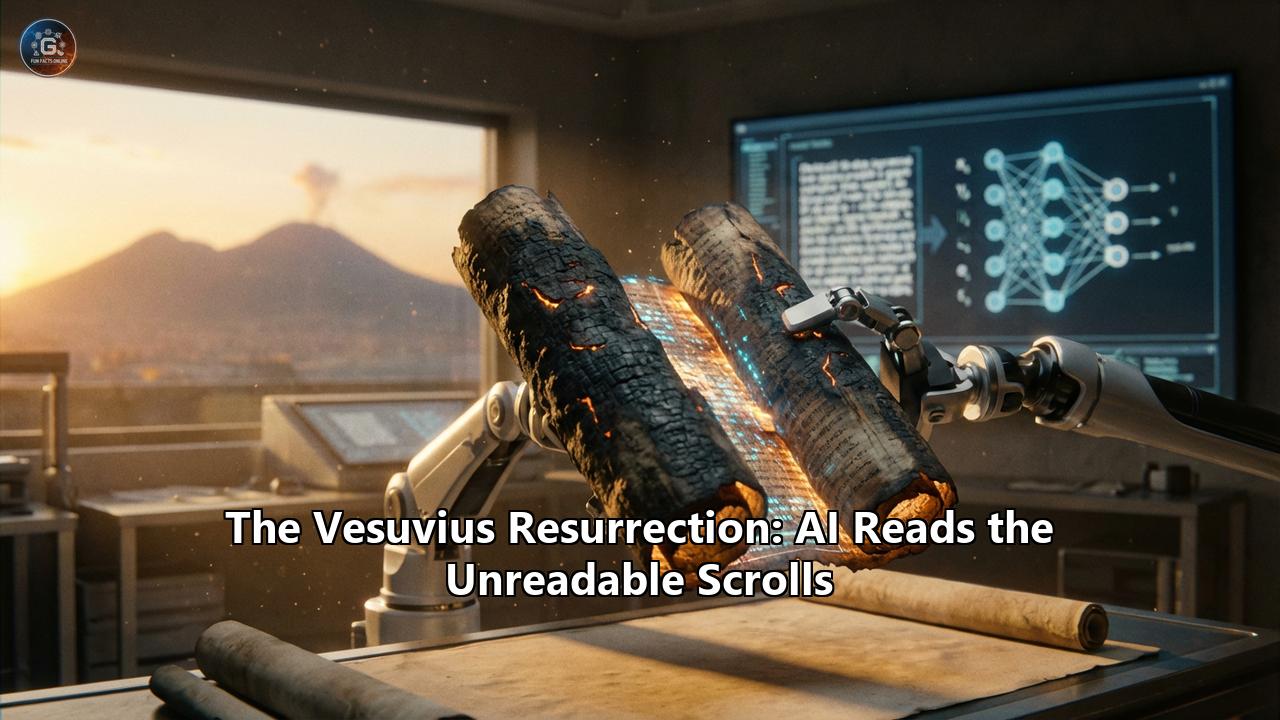
The Villa of the Papyri stood as a testament to the heights of Roman sophistication, a seaside palace in Herculaneum owned, it is believed, by Lucius Calpurnius Piso Caesonius, the father-in-law of Julius Caesar. Its floors were mosaics of intricate geometry, its gardens populated by bronze statues of runners and gods, and its library—the only one from antiquity to survive to the modern day—was stacked with nearly 1,800 papyrus scrolls.
Then came the afternoon of August 24, 79 AD. Mount Vesuvius, the looming shadow over the Bay of Naples, erupted with the force of a hundred thousand atomic bombs. While Pompeii was buried in ash and pumice, Herculaneum faced a different, more violent fate. A pyroclastic surge—a superheated avalanche of gas and rock moving at hurricane speeds—slammed into the town. The heat was so intense, reaching 500 degrees Celsius, that it instantly carbonized organic matter. The brains of victims vitrified into glass; bread turned to charcoal; and the scrolls in Piso’s library were flash-fried.
In an instant, the knowledge of the ancients was locked away, fused into lumps of carbon that looked more like burnt logs than books. For nearly 2,000 years, they slept in the darkness of the solidified mud, waiting for a technology that could match the violence of their preservation with the delicacy of light.
This is the story of the Vesuvius Resurrection: how a coalition of computer scientists, classicists, and silicon valley entrepreneurs used Artificial Intelligence to read the unreadable, unlocking a time capsule that promises to rewrite the history of philosophy and literature.
Part I: The Black Library
To understand the magnitude of the AI breakthrough, we must first understand the tragedy of the scrolls' discovery. When well-diggers accidentally punched through the roof of the Villa in 1750, they found a treasure trove of art. But they also found "lumps of charcoal" which were largely ignored or thrown away as fuel. It was only when one broke open, revealing faint traces of letters, that the excavators realized what they had found.
The early history of the Herculaneum papyri is a history of destruction. In their eagerness to read the texts, 18th-century antiquarians used knives to slice them open, destroying the outer layers to reach the inner ones. They tried mercury, rose water, and strange chemical concoctions. One early attempt involved slicing the scrolls down the middle, copying the visible text, and then scraping it away to see the layer beneath—a process that obliterated the artifact as it was read.
The hero of this early era was Antonio Piaggio, a monk from the Vatican who invented a machine in 1753 that could slowly, painfully unroll the scrolls. using silk threads and gravity. It took Piaggio four years to unroll a single scroll. While his machine saved some texts, the physical stress often tore the papyrus or left the inner layers stuck together, creating a chaotic "garbled" text that scholars struggled to interpret.
By the 20th century, archaeologists had largely given up. The "opened" scrolls were fragmentary and difficult to read. The "closed" scrolls—hundreds of them—sat in the National Library of Naples, deemed impossible to open without destroying them. They were the ultimate "cold case" of archaeology: a library of lost masterpieces, physically present but informationally inaccessible.
Part II: The Digital Architect
Enter Dr. Brent Seales. A computer science professor at the University of Kentucky, Seales is not your typical Indiana Jones figure. He deals in voxels, not bullwhips. In the early 2000s, Seales became obsessed with the idea of "virtual unwrapping." He reasoned that if a medical CT scan could look inside a human body to see a tumor without surgery, it should be able to look inside a scroll to see the writing without unrolling it.
The theory was sound, but the physics were unforgiving.
In 2015, Seales achieved a massive victory. He used his technique to read the En-Gedi scroll, a charred lump found in an ancient synagogue in Israel. The CT scans revealed the text to be the book of Leviticus, making it the oldest biblical text found since the Dead Sea Scrolls.
But Herculaneum was different. The En-Gedi scroll was written with ink containing metal (iron gall), which shows up brightly on X-rays because metal is denser than carbon. The Herculaneum scribes, however, used a carbon-based ink made of soot and gum.
This was the nightmare scenario: Carbon ink on carbonized papyrus.
To an X-ray, the ink and the paper look chemically identical. There is no density contrast. When Seales scanned the Herculaneum scrolls, the results were heartbreaking. The 3D structure of the scroll was visible—the complex, twisting layers of the spiral—but the pages appeared blank. The data was there, but the human eye couldn't see it. The ink was physically raised by only a few microns, a topographic bump on the fiber of the papyrus, invisible to standard imaging.
Seales suspected that even if the density was the same, the texture of the ink might be different from the papyrus. But he needed something sharper than the human eye to find it. He needed a brain that could learn to see the invisible.
Part III: The Vesuvius Challenge
While Seales had the scientific vision, the project needed scale. It needed speed. It needed the hive mind.
Enter Nat Friedman. The former CEO of GitHub and a tech investor, Friedman became captivated by Seales' work after watching a lecture online. He realized that this wasn't just an archaeological problem; it was a data science problem. If Seales could provide the high-resolution scans, the global community of AI researchers could build the models to read them.
In March 2023, Friedman, along with Seales and fellow investor Daniel Gross, launched the Vesuvius Challenge. They released terabytes of high-resolution CT scans of two intact scrolls (Scroll 1 and Scroll 2) taken at the Diamond Light Source particle accelerator in the UK.
The prize? Over $1,000,000 in cash awards, funded by Silicon Valley donors. The Grand Prize of $700,000 would go to the first team to read four distinct passages of text from the inner layers of the scrolls.
The challenge ignited a frenzy. Thousands of competitors joined the Discord server. They were a motley crew: particle physicists from Switzerland, biology students from Nebraska, robotics engineers from Egypt. They weren't papyrologists; they were pattern matchers.
The competition was broken down into three technical hurdles:
- Segmentation: The 3D X-ray scan is a solid cylinder of data (voxels). Before you can read writing, you have to digitally trace the individual sheets of papyrus as they spiral through the scroll. This is incredibly difficult because the scrolls are crushed, twisted, and fused. Imagine trying to trace a single noodle in a block of compressed lasagna.
- Flattening: Once a sheet is segmented (traced), it exists as a crumpled 3D mesh. It needs to be mathematically "flattened" into a 2D image, like pressing a wrinkled shirt.
- Ink Detection: This was the Holy Grail. On the flattened 2D image, which still looked blank to the naked eye, the AI had to find the ink.
Part IV: The Crackle Pattern
The breakthrough didn't come from a professor, but from a 21-year-old computer science student named Luke Farritor.
Farritor, an intern at SpaceX, spent his nights staring at the "crackle pattern." He noticed that in the high-resolution scans, the texture of the papyrus looked slightly different where there might be ink. It was a subtle, microscopic fracturing of the surface.
He trained a machine learning model—a Convolutional Neural Network (CNN)—to recognize this texture. He fed the model "truth data" from small fragments of broken-off scroll where the ink was visible to the eye, teaching the AI: "This texture is papyrus; this texture is ink."
Then, he applied the model to the invisible layers inside the intact scroll.
One night in August 2023, the model returned a result. On a screen in Nebraska, a few bright pixels lit up. Then a few more. They formed a shape. A vertical line. A loop.
ΠΟΡΦΥΡΑΣ (Porphyras)Purple.
It was the first word read from an unopened ancient scroll in history. "Purple" (or "purple dye") was a word of immense significance in the ancient world, associated with royalty, wealth, and sensory experience.
Farritor won the "First Letters Prize." But the race for the Grand Prize was just beginning.
Part V: The Winning Algorithm
While Farritor had found a word, Youssef Nader, an Egyptian biorobotics grad student in Berlin, was building an engine.
Nader’s approach was elegant and ruthless. He used a more complex architecture, a modified U-Net (commonly used in biomedical imaging to find tumors), combined with a "TimeSformer" attention mechanism. He didn't just look at the surface; his model looked at the 3D volume of the ink, slicing through the Z-axis of the paper to find the "shadow" the ink cast in the data.
Nader and Farritor, initially rivals, eventually teamed up with Julian Schilliger, a Swiss robotics student who had mastered the "segmentation" problem. Schilliger built a tool called "ThaumatoAnakalyptor" (The Miracle Uncoverer), which automated the tedious process of tracing the papyrus sheets.
Their combined super-team unleashed their AI on the data. The results were spectacular.
In early 2024, the team submitted their entry. It wasn't just a word. It wasn't just a sentence. It was fifteen columns of text.
The judges—top papyrologists from around the world—were stunned. They weren't looking at fuzzy guesses; they were looking at clear, legible Greek characters. The AI had not only found the ink; it had reconstructed it with a clarity that rivaled the physical scrolls opened by Piaggio.
On February 5, 2024, Nat Friedman announced the winners. The Vesuvius Challenge had been solved. The Resurrection was real.
Part VI: The Voice of Philodemus
What did the scroll say?
For 2,000 years, the thoughts inside this carbonized cylinder had been silent. Now, translated by scholars, a voice emerged. It was a voice of confidence, wit, and perhaps a little arrogance.
The author was identified as Philodemus of Gadara, an Epicurean philosopher who lived in the 1st century BC. Philodemus was the "house philosopher" of the Villa, a teacher who brought Greek Epicureanism to the Roman elite.
The text decoded by the AI is a philosophical treatise on pleasure.
In the decoded passages, Philodemus attacks his intellectual rivals (likely the Stoics) who argued that the scarcity of a good makes it more pleasurable. Philodemus disagrees. He argues that pleasure is defined by the satisfaction of natural and necessary desires, not by the rarity of the object.
He writes:
"...as too in the case of food, we do not immediately believe things that are scarce to be absolutely more pleasant than those which are abundant."He asks if the pleasure we get from a combination of elements is due to the major component or the minor one, debating the nuances of sensory experience, music, and food.
It is a stunningly human moment. Here, in a scroll burned by a volcano, is a man arguing about whether fancy, rare food actually tastes better than simple, abundant food. It bridges the millennia. The "pleasure" he discusses is the Epicurean ideal: ataraxia, or freedom from anxiety.
But the text also contained a tease. The final columns decoded by the team suggest that this scroll is just the beginning of a larger work. It ends with a hook, criticizing those who "have nothing to say about pleasure, either in general or in particular."
Part VII: The Invisible Library
The implications of this success are staggering.
The Villa of the Papyri is thought to contain mostly the works of Philodemus, but scholars believe the "Latin Library" of the Villa has yet to be found. The current collection is the "Greek Library." In Roman villas, these were often separate rooms.
If the technology can scale—and the Vesuvius Challenge 2025 goal is to read 90% of the scanned scrolls—we are on the verge of the greatest literary rediscovery since the Renaissance.
What could be in the other scrolls?
- Lost History: The lost books of Livy, which cover the history of Rome in detail. We currently have only 35 of the 142 books he wrote.
- Lost Poetry: The poems of Sappho. We have only fragments of her work today. A complete scroll of Sappho would revolutionize the study of ancient poetry.
- Lost Drama: The missing plays of Sophocles, Aeschylus, and Euripides. We possess only a tiny fraction of what they wrote.
- Early Christian Texts: While less likely in an Epicurean library, the timeline (79 AD) tantalizingly overlaps with the writing of the Gospels.
The "invisible library" is no longer a metaphor. It is a data set waiting to be processed.
Part VIII: The Future of the Past
The Vesuvius Resurrection is more than just reading one scroll. It is a validation of a new kind of archaeology. We are moving from the archaeology of atoms—digging, brushing, lifting—to the archaeology of bits.
The techniques developed by Nader, Farritor, and Seales can be applied to other "unreadable" texts:
- The Mummy Cartonnage: Ancient Egyptian mummy masks were often made from recycled papyrus. AI could read the texts inside the plaster without destroying the mask.
- Medieval Book Bindings: Parchment from older manuscripts was often glued together to make covers for new books. "Virtual unwrapping" could reveal the hidden layers.
- The Dead Sea Scrolls: Many fragments remain too brittle to touch.
The success of the Vesuvius Challenge has also democratized science. It proved that a student in a dorm room in Nebraska could solve a problem that baffled professors for centuries, provided they had access to the data and the incentive.
Conclusion: The Unburnt Mind
In 79 AD, the pyroclastic flow stopped the clock in Herculaneum. It was a tragedy that killed thousands. But in a cruel twist of irony, the volcano that destroyed the library also saved it. Had the scrolls not been carbonized, they would have rotted away in the humid Italian climate within a few centuries, just like almost every other papyrus from antiquity.
The fire turned them into stone, and the stone preserved the thought.
Now, as the AI scans parse the microscopic ridges of carbon ink, we are witnessing a resurrection. We are pulling the thoughts of Philodemus out of the fire. We are sitting down at the table with the ancients, listening to them argue about food, music, and the nature of a good life.
The scrolls are unreadable no more. The Vesuvius Resurrection has begun, and the library is open.
Reference:
- https://www.extremetech.com/extreme/225338-roman-scrolls-long-buried-by-vesuvius-reveal-their-secrets
- https://www.youtube.com/watch?v=h3zI9SVJsqc
- https://www.neh.gov/news/students-decipher-2000-year-old-herculaneum-scrolls
- https://en.wikipedia.org/wiki/Herculaneum_papyri
- https://www.ancient-origins.net/artifacts-ancient-writings-news-history-archaeology/herculaneum-scroll-buried-mount-vesuvius-79-ad
- https://dig.watch/updates/researchers-virtually-unroll-and-decipher-ancient-roman-scrolls-through-revolutionary-technology
- https://www.youtube.com/watch?v=rvVRXPsX9x8
- https://medium.com/aimonks/unveiling-the-secrets-of-the-herculaneum-scrolls-a-remarkable-breakthrough-6660e0852c02
- https://www.wuky.org/local-regional-news/2023-10-13/technology-developed-by-professor-at-uk-helps-digitally-unwrap-mystery-of-2-000-year-old-herculaneum-scrolls
- https://www.youtube.com/watch?v=z_1078WDY3E
- https://www.finebooksmagazine.com/news/title-work-deciphered-sealed-herculaneum-scroll-digital-unwrapping
- https://www.ancient-origins.net/news-history-archaeology/herculaneum-scroll-deciphered-0020309
- https://www.cbsnews.com/news/herculaneum-scrolls-scientists-digitally-unroll-2000-year-old-papyrus/
- https://www.cbsnews.com/news/scroll-buried-mount-vesuvius-eruption-deciphered-artificial-intelligence/
- https://www.nationalgeographic.com/premium/article/herculaneum-scrolls-vesuvius-challenge-seales
- https://www.nationalgeographic.com/science/article/ai-scrolls-ancient-rome
- https://electronics360.globalspec.com/article/7367/using-3-d-virtual-technology-to-unwrap-a-1-500-year-old-scroll
- https://arkeonews.net/the-artificial-intelligence-revolution-the-dark-age-of-ancient-scrolls-ends/