
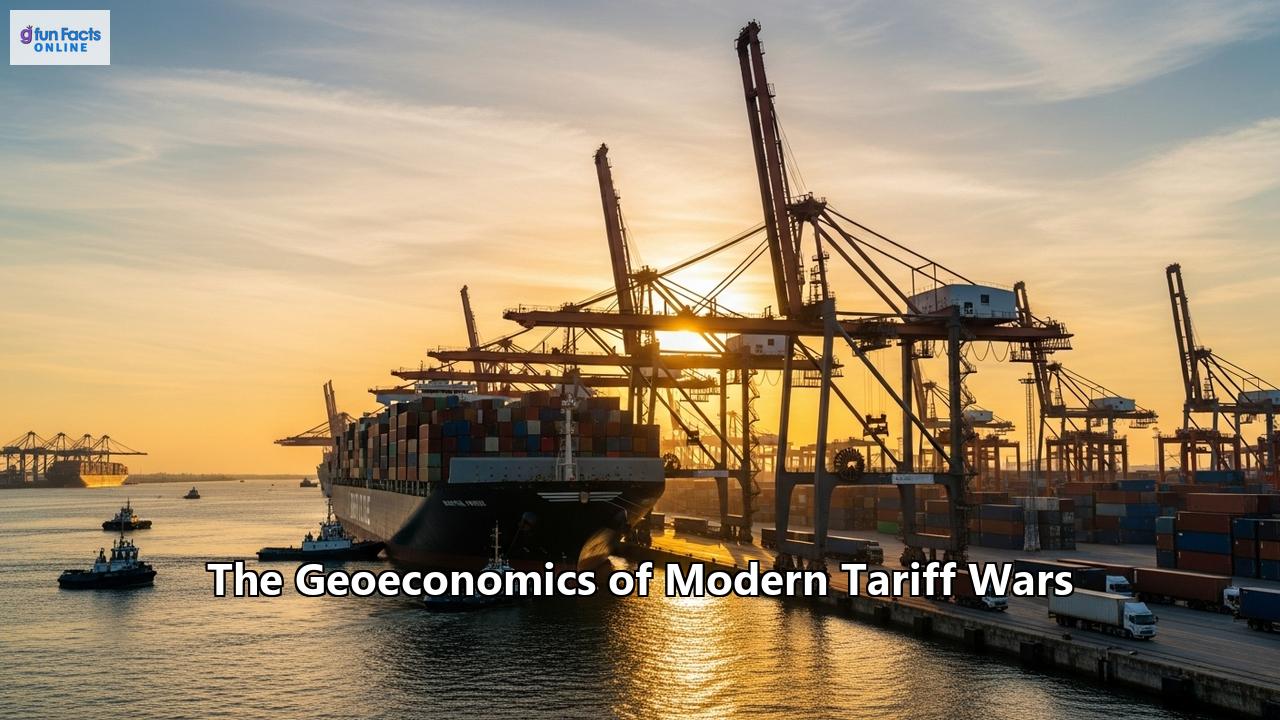
The New Battlefield: Navigating the Geoeconomics of Modern Tariff Wars
In an increasingly interconnected world, the lines between economic policy and geopolitical strategy have blurred, giving rise to a new era of global competition. At the heart of this evolving landscape lies the concept of geoeconomics, where nations wield economic instruments to project power and pursue strategic objectives. One of the most prominent and disruptive tools in this modern arsenal is the tariff, a tax on imported goods that has been weaponized to wage complex and often damaging trade wars. This article delves into the geoeconomics of modern tariff wars, exploring their historical context, the motivations behind them, their multifaceted impacts, and their role in reshaping the international order.
The Rise of Geoeconomics: A Shift in Global Power Dynamics
The term "geoeconomics" has gained significant traction in recent years, reflecting a fundamental shift in how international relations are conducted. It refers to the use of economic tools to achieve geopolitical goals, a departure from the post-Cold War consensus that largely separated market dynamics from political power. In this new paradigm, trade policy, investment, sanctions, and control over critical technologies and supply chains are no longer just matters of economic well-being but are central to a nation's security and influence on the world stage.
The resurgence of geoeconomic thinking can be attributed to several factors. The rise of China as a major economic and technological power has challenged the unipolar dominance of the United States, leading to a new era of great power competition. Furthermore, the 2008 financial crisis and the COVID-19 pandemic exposed the vulnerabilities of deeply integrated global supply chains, prompting a renewed focus on economic resilience and national security. This has led to a convergence of economic and security concerns, with nations increasingly viewing economic interdependence as a potential source of risk.
Tariff Wars: A Historical Perspective
Tariff wars, or economic conflicts where countries impose escalating tariffs on each other's exports, are not a new phenomenon. History is replete with examples of trade disputes that have had profound economic and political consequences.
One of the earliest and most infamous examples is the Smoot-Hawley Tariff Act of 1930 in the United States. Enacted to protect American farmers and industries at the onset of the Great Depression, the act raised tariffs to record levels. This move backfired spectacularly, triggering retaliatory tariffs from other countries, contributing to a 61% decline in U.S. exports by 1933, and exacerbating the global economic downturn. Many historians argue that the Smoot-Hawley tariffs also contributed to the rise of political extremism that ultimately led to World War II.
Other notable historical tariff conflicts include:
- The British Corn Laws (1815-1846): High tariffs on imported grain protected British landowners but caused widespread hardship, eventually leading to their repeal and a shift towards free trade.
- The Anglo-Irish Trade War (1932-1938): A dispute over land annuity payments led to a six-year tariff war that severely damaged the Irish economy.
- The "Chicken War" of the 1960s: The European Economic Community imposed tariffs on American chicken, leading to retaliatory U.S. tariffs on various European goods.
- The 1980s U.S.-Japan Trade Conflict: The U.S. accused Japan of unfair trade practices in the automotive and electronics sectors, leading to the imposition of quotas and the threat of tariffs. Japan responded with voluntary export restraints.
- The "Banana Wars" (1993-2012): The European Union's preferential tariffs for bananas from former colonies sparked a lengthy dispute with the United States and Latin American producers, which was eventually settled through the World Trade Organization (WTO).
These historical examples underscore a recurring theme: while intended to protect domestic industries, tariff wars often lead to mutually destructive outcomes, disrupting trade, increasing consumer prices, and straining international relations.
The Anatomy of Modern Tariff Wars: The U.S.-China Conflict
The most significant modern example of a geoeconomic tariff war is the ongoing trade conflict between the United States and China. This dispute, which escalated significantly in 2018, goes beyond traditional trade disagreements over tariffs and quotas. It represents a fundamental clash between two competing economic and geopolitical models.
The U.S. has justified its tariffs on Chinese goods by citing a range of grievances, including intellectual property theft, forced technology transfer, and unfair state subsidies to Chinese companies. China, in turn, has retaliated with its own tariffs on American products, particularly agricultural goods. This tit-for-tat escalation has had far-reaching consequences for the global economy.
The U.S.-China trade war exemplifies the core tenets of modern geoeconomics. For the U.S., the tariffs are not just about reducing the trade deficit; they are a tool to counter China's technological rise and protect America's long-term economic and national security interests. For China, the conflict is a test of its economic resilience and its ability to challenge the U.S.-led global order.
The Ripple Effects: Impacts on Global Trade and Supply Chains
The fallout from modern tariff wars extends far beyond the primary belligerents. The interconnectedness of the global economy means that disruptions in one part of the system can have cascading effects worldwide.
For Consumers and Businesses: Tariffs act as a tax on imported goods, and this cost is often passed on to consumers in the form of higher prices. This can lead to inflation and reduced purchasing power. For businesses that rely on global supply chains, tariffs increase production costs, reduce competitiveness, and create uncertainty. The U.S.-China trade war, for example, has hurt American manufacturers who rely on Chinese components and has also negatively impacted the Chinese economy. Global Supply Chain Restructuring: The sustained use of tariffs is forcing companies to rethink their global supply chain strategies. To avoid the impact of tariffs, some businesses are "reshoring" or bringing manufacturing back to their home countries, while others are diversifying their sourcing to other nations. This "deglobalization" trend, accelerated by the pandemic, represents a significant shift away from the efficiency-focused supply chains of the past towards a model that prioritizes resilience and risk mitigation. Weaponization of Economic Interdependence: The U.S.-China conflict has also highlighted how economic interdependence can be weaponized. The U.S. has leveraged its control over key technologies, such as semiconductors, and its central role in the global financial system to exert pressure on China. Conversely, China's dominance in the manufacturing of certain goods and its control over critical raw materials give it leverage in the ongoing trade dispute.The Role of International Institutions and the Future of Global Trade
The rise of geoeconomics and the proliferation of tariff wars have placed immense strain on the rules-based international trading system, which is embodied by the World Trade Organization (WTO). The WTO was created to provide a forum for negotiating trade agreements and resolving disputes, but its authority has been challenged by the unilateral actions of major economic powers.
The U.S. has, at times, threatened to withdraw from the WTO and has blocked appointments to its appellate body, effectively hampering its ability to adjudicate disputes. This has led to a situation where countries are increasingly resorting to bilateral or regional agreements to govern their trade relationships, potentially leading to a more fragmented and less predictable global trading environment.
Looking ahead, the geoeconomics of modern tariff wars are likely to remain a defining feature of the international landscape. The great power competition between the U.S. and China shows no signs of abating, and other nations are increasingly adopting geoeconomic strategies to advance their own interests.
This new reality presents both challenges and opportunities. The challenges lie in the potential for escalating trade conflicts to destabilize the global economy and undermine international cooperation. However, the current environment may also spur the development of new, more resilient economic models that are less vulnerable to geopolitical shocks.
In conclusion, the modern era of tariff wars is more than just a series of trade disputes. It is a manifestation of a deeper shift in global power dynamics, where economic tools are being used as instruments of statecraft. Navigating this new geoeconomic landscape will require a sophisticated understanding of the interplay between economics, politics, and security, as well as a renewed commitment to finding cooperative solutions to shared global challenges. The lessons from history are clear: while tariffs may offer short-term protection, they often lead to long-term pain, and a world of open and fair trade remains the surest path to global prosperity.
Reference:
- https://www.ui.se/english/research/europe/geoeconomics/
- https://corporatefinanceinstitute.com/resources/economics/trade-wars/
- https://www.chathamhouse.org/2016/12/geoeconomics-explained
- https://en.wikipedia.org/wiki/Geoeconomics
- https://nordicdefencereview.com/trade-wars-batter-defence-industry-and-sometimes-lead-to-real-wars/
- https://intelligence.weforum.org/topics/a1Gb0000000LHOoEAO
- https://www.investopedia.com/terms/t/tariff-war.asp
- https://greenwichlibrary.bibliocommons.com/v2/list/display/1015184247/1436757397
- https://www.britannica.com/money/trade-war-meaning
- https://www.history.com/articles/7-trade-wars-boston-tea-party-smoot-hawley
- https://www.ndtv.com/world-news/banana-war-to-trump-tariffs-a-brief-history-of-trade-wars-8083948
- https://www.gsb.stanford.edu/insights/us-china-trade-war-return-geoeconomics
- https://www.investopedia.com/terms/t/trade-war.asp
- https://tribune.com.pk/story/2557298/geo-economics-of-trade-and-development
- https://www.mapfre.com/en/insights/economy/geoeconomic-tensions-global-trade/
- https://www.cfr.org/trade-tariffs-and-trumponomics
- https://en.wikipedia.org/wiki/Trade_war