
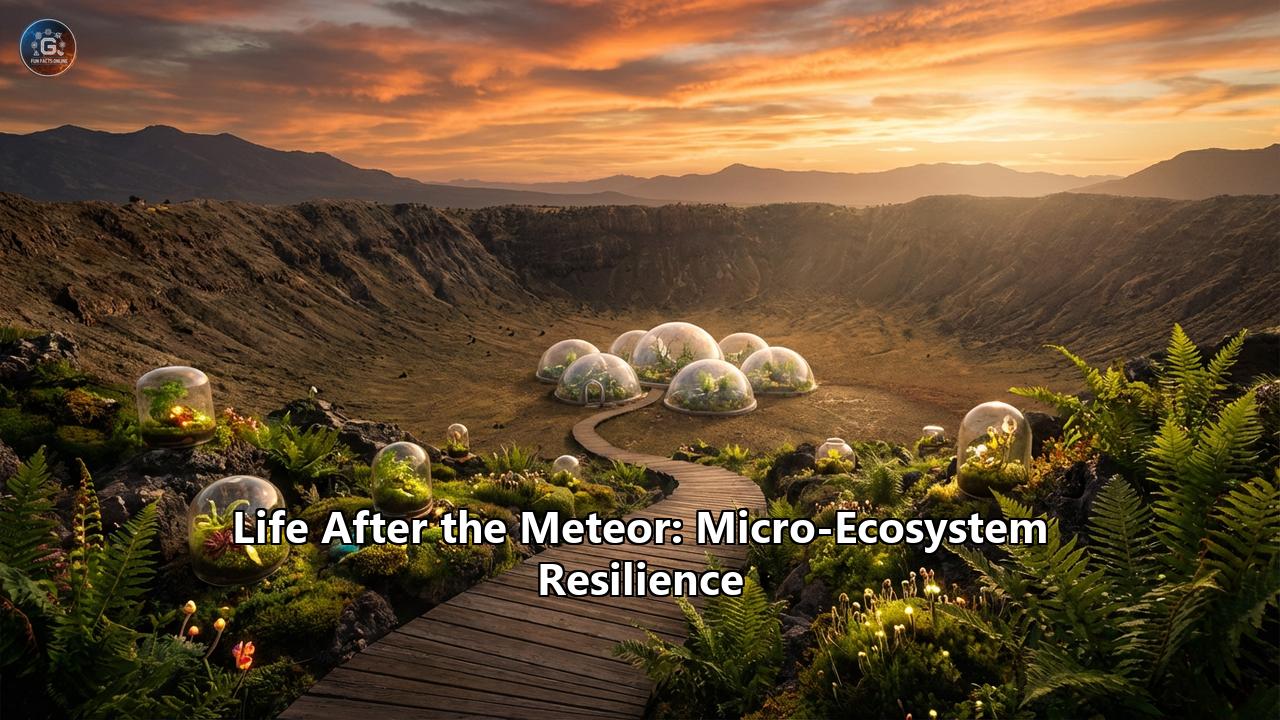
I. The Silence of the Giants, The Roar of the Microbes
The date is 66,043,000 years ago, give or take a few millennia. For over 150 million years, the Earth has been the domain of giants. The ground has trembled under the footfalls of Argentinosaurus; the air has been cleft by the leathery wings of Quetzalcoatlus. To an observer standing on the shores of the Western Interior Seaway, the biosphere seems immutable, a permanent architecture of scale and power.
Then, in a single, blinding second, the architecture collapses.
A bolide, ten kilometers wide and traveling at twenty kilometers per second, strikes the carbonate platform of the Yucatán Peninsula. The energy release is incomprehensible—100 million megatons of TNT, two million times more powerful than the most potent nuclear weapon ever detonated. In the immediate radius of the Chicxulub impact, life is vaporized. A wall of plasma expands outward, followed by a shockwave that flattens forests thousands of kilometers away. Ejecta is lofted into the stratosphere, superheated to incandescence, raining back down globally as trillions of shooting stars, broiling the atmosphere and igniting wildfires on every continent.
When the fires burn out, a new terror begins. Vaporized rock and sulfur aerosols choke the sky, plunging the planet into a deep, bruised darkness. Photosynthesis ceases. Temperatures plummet. The "Impact Winter" has begun.
In the fossil record, this moment is a black line. Below it, the Cretaceous diversity of dinosaur bone and ammonite shell. Above it, for thousands of years, a ghostly silence. The giants are gone. The great metabolic engines of the Mesozoic—the herbivores that required tons of fodder, the carnivores that hunted them—starved in the cold dark.
But look closer. Kneel in the mud of this ruined world, zoom in past the charcoal layer, past the shattered vertebrae, down to the micrometer scale. There, in the soil pore spaces, in the frozen mud of a drying pond, in the guts of a surviving shrew, a different story is unfolding. It is a story not of extinction, but of defiance.
While the macro-world died, the micro-world went to war. This is the untold saga of the K-Pg boundary: the triumph of the invisible. It is a story of fungal blooms that consumed a dying world, of water bears that turned to glass to weather the cold, and of the microscopic engineers that rebuilt the biosphere from the ashes up.
II. The Fungal Spike: A World of Decay
In the immediate aftermath of the impact, the Earth was a graveyard. Forests were leveled, their charred trunks lying in heaps. Billions of tons of animal biomass lay rotting. In a functioning ecosystem, death is quickly recycled. But with the sun blocked and plants dying, the primary producers had failed. The food web collapsed from the bottom up.
However, one kingdom of life looked at this global catastrophe and saw the greatest feast in history.
Paleontologists analyzing rock layers at the K-Pg boundary—from New Zealand to North America—have discovered a strange anomaly. Just above the layer of iridium-enriched impact dust, pollen grains vanish. In their place is a massive surge in fungal spores. This phenomenon is known as the Fungal Spike.
The dominant microfossils of this era are not the intricate shapes of flowering plants, but the simple, resilient spores of fungi like Monoporisporites. For a brief, surreal window of time—perhaps a few years, perhaps a decade—Earth was not a planet of plants and animals, but a planet of mushrooms and molds.
This "strangelove ocean" of decay was a critical engine of survival. Without the sun, the energy flow of the planet shifted from production (photosynthesis) to decomposition (saprotrophy). Fungi did not need sunlight; they needed carbon, and the dead world was made of carbon. They broke down the lignin of fallen trees and the collagen of fallen dinosaurs, releasing nutrients back into the soil that would otherwise have been locked away forever.
In the darkness, vast mycelial networks expanded through the ash-choked soil. These networks became the life-support systems for the few remaining plants. Modern research suggests that some plants may have survived the years of darkness by tapping into these fungal networks, trading their remaining carbohydrate reserves or simply parasitizing the fungi to stay alive—a survival strategy known as mycoheterotrophy. The fungi were not just undertakers; they were the bridge across the abyss.
III. The Cryptobiotic Shield: Surviving the Impact Winter
While fungi feasted, the animal kingdom faced a binary choice: adapt or die. For the large, the choice was made for them. But for the microscopic invertebrates—creatures smaller than a grain of rice—evolution had provided a secret weapon.
The impact winter brought two deadly conditions: extreme cold and, strangely, extreme drought. As water locked up in ice and atmospheric circulation stalled, the land became an arid, frozen wasteland.
Enter the Tardigrade, the Rotifer, and the Nematode.
These lineages are ancient, predating the dinosaurs by hundreds of millions of years. Their survival strategy is not flight or fight, but suspension. When faced with desiccation or freezing, these organisms enter a state called cryptobiosis.
Imagine a tardigrade in a moss patch on a Cretaceous tree. The heat pulse from the impact dries the moss instantly. A human would die. The tardigrade, however, curls its eight legs inward, expels the water from its body, and synthesizes a sugar called trehalose. This sugar replaces the water in its cells, turning the cellular fluid into a biological glass. The tardigrade becomes a "tun"—a dry, lifeless husk.
In this state, its metabolism drops to 0.01% of normal. It does not eat, breathe, or age. It is effectively a granule of sand. It can withstand temperatures near absolute zero, intense radiation, and the vacuum of space.
During the K-Pg impact winter, millions of these microscopic tuns lay scattered in the dust. The acid rain fell, the temperatures dropped to freezing, and the sun vanished for years. The tuns waited. They were time travelers, skipping the apocalypse by simply pausing their biological clocks.
Alongside them were the Springtails (Collembola). These hexapods are not quite insects, but they are omnipresent in soil. Modern studies have revealed that Arctic springtails possess a potent adaptation: antifreeze proteins. These proteins bind to ice crystals within the body, preventing them from growing and rupturing cells. It is highly probable that the ancestors of modern springtails possessed this genetic toolkit. As the tropics froze, the springtails did not need to migrate. They simply activated their antifreeze and continued to graze on the exploding fungal populations.
This micro-resilience explains a key puzzle of the fossil record: the survival of soil biology. While the canopy died, the soil ecosystem—the "brown food web"—remained largely intact. The mites, springtails, and nematodes that churned the earth found refuge in the soil's thermal inertia and their own physiological superpowers.
IV. The Fern Spike: The Pioneers of the Ash
As the dust slowly settled and the sun began to pierce the gloom, the grip of the fungi loosened. The world was grey, covered in unstable ash and mud. The first vascular plants to reclaim this moonscape were not the flowering trees that had dominated the late Cretaceous, but an ancient lineage: the Ferns.
The fossil record shows a dramatic "Fern Spike" immediately following the fungal interval. In some regions, fern spores like Cyathidites and the swamp fern Stenochlaena make up 90% of the palynological record.
Why ferns? The answer lies in the "micro-ecology" of reproduction.
Most Cretaceous trees reproduced via heavy seeds or insect-pollinated flowers. The insects were dead; the heavy seeds had no mechanism to spread across the vast dead zones. Ferns, however, reproduce via microscopic spores. A single fern can release millions of spores into the wind. These spores are light, durable, and capable of traveling thousands of kilometers.
More importantly, fern spores are adapted to "primary succession"—the colonization of raw, nutrient-poor ground. We see this today in modern disaster zones.
Modern Analog: Mount St. HelensWhen Mount St. Helens erupted in 1980, it created a sterile "pumice plain" that baffled ecologists. It seemed nothing could grow there. The first colonizers were not trees, but small, hardy species. While lupines are often cited for their nitrogen-fixing ability, the micro-succession was even more critical.
Before the plants could take hold, biological soil crusts (biocrusts) had to form. Cyanobacteria, mosses, and lichens wove a sticky web over the loose ash, stabilizing it against erosion and trapping moisture. In the K-Pg aftermath, this "micro-skin" of the Earth would have been the first green layer. The fern gametophytes—tiny, heart-shaped, sexual phases of the fern life cycle—thrived in these damp, low-light micro-habitats.
The ferns of the K-Pg were the "disaster taxa." They didn't just survive; they specialized in ruin. Stenochlaena, a climbing fern, formed dense thickets in the swamps, stabilizing the banks of acid-choked rivers and creating the first shade for the recovering seedlings of the flowering plants.
V. Refugia: The Underground Ark
While the surface was a battleground of spores and ice, the "Refugia" theory explains the survival of larger organisms. But these refugia were often microscopic in scale.
Consider the freshwater ecosystems. The fossil record shows that freshwater fish, amphibians, and turtles survived the extinction event at much higher rates than their marine counterparts. Why?
The answer lies in the detritus loop. Marine food webs are based on phytoplankton. When the sun went out, the plankton died, and the entire marine chain snapped. Freshwater systems, however, are often fueled by detritus—dead organic matter washing in from the land. The massive die-off of terrestrial vegetation provided a glut of food for freshwater detritivores. Insect larvae, crayfish, and small mollusks feasted on the rot. The fish and turtles that ate them survived.
Furthermore, freshwater bodies have high thermal inertia. A deep pond does not freeze solid as quickly as the air cools. In the bottom mud of these ponds, life hunkered down.
On land, the refugia were subterranean. The concept of the "fossorial advantage" is crucial. Small mammals, lizard-like rhynchocephalians, and early relatives of modern marsupials survived because they were burrowers.
Modern Analog: The Pocket GopherReturning to Mount St. Helens, the Northern Pocket Gopher (Thomomys talpoides) survived the volcanic blast in its deep burrows. But its role didn't end with survival. By tunneling through the sterile ash, these gophers brought old, nutrient-rich soil to the surface. These "mound micro-habitats" became oases where seeds could germinate.
In the post-meteor world, the surviving burrowers—multituberculates and early eutherians—acted as bioturbators. They mixed the toxic iridium-laced dust with the underlying soil. Their burrows provided micro-climates where humidity was high and temperatures were stable, shielding the "micro-ecosystem" of symbiotic bacteria and fungi that would later repopulate the surface.
VI. Chernobyl and the "Toxic" Adaptation
The K-Pg world was not just cold; it was chemically hostile. The impact vaporized anhydrite rocks, releasing gigatons of sulfur and creating acid rain with a pH similar to battery acid. Heavy metals from the asteroid polluted the soil.
To understand how life copes with such toxicity, we look to the Chernobyl Exclusion Zone.
After the 1986 nuclear disaster, the "Red Forest" pine trees died instantly. But the microbial world adapted with terrifying speed. Scientists have discovered "radiotrophic" fungi in the reactor ruins that use melanin—the same pigment in our skin—to convert gamma radiation into chemical energy.
In the soil of Chernobyl, the microbial community shifted. Bacteria like Firmicutes became more prevalent in the guts of local voles, aiding in the digestion of complex plant matter and perhaps detoxifying ingested radionuclides.
This modern analog suggests that the K-Pg micro-biosphere was likely a hotbed of rapid evolution. In the acid-drenched soils, acidophilic (acid-loving) archaea and bacteria would have boomed. These microbes would have been the first to neutralize the soil pH, processing the sulfur and heavy metals, slowly making the ground habitable for plant roots again. The recovery of the biosphere was likely led by a "remediation crew" of single-celled organisms that cleaned the mess left by the asteroid.
VII. The Marine Reboot: A Tale of Two Recoveries
In the oceans, the story of resilience is even more stark. The collapse of the phytoplankton was catastrophic—90% of the nannoplankton species went extinct. The ocean turned into a "Strangelove Ocean," depleted of life and productivity.
For decades, scientists believed the ocean remained a wasteland for millions of years. But new high-resolution analysis of microfossils has overturned this view.
We now know that functional recovery happened much faster than species recovery.
Within a mere 100 years of the impact, bacterial blooms appeared. Within 30,000 years—a blink of an eye in geological time—the Chicxulub crater itself, the very Ground Zero of the apocalypse, was teeming with life.
How? The impact created a hydrothermal system. The fractured crust, superheated by the impact energy, circulated seawater, creating mineral-rich vents. Just as life may have begun in hydrothermal vents, it restarted there too. Chemosynthetic bacteria colonized the crater, feeding on chemical energy rather than sunlight. These bacteria supported colonies of tubeworms and small crustaceans.
In the open ocean, "disaster plankton" like Guembelitria took over. These were tiny, opportunistic species that thrived in the chaotic, nutrient-rich, low-competition waters. They were the "weeds" of the sea.
It took millions of years for the complex, specialized plankton (and the food webs they supported) to return, but the machinery of the ocean—the pumping of carbon, the cycling of nutrients—was rebooted by these microscopic opportunists almost immediately. The resilience of the ocean lay not in its diversity, which was shattered, but in the redundancy of its smallest players.
VIII. The Legacy: How the Micro-World Built the Cenozoic
The world that emerged from the K-Pg boundary was fundamentally different. The dinosaurs were gone, yes, but the micro-structure of the planet had changed.
The "Fern Spike" eventually gave way to the "Angiosperm Explosion." The flowering plants, which had been present but not fully dominant in the Cretaceous, exploded in diversity. Why?
One theory is that the "reboot" of the soil nitrogen cycle by the post-impact microbial community favored plants that could form symbiotic relationships with nitrogen-fixing bacteria. The Legumes (bean family) are the masters of this. They host Rhizobia bacteria in their roots. It is no coincidence that the first rain forests—dense, multi-layered canopies—appear in the fossil record shortly after the recovery. The micro-ecosystem, enriched by the pulse of death and recycled by the disaster taxa, provided the nutritional foundation for the dense vegetation that would eventually support the rise of mammals.
Furthermore, the "Springtail Survival" and the persistence of soil mites meant that the decomposer community was ready and waiting when the forests returned. Without these tiny arthropods to break down leaf litter, the nutrients would have remained locked in dead plant matter, and the new forests would have starved.
IX. Conclusion: The Indestructible Thread
We often view the history of life as a history of kings—the T. rex, the Mammoth, the Human. But the K-Pg extinction teaches us that the true kings of Earth are its smallest inhabitants.
When the sky fell, the giants could not hide. They could not turn into glass, nor freeze solid and wake up, nor feast on the decay of their kin. They were too big, too hungry, too specialized.
But in the soil, in the water, and in the rock, the micro-ecosystem held the line. The fungal hyphae stitched the wounded earth together. The cyanobacteria glued the ash into soil. The tardigrades and nematodes slept through the nightmare, guarding the genetic spark of animal life in their suspended bodies.
Life did not just "return" after the meteor. It never left. It just got very, very small. And when the sun finally broke through the haze of the impact winter, it was these invisible architects who laid the foundation for the world we know today. The resilience of the biosphere is not measured in the stride of a dinosaur, but in the endurance of a spore.