
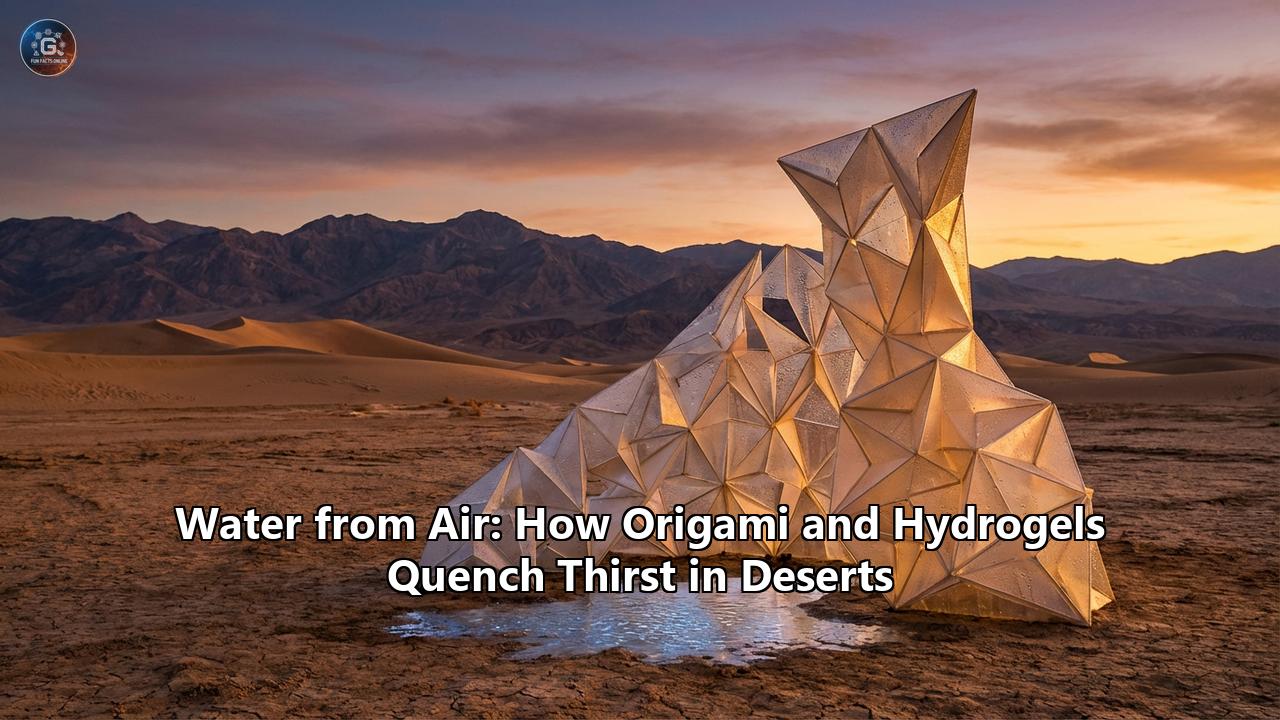
The sun beats down on the cracked earth of Death Valley, a place where the air itself seems thirsty. It is one of the driest places on the planet, a landscape of salt flats and searing heat where survival feels like a defiance of nature. Yet, in this crucible of aridity, a black, window-sized panel stands silent and still. It has no plugs, no moving fans, and no loud compressors. It simply sits there, breathing. As the sun climbs higher, droplets of pure, crystal-clear water begin to bead on the glass, trickling down into a collection tube. By the end of the day, this passive device has wrung a cup of life-sustaining liquid from air so dry it cracks human lips.
This is not magic; it is the cutting edge of material science. It is the marriage of ancient geometry and modern chemistry—a technology where "origami" meets "hydrogels" to quench the world's thirst.
In a world where freshwater is becoming the new gold, the race to unlock the vast atmospheric reservoir—the 13 trillion liters of water floating above our heads as vapor—is heating up. For decades, we have looked to the ground for water, draining aquifers and diverting rivers. Now, scientists are looking up. And the solution they are finding lies in a squishy, jelly-like material folded into complex shapes, capable of pulling drinking water from the driest deserts on Earth.
Part I: The Atmospheric Ocean
To understand the magnitude of this breakthrough, we must first understand the resource it taps into. The Earth’s atmosphere is a colossal, invisible river. At any given moment, the sky holds more freshwater than all the rivers on Earth combined. It is a renewable resource, constantly replenished by evaporation from the oceans.
For centuries, civilizations have tried to harvest this water. The Incas collected dew; the people of the Atacama Desert use fog catchers—massive mesh nets that snag passing clouds. But these ancient methods have a fatal flaw: they require high humidity. Fog catchers need thick, moist banks of fog to work. They are useless in the true deserts, the arid interiors where billions of people live on the razor's edge of water scarcity.
Modern engineering gave us "atmospheric water generators" (AWGs), essentially heavy-duty dehumidifiers. They work by cooling air until the water condenses, much like a cold soda can "sweats" on a hot day. But these machines are energy gluttons. They require massive amounts of electricity to run compressors and fans. In off-grid villages or disaster zones—places where power is as scarce as water—they are glorified paperweights.
The holy grail of water science has always been a passive system. A device that needs no electricity, works in bone-dry air, and runs on the only abundant energy source in the desert: sunlight.
Enter the hydrogel.
Part II: The Sponge That Breathes
The heart of this new technology is a material known as a hydrogel. To the naked eye, it looks like a cross between a contact lens and a piece of Jell-O. At a molecular level, it is a tangled network of polymer chains—long, spaghetti-like molecules that love water.
Hydrogels are not new; they are the magic ingredient in disposable diapers that allows them to soak up massive amounts of liquid. But a standard diaper can only hold liquid water; it cannot grab water vapor out of the air. To turn a hydrogel into an atmospheric sponge, researchers at MIT, led by Professor Xuanhe Zhao, had to supercharge it.
They infused the hydrogel with lithium chloride, a type of salt. If you’ve ever seen a salt shaker clog up in humid weather, you know that salt is hygroscopic—it naturally attracts moisture from the air. Lithium chloride is the champion of this property; it is so thirsty it will pull water vapor out of air with as little as 20% humidity (typical of a desert afternoon).
However, simply mixing salt into a gel isn't enough. In early experiments, the salt would dissolve in the water it captured and leak out, rendering the device useless after a few cycles. The breakthrough came when the researchers added a third ingredient: glycerol. This common compound acted as a stabilizer, locking the salt ions into the polymer network.
The result was a super-material: a hydrogel that could sit in dry air and aggressively suck in water vapor, swelling and becoming heavy with moisture. But capturing the water is only half the battle. You have to get it back out.
Part III: The Origami Revolution
This is where the ancient art of paper folding, or origami, enters the equation.
In the world of surface chemistry, shape is everything. A flat sheet of hydrogel is inefficient. It has a limited surface area exposed to the air, meaning it takes a long time to absorb moisture and even longer to release it. In a passive system driven by the sun, speed is crucial. You only have a few hours of peak sunlight to heat the gel and release the water.
The MIT team realized that to make the system viable, they needed to maximize the surface area without making the device massive. They turned to nature’s favorite geometric trick: folding.
They molded the hydrogel into a 3D structure that resembles a black, architectural bubble wrap. This isn't just random texture; it is a calculated "origami" array of micro-domes.
Why the "Bubble" Shape Matters:- Absorption: The dome shape exposes more surface area to the air, allowing the thirsty salt ions to grab moisture from multiple angles simultaneously.
- Desorption (Release): When the sun hits the black hydrogel, the heat needs to penetrate evenly. The thin, curved walls of the domes heat up faster than a thick, flat slab.
- The "Breathing" Motion: As the hydrogel swells with water, the origami domes expand. When they dry out, they shrink. This physical movement—a literal swelling and shrinking—helps cycle the air around the material, keeping the process dynamic.
The device operates on a simple, rhythmic cycle, perfectly synced with the desert day.
- The Night Cycle (Absorption): At night, the box is opened to the air. The desert cools, and the relative humidity rises slightly. The hydrogel "bubbles" greedily absorb water vapor, swelling up and storing the moisture inside their polymer chains. The salt locks the water in, preventing it from evaporating back out.
- The Day Cycle (Release): When the sun rises, the box is closed. The black hydrogel acts as a solar absorber, heating up rapidly. The heat breaks the weak bonds holding the water molecules to the salt. The water turns into steam, rises, and hits the cooler glass cover of the box. There, it condenses into liquid droplets and flows down into a sterile collection tank.
Part IV: The Death Valley Test
Theory is one thing; the desert is another. To prove their device worked, the researchers didn't go to a humid backyard in Boston. They went to Death Valley.
In the blistering heat of the Mojave, where relative humidity often drops below 20%, most passive water harvesters fail. They simply cannot pull enough moisture from the parched air to overcome the rate of evaporation.
The origami hydrogel device was set up on the valley floor. The results were startling. Even in these punishing conditions, the device produced drinking water. The "bubble wrap" design proved to be a game-changer. The accelerated kinetics allowed the gel to release its captured water quickly during the limited window of peak sunlight.
The test showed that a single square meter of this material could generate several liters of water per day in moderate humidity, and a survival-sustaining amount even in extreme aridity. For a hiker lost in the dunes, or a soldier at a remote outpost, a device the size of a backpack could mean the difference between life and death.
Part V: Beyond the Hydrogel – The MOF Contender
While MIT’s hydrogels are grabbing headlines, they are not the only players in the "water-from-air" game. Just across the country at UC Berkeley, another scientific titan, Professor Omar Yaghi, has been pioneering a rival technology: Metal-Organic Frameworks (MOFs).
If hydrogels are like super-sponges, MOFs are like molecular cages. They are crystalline powders made of metal atoms connected by organic linkers, forming a 3D lattice with incredibly vast internal surface areas. A single gram of MOF powder, if unfolded, would cover a football field.
The pores in these MOFs are engineered to be the exact size of a water molecule. This means they can be incredibly selective. They don't just "absorb" water; they trap it in a lock-and-key mechanism.
The Clash of Technologies:- MOFs: operate brilliantly at ultra-low humidity (even 10%). They are precise and efficient but historically expensive to manufacture, requiring exotic metals like zirconium.
- Hydrogels: are generally cheaper to produce (using common polymers and salts) and can carry more water by weight. The introduction of the origami structure has helped them catch up to MOFs in terms of speed and efficiency.
The competition between these two technologies is driving rapid innovation. We are seeing a divergence in application: MOFs might be used for high-end, medical-grade water generation in the driest of dry environments, while origami hydrogels could become the "people’s solution"—a low-cost, mass-producible sheet that can be rolled out on rooftops across the developing world.
Part VI: A Solution for the Global Water Crisis
The implications of this technology extend far beyond cool science experiments. We are facing a global water crisis. According to the World Health Organization, by 2025, half of the world’s population will be living in water-stressed areas.
In places like sub-Saharan Africa, rural India, or the arid coasts of Chile, infrastructure is the enemy. Building pipes, pumps, and desalination plants costs billions and takes decades. A passive water harvester bypasses infrastructure entirely. It is decentralized water.
Imagine a future where every home in a drought-stricken village has a panel on its roof, right next to a solar panel. The solar panel provides electricity; the hydrogel panel provides water. No pipes, no monthly bills, no reliance on a failing municipal grid.
Humanitarian Aid:In the wake of earthquakes or hurricanes, water lines are often the first to break. Cholera and dysentery follow soon after. Air-droppable crates containing these lightweight, passive harvesters could provide immediate, sterile water sources to refugees and disaster victims without the need for diesel generators or fuel convoys.
Agriculture:The technology is also being adapted for "self-watering soil." Scientists are experimenting with mixing the hydrogel directly into the earth. At night, the soil itself would absorb moisture from the air. During the day, as the soil heats up, the water would be released directly to the roots of the plants. This could allow farming in regions where rain is a memory.
Part VII: The Road Ahead
The "origami hydrogel" is a triumph of human ingenuity, but it is not yet a household product. Challenges remain.
- Scalability: Making a window-sized prototype is different from manufacturing millions of square meters of specialized polymer. The cost needs to drop from hundreds of dollars per unit to mere pennies.
- Durability: The desert is harsh. Sandstorms, UV radiation, and extreme temperature swings degrade materials. The hydrogel needs to last for years without losing its sponge-like ability.
- Output: While a few liters a day is enough for survival, it isn't enough for a shower or a washing machine. To replace the tap, these systems need to become more efficient, or homes will need massive arrays of panels.
However, the trajectory is clear. The efficiency of these devices has doubled and tripled in just the last five years. Startups are spinning out of university labs, and venture capital is flowing into the sector.
Conclusion: Drinking the Sky
For most of human history, looking at the sky for water meant praying for rain. We were passive recipients of nature’s whims. When the clouds didn't come, civilizations collapsed.
The origami hydrogel represents a shift in our relationship with the planet. It turns the atmosphere into a reliable utility. It proves that with the right geometry and the right chemistry, we can wring sustenance from the most unforgiving environments.
As we stand on the precipice of a hotter, drier future, these black, bubble-wrapped panels offer a shimmering hope. They remind us that even in the driest death valley, the air is alive with the promise of water—if only we know how to fold the catch.
Reference:
- https://www.thecooldown.com/green-tech/drinking-water-air-mit-device/
- https://watertoday.ca/viewarticle.asp?article=802
- https://lessonslearned.beehiiv.com/p/origami-hydrogel-atmospheric-water-harvesting
- https://www.youtube.com/watch?v=jrP7buPo2yA
- https://www.snexplores.org/article/salty-hydrogel-pull-fresh-water-from-air
- https://news.mit.edu/2025/window-sized-device-taps-air-safe-drinking-water-0611
- https://www.asme.org/topics-resources/content/water%E2%80%94out-of-thin-air
- https://www.miragenews.com/mits-top-research-stories-of-2025-1594874/
- https://scienmag.com/metre-scale-origami-hydrogel-harvests-water-in-death-valley/
- https://aimbe.org/mits-origami-inspired-hydrogel-harvests-clean-water-from-air-with-zero-power/
- https://cdss.berkeley.edu/news/hand-held-water-harvester-powered-sunlight-could-combat-water-scarcity
- https://www.researchgate.net/publication/392609719_A_metre-scale_vertical_origami_hydrogel_panel_for_atmospheric_water_harvesting_in_Death_Valley
- https://news.asu.edu/20250317-environment-and-sustainability-mapping-way-harvesting-water-air