
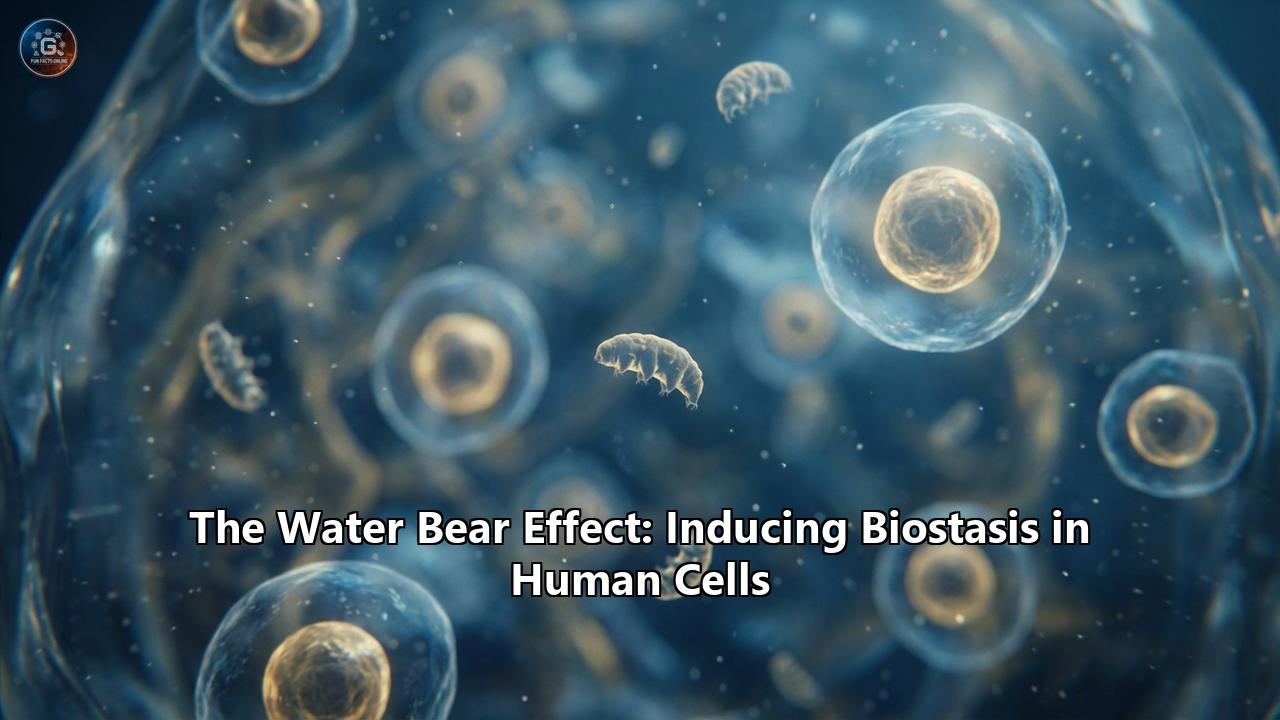
Introduction: The Immortal Bear
In the microscopic realm, where the laws of survival are written in brutal efficiency, there exists a creature that defies the very definitions of life and death. It is not a rare bacterium found in a deep-sea vent, nor is it a genetically engineered super-organism. It is the tardigrade, a micro-animal affectionately known as the "water bear." These eight-legged, lumbering invertebrates, often no larger than a grain of sand, have survived all five of Earth’s major mass extinction events. They can withstand the crushing pressure of the deep ocean, the sterilizing radiation of a nuclear blast, the searing heat of a volcanic vent, and even the freezing vacuum of outer space.
For centuries, scientists have looked at the tardigrade with a mixture of awe and confusion. How can an organism made of the same biological building blocks as humans—proteins, DNA, lipids—survive conditions that would shred our cells in microseconds? The answer lies in a biological superpower known as cryptobiosis—the ability to enter a state of suspended animation so profound that metabolism virtually stops. In this state, the water bear is indistinguishable from a lifeless mineral. Yet, add a single drop of water, and the creature returns to life, scurrying away as if nothing happened, even after decades of dormancy.
For years, this ability was seen as a biological curiosity, a quirk of nature irrelevant to human physiology. But that view has shattered. Groundbreaking research has recently demonstrated that the molecular machinery driving the tardigrade’s resilience—specifically, a unique class of "intrinsically disordered proteins"—can be transferred to human cells. When introduced, these proteins induce a reversible state of biostasis, effectively "pausing" the human cell’s biological clock.
This phenomenon, now dubbed "The Water Bear Effect," represents one of the most significant potential leaps in biotechnology of the 21st century. It promises a future where human organs can be stored on shelves for weeks without ice, where trauma victims can be placed in suspended animation to buy time for surgery, and where the dream of long-duration space travel moves from science fiction to engineering reality.
This is the story of how we unlocked the secrets of the water bear, and how we are learning to pause life itself.
Chapter 1: A History of Suspended Animation
The concept of life existing in a state of suspension is not new to science, though for centuries it was treated with deep skepticism. The story begins in 1702 with Antonie van Leeuwenhoek, the Dutch draper turned scientist who is widely regarded as the father of microbiology.
Leeuwenhoek was a man of insatiable curiosity. Using his handcrafted microscopes, he was the first human to lay eyes on the hidden universe of "animalcules" teeming in a drop of water. One day, while examining sediment from the gutters of his roof, he observed small, rotifer-like creatures that appeared completely dead—dried, shriveled, and motionless. However, when he added water to the dust, he watched in astonishment as the creatures swelled, moved, and swam away.
He wrote to the Royal Society in London, describing this miracle. "The animalcules that had been dead, came to life," he penned. His peers were skeptical. The prevailing scientific dogma of the time held that life was a continuous combustion; once the fire went out, it could not be reignited. The idea that an organism could press "pause" was heretical.
For nearly two centuries, the phenomenon remained a fringe topic. It wasn't until the 19th and 20th centuries, with the discovery of the tardigrade by German zoologist Johann August Ephraim Goeze in 1773, that the study of "latent life" began in earnest. Goeze called them kleiner Wasserbär (little water bears) because of their bear-like gait. As microscopes improved, so did our understanding of their resilience.
Experiments in the 20th century pushed the boundaries of belief. Tardigrades were dried out for decades and revived. They were frozen to near absolute zero (-273°C), a temperature where molecular motion ceases, and they survived. In 2007, the European Space Agency’s FOTON-M3 mission exposed dried tardigrades to the vacuum of space and direct solar radiation for ten days. Upon returning to Earth, they were rehydrated. They not only survived; they reproduced.
These feats forced a rewriting of biological rules. We learned that life is not merely a binary state of "alive" or "dead." There is a third state: cryptobiosis. In this state, an organism is not alive in the metabolic sense—it consumes no oxygen, produces no energy, and performs no repair—but it is structurally intact, waiting for the signal to resume.
For decades, the mechanism remained a mystery. Did they have super-strong cell walls? Did they use special sugars to turn their insides into glass? The answer, it turned out, was far more elegant and strange. It lay in the physics of chaos.
Chapter 2: The Biology of the Impossible
To understand how the Water Bear Effect works in human cells, we must first understand the enemy of all life: entropy.
Biological life is a constant battle against disorder. Our cells are filled with complex machinery—proteins folded into precise shapes, membranes maintaining strict chemical gradients, and DNA sequences that must remain uncorrupted. Water is the medium that makes this possible. It acts as a solvent, a lubricant, and a scaffold.
When a normal cell dries out (desiccation), the water disappears. Without water, proteins lose their shape (denature), membranes collapse and fuse together, and sharp salt crystals form, shredding the cell from the inside. It is a catastrophic, irreversible failure.
Tardigrades survive this via a process called anhydrobiosis (life without water). When a tardigrade senses its environment drying up, it initiates a transformation. It curls its legs in, expels water from its body, and contracts into a barrel-shaped structure called a "tun."
Inside the tun, a radical chemical change occurs. For years, scientists believed tardigrades survived solely by accumulating trehalose, a sugar that acts like a biological antifreeze. Trehalose is used by brine shrimp (Sea Monkeys) and wood frogs to survive freezing and drying. It works by forming a glass-like solid that physically holds proteins in place.
However, researchers noticed that some tardigrade species produced very little trehalose yet survived conditions that would kill a brine shrimp instantly. There had to be another player.
That player was identified in 2017: a unique class of proteins found only in tardigrades. They were named Tardigrade-specific Intrinsically Disordered Proteins (TDPs). Among these, the most critical for desiccation tolerance are the CAHS (Cytosolic Abundant Heat Soluble) proteins.
Unlike normal proteins, which fold into rigid, reliable 3D structures (like a key fitting a lock), CAHS proteins are floppy, shapeless, and chaotic. They look like unraveling balls of yarn. In a hydrated cell, they flow freely, doing very little. But when the cell effectively dries out, these chaotic proteins do something extraordinary: they self-assemble into a protective gel.
Chapter 3: The Chaos Engines - Intrinsically Disordered Proteins
The discovery of CAHS proteins challenged the "structure-function paradigm" of biology. For decades, biology students were taught that a protein’s function is determined by its structure. An enzyme works because it has a specific groove for a molecule to sit in; a structural protein works because it forms a rigid rod.
CAHS proteins are Intrinsically Disordered Proteins (IDPs). They have no fixed shape. In a watery solution, they fluctuate rapidly between millions of different conformations. This disorder is not a bug; it is a feature.
When the concentration of water in a cell drops, the concentration of CAHS proteins relative to the remaining water rises. As they become crowded, these floppy proteins begin to interact with each other. But instead of crystallizing (which would be fatal), they undergo a phase transition.
Think of it like a crowded dance floor. When there are few people (hydrated state), everyone moves randomly. As more people pack in (desiccation), they link arms and form a massive, interconnected web. This is fibrillization. The CAHS proteins link up to form long, microscopic fibers that crisscross the cell.
These fibers form a hydrogel—a porous, semi-solid network that permeates the entire cytoplasm. This gel has two critical functions:
- Molecular Shielding: The gel physically prevents other sensitive proteins from crashing into each other and clumping together (aggregating). It isolates them in the pores of the gel network.
- Structural Support: The network acts like an internal skeleton, preventing the cell membrane from collapsing as the water leaves.
Crucially, this process is reversible. The interactions holding the gel together are weak—they are not permanent chemical bonds. When water is added back to the system, the CAHS proteins dissolve, the gel melts, and the cell’s machinery is free to move again.
This is the "Water Bear Effect" in its purest form: the controlled solidification of life to prevent the damage of time and stress.
Chapter 4: The Breakthrough - Human Cells on Pause
The theory was sound, but the application was the true test. Could these alien-like proteins function inside the complex, delicate environment of a human cell?
In 2024, a team led by Dr. Silvia Sanchez-Martinez and Dr. Thomas Boothby at the University of Wyoming attempted exactly this. They engineered HEK-293 cells—a standard line of human kidney cells used in research—to express the gene for the tardigrade CAHS D protein.
The results were startling.
Under normal conditions, the human cells containing the tardigrade protein looked and acted completely normal. The CAHS D proteins floated harmlessly in the cytoplasm, unstructured and invisible. But when the researchers induced "osmotic stress"—essentially sucking the water out of the cells to simulate desiccation—the Water Bear Effect took hold.
Using advanced microscopy, the team watched in real-time as the CAHS D proteins within the human cells began to condense. They formed the same fibrillar networks seen in tardigrades. The cytoplasm of the human cells turned from a liquid into a gel.
More importantly, the metabolism of the human cells slowed dramatically. They entered a state of biostasis. They stopped consuming energy. They stopped dividing. They were, for all intents and purposes, paused.
But the true miracle occurred when the stress was removed. The researchers added water back to the petri dish. Within minutes, the gel dissolved. The CAHS D proteins returned to their chaotic, liquid state. The human cells "woke up" and resumed their normal metabolic functions as if nothing had happened. They showed no signs of toxicity or damage from the transition.
This was the first proof of principle that the biostasis machinery of an extremophile could be transplanted into a human system. We had successfully borrowed the water bear's shield.
Chapter 5: Mechanisms of Stasis - How it Works
The mechanism observed in the Sanchez-Martinez/Boothby study is a masterclass in soft matter physics. It relies on a concept called Liquid-Liquid Phase Separation (LLPS), which is currently one of the hottest topics in cell biology.
Imagine a vinaigrette dressing. You shake it, and the oil and vinegar mix. Let it sit, and they separate into droplets. This is phase separation. Cells use this physics to create "membraneless organelles"—droplets of protein and RNA that float in the cell like oil in water.
CAHS D proteins take this a step further. They undergo a Sol-Gel Transition.
- The Trigger: As water leaves the cell, the "ionic strength" (saltiness) of the cytoplasm increases.
- The Nucleation: The CAHS D proteins, sensing this change in crowding and chemistry, begin to stick together via "beta-beta interactions"—specific parts of their chaotic chains that lock together.
- The Fibrillization: These sticking points grow into long filaments, creating a 3D mesh.
- The Vitrification: The cytoplasm becomes viscous, slowing down the movement of all molecules.
This slowing of movement is the key to biostasis. Aging, decay, and damage are all kinetic processes—they require molecules to move and bump into each other. If you turn the cell's interior into a thick gel, you essentially freeze time. Enzymes can't reach their substrates to degrade them. Free radicals are trapped in the mesh, unable to damage DNA. The cell is locked in a protective embrace.
This mechanism is distinct from cryogenics. Cryogenics uses cold to slow molecular motion. The Water Bear Effect uses molecular crowding and gelation to achieve the same result at room temperature (or warmer). This distinction is vital because freezing causes ice crystals, which damage cells. The CAHS gel is soft, non-crystalline, and protective.
Chapter 6: The End of the Cold Chain
The immediate implications of the Water Bear Effect are not in sci-fi human hibernation, but in the gritty, expensive world of logistics.
We live in a world dependent on the "Cold Chain." Vaccines, insulin, antibody therapies, and blood products must be kept refrigerated from the moment of manufacture to the moment of use. This logistical nightmare costs billions of dollars annually and results in massive waste. In developing nations or remote areas, the lack of reliable electricity means life-saving medicines often spoil before they reach patients.
The Water Bear Effect offers a solution: Dry Preservation.
If we can mix sensitive biological drugs (like Factor VIII for hemophiliacs) with CAHS proteins, we could potentially dry them into a powder or a gel that is stable at room temperature.
The Boothby lab has already demonstrated this potential. They showed that Factor VIII, an essential blood-clotting protein that usually requires strict refrigeration, could be stabilized with tardigrade proteins. The CAHS proteins formed a protective gel around the Factor VIII, shielding it from heat and desiccation. When rehydrated, the Factor VIII was fully functional.
Imagine a future where vaccines are shipped in envelopes rather than refrigerated containers. Imagine insulin that can be stored in a cupboard in the tropics for years without losing potency. The democratization of medicine that this technology could enable is profound. It would eliminate the "last mile" problem in global health logistics, ensuring that the most advanced biological therapies are available to the most remote villages on Earth.
Chapter 7: The Organ Shortage Solution
Moving up the scale of complexity, we arrive at one of the most heartbreaking crises in modern medicine: the organ transplant shortage.
Currently, an organ outside the body has a terrifyingly short shelf life. A heart lasts about 4 to 6 hours. A lung, perhaps 6 to 8. Kidneys can last up to 24-36 hours, but with diminishing quality. This tight window means that a perfectly good heart in Los Angeles often cannot reach a dying patient in New York in time. Thousands of viable organs are discarded every year simply because the logistics didn't work out.
The current preservation method is essentially "put it on ice." We flush the organ with a cold solution and keep it in a cooler. This slows metabolism, but it doesn't stop it. The cells continue to slowly die, accumulating toxic waste products (ischemic injury).
The Water Bear Effect could revolutionize this field. If we could perfuse a donor organ with a solution containing CAHS proteins and then induce a mild desiccation or osmotic trigger, we could gel the entire organ. The cells would enter biostasis. Their metabolic demand for oxygen would drop to near zero.
Instead of hours, we could potentially preserve organs for days or even weeks. This would change transplant medicine from an emergency procedure to a scheduled one.
- Global Matching: A kidney from a donor in Japan could be matched to the perfect recipient in Brazil.
- Better Outcomes: Doctors would have time to prep the recipient, reducing rejection risks.
- Organ Banking: We could potentially bank organs, creating a reserve for emergencies.
While perfusing a whole organ is infinitely more complex than a single cell—we have to ensure the gel reaches every capillary and doesn't clog the system upon rehydration—the fundamental physics holds promise.
Chapter 8: Trauma and Emergency Medicine
The concept of the "Golden Hour" in trauma medicine dictates that a patient's survival chances drop precipitously if they don't receive definitive care within an hour of injury. Bleeding out (exsanguination) is the leading cause of preventable death in trauma.
Biostasis offers a radical new approach: Emergency Preservation and Resuscitation (EPR).
Researchers are already experimenting with cooling patients to buy time—a technique sometimes called "suspended animation" currently used in extreme cardiac surgeries. But cooling is dangerous and difficult to maintain.
Imagine a battlefield scenario or a remote car accident. A medic arrives. The patient is losing blood fast. Instead of just applying a tourniquet, the medic administers a "biostasis cocktail" derived from tardigrade proteins. This solution circulates through the remaining blood volume, triggering a systemic metabolic slowdown.
The patient’s cells enter the gel state. Their oxygen requirement plummets. The tissues become resistant to the lack of blood flow (ischemia). The patient is effectively "paused" on the side of the road. This buys not just one hour, but perhaps ten or twenty hours to transport them to a major surgical center.
Upon arrival, surgeons repair the damage, flush out the biostasis agents, and rehydrate the system to "reboot" the patient. This application is speculative and fraught with challenges—systemic gelation could stop the heart (which might be the point) and restarting it is no small feat—but the potential to save lives in otherwise fatal scenarios is driving significant military and medical interest.
Chapter 9: The Final Frontier - Space Travel
Perhaps the most culturally resonant application of the Water Bear Effect is in the realm of space exploration. Science fiction has long relied on "cryosleep" or "hypersleep" to explain how humans travel the vast distances between stars. In reality, we have no such technology.
A trip to Mars takes 6 to 9 months. A round trip is nearly two years. During this time, astronauts consume massive amounts of food, water, and oxygen. They also suffer from muscle atrophy, bone density loss, and the psychological strain of confinement.
More dangerously, they are exposed to Galactic Cosmic Rays (GCRs). This high-energy radiation shreds DNA. On Earth, our magnetic field protects us. In deep space, there is no shield. A trip to Mars significantly increases an astronaut's lifetime cancer risk.
This is where the tardigrade offers a dual solution: Biostasis + Radiation Shielding.
Tardigrades possess another protein called Dsup (Damage Suppressor). Unlike CAHS, which manages structure, Dsup binds directly to DNA. It acts like a physical shield, hugging the DNA helix and absorbing radiation particles before they can break the genetic code.
Research has shown that human cells engineered to express Dsup have 40-50% less DNA damage when exposed to X-rays compared to normal cells.
A theoretical "Hibernation" system for Mars astronauts could combine these technologies:
- Dsup Expression: Gene therapy prior to the mission equips the astronauts' cells with the Dsup protein, hardening their DNA against radiation.
- CAHS Biostasis: For the long transit, astronauts enter a medically induced biostasis facilitated by CAHS proteins. Their metabolism drops. They don't need to eat. They don't fight with their crewmates.
- Radio-Resistance: While in this state, the biostasis gel prevents the movement of free radicals created by radiation, further enhancing the protection offered by Dsup.
This would allow for smaller ships (less food storage) and healthier crews upon arrival. The "Water Bear Astronaut" might be the only way humanity ever reaches the outer planets.
Chapter 10: The Ethical Horizon
As with any technology that touches the fundamental nature of life, the Water Bear Effect raises profound ethical questions.
1. The Definition of Death:If a person is in biostasis, are they alive? They have no brain activity, no heartbeat, no metabolism. Yet, they are not dead. Our legal and medical definitions of death rely on the "irreversible cessation" of functions. Biostasis challenges the "irreversible" part. If death becomes a reversible condition—a pause button rather than a stop button—how do we handle inheritance, marriage contracts, or criminal sentences?
2. The Identity Problem:Tardigrade biostasis involves the gelation of the cytoplasm. While the structure is preserved, we do not yet know the effects of this phase transition on the delicate electrochemical networks of the human brain. Memories and consciousness are stored in precise synaptic connections. Could the gelation process subtly alter these connections? Would the person who wakes up be the same person who went to sleep? Or would the "software" of the mind be corrupted by the "freezing" of the hardware?
3. "Playing God" and Evolution:By integrating tardigrade proteins into the human genome (as would be required for Dsup radiation shielding), we are effectively creating a transgenic species. We are directing our own evolution, borrowing traits from other branches of the tree of life. Is it ethical to permanently alter the human germline to allow us to survive in environments (like space) where we were never meant to be?
4. Access and Inequality:Will biostasis be a luxury for the rich? A way to "skip" boring years or wait for a cure to a disease? If a wealthy individual can pause their life to wait for better medical technology, while the poor must live and die in their natural time, the social rift would be catastrophic.
Conclusion: The Age of Biostasis
The Water Bear Effect is more than just a biological curiosity; it is a key that unlocks the door to a new understanding of life. It teaches us that life is not a fragile flame that blows out at the first sign of trouble, but a resilient structure that can be reinforced, braced, and paused.
The journey from Leeuwenhoek’s "animalcules" to human cells engineered with tardigrade proteins has been long, but we are essentially just stepping out of the ocean and onto dry land. We have proven that the machinery of the water bear works in human cells. The next decades will be defined by the engineering challenges of scaling this up—from cells to tissues, from tissues to organs, and eventually, perhaps, to entire organisms.
If we succeed, the implications are boundless. We could cure the organ shortage, revolutionize trauma care, stabilize the global supply of medicine, and finally possess the biological armor necessary to leave our home planet.
The water bear has survived every apocalypse Earth has thrown at it for 500 million years. By borrowing its secrets, humanity might just ensure its own survival for the next 500 million. We are learning, finally, how to hibernate through the hard times, waiting for the rain to return.
Reference:
- https://winvertebrates.uwsp.edu/vanremortel_361_2013.html
- https://en.wikipedia.org/wiki/Antonie_van_Leeuwenhoek
- https://www.gideononline.com/blogs/leeuwenhoek-scientist-who-saw-animalcules/
- https://pmc.ncbi.nlm.nih.gov/articles/PMC9679978/
- https://en.wikipedia.org/wiki/Tardigrade_specific_proteins
- https://www.biorxiv.org/content/10.1101/2021.08.16.456555v2.full
- https://pmc.ncbi.nlm.nih.gov/articles/PMC5492148/
- https://www.frontiersin.org/journals/physics/articles/10.3389/fphy.2023.1213304/full
- https://www.researchgate.net/figure/Proposed-mechanism-for-CAHS-D-mediated-protection-against-desiccation-induced-protein_fig2_353965491
- https://pmc.ncbi.nlm.nih.gov/articles/PMC10949331/
- https://pmc.ncbi.nlm.nih.gov/articles/PMC12432419/
- https://blog.brasi.org/cold-chain-management-logistics/
- https://pubmed.ncbi.nlm.nih.gov/39325258/