
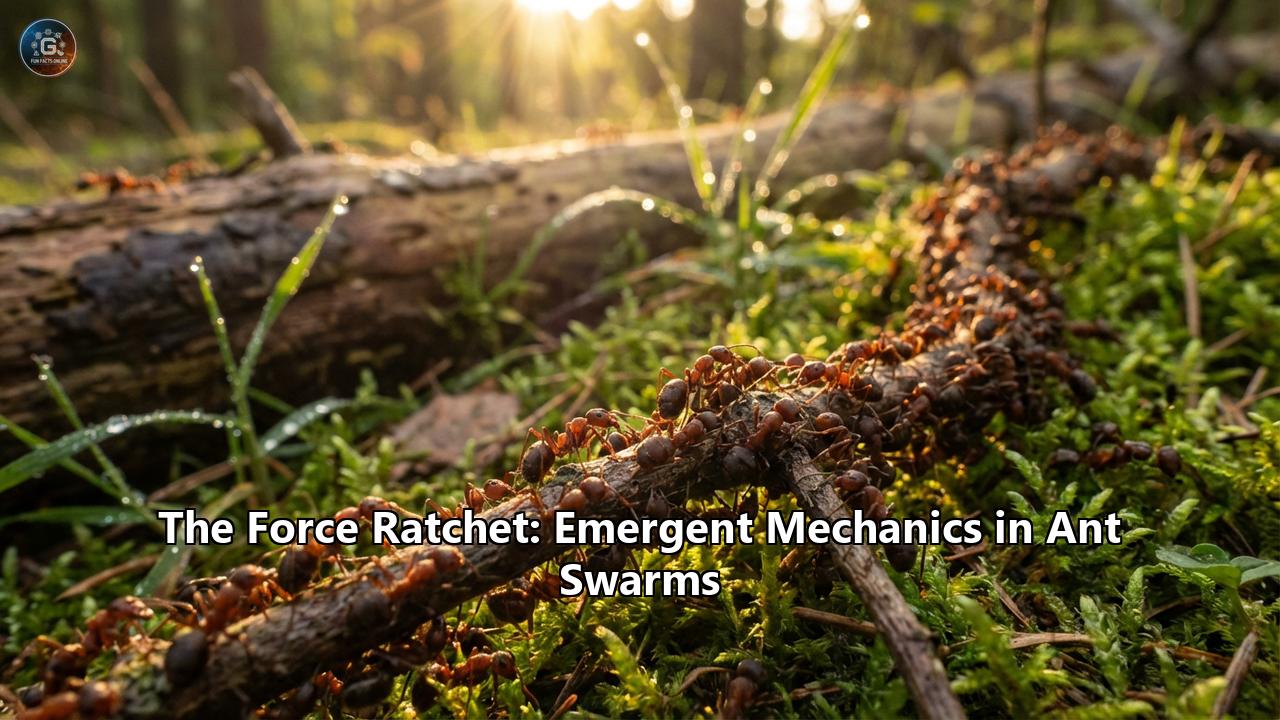
The jungle floor is not merely a surface; it is a battleground of physics. Here, the conventional laws of engineering are not just applied but seemingly bent by creatures that have had a hundred million years to perfect the art of construction. For centuries, human observers have watched ants build bridges, form rafts, and erect towers with a mixture of curiosity and condescension. We saw them as biological automata, impressive but simple. We were wrong.
Recent breakthroughs in biophysics and myrmecology—the study of ants—have shattered the illusion of simplicity. We are now peering into the "black box" of the swarm and discovering mechanisms that rival our most sophisticated machines. Foremost among these discoveries is a phenomenon that has sent shockwaves through the fields of active matter physics and robotics: the Force Ratchet.
This is not a mechanical gear made of steel, but a dynamic, emergent property arising from the interactions of thousands of living bodies. It is the secret that allows Weaver ants to generate forces that defy the "Ringelmann effect"—the tendency for individual efficiency to drop as group size increases. It is the invisible engine that powers the tensile strength of ant chains, turning a fluid group of insects into a solid cable of immense power.
But the Force Ratchet is just one gear in a larger machine. From the viscoelastic "living fluids" of Fire ants to the treadmilling rafts that survive hurricanes, ant swarms are revealing themselves to be a unique phase of matter. They are "active matter," capable of changing their material properties from liquid to solid, from elastic to viscous, in response to stress.
In this exploration, we will descend into the microscopic world of the swarm. We will disassemble the Force Ratchet to understand its gears. We will wade into the living rafts of the Amazon and climb the writhing towers of the laboratory. We will look at how these biological blueprints are already rewriting the future of robotics. This is the story of how nature solved the hardest problems of engineering not with stronger materials, but with smarter interactions.
Part I: The Paradox of the Pull
To understand the magnitude of the Force Ratchet discovery, we must first understand the flaw in human teamwork. In 1913, French agricultural engineer Maximilien Ringelmann conducted a simple experiment. He asked individuals to pull on a rope and measured the force they exerted. Then, he asked groups to do the same. Logic dictated that a group of eight people should pull with eight times the force of one person.
The results were disappointing. As the group size increased, the average force exerted by each individual decreased. In a team of eight, people were pulling less hard than they did alone. This phenomenon, known as the "Ringelmann effect" or "social loafing," has been observed in humans, horses, and even simple robotic swarms. It is a coordination cost; as more agents are added, it becomes harder to synchronize effort, and efficiency bleeds away.
For over a century, biology seemed to suggest that this was a universal law of collective effort. Then came the Weaver ants (Oecophylla smaragdina).
These arboreal architects are famous for binding leaves together to form nests, using their own larvae as living glue guns. To pull these leaves together, they form living chains, linking legs to waists, spanning gaps and hauling jagged foliage with a coordination that looks supernatural.
When researchers recently hooked these ant chains up to force sensors, they expected to see the Ringelmann effect. They expected that as the chain grew longer and the team larger, the per-ant force would drop.
They saw the opposite.
In a defiance of expectations that one researcher termed "superefficiency," the Weaver ants demonstrated that as the team size grew, the force contributed by each individual actually increased. A large chain was not just stronger because it had more ants; it was stronger because each ant was working harder and more effectively than it would in a smaller group.
This is the Force Ratchet.
The Mechanics of the Ratchet
The Force Ratchet is not a magical increase in muscle power. It is an emergent mechanical strategy that separates the swarm into distinct functional roles based on their position in the chain.
In a Weaver ant chain, the ants are not all doing the same thing. The ants at the front—closest to the object being pulled—are the active engines. They contract their bodies, scrabbling for purchase, injecting kinetic energy into the system.
However, the ants at the back of the chain do not simply pull. If they did, they might destabilize the delicate links or lose their footing. Instead, they transform into passive anchors. They stretch their bodies out, locking their joints and utilizing the friction of their footpads to create a rigid, immovable base. They effectively "store" the force generated by the front ants, preventing the chain from slipping back during the relaxation phase of the pullers.
This dynamic creates a ratchet mechanism similar to the tool found in a mechanic's workshop. A mechanical ratchet allows motion in one direction while preventing it in the other. The Weaver ant chain functions identically:
- The Pull (Stroke): The front ants contract, pulling the load forward.
- The Lock (Latch): The rear ants rigidify, holding the tension and preventing the load from sliding back as the front ants reset their grip.
This division of labor allows the chain to accumulate force over time. The "superefficiency" comes from the fact that in a longer chain, there is more "anchoring mass." The more ants you have at the back, the more force the front ants can safely exert without ripping the whole chain loose from the substrate. The group structure enables the individuals to perform at their physiological peak, uncapped by the fear of slipping.
The Internal Lock: Anatomy Meets Emergence
The Force Ratchet operates on two levels: the collective and the individual. While the chain acts as a macroscopic ratchet, the individual ant possesses a microscopic one.
High-resolution imaging of Weaver ant anatomy has revealed a locking mechanism in the neck joint. When an ant clamps its mandibles onto a leaf or a neighbor and retracts its head, a series of ridges and latches in the exoskeleton can engage. This allows the ant to maintain a high-tension hold without constantly expending muscle energy. It is analogous to "standing" on a locked leg rather than holding a squat.
This individual biological ratchet is the fundamental unit of the collective Force Ratchet. Because each ant can mechanically lock its hold, the chain as a whole becomes a structure capable of maintaining immense tension with zero metabolic cost for the "anchor" ants. They are not getting tired; they are simply becoming part of the geometry.
Part II: The Living Fluid
While Weaver ants master the art of tension, their cousins, the Fire ants (Solenopsis invicta), are the masters of viscoelasticity.
If Weaver ants are the cables of the insect world, Fire ants are the cement, the rubber, and the water, all at once. Originating from the floodplains of South America, Fire ants have evolved to survive catastrophic inundation. When the waters rise, they do not flee; they coalesce.
Scoop a handful of Fire ants from a bucket, and they feel like a solid ball of dough. You can toss them, juggle them, and squeeze them. They are elastic; if you press on the ball, it springs back. But if you leave that same ball on a flat surface and wait, it slowly collapses, spreading out like thick honey. If you push a penny into the mass, it sinks slowly, as if through quicksand.
This dual nature—behaving as a solid under sudden shock and a fluid under sustained pressure—is known as viscoelasticity. It is a property shared by materials like Silly Putty and cornstarch in water. But Fire ants are "active" viscoelastic matter. Their properties are not just passive reactions; they are actively tuned by the behavior of the swarm.
The Physics of Entanglement
The secret to this phase-shifting lies in the legs. A single Fire ant has six legs, and each leg is covered in microscopic hooks and adhesive pads. When thousands of ants gather, the number of potential connections skyrockets.
In a "solid" state, the ants are actively gripping one another. They link tarsi (feet) to form a cross-linked polymer network. This network can distribute stress instantly. When you poke a Fire ant ball, the force is transmitted through thousands of leg-to-leg connections, dispersing the energy and allowing the structure to bounce back.
However, these bonds are transient. Ants are living creatures; they need to move, breathe, and adjust. They constantly break and reform these connections. This turnover of bonds is what allows the "fluid" behavior. Under gravity, the ants slowly rearrange themselves, sliding past one another while maintaining enough connectivity to stay together. This is "viscous flow."
Researchers at Georgia Tech have quantified this behavior, defining the "Maxwell time" of a Fire ant swarm—the timescale over which they transition from solid to liquid. For Fire ants, this is a matter of seconds. Apply a force faster than they can rearrange, and they are a brick. Apply it slower, and they are a liquid.
The Raft: A Waterproof Fabric
The ultimate expression of this mechanics is the Fire Ant Raft. During floods, a colony of 100,000 ants can self-assemble into a floating pontoon in less than two minutes.
This is not a chaotic pile of drowning insects. It is a highly engineered structure. The ants weave themselves into a multi-layered lattice. The bottom layer of ants acts as the hull. Remarkably, these hull ants do not drown. The weave of the raft is tight enough to trap a layer of air—a plastron—against the ants' hydrophobic exoskeletons. The raft floats not just on the buoyancy of the ants' bodies, but on this bubble of air.
The Force Ratchet concept reappears here in a different guise. To maintain the raft's structural integrity against waves and debris, the ants must constantly exert force. They tighten their connections, effectively "ratcheting" the raft into a denser, tougher state when turbulence hits. When the water is calm, they relax, increasing the raft's surface area to maximize stability.
Part III: Treadmilling and the Conveyor Belt of Life
The Force Ratchet and viscoelasticity explain how ants hold together. But how do they move and build? Static structures are death for a swarm; they must be dynamic to survive. This leads us to the third pillar of emergent mechanics: Treadmilling.
Imagine a tower of ants. Fire ants can build Eiffel Tower-like structures to escape containers or reach hanging branches. These towers can be 30 ants high, defying gravity without any internal skeleton.
For years, scientists assumed these towers were static—that the ants at the bottom just stood there, bearing the weight of their sisters, until the tower was no longer needed. But when researchers used X-ray videography to look inside these towers, they saw something startling.
The tower was flowing.
The ants at the bottom were not stationary pillars. They were slowly sinking, spreading out into the base. Meanwhile, ants from the base were climbing up the outside of the tower to the top. The entire structure was a fountain of life: a central column of sinking ants surrounded by a shell of climbing ants.
This is Treadmilling.
The Universal cyclicality
Treadmilling is a fundamental solution to the problem of fatigue and structural stability.
- Load Sharing: No single ant has to bear the crushing weight of the tower for long. An ant at the bottom supports a heavy load, but she slowly yields to it, sinking and spreading out. As she moves out of the high-pressure zone, she is released from duty and can climb back up to the top to become a "brick" once more.
- Self-Healing: Because the structure is fluid, it is immune to brittle fracture. If you slice the top off an ant tower, the upward flow of ants simply replaces it. If you damage the base, the sinking column fills the void.
- Plasticity: The tower can morph. If the target branch moves, the stream of climbing ants can bias their path, causing the tower to lean and grow in a new direction.
This mechanism is also seen in the rafts. When a raft needs to extend a "pseudopod" or arm to grab a nearby twig, it doesn't just stretch. It cycles ants from the main body, flowing them out to the tip of the protrusion and cycling them back. The raft is a fluid machine that recycles its own parts.
In the context of the Force Ratchet, treadmilling provides the "reset" mechanism. In a pulling chain of Weaver ants, the ratchet locks force. In a tower of Fire ants, the treadmill releases force, dissipating the potential energy of the load through controlled movement to prevent catastrophic failure.
Part IV: The Comparative Engineering of Species
Evolution is a prolific engineer, and it has designed different mechanical systems for different environmental niches. By comparing these, we can see the versatility of the Force Ratchet and its counterparts.
The Tensile Architects: Weaver Ants (Oecophylla)
- Primary Mechanic: Force Ratchet.
- Material Property: High Tensile Strength, Low Elasticity.
- Application: Pulling leaves, bridging horizontal gaps under tension.
- Physics: Weaver ants live in the canopy. Their world is one of gaps and thin supports. Gravity is an enemy to be bridged, not necessarily fought directly. Their chains are designed to be "ropes." Ropes are useless in compression (you can't push a rope), but incredible in tension. The Force Ratchet is a tension-maximizing mechanism.
The Viscoelastic Blobs: Fire Ants (Solenopsis)
- Primary Mechanic: Active Viscoelasticity / Treadmilling.
- Material Property: Variable Viscosity, High Compressive Strength (dynamic).
- Application: Rafts, Towers, Bivouacs.
- Physics: Fire ants are ground dwellers subject to flooding. Their structures must resist compression (gravity pulling the tower down) and fluid dynamics (water tearing the raft apart). Their mechanics focus on shock absorption and buoyancy. The treadmill allows them to exist as a "solid fluid," flowing around obstacles while maintaining cohesion.
The Living Bridges: Army Ants (Eciton)
- Primary Mechanic: Self-Jamming / Tensegrity.
- Material Property: Solid-like lattice.
- Application: Bridges, Bivouacs (nests made of bodies).
- Physics: Army ants do not dig nests; they are the nest. They form a bivouac, a massive cluster of up to a million ants hanging from a log. Inside, the queen and brood are protected in climate-controlled chambers made of worker bodies. When moving, they form bridges over gaps. Their mechanics rely on self-jamming. They interlock so tightly that they become a rigid solid, minimizing movement to maximize stability for the traffic running over their backs. Unlike the flowing Fire ant tower, an Army ant bridge is remarkably static once formed, prioritizing a stable roadway over dynamic growth.
Part V: The Algorithms of Nature
How do they do it?
There is no "General Ant" shouting orders. There is no blueprint. The Force Ratchet, the treadmill, and the raft emerge entirely from local interactions. This is the heart of swarm intelligence.
1. Stigmergy
The concept of stigmergy is that the work effectively directs the work.
- In Weaver Ants: An ant grabs a leaf. This mechanical stress—the feeling of resistance—is a signal. Another ant senses this tension and instinctively grabs the first ant to help. A chain forms not because they "know" to build a chain, but because the local rule is "if you feel tension, pull and recruit." The Force Ratchet emerges because the rule "if you are being pulled too hard, lock your joints" is triggered in the rear ants, while "if you have footing, pull" is triggered in the front ants.
- In Fire Ants: The rule is often "if you are surrounded by friends, hold on." If an ant feels water, she grabs the nearest solid object (a sister). If every ant does this, a raft forms. In a tower, the rule might be "if you are bearing too much weight, move down; if you are light, move up." This simple gradient of pressure creates the complex treadmill cycle.
2. Threshold-Based Behavior
Ants operate on thresholds. An ant might wander aimlessly until the concentration of pheromone X hits a certain level, or until the physical tension on her legs exceeds X Newtons.
This creates "phase transitions." A loose group of foraging Fire ants is a gas. Shake them (adding energy/stress), and they jam into a solid. Pour them into water, and they cross a threshold to become a liquid raft. The Force Ratchet is a phase transition induced by tensile load.
3. The Wisdom of Noise
Ant behavior is not deterministic; it is stochastic (random). Ants make mistakes. They jitter. They let go.
Surprisingly, this "noise" is essential. If every ant locked perfectly and never moved, the structure would be brittle. It would shatter under a sudden shift. The random movements of individual ants—the "thermal energy" of the active matter—allow the swarm to anneal. It allows the Force Ratchet chains to readjust if the leaf tears. It allows the Fire ant raft to re-shape itself around a rock. The system is robust because it is imperfect.
Part VI: The Robotic Force Ratchet
The discovery of these mechanics is not staying in the biology journals. It is being copy-pasted into the code of the next generation of robots.
Robotics has long suffered from the Ringelmann effect. Coordinating a swarm of robots is a nightmare of communication bandwidth and latency. If you have 100 robots trying to move a heavy box, they often fight each other, push in slightly different directions, or wait for confirmation from a central server. Efficiency plummets.
The Weaver ant's Force Ratchet offers a solution: Physics-driven coordination.
Instead of programming robots to talk to each other ("I am pulling now, you should pull too"), engineers are designing robots that communicate through force.
- The Anchor-Puller Protocol: A team of simple robots can be programmed with the Weaver ant rule set. "If I measure forward motion, I pull. If I measure high resistance and no motion, I deploy anchors and lock."
- Result: A self-organizing chain that automatically distributes the load. The robots at the front sense the motion and drive; the robots at the back sense the drag and lock. No Wi-Fi required. The information is transmitted through the physical chain itself.
Modular Self-Reconfigurable Robots (MSRRs)
We are seeing the birth of "programmable matter" inspired by Fire ants. Projects like the "Smarticle" (Smart Particle) at Georgia Tech use simple robots that only flap their arms. Put five in a ring, and nothing happens. Put 100 in a box, and they jam, flow, and move like a Fire ant swarm.
By tweaking the "activity level" (how much they flap), researchers can make the swarm transition from solid to liquid, just like the ants. Future search-and-rescue robots might not be humanoid; they might be buckets of "sand" that can be poured into rubble, solidify into a jack to lift a beam, and then liquefy to flow out again.
The Soft Robotics Revolution
Ants are soft. They are not made of titanium; they are made of chitin and fluid. This compliance is key to the Force Ratchet. If ants were rigid steel, the chain would snap. The elasticity of their bodies allows them to share the load.
Roboticists are now building "soft robots" made of silicone and pneumatic muscles. These robots can use the Force Ratchet principle to grip objects. A soft gripper doesn't need to calculate the shape of a cup; it just wraps around it and "ratchets" tight, using friction and geometry rather than precise motor control.
Part VII: The Evolutionary Calculus
Why did the Force Ratchet evolve? Why did nature choose these specific mechanics?
The answer lies in the economics of energy.
For a Weaver ant, a leaf nest is a castle. It protects the brood, cultivates fungi, and houses the queen. But leaves are heavy, elastic springs. Bending them requires immense energy. Holding them in place while the silk glue dries takes time—hours of sustained effort.
If Weaver ants relied on muscle power alone, they would burn through their metabolic reserves in minutes. They would starve holding the door shut.
The Force Ratchet is an energy-saving device. By using the "latch" mechanism in their necks and the "anchor" role in the chain, the colony converts metabolic work (burning sugar to pull) into structural static (using friction and bone-locking to hold). They turn themselves into a clamp. A clamp holds things together for free.
Similarly, the Fire ant treadmilling behavior is an adaptation to the high cost of flooding. Losing a queen is game over. Losing 10% of the workers to exhaustion is acceptable, but losing the raft structure is fatal. The treadmill ensures that fresh, rested workers are constantly rotated to the high-stress perimeter of the raft, while tired workers rest in the center. It is a biological heat-exchanger, but for fatigue.
These mechanics are the result of an optimization algorithm that has run for millions of generations. They prove that in the natural world, "intelligence" is not always about neurons. Often, it is about mechanics. The smartest solution is often the one that requires the least amount of brainpower to execute.
Part VIII: Future Horizons
As we unlock the secrets of the Force Ratchet and active matter, the applications grow stranger and more exciting.
1. Self-Healing Architecture:Imagine bridges made of materials that "treadmill." If a crack forms, the material flows to fill it, while fresh material cycles in from a reservoir. Buildings that can stiffen (solidify) during an earthquake to resist shock, then soften (liquefy) to dissipate energy.
2. Nano-Swarms in Medicine:The Force Ratchet operates on local rules. This is perfect for nanobots that are too small to carry complex computers. A swarm of nanoparticles injected into the bloodstream could use the "anchor and pull" ratchet to mechanically drag a clot out of a vein, or use viscoelastic jamming to seal a ruptured artery.
3. Space Exploration:Sending heavy machinery to Mars is expensive. Sending a bag of "ant-bots" is cheap. A swarm of simple modules could use Force Ratchet chains to pull rovers out of sand traps, or assemble into towers to act as radio antennas. They could form rafts to cross methane lakes on Titan.
Conclusion: The Lesson of the Ratchet
The Force Ratchet is more than just a clever trick of ant anatomy. It is a profound statement on the nature of power.
In the human world, we often equate power with individual strength—the horsepower of an engine, the voltage of a battery. But the ant teaches us that true power lies in the connection.
A single Weaver ant is a nuisance. A chain of them is a Force Ratchet, capable of manipulating its environment on a scale that dwarfs the individual. A single Fire ant is a speck of dust. A raft of them is an unsinkable ship.
By studying these emergent mechanics, we are learning that the properties of the whole need not be limited by the properties of the parts. We can build strong things out of weak components. We can build intelligent systems out of simple agents. We can build solids that flow and liquids that hold weight.
The Force Ratchet turns the physics of the swarm into a tool. It captures the fleeting energy of the individual and locks it into a collective legacy. As we look to the future of technology, we would do well to look down at the jungle floor. The blueprint for the next industrial revolution isn't on a microchip; it's being written in the dirt, six legs at a time.
Reference:
- https://physicsworld.com/a/swarming-fire-ants-show-solid-and-liquid-properties/
- https://pmc.ncbi.nlm.nih.gov/articles/PMC8876490/
- https://www.youtube.com/watch?v=LIGGbBcx3TA
- https://www.sciencedaily.com/releases/2025/08/250814094702.htm
- https://www.youtube.com/shorts/6wNn-JD0crg
- https://www.livescience.com/13867-raft-fire-ants-buoyancy-flood-water-repellant-floatation.html
- https://hu.gatech.edu/wp-content/uploads/2015/11/Hu15-rheometer.pdf
- http://www.2physics.com/2016/02/material-properties-of-fire-ant.html
- https://www.youtube.com/watch?v=OIYsH2HPDIU
- https://www.smithsonianmag.com/smart-news/how-fire-ants-build-incredible-writhing-towers-180964055/
- https://royalsocietypublishing.org/rsif/article/18/179/20210213/89979/Treadmilling-and-dynamic-protrusions-in-fire-ant
- https://www.researchgate.net/publication/352847559_Treadmilling_and_dynamic_protrusions_in_fire_ant_rafts
- https://www.youtube.com/watch?v=DtqEVl-kJ6I
- https://pmc.ncbi.nlm.nih.gov/articles/PMC3093451/
- https://pubmed.ncbi.nlm.nih.gov/34186017/