
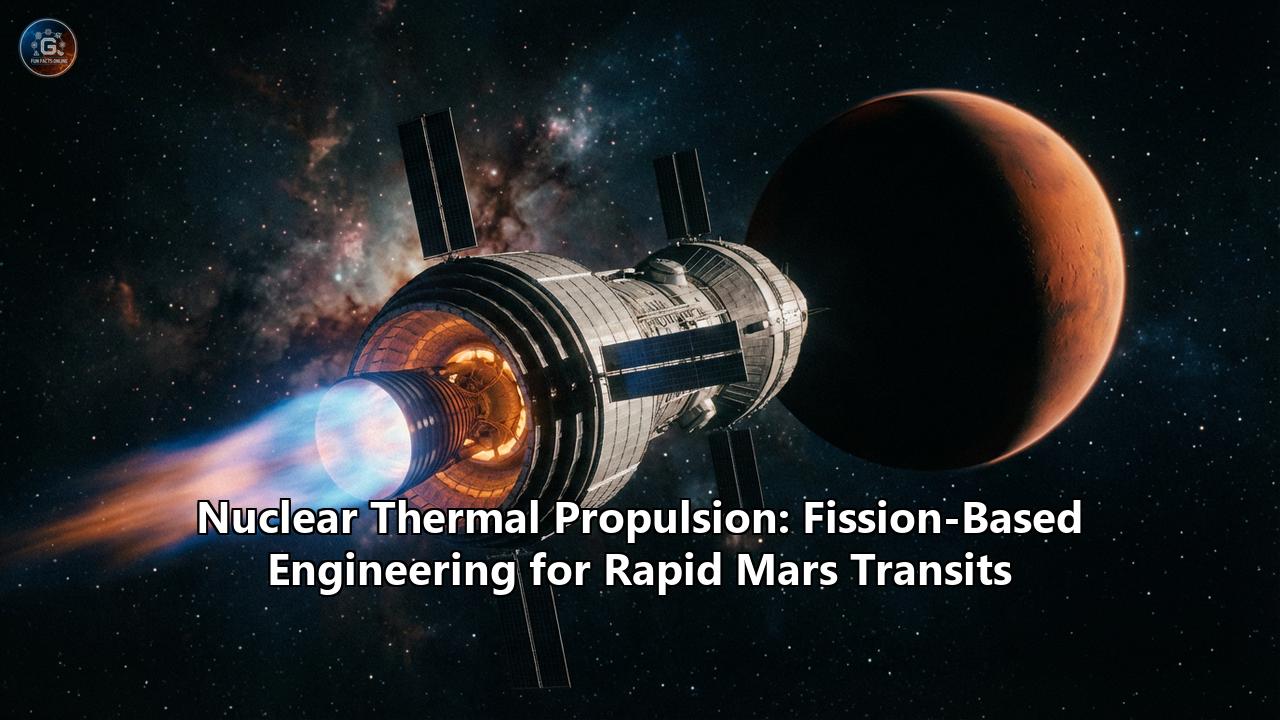
The Red Planet has taunted humanity for decades. It is a world of rusted dust and frozen potential, sitting tantalizingly close in the cosmic scale yet frustratingly far in human terms. With current chemical propulsion—the fire-and-smoke rockets that have powered everything from the V-2 to the Falcon 9—a round-trip mission to Mars is a multi-year commitment, a logistical nightmare that exposes astronauts to dangerous doses of cosmic radiation and the psychological torment of isolation.
But there is an alternative. It is a technology that was born in the Atomic Age, tested in the deserts of Nevada during the 1960s, and has recently seen a resurgence in interest from NASA and defense agencies. It promises to cut the travel time to Mars in half, open up "abort modes" that currently don't exist, and fundamentally change the economics of deep space flight.
This technology is Nuclear Thermal Propulsion (NTP).
The Tyranny of the Rocket Equation
To understand why we need nuclear rockets, we must first understand the limitations of chemical ones. Rocket science is ruled by the Tsiolkovsky rocket equation, which dictates that the change in velocity (delta-v) a spacecraft can achieve is a function of its exhaust velocity and the ratio of its initial mass to its final mass.
In a chemical rocket, like the Space Launch System (SLS) or Starship, energy is released by breaking chemical bonds. You mix a fuel (like hydrogen or methane) with an oxidizer (oxygen), burn them, and blast the resulting hot gas out of a nozzle. The efficiency of this process is measured by "Specific Impulse" (Isp), which represents the seconds a pound of propellant can deliver a pound of thrust.
The best chemical engines, like the Space Shuttle’s main engines, max out at an Isp of around 450 seconds. This is a hard limit imposed by chemistry. To go faster, you need exponentially more fuel, eventually reaching a point of diminishing returns where you are just building a bigger rocket to lift the fuel for the bigger rocket.
Nuclear Thermal Propulsion cheats this limit. Instead of burning fuel, an NTP engine uses a small fission reactor to heat a propellant—typically liquid hydrogen (LH2)—to extreme temperatures. Because no oxidizer is heavy oxygen (which weighs 16 times more than hydrogen), the exhaust consists of ultra-light hydrogen atoms moving at incredible speeds.
The result? An Isp of 900 seconds or more. In plain English, a nuclear rocket is twice as efficient as the best chemical rocket. For a Mars mission, this efficiency doesn't just mean saving fuel; it means speed.
The Engine: Fission-Based Fire
At the heart of an NTP system is a flying nuclear reactor. This is not a Radioisotope Thermoelectric Generator (RTG) like the one in the Perseverance rover, which uses the passive heat of decaying plutonium to generate a trickle of electricity. This is a high-power density beast designed to run at thousands of degrees.
The Fuel: HALEU and Cermets
The reactor core is composed of fuel elements containing uranium. Modern designs, such as those explored in the recent DRACO program, utilize HALEU (High-Assay Low-Enriched Uranium). Unlike weapons-grade uranium (used in early Cold War designs), HALEU is enriched to between 5% and 20% U-235. It strikes a balance: potent enough to generate the required neutron flux for a compact core, but significantly harder to weaponize, easing proliferation concerns.
The fuel itself is often a Cermet (ceramic-metallic) composite.
- Ceramic: Usually Uranium Dioxide (UO2) or Uranium Nitride (UN), which can withstand the fission process.
- Metal Matrix: Tungsten or Molybdenum, which holds the ceramic fuel in place and provides structural integrity even when the core heats up to 2,700 Kelvin (4,400°F).
Recent advancements have moved away from the graphite-composite fuels of the 1960s (which were prone to cracking and erosion by the hot hydrogen) toward these robust cermets, which are tougher and more resistant to the brutal environment inside the engine.
The Moderator: Taming the Neutrons
To sustain a chain reaction with HALEU, the fast neutrons produced by fission must be slowed down (moderated). Modern designs often employ Zirconium Hydride (ZrH) as a moderator. ZrH is efficient at slowing neutrons in a small volume, allowing the reactor to remain compact—critical for a spacecraft where every kilogram counts.
The Coolant is the Propellant
In a terrestrial nuclear plant, water cools the reactor and spins a turbine. In an NTP engine, the liquid hydrogen is the coolant. It flows through tiny channels in the white-hot fuel elements, picking up heat and transforming from a cryogenic liquid at -253°C to a superheated gas in milliseconds. This gas expands explosively through the nozzle, generating thrust.
The Mission: Rapid Transit to the Red Planet
The primary selling point of NTP is time. A conventional "Conjunction Class" mission to Mars follows a minimum-energy Hohmann transfer orbit. You launch when Earth and Mars are aligned, coast for 7-9 months, stay on Mars for over a year waiting for the planets to realign, and then fly 9 months back. The total mission time is nearly 3 years.
NTP enables "Opposition Class" missions.
The 100-Day Dash
With the high efficiency of nuclear propulsion, a spacecraft can burn its engines longer and harder, taking a more direct, high-energy trajectory. Instead of coasting, the ship cuts across the solar system.
- Travel Time: NTP can reduce the one-way transit to 100–120 days.
- Total Mission: A round trip could be completed in under a year, or allow for a "short stay" of 30-60 days on the surface before returning.
The Abort Option
Perhaps the most critical safety feature NTP offers is the ability to turn around. In a chemical rocket, once you perform the Trans-Mars Injection (TMI) burn, you are committed. If a life-support system fails halfway there, the crew dies; there is no fuel to turn back.
With NTP, the high delta-v capability allows for abort modes. Even weeks into the flight, the ship could perform a high-energy burn to loop back to Earth, potentially saving a crew facing a critical emergency.
Safety: The Elephant in the Room
The phrase "nuclear rocket" instinctively triggers alarm. What if it explodes on the launch pad? What if it reenters the atmosphere? Engineers have spent decades designing protocols to mitigate these risks.
1. Cold Launch:The reactor is launched "cold" and inactive. The fuel is not radioactive at launch because the fission process hasn't started. If the rocket blows up on the pad, the uranium fuel elements would scatter, but they would present a toxic heavy metal hazard (like lead) rather than a radiological one. There is no "Chernobyl cloud" from a cold reactor.
2. Poison Wires:During launch, neutron-absorbing "poison wires" are inserted into the reactor core. These wires physically prevent a chain reaction from starting, even if the reactor were crushed or submerged in water (which acts as a moderator) after a crash. These wires are only withdrawn once the spacecraft is safely in space.
3. Nuclear Safe Orbit (NSO):The engine is never fired in the lower atmosphere. A conventional chemical rocket lifts the NTP upper stage to a "Nuclear Safe Orbit"—typically above 1,000 km. At this altitude, the orbit is stable for hundreds of years. If the engine fails to ignite, the reactor will not reenter the atmosphere for centuries, giving the radioactive elements time to decay or future generations time to retrieve it.
The Status of the Dream: DRACO and Beyond
In recent years, the torch for NTP was carried by the DRACO (Demonstration Rocket for Agile Cislunar Operations) program, a collaboration between DARPA and NASA. The goal was to fly a demonstrator by 2027.
However, in July 2025, news broke that the DRACO program was being canceled due to budget constraints and shifting strategic priorities. While this specific flight test may be grounded, the engineering reality remains unchanged. The physics of nuclear thermal propulsion is sound. The fuel designs (HALEU cermets) have been matured. The mission architectures for Mars demand it.
While the cancellation of a specific program is a setback, the technology itself is inevitable if we are serious about becoming a multi-planetary species. Chemical rockets are the galleons of the coast; they can hug the shore to the Moon. But to cross the ocean to Mars and beyond, we need the steamship. We need the nuclear engine.
Conclusion
Nuclear Thermal Propulsion represents the threshold between being a species that visits space and a species that masters it. It replaces the delicate, months-long drift of chemical rocketry with the brute force of atomic energy. It offers speed, safety through abort capability, and a power density that chemical reactions simply cannot match.
The engineering is difficult. The politics are complex. But the math is undeniable. If we want to see humans walk on the Red Planet in our lifetimes—and more importantly, see them return safely home—we must embrace the power of the atom. The road to Mars is paved with uranium.
Reference:
- https://ntrs.nasa.gov/api/citations/20230001413/downloads/NETS2023_pingel_final.pdf
- https://ntrs.nasa.gov/citations/20140013259
- https://www.researchgate.net/publication/346690366_NTP_Robustness_for_Mars_Conjunction_and_Opposition_Class_Missions
- https://arc.aiaa.org/doi/10.2514/6.2020-4124
- https://forum.nasaspaceflight.com/index.php?topic=60353.20
- https://www.researchgate.net/publication/319858312_Enabling_Multiple_Abort_Strategies_Using_the_NTP_Approach_for_Human_Mars_Missions
- https://ntrs.nasa.gov/api/citations/20140013259/downloads/20140013259.pdf
- https://www.tandfonline.com/doi/pdf/10.1080/00295450.2024.2431777
- https://ntrs.nasa.gov/api/citations/20240004085/downloads/NETS_2024_launch_assembly_v7.pdf
- https://www.tandfonline.com/doi/full/10.1080/00295450.2024.2431777?af=R