
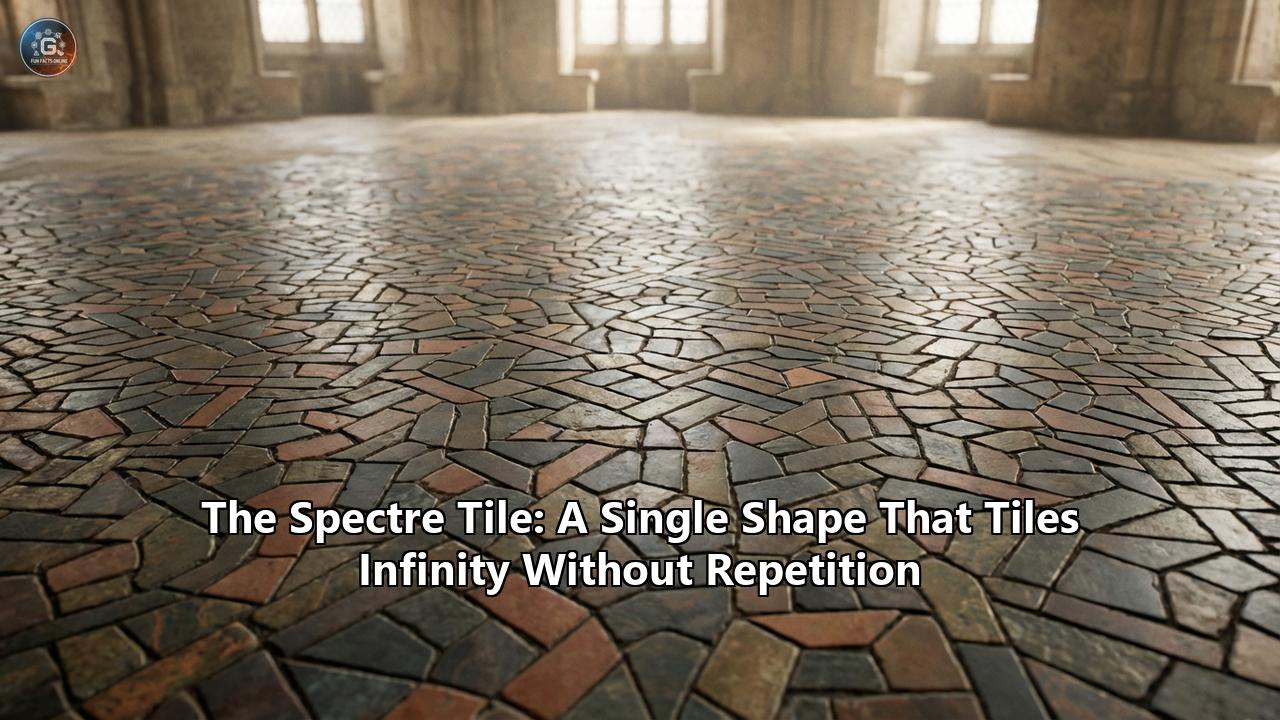
In the quiet world of geometry, where rules are absolute and order is paramount, a shape known as the "Spectre" has recently upended decades of mathematical dogma. It is a jagged, somewhat ghostly polygon that looks deceptively simple—like a distorted arrow or a lopsided chevron. Yet, this unassuming 14-sided tile holds a power that mathematicians searched for in vain for nearly sixty years.
It is an "einstein"—not a reference to the physicist, but a play on the German ein Stein, meaning "one stone." It is a single shape that can cover an infinite plane without gaps or overlaps, but only in a pattern that never, ever repeats.
For generations, we believed that if you could tile a floor with a single shape, you could eventually find a repeating grid pattern. The Spectre proves this wrong. It forces chaos—or rather, a complex, non-repeating order—upon the universe. And perhaps most remarkably, it was not found by a supercomputer or a tenured professor at a prestigious university, but by a retired print technician in East Yorkshire tinkering with cardboard cutouts.
This is the story of the Spectre, the shape that broke geometry.
Part I: The Holy Grail of Tiling
To understand why the Spectre is such a monumental discovery, we must first look at the history of the problem it solved. The question seems simple: Can a single shape tile the plane only aperiodically?
The Tyranny of the Grid
For most of human history, tiling was synonymous with periodicity. If you look at your bathroom floor, a honeycomb, or a brick wall, you see a periodic pattern. You can take a section of the floor, shift it (translate it) by a certain distance, and it will line up perfectly with the pattern again. Squares, triangles, and hexagons are the classic examples of shapes that tile periodically.
In 1961, a mathematician named Hao Wang asked a deeper question. He was studying logic and computability and proposed a conjecture: If a set of shapes can tile the plane, they must be able to tile it periodically. Wang believed that "forced aperiodicity" was impossible. He thought that if you could cover infinity, you could eventually fall into a repeating rhythm.
His student, Robert Berger, proved him wrong in 1966. Berger discovered a set of 20,426 different square tiles with jagged edges that could tile the plane, but only in a non-repeating pattern. It was a mathematical earthquake. It proved that aperiodicity was possible. But 20,000 tiles is a clumsy solution. Mathematicians immediately began to ask: Can we do it with fewer?
The Penrose Era
The number dropped rapidly. By the 1970s, the Nobel Prize-winning physicist Roger Penrose had reduced the set to just two shapes: a "kite" and a "dart."
These two simple quadrilaterals, when matched with specific rules, could dance across infinity in a dazzling, five-fold symmetric pattern that never repeated. Penrose tilings became famous. They appeared in architecture, in floor designs, and even in toilet paper quilting patterns (which led to a lawsuit).
But the number two is not one. The "Einstein Problem" remained: Could a single shape do what Penrose’s pair did? For fifty years, the answer appeared to be "no."
Part II: The Hobbyist and the Hat
Enter David Smith. A retired print technician living in Bridlington, UK, Smith was not a professional mathematician. He was a "shape hobbyist." He used a program called PolyForm Puzzle Solver and, more importantly, physical cardstock cutouts to explore how weird shapes fit together.
In November 2022, Smith was playing with a 13-sided polygon he had constructed by gluing together simpler "kite" shapes. He noticed something strange. The shape nested with itself comfortably, but it didn't seem to want to form a grid. No matter how large a patch he built, it refused to repeat.
He emailed Craig Kaplan, a computer scientist at the University of Waterloo in Canada. "I think I've found something," he wrote.
Kaplan was intrigued. He ran the shape through powerful software designed to find repeating patterns. The software churned and churned, but it couldn't find a period. It kept tiling, further and further, without ever locking into a grid. They called in backup: software developer Joseph Samuel Myers and mathematician Chaim Goodman-Strauss.
Together, they proved it. The shape, which they affectionately named "The Hat" (because it looks like a fedora), was an aperiodic monotile. It was the first "einstein."
The world celebrated. The Hat made the front page of the New York Times. It was a historic breakthrough. But amongst the champagne and headlines, there was a small, nagging asterisk.
The Vampire Problem
The Hat had a "flaw." To tile the plane, the Hat required reflections. In the infinite puzzle of Hats, most of the tiles were "right-handed," but about 15% of them had to be flipped over—mirror images—to make the pieces fit.
In the world of pure mathematics, a shape and its mirror image can be considered the same shape. But to a purist (and certainly to a tile manufacturer), they are two different things. You cannot flip a glazed ceramic tile over; the unglazed side will show. You cannot flip a Tetris piece if it’s defined only in 2D space.
Because it required a mirror image, some critics argued the Hat wasn't a true single tile. It was a tile and its "evil twin." It was, as some joked, a "vampire" tile—it couldn't survive without its reflection.
The team knew this. And remarkably, just two months after announcing the Hat, they fixed it.
Part III: The Spectre Rises
While analyzing the Hat, the team had realized it was part of a continuous family of shapes. By changing the lengths of the edges, you could morph the Hat into a "Turtle" (another aperiodic tile) or degenerate it into a shape that tiled periodically.
In this continuum, there was a shape they called Tile(1,1). It was an equilateral polygon—all its edges were the same length. At first glance, Tile(1,1) seemed like a failure. It could tile the plane periodically if you used reflections. It seemed to lose the "magical" aperiodic property of the Hat.
But David Smith, with the intuition that only comes from handling thousands of paper shapes, noticed something else. If you forbade reflections—if you made a rule that you were never allowed to flip the tile over—Tile(1,1) still tiled the plane. And crucially, without reflections, it tiled only aperiodically.
This was a "weakly chiral" aperiodic monotile. It didn't force aperiodicity on its own (because it could repeat if you cheated and flipped it), but it behaved aperiodically if you followed the rules.
To solve the problem once and for all, the team modified the edges of Tile(1,1). They replaced the straight lines with complex, curved edges. These curves acted like a key in a lock, physically preventing the tile from fitting with its mirror image.
The result was the Spectre.
A Strictly Chiral Monotile
The Spectre is the ultimate solution. It is a single shape. It does not need a mirror image. It tiles the plane. It never repeats.
Unlike the Hat, which relied on a mix of reflected and unreflected copies, the Spectre is "strictly chiral." Every single Spectre in an infinite tiling faces the same "way" (relative to the plane). It is the first shape in history that proves purely translation and rotation are enough to create infinite, non-repeating complexity.
Part IV: Deconstructing the Shape
What does a Spectre look like, and how is it built?
Geometrically, the Spectre is a 14-sided polygon. If you want to build one yourself, you don't need complex curves; the straight-edged version (Tile 1,1) is the underlying skeleton.
- Start with a Hexagon: Imagine a grid of regular hexagons.
- The Kite Construction: The Spectre can be understood as a modification of the Hat. The Hat was built from "kites" (specifically 60°-90°-120°-90° deltoids).
- Equalizing Edges: The Hat had two side lengths: a short side (1) and a long side (square root of 3). The Spectre is what happens when you stretch the short sides so they equal the long sides.
- The Result: You get a shape with 14 sides of equal length. (Technically, one side is length 2, or two collinear sides of length 1).
The magic lies in the angles. The Spectre has interior angles that are all multiples of 30 degrees (specifically 90°, 120°, 270°, etc.). This allows it to interlock in a hexagonal-like structure, but the specific order of the turns prevents the formation of a regular lattice.
The "Curvy" Spectre
To make the tile "strictly" chiral—to ensure no one can accidentally build a periodic grid by flipping it over—the edges are modified.
- Every straight edge is replaced with a curve.
- Some edges get an "S" curve, others get a "C" curve.
- The curves are designed so that edge A can only mate with edge B, enforcing the specific rotation required to break periodicity.
This curved version is the true "Spectre" in the rigorous sense, though the straight-edged polygon is often called by the same name in casual conversation.
Part V: Why It Matters
Why should we care about a funny-shaped tile? Why did this discovery make headlines around the world?
1. The End of a Mathematical Odyssey
The Einstein problem was one of the great open questions of discrete geometry. For decades, we didn't know if the set of "aperiodic tiles" could reach the number one. We went from 20,426 to 2 to 1. It is the closing of a chapter, a definitive answer to a question that connects logic, geometry, and algorithm theory.
2. Physics and Quasicrystals
In the 1980s, materials scientist Dan Shechtman discovered "quasicrystals." These are alloys that have an atomic structure that is ordered but not periodic—exactly like a Penrose tiling or a Spectre tiling. At the time, he was ridiculed; peers told him to "go back to school." He eventually won the Nobel Prize.
Quasicrystals have unique properties (like low friction and low heat conductivity) because of their aperiodic structure. The discovery of the Spectre provides a new theoretical model for these materials. It suggests that a single atomic geometry (a single "molecule" shape) could theoretically self-assemble into a quasicrystalline structure without needing a mix of different atoms or complex bonding rules.
3. The Nature of Order
The Spectre challenges our philosophical understanding of order. We tend to think of "order" as repetition (like a checkerboard) and "disorder" as randomness (like white noise). The Spectre exists in the "spectral" middle ground. It is perfectly ordered—every tile fits with zero tolerance—yet it never repeats. It is a deterministic chaos. It proves that simple local rules (the shape of a single tile) can enforce complex, global behavior that never stabilizes.
Part VI: The Human Element
The story of the Spectre is also a triumph of citizen science. David Smith is not a professor. He is a man who loves shapes. He spent countless hours cutting out paper, taping them together, and staring at the negative space.
In an era of supercomputing and AI, the "Holy Grail" of geometry was found by a human being using his hands and eyes.
"It’s always nice to see a hobbyist beat the pros," said Chaim Goodman-Strauss, one of the co-authors and a math professor (who is now with the National Museum of Mathematics). The collaboration between Smith and the academic team (Myers, Kaplan, Goodman-Strauss) is a beautiful example of how modern science can work—intuition coupled with rigorous proof.
Smith named the shape "Spectre" not just because it sounds cool, but perhaps as a nod to its ghostly ability to pass through the "mirror" barrier that trapped the Hat. It is a spirit that refuses to be reflected.
Part VII: How to Experience the Spectre
You don't need a PhD to appreciate the Spectre. Because it is a monotile, it is the perfect puzzle.
- 3D Printing: Files for the Spectre tile are widely available online. You can print 50 or 100 of them and try to tile your coffee table.
- The Challenge: Try to build a "Spectre patch" without gaps. You will find it is harder than it looks. The tile guides you, but it also tricks you. You will instinctively try to build rows or columns, but the Spectre will force you to curve, to spiral, to branch out.
- Art and Design: We are likely on the cusp of a Spectre renaissance in design. Expect to see this shape on bathroom floors, backsplashes, and wallpapers. Unlike Penrose tiles, which are patented and restrictive, the Spectre is a discovery of pure math (though commercial rights for specific designs may vary, the shape itself is a mathematical fact).
Conclusion: The Infinite Puzzle
The Spectre tile is more than just a polygon; it is a window into the infinite. It reminds us that the universe is not always simple, and it doesn't always repeat itself. Sometimes, it takes a single, jagged little stone to build a world that is endlessly new.
David Smith found the "one stone"—the Einstein—and in doing so, he showed us that there are still mysteries hiding in plain sight, waiting for someone with a sharp pair of scissors and an open mind to find them.
Reference:
- https://momath.org/the-hat/
- https://n-e-r-v-o-u-s.com/blog/?p=9333
- https://www.maths.cam.ac.uk/features/tip-hat-celebrating-aperiodic-monotile-discovery
- https://en.wikipedia.org/wiki/Einstein_problem
- https://www.instructables.com/Hectre-the-Spectre/
- https://arxiv.org/pdf/2407.05359
- https://beachspectres.com/how-to-tile/
- https://hedraweb.wordpress.com/2023/06/02/the-special-one/
- https://en.wikipedia.org/wiki/David_Smith_(amateur_mathematician))
- https://aperiodical.com/2023/05/now-thats-what-i-call-an-aperiodic-monotile/
- https://arxiv.org/html/2310.06759v2
- https://polytope.miraheze.org/wiki/Tile(1,1))
- https://mathstodon.xyz/@csk/110454688922431426
- https://www.youtube.com/watch?v=OImGgciDZ_A