
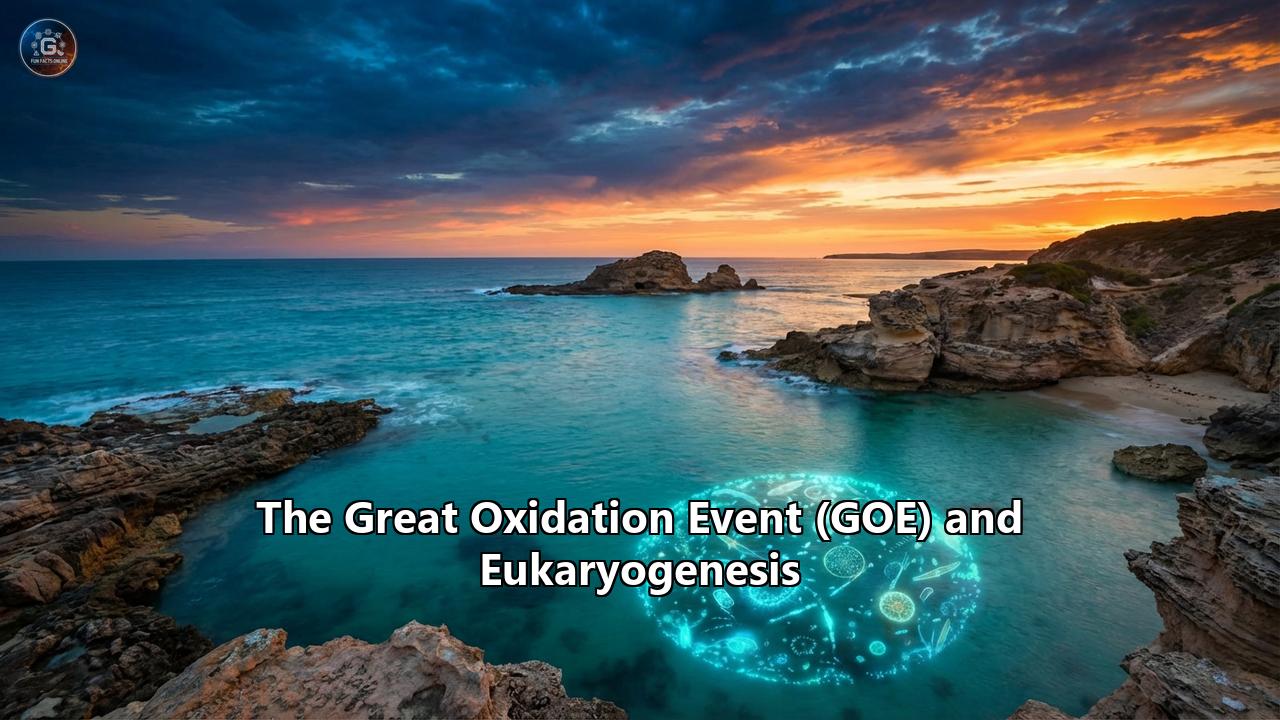
Imagine an Earth unrecognizable to modern eyes. It is 2.5 billion years ago. The sky is not blue but a hazy, alien orange, choked with methane and carbon dioxide. The oceans are green with iron, and the land is a barren, rocky wasteland whipped by fierce winds. There is no sound of birds, no rustle of leaves, no breath of animals. Life exists, but it is microscopic, hidden, and simple—a silent empire of single-celled bacteria and archaea thriving in an anaerobic world.
Then, a quiet revolution begins. In the shallow, sunlit waters, a specific group of blue-green bacteria—cyanobacteria—stumbles upon a biological magic trick that will rewrite the destiny of the planet. They learn to split water molecules using sunlight, releasing a waste product that is highly toxic to almost every other living thing on Earth: oxygen.
This was the spark of the Great Oxidation Event (GOE), a cataclysmic shift that would poison the ancient world, freeze the planet, and yet, paradoxically, pave the way for the most complex, beautiful, and intelligent life forms to ever exist. It set the stage for Eukaryogenesis—the miraculous merger of cells that gave rise to you, me, and every plant, animal, and fungus we see today.
Part I: The Oxygen Catastrophe
The GOE, occurring roughly 2.4 to 2.1 billion years ago, was arguably the most significant environmental change in Earth's history. For hundreds of millions of years, cyanobacteria had likely been puffing out "whiffs" of oxygen, but the planet’s chemistry acted as a sponge. Iron dissolved in the oceans instantly reacted with the oxygen, rusting out of the water and sinking to the seafloor to form the massive Banded Iron Formations (BIFs) we mine today.
But eventually, the sponge became saturated. Oxygen began to accumulate in the atmosphere.
The Poisoned Sky
To the anaerobic life that ruled the Earth, oxygen was a deadly poison. It attacked their enzymes and shredded their DNA. A mass extinction ensued—a microscopic apocalypse that wiped out vast lineages of ancient microbes. The survivors were forced into the shadows: deep ocean mud, hydrothermal vents, and oxygen-free pockets where their descendants still live today.
The Big Freeze
The rising oxygen reacted with methane, a potent greenhouse gas that had been keeping the Earth warm under a faint young sun. As methane was scrubbed from the atmosphere and replaced by carbon dioxide (a weaker greenhouse gas), global temperatures plummeted. The Earth entered the Huronian Glaciation, potentially becoming a "Snowball Earth" where ice sheets stretched from the poles to the tropics. Life hung by a thread.
Part II: The Boring Billion? Hardly.
Following the chaos of the GOE and the subsequent thaw, Earth entered a period often dismissively called the "Boring Billion" (roughly 1.8 to 0.8 billion years ago). Geologically, it was quiet. Oxygen levels stabilized at a low hum—enough to support an ozone layer, but not enough to support active animals. The deep oceans remained anoxic and sulphidic (a condition known as the "Canfield Ocean").
But biologically, this era was anything but boring. It was the crucible of complexity. In this low-oxygen, high-sulfur world, a biological singularity occurred. Life stopped just existing and started cooperating in a way never seen before.
Part III: The Missing Link—Asgard Archaea
For decades, the origin of the eukaryotic cell—the complex cell with a nucleus and organelles that makes up all plants and animals—was a mystery. The prevailing textbook story was the "Three Domains" model: Bacteria, Archaea, and Eukaryotes were three distinct branches.
But in 2015, a team led by Thijs Ettema made a shocking discovery in the mud of a hydrothermal vent field called Loki’s Castle in the Arctic Ocean. They found DNA of an archaeon that wasn't just an archaeon. It contained genes that were supposed to be unique to eukaryotes—genes for building skeletons (actin), trafficking molecules (ESCRT complexes), and tagging trash (ubiquitin).
They named it Lokiarchaeota. Soon, other relatives were found: Thorarchaeota, Odinarchaeota, and Heimdallarchaeota. Collectively, they are the Asgard superphylum.
These were not just cousins of eukaryotes; they were our direct ancestors. The discovery confirmed the "Two Domains" tree of life: Eukaryotes didn't branch off from Archaea; we emerged from within them. We are, at our core, complex archaea.
Part IV: The Hydrogen Hypothesis—A Metabolic Marriage
How did a simple Asgard archaeon become a complex eukaryote? The answer lies in the Endosymbiotic Theory, made famous by Lynn Margulis. We know that mitochondria (the power plants of our cells) were once free-living bacteria. But why did they merge?
The old story was that a primitive eukaryote "ate" a bacterium and failed to digest it. But a more chemically rigorous theory, proposed by William Martin and Miklós Müller, offers a more compelling narrative: The Hydrogen Hypothesis.
The Setup
Imagine the pre-eukaryotic world. You have two microbes living in close proximity—a "syntrophic" relationship:
- The Host: An Asgard archaeon (likely similar to Heimdallarchaeota). It is an autotroph that eats hydrogen gas ($H_2$) to survive.
- The Symbiont: A facultatively anaerobic bacterium (an alpha-proteobacterium). It breathes oxygen when available, but in the low-oxygen world of the Boring Billion, it often switches to fermentation, releasing hydrogen as a waste product.
The Merger
The archaeal host gets addicted to the hydrogen waste of the bacterium. To ensure a steady supply, the host physically surrounds the bacterium, increasing its surface area to catch every molecule of hydrogen. Over eons, this embrace becomes permanent. The bacterium is engulfed, not to be eaten, but to be "farmed."
This was the moment of Eukaryogenesis.
The bacterium eventually ceased to be an independent organism. It streamlined its genome, transferring many genes to the host’s control (the future nucleus), and became the mitochondrion.
Part V: The Power of the Mitochondrion
Why was this merger so revolutionary? Energy.
Bacteria reproduce by dividing. They are limited by surface area; if they get too big, they can't generate enough energy across their membrane to support their volume. They hit an energetic glass ceiling.
By internalizing the power plants (mitochondria), the new eukaryotic cell broke this ceiling. It now had a fleet of internal generators. It could expand its genome by orders of magnitude, accumulating the "junk" DNA that would eventually become regulatory codes for building complex bodies. It could build dynamic internal skeletons (using the actin from its Asgard ancestor) and traffic cargo across vast cellular distances.
The rise of oxygen from the GOE, initially a poison, eventually became the high-octane fuel for these mitochondria. Aerobic respiration provides 18 times more energy than anaerobic fermentation. This energy surplus allowed life to grow large, multicellular, and specialized.
Conclusion: The Legacy of a Breath
The story of the Great Oxidation Event and Eukaryogenesis is a reminder that life is not just a passenger on Earth, but a driver. The humble cyanobacteria changed the atmosphere, nearly froze the world, and forced life to innovate.
We are the children of that innovation. Our cells are chimeras—monsters in the best sense—stitched together from an archaeal host that learned to cooperate with a bacterial guest. Every breath you take today is a tribute to that ancient struggle: your lungs harvesting the toxic waste of cyanobacteria, to feed the enslaved bacteria inside your cells, powering the complex thoughts of a brain that could only exist in an oxygenated world.
Reference:
- https://www.researchgate.net/publication/371573620_Inference_and_reconstruction_of_the_heimdallarchaeial_ancestry_of_eukaryotes
- https://pmc.ncbi.nlm.nih.gov/articles/PMC8220308/
- https://pmc.ncbi.nlm.nih.gov/articles/PMC4444528/
- https://pmc.ncbi.nlm.nih.gov/articles/PMC10955848/
- https://static1.squarespace.com/static/522b22f2e4b04879e6b51037/t/649b56b3244649608e978037/1687901918477/Asgard+archaea+illuminate+the+origin+of+eukaryotic+cellular+complexity++-++Nature++2017.pdf
- https://emelaura.com/wp-content/uploads/2018/02/Eme_NatRevMicro2017.pdf
- https://www.molevol.hhu.de/fileadmin/redaktion/Fakultaeten/Mathematisch-Naturwissenschaftliche_Fakultaet/Biologie/Institute/Molekulare_Evolution/Dokumente/Rotte_Curr_Opin_Microbiol_2000.pdf
- https://en.wikipedia.org/wiki/Hydrogen_hypothesis
- https://www.chemeurope.com/en/encyclopedia/Hydrogen_hypothesis.html