
When we think of climate change, the images that spring to mind are usually tailpipes and smokestacks attached to power plants. We picture electric cars replacing gas guzzlers and solar panels replacing coal. But there is a massive, invisible sector of the energy economy that these solutions barely touch: industrial process heat.
Making the steel for your car, the cement for your driveway, and the glass for your smartphone requires temperatures that would melt a standard heating element in seconds. For over a century, the only reliable way to generate this 1,500°C+ (2,700°F+) heat was to burn something—usually coal or natural gas. This "thermal reliance" accounts for roughly 20% of global greenhouse gas emissions, a stubborn wedge of the carbon pie that batteries and wind turbines have struggled to cut.
Until now.
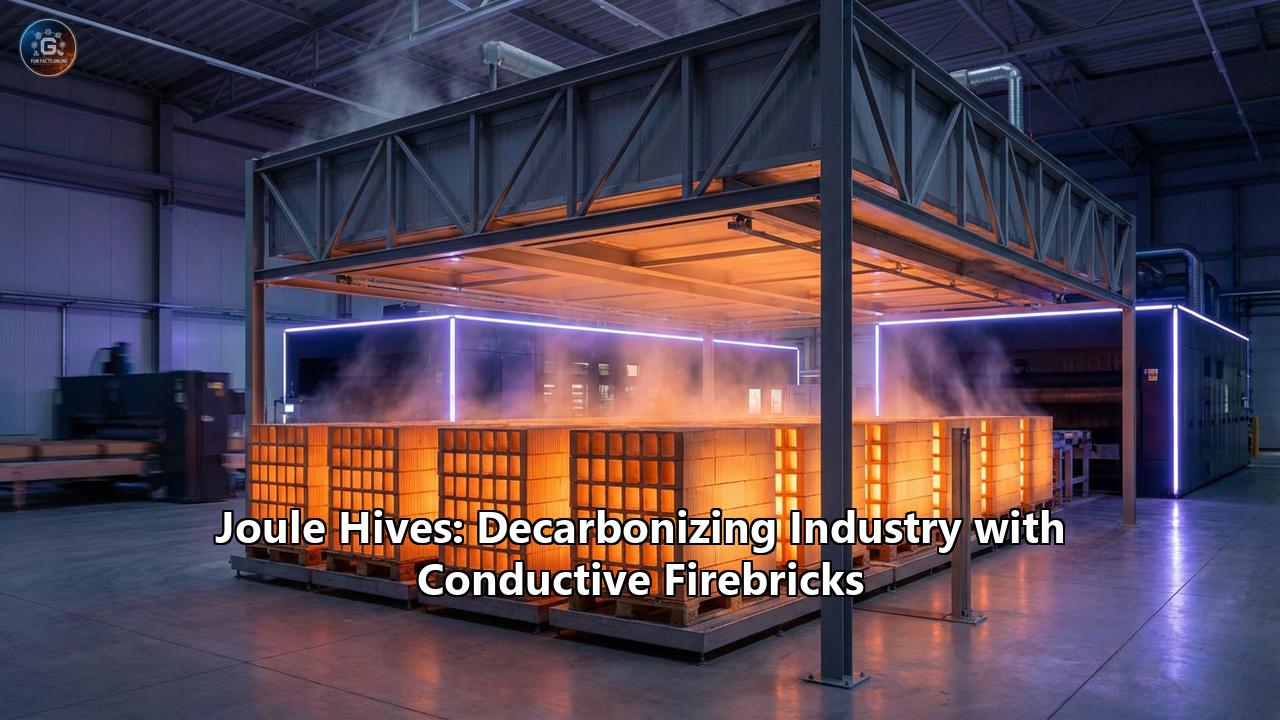
A Boston-based startup, Electrified Thermal Solutions (ETS), has reinvented one of humanity’s oldest technologies—the firebrick—to solve this modern crisis. Their solution, the Joule Hive™, is a thermal battery that doesn't just store heat; it generates it, turning intermittent renewable electricity into a reliable, flame-temperature inferno that can run heavy industry 24/7.
The Core Innovation: The "E-Brick"
To understand why the Joule Hive is revolutionary, you first have to understand the limits of a toaster.
Most electric heating works like a toaster or a hair dryer: electricity passes through a metal wire, which resists the flow and heats up. This is great for making toast at 200°C. But if you try to heat a steel blast furnace to 1,600°C using metal wires, the wires themselves will soften, oxidize, and eventually melt or snap. You cannot easily heat a kiln to temperatures hotter than the heating element itself.
This physical limit has been the "Great Wall" blocking the electrification of heavy industry.
ETS, spun out of MIT’s Department of Nuclear Science and Engineering, found a way to bypass the wire entirely. Their co-founders, Dr. Daniel Stack and Joey Kabel, developed the E-Brick (electrically conductive firebrick).
Unlike standard ceramic bricks, which are excellent electrical insulators, E-Bricks are doped with specific metal oxides (such as small amounts of nickel added to chromia-based ceramics). This "doping" process creates defects in the atomic lattice of the ceramic, allowing electrons to hop from atom to atom. This phenomenon turns the brick itself into a resistor.
When you plug a Joule Hive into the grid, electricity flows directly through the stack of bricks. The bricks themselves are the heating element. Because they are made of refractory ceramic materials designed to withstand extreme environments, they can safely reach temperatures of 1,800°C (3,275°F)—hotter than the melting point of steel and hot enough for virtually any industrial process.
How the Joule Hive Works
The Joule Hive system is deceptively simple, often described as "a box of hot rocks," but the engineering behind it is precise.
- Charging (Joule Heating): During periods when electricity is cheap (e.g., midday solar peaks or windy nights), the system draws power from the grid. This electricity passes through the E-Bricks, which heat up via Joule heating (also known as resistive heating) with 100% efficiency.
- Storage: The E-Bricks are stacked inside a heavily insulated steel container. This thermal mass can hold its temperature for hours or even days with minimal energy loss. It effectively "time-shifts" renewable energy, storing it until the factory needs it.
- Discharging: When the factory needs heat, air or another gas is blown through channels engineered into the brick stack. The gas absorbs the intense heat and exits the hive at the precise temperature required by the facility—whether that’s 300°C for drying food or 1,600°C for making cement clinker.
This system turns a variable input (wind/solar) into a constant output (industrial heat), acting as a bridge between the clean energy grid and the 24/7 demands of manufacturing.
The "Thermal Battery" Landscape: ETS vs. The Field
ETS is not the only player in the thermal storage game, but their technology occupies a unique niche.
- Rondo Energy uses a "toaster" approach. They use conventional heating elements (wires) to radiate heat into standard firebricks. While effective and simple, this method is generally limited to temperatures around 1,500°C due to the heating element constraints.
- Antora Energy uses solid carbon blocks heated to over 2,000°C. Carbon is incredibly cheap and heat-resistant, but it oxidizes (burns) if exposed to air. This means Antora’s system requires an inert atmosphere (like argon) and is often paired with thermophotovoltaics (TPV) to turn heat back into electricity.
- ETS (Joule Hive) uses conductive ceramics that are oxide-based. This means they cannot burn because they are already oxidized. The Joule Hive can operate in standard ambient air, eliminating the need for complex inert gas systems or vacuum seals. This "air-breathing" capability makes it a drop-in replacement for gas boilers and kilns that already use air intake.
Real-World Applications: From Cement to Chemicals
The technology has moved rapidly from the lab bench to the real world, securing major partnerships and funding to prove its viability.
1. Decarbonizing Chemicals with Ashland
In a landmark pilot funded partly by the U.S. Department of Energy (DOE), ETS is partnering with Ashland, a global additives and specialty ingredients company. The project involves replacing natural gas-fired boilers at Ashland’s Calvert City, Kentucky plant.
- The Goal: The Joule Hive will generate steam for the plant's operations.
- The Impact: This single project is projected to reduce CO2 emissions associated with steam generation at the site by nearly 70%, eliminating roughly 72,000 tons of CO2 per year—equivalent to taking over 15,000 cars off the road.
2. Green Cement with Buzzi Unicem
Cement production is notoriously difficult to decarbonize because the chemical reaction to make clinker requires consistent heat around 1,450°C. ETS has partnered with Buzzi Unicem USA and the Southwest Research Institute (SwRI) to build a commercial-scale pilot in San Antonio, Texas.
If successful, this pilot could prove that electric heat can replace the massive coal and gas kilns used in cement production, potentially unlocking a path to net-zero concrete.
3. Steel with ArcelorMittal
In September 2024, steel giant ArcelorMittal invested in ETS through its XCarb™ Innovation Fund. The steel industry is hunting for ways to move beyond coal-fired blast furnaces. While hydrogen is one option, it is currently expensive and inefficient to transport. Direct electrification via Joule Hive offers a compelling alternative for heating processes like reheating furnaces and potentially even primary iron-making.
The Economic and Policy Winds
The rise of Joule Hives isn't just about physics; it's about economics.
1. The "Duck Curve" and Negative PricingAs solar power saturates the grid, electricity prices often plummet to near zero (or even negative) during the middle of the day. Industrial plants using gas boilers can't take advantage of this because they can't easily switch fuel sources. A Joule Hive, however, loves this volatility. It can "gorge" on cheap electricity for 4 hours and slowly release that heat over the next 20 hours, effectively arbitraging the electricity market.
2. The Inflation Reduction Act (IRA)The U.S. Inflation Reduction Act has been a game-changer for thermal batteries. Specifically, the Section 48C Investment Tax Credit provides a credit of up to 30% for advanced energy manufacturing projects. Furthermore, the DOE’s "Industrial Heat Shot" initiative has set a target to reduce emissions from industrial heating by 85% by 2035, creating a massive government push for technologies exactly like the Joule Hive.
The Future: A New Bronze Age?
In a poetic twist, the solution to our most futuristic energy problem lies in one of our oldest materials. Firebricks have lined kilns since the Bronze Age. By tweaking their atomic structure to conduct electricity, Electrified Thermal Solutions has bridged the gap between the ancient and the modern.
The challenge ahead is scaling. The industrial heat market is massive—double the size of the global electricity market. To make a dent, ETS will need to deploy gigawatts of capacity. But with no exotic materials (nickel and chrome are abundant), no rare-earth supply chains, and a modular design that fits into shipping containers, the E-Brick is uniquely positioned to scale.
We are standing on the precipice of a new industrial revolution—one where the blast furnaces are silent, smokeless, and powered by the sun.
Reference:
- https://www.renewablethermal.org/electrified-thermal-solutions/
- https://triplepundit.com/2025/thermal-energy-storage-decarbonization/
- https://patents.google.com/patent/IL301680A/en
- https://electrifiedthermal.com/electrified-thermal-solutions-will-partner-with-3m-amys-kitchen-buzzi-unicem-usa-southwest-research-institute-swri-epri-and-others-to-establish-pilot-projects/
- https://insideclimatenews.org/news/20052024/mit-electrified-thermal-solutions-decarbonize-heavy-industry/
- https://solarthermalworld.org/news/what-is-in-the-inflation-reduction-act-for-solar-thermal/
- https://home.treasury.gov/news/press-releases/jy2779
- https://inldigitallibrary.inl.gov/sites/sti/sti/Sort_8882.pdf